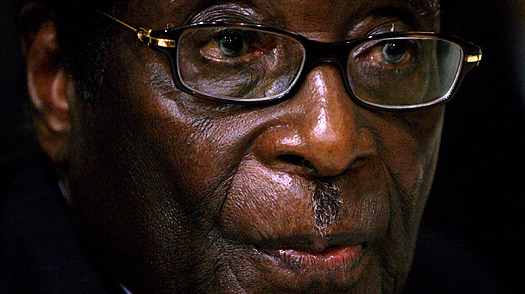
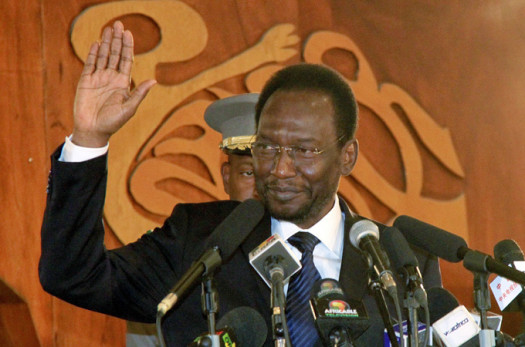
Zimbabwe’s President Mugabe says that he will follow the constitutional court ruling to hold elections by July 31, 2013. (Google Images)
BBC Africa is reporting that Zimbabwe’s president Robert Mugabe has said that he will abide by a Zimbabwean constitutional court ruling that elections should be held by the end of July. BBC Africa reports:
“Zimbabwe’s Constitutional Court said on Friday that elections must be held by 31 July, and that Mr. Mugabe should set a date ‘as soon as possible’.
Mr. Mugabe has been in coalition with the former opposition leader Morgan Tsvangirai since 2009.
Mr. Tsvangirai’s party has said it is ready for ‘free and fair elections’.”
You may recall that in 2008, Tsvangirai won the first round of elections, only to pull out of the second round after increasing violence against his supporters. During this time Tsvangirai and his then-wife Susan were involved in a freak car accident in which the couple was hit head-on by a truck. Mrs. Tsvangirai died in the accident while Mr. Tsvangirai sustained injuries. President Mugabe went forward with the elections after Tsvangirai pulled out, winning 85% of the vote. Amid international controversy over Mugabe’s win, regional mediators intervened to organize a power-sharing agreement with Tsvangirai.
Zimbabwe’s constitutional referendum includes new checks and balances that have been agreed to by all involved parties. Despite the changes, some believe that president Mugabe may still win this election due to increasing dissatisfaction with Tsvangirai and voter apathy.
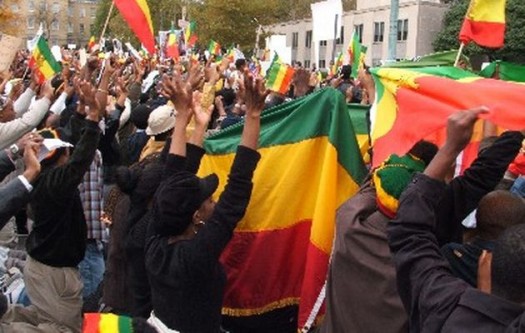
Ethiopians protest human rights abuses in Addis Ababa. (Google Images)
AllAfrica.com is reporting that thousands of Ethiopians in Addis Ababa protested against the ruling party on Sunday in an effort to ensure human rights protections. This is the first protest of this kind since 2005 when many protesters and opposition leaders were jailed. The author writes:
“The demonstrators were shouting they wanted their human rights to be ensured, that political and religious prisoners should be released, and accusing state television of only broadcasting propaganda.
‘We have been raising lots of questions for the government and one is to release those political party leaders and journalists,’ said Getaneh Banch, a member of the Blue Party, the opposition party that organized the demonstration. ‘And we have been also calling for the government to release also those who have been dislocated from their locations, because of their ethnic background.'”
Ethiopian authorities are accused of detaining a journalist who sought to interview people evicted from their homes in a region where the government is building a contentious hydro-electric dam on the Blue Nile. The journalist has been held since Friday and joins two award-winning journalists, Reeyot Alemu and Woubshet Taye, who are also in jail. The dam project is part of a $12 billion plan to boost power exports. The BBC reports that Egypt and Sudan object to the dam because they say it violates a colonial-era agreement, which gives them rights to 90% of the Nile’s water. The Blue Nile is one of two major tributaries of the Nile (one of the world’s longest rivers).
“One of the opposition leaders jailed after the 2005 elections, Jacob Hailemariam, says this demonstration is significant for Ethiopia. ‘This will definitely encourage people to demand their rights that they have been very quite about, until today,’ he said. Many of the protesters were young men with a Muslim background who do not necessarily support the Blue Party, but do feel a change in government is needed.”
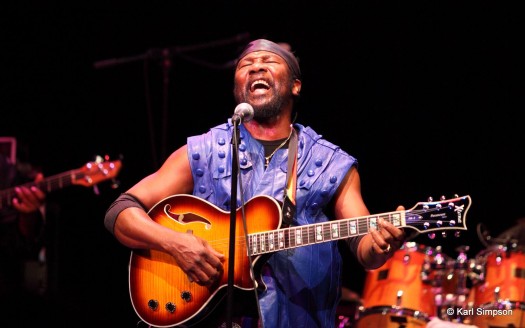
Reggae legend Toots Hibbert is canceling his tour after injuries sustained at a concert in Richmond, VA. (Photo Credit: Commons.wikimedia.org)
This week has been pretty eventful for black music. Common lore suggests that bad things happen in threes. This week, the music world lost two major singers in Marvin Junior of the mighty Dells and Clarence Burke of the Five Stairsteps whose classic “O-o-h Child” has been sampled, covered and included in more movie soundtracks than can be named. Grammy award-winning Reggae artist Toots Hibbert has been forced to cancel his tour due to an injury sustained from a violent concert goer, ending what was a successful concert tour. As mainstream media focuses on frivolous fare like Kanye West’s album covers, American Idol rejects Mariah Carey and Nikki Minaj (who embarrassed themselves and black music with their petulant behavior on the show), The Burton Wire wants to make sure that these important stories aren’t overlooked. – Nsenga K. Burton
MARVIN JUNIOR Marvin Junior, singer for the legendary R&B group ‘The Dells’ passed away. In an obituary for the New York Times, William Yardley writes:
“Marvin Junior, whose raw but robust baritone served for half a century as the sturdy foundation for the Dells, a Chicago doo-wop and rhythm-and-blues group that was formed when he and most of its other members were in high school in the early 1950s, died on Wednesday at his home in Harvey, Ill. He was 77. The cause was kidney and heart problems, said his son Marvin Jr. ‘Iron Throat’ is what David Ruffin, the former lead singer of the Temptations, once called Mr. Junior. ‘Two tons of fun’ is what he called himself. He grew up hoping to be the next Ray Charles and eventually inspired other singers, including Teddy Pendergrass.
His voice was huge and versatile — it often reached into tenor territory — and it held up through more than two dozen albums and 57 years of performing. Unlike some other acts of their era, the Dells had no angry breakups and few personnel changes.”
CLARENCE BURKE CBS News is reporting that Clarence Burke of the Five Stairsteps passed away just one day following his 64th birthday, according to his friend and manager Joe Marno. The author of the post writes:
“Formed in Chicago in 1965, the Five Stairsteps included Burke, three of his brothers and a sister. They owed their name to their mother, who said that they looked like stairsteps when they stood beside each other in order of age, the Los Angeles Times reported.
Burke, the eldest brother, was the group’s producer and choreographer, played guitar and wrote many of the songs. He wrote the group’s first single, ‘You Waited Too Long.’ He was not yet 17 when it rose to No. 6 on Billboard’s R&B charts in 1966.
Other hits included ‘World of Fantasy,’ ‘Don’t Change Your Love’ and ‘From Us to You.’
However, the group’s biggest hit was 1970’s ‘O-o-h Child,’ written by Stan Vincent. Its signature refrain croons “o-o-h child” and promises that “things are gonna get easier.”
The song has been covered many times and has repeatedly been used in movies and TV shows.
FREDERICK “TOOTS” HIBBERT
Erin Coulehan ofRolling Stone is reporting that Grammy award-winning reggae artist Toots Hibbert has been forced to cancel the remainder of his tour due to injury sustained during a concert in Richmond, Va. Coulehan writes:
After being hit in the head with a glass bottle at a concertearlier this month, Toots Hibbert has canceled the remainder of his U.S. tour and returned to Jamaica. Billboard reports that the injured Grammy winner made the decision to return home to focus on his recovery.
Frederick “Toots” Hibbert was performing with his band the Maytals on May 18th in Richmond, Virginia, when a 19-year-old man in the crowd threw a glass bottle onstage, striking Hibbert in the head and bringing the set to an early close. The reggae veteran was taken to the hospital for treatment, and the alleged bottle thrower was arrested and charged with aggravated assault and public intoxication.
A spokeswoman for Hibbert, Andrea Davis, said the singer regretted having to cancel the tour, but that he wanted to focus on his recovery.
This post was written/compiled by Nsenga K. Burton, Ph.D., founder & editor-in-chief of The Burton Wire.
Patricia Roberts Harris was the first African-American woman named to a presidential cabinet (President Jimmy Carter). (Photo Credit: Biography)
“You do not seem to understand who I am. I am a black woman, the daughter of a dining-car worker. If my life has any meaning at all, it is that those who start out as outcasts can wind up as being part of the system.” – Patricia Roberts Harris, the first African American woman to serve in the United States Cabinet
Patricia Roberts Harris
On May 31, 1924, Patricia Roberts Harris, the first Black woman to hold a presidential cabinet position, was born in Mattoon Illinois. Harris, the was also first African American woman to serve as a United States Ambassador, was born in Mattoon, Illinois. She earned her Bachelor of Arts degree summa cum laude from Howard University in 1945 and in 1960 graduated at the top of her class from the George Washington University National Law Center. In 1965, President Lyndon Johnson appointed her Ambassador to Luxembourg where she served until 1967. In 1969, Harris was named dean of Howard University’s School of Law, a position she held until 1972. In 1977, President Jimmy Carter appointed Harris Secretary of Housing and Urban Development and in 1979 she became Secretary of Health, Education and Welfare where she served until 1981. In 1982, she was appointed a professor at the George Washington University National Law Center, a position she held until her death on March 23, 1985. Harris also served on the Board of Directors of several corporations, including Chase Manhattan Bank, Scott Paper Company, and IBM. The Patricia R. Harris Education Center in Washington, D.C. is named in her honor.
The Akosua Report: Facts on The African Diaspora, is written by Akosua Lowery. Follow her on Twitter @AkosuaLowery.
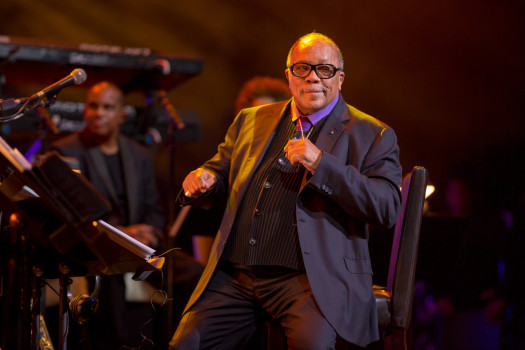
Legendary music producer Quincy Jones believes that music heals all wounds. (Photo Credit: American Cancer Society)
From the African village and church to juke joints and neighborhood parks, people of color have been privileged historically with producing music as a way of communicating concerns and healing life-threatening wounds.
The Rock & Roll Hall of Famer, 80, conducts musicians with clenched fists and direct eye contact angled acutely towards his music stand. Known simply as “Q,” the maestro with countless accolades has produced myriads of legendary recording artists including Michael Jackson, Frank Sinatra, Ray Charles and Lesley Gore.
“Q” starts the evening speaking in flashbacks about some of his famous friends and slightly joking about having brain surgery and an appendectomy. “I’m almost robotic, but life is amazing. I feel like I’m just starting over again,” says Jones. Self-described as “pretty fair for a square,” “Q” is an innovator for service, technology and education.
“There are two things in our industry: song and story. You got to go to know. That’s what it’s about. God gave us 12 notes that everybody has had to use for the last 500 years. Nothing scares me musically,” says Jones. In addition to his signature headphones, “Q” co-founded a software application, Playground Sessions, which teaches pop music piano lessons via video tutorials.
“Music can pull people together. It’s a strange animal. You can’t taste it, smell it, see it or touch it. It can change your life,” says Jones. ACS believes its mission runs parallel to Jones’ legacy. “Here’s a legendary person with a legendary organization. We feel so fortunate to have [Quincy] here. It’s a great way to symbolize the first 100 years. Music is a common language around the world. However we can get our message out there is going to help us finish the fight a lot quicker,” says volunteer board chair Gary Reedy.
Austin agrees. “It’s a very powerful gift we’ve been given from on high. Music is a healing tool and can help people get through pain and illness,” says Austin.
“Q’s” mentorship and longevity resonates with artists both young and old. “He told me ‘Stay in the game, and keep playing the piano,’” says Ingram. Adds Pentatonix, “He always says, ‘Completely nurture people because they’re gonna rise up and be the next generation of musical talent. Be passionate and find projects that speak to who you are,’” says the group.
When Yanofsky – delivering powerhouse performances on-stage – was 15, she performed for Jones in his living room. The concert is bittersweet yet rewarding for the 19-year-old Canadian vocalist, who lost her grandmother to cancer.
“He told me ‘Check your ego at the door, enjoy and live in the moment.’ I want to help carry on a legacy and bring joy to the stage,” says Yanofsky.
Christopher A. Daniel is a pop cultural critic and music editor for The Burton Wire. He is also a contributing writer for Urban Lux Magazine and Blues & Soul Magazine. Follow Christopher @Journalistorian on Twitter.
Mali’s acting President Dioncounda Traore will not run in the 2013 election scheduled for July 28. (Google Images)
AllAfrica.com is reporting that Mali has scheduled elections for July 28, 2013. Mali has been in a state of turmoil since the ouster of President Amadou Toure in March 2012. After Toure’s ouster, the northern part of the country was taken over by Islamist militants leading to more chaos and confusion. While French-led forces have helped drive out some Islamist militants (Tuareg separatists are still in control of the key Northern city of Kidal), the fighting has led to hundreds of thousands of displaced Malians posing a serious problem for upcoming elections. The author writes:
“The U.N. refugee agency said Tuesday it will support voter registration efforts in camps for Malian refugees in Burkina Faso, Niger, Mauritania and Algeria.Mali’s current leader, interim President Dioncounda Traore, has said that neither he nor any member of his government will run in the presidential poll.Mali’s interim government says campaigning for the election will begin July 7 and end on July 26. If no candidate wins an absolute majority, a run-off vote will take place August 11.Western countries have made the stabilization of Mali a high priority because of fears the country could become a haven for terrorists.”
In December 2012, the United States sent troops to 35 African countries, including Mali, to stop the spread of terrorism. On May 15, 2013, international donors meeting in Europe pledged more than $4 billion for development and peace-building efforts in Mali.
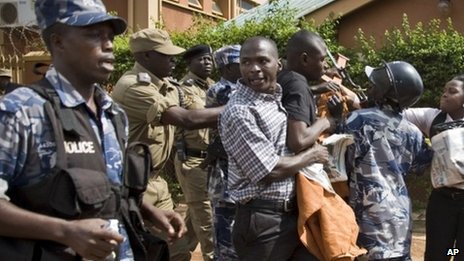
Armed police tear gassed protesters against the closing of two independent newspapers. (Google Images)
Mail&Guardian is reporting that Ugandan police fired tear gas at journalists protesting the closing of key independent media in Uganda. The author writes:
“Riot police scattered around 100 journalists, their supporters and human rights activists who tried to gather outside the offices of the Daily Monitor and Red Pepper newspapers, which were closed on May 20 by armed police. “This is a violation of media freedom and economic sabotage,” rights activist Geoffrey Ssebaggala shouted at police.
The closure of the two papers leaves only one major operating newspaper, the government-owned New Vision.
Two radio stations in the Monitor’s offices also remain off air. “Instead of arresting criminals killing people in the country, you are here terrorising us,” journalist Moses Ouma told police as they dragged him away from outside the Monitor’s offices.”
The post goes on to say:
“The closures came after the newspapers in early May printed a leaked confidential memo by a senior general, David Sejusa Tinyefuza, alleging that President Yoweri Museveni was grooming his son Muhoozi Kainerugaba to succeed him.
Tinyefuza said there were plots to assassinate those opposed to the plan.”
One of the papers shut down by police Red Pepper Newspaper, posted online that officials in the Interparty Organization for Dialogue (IPOD) have expressed grave concern over the continuous closure of media houses.
The unidentified Red Pepper writer offers:
“In ongoing meetings since last week to discuss among others the media closure, John Ken Lukyamuzi the President General of the Conservative Party states that Uganda is in a state of emergency to warrant closure of the media.
The parties involved include the ruling National Resistance Movement, Forum for Democratic Change, JEEMA, Conservative Party, Democratic Party and the Uganda People’s Congress.
He advises government to act in accordance with the issues raised by General David Sejusa the head of internal intelligence instead of terrorizing the media.”
Red Pepper is also reporting that the Uganda Communication Commission (UCC) has been sued for among others disciplining ‘errant’ media houses that would not adhere to the minimum broadcasting standards while reporting on the General David Sejusa saga.
The unidentified author writes:
“The suit was filed today before the High Court in Kampala by a concerned city advocate, Brian Ogago Abangi.
In his affidavit, Abangi says that the 14th day of May 2013, UCC unlawfully decided to discipline errant media houses that would not adhere to the minimum broadcasting standards in respect to coverage of the events on Gen. David Sejusa.
Abangi further notes that on May 17 2013, UCC unlawfully made a decision and set the local content quotas to which all broadcasters are to comply effective January 1st 2014.
According to the concerned lawyer, the resolutions by UCC to warn the alleged errant media houses were passed without being backed by the Board, which action, he says is illegal.”
Vivian G. Harsh was the first African American to head a branch of the Chicago Public Library. (Google Images)
VIVIAN G. HARSH, Bibliophile
“As a Black bibliophile and collector, Vivian Harsh’s achievements compliment the work of Arthur Schomburg, Jesse Moorland, and others.” — Reference Library of Black America Volumes 1 through 5 Edited by Mpho Mabunda
Vivian Harsh was born on May 27, 1890. She was an African American librarian, historian, and administrator, who made an important contribution to saving African American history.
Harsh was born in Chicago, IL, the daughter of Fenton W. Harsh and Maria L. Drake Harsh. After graduating from Wendell Phillips High School in 1909, Harsh began working for the only employer she would ever have, the Chicago Public Library. In 1921, she graduated from the Simmons College Library School in Boston and in February 1924, Harsh became the first Black librarian in the Chicago Public Library system.
She was instrumental in convincing Julius Rosenwald to donate land for the George Cleveland Hall branch library in 1932. Because of this, Harsh was named its first head librarian. She immediately began establishing a “Special Negro Collection” which became an integral part of the branch’s community service. While developing this collection as a research and programming center for Chicago’s community of Black scholars and activists, Harsh won the support and assistance of such leaders and writers as Richard Wright, Arna Bontemps, Langston Hughes, and Horace Cayton.
The collection Harsh started has been renamed the Vivian G. Harsh Research Collection of Afro-American History and Literature and is now located at the Woodson Regional Library in Chicago.
South African musician Jonathan Butler works with youth ensemble in Atlanta. (Photo Credit: DJ Blak Magic)
When Jonathan Butler was growing up in South Africa, the thought of him becoming a jazz musician during the Apartheid era seemed farfetched — and yet, here he stands.
The ambitious Athlone, Cape Town-born singer/musician, now 51, has young musicians welcoming him to Atlanta to the tunes of Duke Ellington and Jamiroquai. Equipped with his custom-built lefty Nylon guitar and a cascading, vibrato-heavy voice that captivates audiences, Butler joins the Tri-Cities High School Jazz Orchestra on-stage for a bombastic encore performance of Stevie Wonder’s “Sir Duke.”
The soulful guitarist had just performed a mind-blowing, acoustic rendition of James Taylor’s “Fire and Rain” yet remained focused on the youth. The youth ensemble, to Butler, was the highlight of the day. “It’s amazing to see that. What I experienced today we’re starting to see happen in South Africa. These kids are reading the information as they’re playing. If they pursue that, it’ll be like listening to the next Charlie Parker or next Dizzy Gillespie. That’s inspiring,” says Butler.
During Butler’s visit, he co-headlined Atlanta’s second season opener of Jazz Roots with Grammy Award-winning saxophonist David Sanborn. Butler’s music defies jazz’s norms in favor of melding R&B, pop, gospel and South African elements.
“I’ve been able to creep it in subtlely through the course of my career. People know it’s me. There’s a certain flavor, rhythm, melody and nuances on the guitar I explore when I do those kinds of things,” says Butler.
In 1974, Butler became the first black artist to be played on mainstream South African radio. His rippling vocals are uplifting and pour out from the microphone. He plays crispy open string chords. He also plays a Jazz Archtop but takes special pride in his Nylon guitar.
“I feel the spirit of Africa all over this guitar. The more wood and wider the body, the bigger the sound and more live the sound is,” says Butler. His 2012 LP, Grace and Mercy, departs from his late 1980s classics like “Lies,”“Sarah Sarah” and “More Than Friends.”
Butler’s daughter, Jodie, travels and performs with him. A devout Christian, Butler’s music delivers spiritual and inspirational subject matter. The transition, he says, stems from an encouraging record executive. “You don’t need a lot of production to get your point across. You get to the meat of what the person is about. I always felt like I was moving into more instrumental jazz and South African flavor. That’s really what I wanted to do. It was all a part of that evolution,” says Butler.
Joshua Redman, Bobby McFerrin and world music artists currently rotate and shuffle on Butler’s iPod. He still considers George Benson, whom he calls “Last of the Mohicans for guitar playing,” his all-time hero.
“Jazz is the coolest thing. It’s timeless. It’s freedom. It’s artistic. It’s improvisation. It’s about exploring yourself and who you are. Jazz has always been able to stay and be authentic. It’s the one music that will always stand the test of time. Everyone has a different interpretation of it,” says Butler. South African music is amazing for the ears to hear, and South African food is amazing for the tastebuds. If you want to mix both together then checking out a South African restaurant downtown Charlottesville will be right up your street.
Christopher A. Daniel is a pop cultural critic and music editor for The Burton Wire. He is also a contributing writer for Urban Lux Magazine and Blues & Soul Magazine. Follow Christopher @Journalistorian on Twitter.
Brazil will increase border security in preparation for the Confederations Cup. (Google Images)
Lucy Jordan of The Rio Times is reporting that the Ministry of Defense in Brazil is sending 25,000 soldiers to patrol its borders in an unprecedented military operation to shore up security at next month’s Confederations Cup. The Confederations Cup will be a test of Brazil’s capacity to successfully host the 2014 World Cup and the 2016 Olympics, as well as the visit of the Pope for World Youth Day this July.
Operation Ágata 7, as the mission is known, was launched over the weekend in response to several high-profile attacks that have made international headlines. In a statement released Saturday the government said it would focus on cross-border crimes that could potentially affect security: drug and weapons trafficking, smuggling, illegal immigration and illegal mining. Operation Ágata 7 will also work to prevent human trafficking.
Read more about border patrols in preparation for the Confederations Cup at the Rio Times.