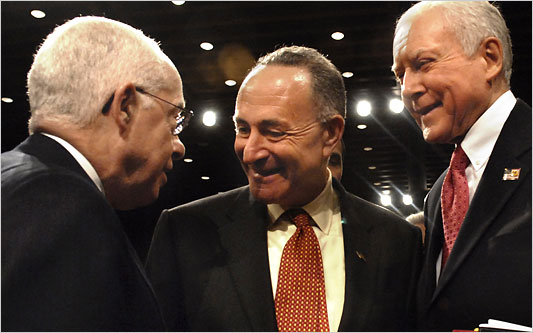
U.S. Immigration Reform bill architects Sen. Orrin Hatch (R-Oklahoma) and Sen. Charles Schumer (D-NY) greet former U.S. Attorney General Michael Mukasey. (Google Images)
CBS News is reporting that far-reaching legislation to grant a chance at citizenship to millions of immigrants living illegally in the United States cleared the Senate Judiciary Committee on a solid bipartisan vote Tuesday night after supporters somberly sidestepped a controversy over the rights of gay spouses.
The 13-5 vote cleared the way for an epic showdown on the Senate floor on the measure, which is one of President Obama’s top domestic priorities yet also gives the Republican Party a chance to recast itself as more appealing to minorities.
The committee’s action sparked rejoicing from immigration activists who crowded into a Senate committee room to witness the proceedings. “Yes, we can!” they shouted as they clapped rhythmically to show their pleasure.
In a statement, Mr. Obama applauded the committee’s action and said the bill was “largely consistent with the principles of common-sense reform I have proposed and meets the challenge of fixing our broken immigration system” — though he said there’s still room for improvement.
This bill will create a pathway to citizenship for 11.5 million immigrants.
To read more about this story, visit CBS News. To read about the negative impact of the U.S. Immigrant Reform Bill on African and Caribbean immigration, click here.
Sancious, whose career has spanned four decades, likes the mystique. He doesn’t care to let hit records or gold and platinum sales define his longevity.
Positive energy, the modest, multi-talented performer believes, is rewarding enough. “You don’t start out wanting to be perceived as great. The only thing you want to do is get better and better at playing. It’s not driven by any perception of wanting to be perceived by the world at all. Those details come later,” says Sancious.
“It comes down to dedication and how much you devote yourself to it. We all really enjoy working together. You have to have a natural love for it without having to be told anything or have anything explained to you,” he says.
Growing up in Asbury Park, NJ the youngest of three boys, Sancious — now 59-years-old – knew early on that music would be his calling. He started playing piano at seven and picked up the guitar four years later. “It’s a lot of fun. You can learn a lot. It’s another window to the music and your own intellectual knowledge to go back and forth between two worlds,” he says.
Sancious recalls being introduced to his influences according to the schedule of the day. “It was Beethoven in the morning, James Brown in the afternoon or John Coltrane and Jimi Hendrix in the evening. I experienced a variation of music simultaneously,” he says.
When Sancious was 15, he met “The Boss.” He played in several versions of the unknown rocker’s band before moving to Virginia to perform session work. Upon Sancious’ return to New Jersey a year later, Springsteen asked the musician to accompany him on his debut album and some gigs around New York.
A tour and three albums later with Springsteen, the soft spoken maestro, along with Ernest Carter and Gerald Carboy, decided to assemble the band, Tone, in 1974. The outfit explored an eclectic range of sounds and rhythms over four albums spanning rock, classical, soul, funk, blues, electronica and world music.
Sancious also recorded five solo projects. He’s currently working on a project that is primarily guitar. “All that does is broaden your whole basis. It directly correlates to the wide array of music I grew up listening to. It’s just a result of the way I am,” says Sancious.
Sancious has accomplished a lot in his extraordinary career. He believes that he has accomplished far beyond his share of goals. His one ambition, however, is as imaginative as his sound. “I’d like to be remembered as a gentleman. I’m interested in being the instrument of music itself and what music will come from me. I want to get it out, have people enjoy it and resonate with it,” he says.
Christopher A. Daniel is a pop cultural critic and music editor for The Burton Wire. He is also a contributing writer for Urban Lux Magazine and Blues & Soul Magazine. Follow Christopher @Journalistorian on Twitter.
Sancious, whose career has spanned four decades, likes the mystique. He doesn’t care to let hit records or gold and platinum sales define his longevity.
Positive energy, the modest, multi-talented performer believes, is rewarding enough. “You don’t start out wanting to be perceived as great. The only thing you want to do is get better and better at playing. It’s not driven by any perception of wanting to be perceived by the world at all. Those details come later,” says Sancious.
“It comes down to dedication and how much you devote yourself to it. We all really enjoy working together. You have to have a natural love for it without having to be told anything or have anything explained to you,” he says.
Growing up in Asbury Park, NJ the youngest of three boys, Sancious — now 59-years-old – knew early on that music would be his calling. He started playing piano at seven and picked up the guitar four years later. “It’s a lot of fun. You can learn a lot. It’s another window to the music and your own intellectual knowledge to go back and forth between two worlds,” he says.
Sancious recalls being introduced to his influences according to the schedule of the day. “It was Beethoven in the morning, James Brown in the afternoon or John Coltrane and Jimi Hendrix in the evening. I experienced a variation of music simultaneously,” he says.
When Sancious was 15, he met “The Boss.” He played in several versions of the unknown rocker’s band before moving to Virginia to perform session work. Upon Sancious’ return to New Jersey a year later, Springsteen asked the musician to accompany him on his debut album and some gigs around New York.
A tour and three albums later with Springsteen, the soft spoken maestro, along with Ernest Carter and Gerald Carboy, decided to assemble the band, Tone, in 1974. The outfit explored an eclectic range of sounds and rhythms over four albums spanning rock, classical, soul, funk, blues, electronica and world music.
Sancious also recorded five solo projects. He’s currently working on a project that is primarily guitar. “All that does is broaden your whole basis. It directly correlates to the wide array of music I grew up listening to. It’s just a result of the way I am,” says Sancious.
Sancious has accomplished a lot in his extraordinary career. He believes that he has accomplished far beyond his share of goals. His one ambition, however, is as imaginative as his sound. “I’d like to be remembered as a gentleman. I’m interested in being the instrument of music itself and what music will come from me. I want to get it out, have people enjoy it and resonate with it,” he says.
Christopher A. Daniel is a pop cultural critic and music editor for The Burton Wire. He is also a contributing writer for Urban Lux Magazine and Blues & Soul Magazine. Follow Christopher @Journalistorian on Twitter.
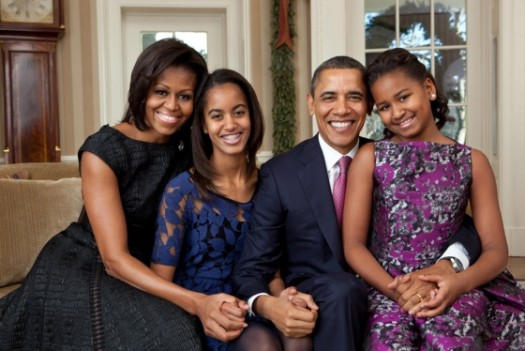
The Obama family will visit Senegal and South Africa next month. (Google Images)
AllAfrica.com is reporting that U.S. President Barack Obama is scheduled to visit Senegal and South Africa next month. First Lady Michelle Obama and daughters Malia and Sasha will accompany the president during his visit. President Obama visited Accra, Ghana in 2009 to deliver a policy address issues of good governance, anti-corruption and to boost support for African farmers. The reason for President Obama’s visit has not been reported. Check out information about President Obama’s 2009 visit to Accra below:
Kenya’s Rita Jeptoo crosses the finish line at the 2013 Boston Marathon two hours before the terrorist bombings. (Google Images)
Agence France-Press (AFP) is reporting that the Boston bombings overshadowed the actual winners of the 2013 Boston Marathon. The sad events of the day took the focus away from the historic marathon and placed it on the terrorists who targeted the finish line, resulting in the deaths of three people and injuring more than 250 people. There were actual winners that day who were presented trophies by Massachusetts Governor Deval Patrick.
Ethiopian Lelisa Desisa, 23, won the marathon in 2 hours, 10 minutes, 22 seconds to become the fourth Ethiopian man to win the race and the first since Deriba Merga won in 2009. Kenya’s Micah Kogo came in second while Ethiopian Gebregziabher Gebremariam came in third in the men’s race.
Rita Jeptoo of Kenya won the women’s title in 2:26:25. Jeptoo is the the third Kenyan woman in a row to win the race. This is her second title as she previously won the women’s competition of the Boston Marathon in 2006. Jeptoo took a break from training in 2008-2010 to have a baby. Ethiopia’s Meseret Hailu came in second place, while defending champion Sharon Cherop of Kenya took third.
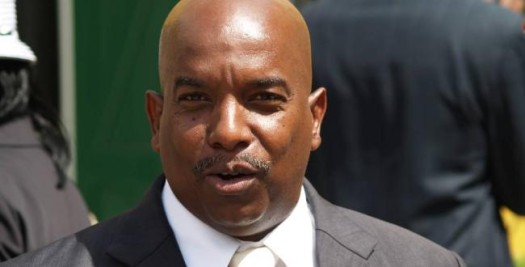
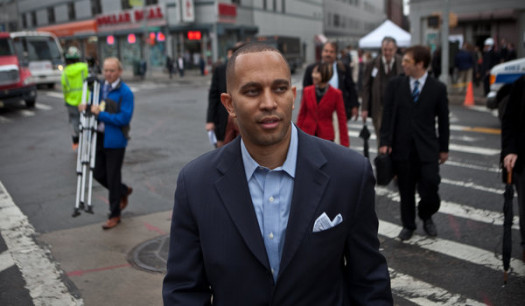
Rep. Hakeem Jeffries, D-N.Y., co-chairman of the immigration task force for the Congressional Black Caucus (CBC) is worried about the removal of diversity visas. (Google Images)
Kevin Bogardus and Russell Berman of the Bay State Banner are reporting that black lawmakers and civil rights groups are concerned over a proposal in the Senate’s immigration reform bill that would do away with ‘diversity’ visas that are often a pathway for African and Caribbean immigrants to enter the United States. Bogardus and Berman write:
“Advocates said they haven’t seen evidence yet that a new merit-based program is an acceptable replacement for the diversity visas.
Hilary Shelton, director of the NAACP Washington bureau, said he is telling lawmakers not to cut the diversity program when comprehensive immigration reform moves forward.
‘At this point, we are urging lawmakers not to eliminate the diversity visa program,” Shelton told reporters. “This is one of the places in the bill that needs to be addressed. We will work with our friends in the Senate, and we have started working with our friends in the House as well.’
Rep. Hakeem Jeffries, D-N.Y., co-chairman of the immigration task force for the Congressional Black Caucus (CBC), called the Senate bill “a significant step in the right direction” but said his caucus is worried about the plan to eliminate diversity visas.
‘With respect to the abolishment of the diversity visa lottery program, the CBC is extremely concerned that it might limit the future flow of immigration for people from certain parts of the world,’ Jeffries said. ‘That’s troublesome, and we’re evaluating the merit-based visa proposal to determine if it’s fair and balanced.’
The diversity program makes 55,000 visas available each year to countries with low immigration rates to the United States. Those awarded the visas are chosen by a lottery, with about half typically going to African immigrants.
Republican lawmakers have targeted the program in the past for elimination, arguing the program’s lottery system can lead to fraud and undermine national security.
If the immigration reform bill passes, then the diversity visas will be eliminated in 2015.
“I am groping about through this American forest of prejudice and proscription, determined to find some form of civilization where all men will be accepted for what they are worth.”
Pickney Benton Stewart Pinchback
On May 10, 1837, Pickney Benton Stewart Pinchback, the first African American to become governor of a state in the United States, was born in Macon, Georgia. In 1862, he made his way to New Orleans, where he raised several companies of the Corps d’Afrique for the Union Army during the Civil War and was one of the few officers of African ancestry. Pinchback resigned his commission because of racial prejudice against black officers. In 1868, he was elected to the Louisiana State Senate and in 1871 became the acting Lieutenant Governor of Louisiana. On December 9, 1872, the incumbent governor was removed from office and Pinchback became governor and served until January 13, 1873. During that brief 35 day period, he received vicious hate mail from around the country as well as threats on his life. After his brief governorship, Pinchback was elected to the U.S. House of Representatives in 1874 and the U.S. Senate in 1876.
The Akosua Report: Facts on The African Diaspora, is written by Akosua Lowery. Follow her on Twitter @AkosuaLowery.
Former diplomat Raychelle Omamo has been nominated for Minister of Defense, a first for a woman in Kenya’s historically male cabinet. She is one of six women nominated for a cabinet position by President Uhuru Kenyatta this term. (Google Images)
Brian Ngugi of AllAfrica.comis reporting that Kenya’s nominees for cabinet secretary positions include an unprecedented number of women. Six out of 18 nominees are women, which is a first for the nation whose cabinets are historically male. All of the candidates underwent a public vetting process by the Parliamentary Committee on Appointments Thursday.
Despite the appointments – which are yet to be confirmed – women’s rights organizations in the East African nation say President Uhuru Kenyatta’s new government must do more to seriously mainstream gender issues in the country.
Kenyatta made history on Apr. 25, when he nominated six women to the cabinet – the highest number the country has had since independence.
The nominees include former diplomat Raychelle Omamo, who is nominated to head the Ministry of Defense, a position that has never before been held by a woman.
Anne Waiguru, an economic and public policy expert, is expected to head the Ministry of Devolution and Planning, which will coordinate the implementation of Kenya’s new devolved system of government in 47 counties.
Charity Ngilu, a former government minister, was nominated to head the Ministry of Land, Housing and Urban Development; Phyllis Kandie, an investment banker, was nominated to head the Ministry of East African Affairs, Commerce and Tourism; and Judy Wakhungu, a former associate professor of science, technology, and society at Pennsylvania State University, was tapped to head the Ministry of Environment, Water and National Resources.
On Apr. 23, Kenyatta and his Deputy William Ruto had announced the nomination of Amina Mohamed as the first woman to head the Ministry of Foreign Affairs.
Janelle Monae’s ode to powerful women in the song and video Q.U.E.E.N. (Google Images)
In honor of Mother’s Day, check out a new track and video by trailblazing performers Janelle Monae and Erykah Badu. The Burton Wire dedicates this song to all of the queens (mothers) out there raising children against all odds, with love in their hearts and minds.
Anti-corruption politician and popular talk show host Helmin Wiels was assassinated by two gunmen in a gold car. (Google Images)
Caribbean 360 is reporting that the leader of the largest political party in Curacao’s coalition government was shot dead late Sunday in the Punda section of the Dutch island’s capital.
Helmin Wiels of the Pueblo Soberano Party (Sovereign People Party) was reportedly shot in a drive-by shooting around 5 pm (2200 GMT) on May 4. Wiels was also a popular talk show host who spoke out for complete independence of Curacao from the Netherlands and the need to develop stronger ties to South American countries.
According to the Washington Post, Donald Balentina, president of the Curacao political party founded by the slain politician, was targeted due to several high-profile anti-corruption speeches that he had recently delivered. Wiels apparently received threats constantly and typically traveled with security, which he declined on this fateful day.




 “I am groping about through this American forest of prejudice and proscription, determined to find some form of civilization where all men will be accepted for what they are worth.”