Venezuelan president Hugo Chavez has died. (Google Images)
The New York Times and CNN are reporting that Venezuelan President Hugo Chavez has died. Vice President Nicolas Maduro just made the announcement. Chavez recently traveled to Cuba for cancer treatment and returned home two weeks ago amid reports that he had come home to die. It was reported in January that the ill president was suffering from a severe lung infection. He was 58.
Five officers of the Women’s League, Newport, Rhode Island, 1900, Library of Congress, LC-USZ62-51555
It has long since been understood that knowledge is power. Women and other subjugated voices have recognized that those who control the world are those who define the world—and thus define not simply what counts as knowledge—that is the content of knowledge, but they also define the production of knowledge—that is what sources and means are considered resources for knowing.
Just as Michel Foucault has made this clear in his deconstruction of discursive power, so have womanists and black feminists like Patricia Hill Collins who have called for an “epistemology of knowledge, where the meaning of knowledge itself, in terms of content and production, is re-examined and re-defined. For it is undeniable that the what and ways of knowing peculiar to marginalized groups and classes of people are rarely considered knowledge—perhaps “wisdom,” “folkways,” “customs,” “superstitions,” or “women’s intuition,” but not knowledge, not something worth knowing and thus not something worth teaching. Why am I talking about all of this on today?
Each day I’m in the classroom, it never ceases to amaze me simply what students don’t know, but also what they apparently don’t need to know to be considered knowledgeable. How many of you have heard of Jane Austin, Charlotte Bronte, George Eliot, Mary Shelley, Emily Dickinson, and Louisa May Alcott? All hands go up.
How many of you have heard of Nella Larson, Ann Plato, Frances Ellen Watkins Harper, Elizabeth Keckley or Anne Petry? A tentative one or two hands go up.
How many of you have heard of the Women’s Suffrage Movement, Elizabeth Cady Stanton and Susan B. Anthony? All hands go up?
How many of your have heard of the Negro Women’s Club Movement, Anna Julia Cooper and Maria Stewart? No hands go up.
If knowledge is power, then not knowing is privilege. Defining what one is privileged not to know, is just as important to understanding the dynamics of power as defining what one needs to know. For it is not simply a matter of lack, it is a matter of absence.
Certain “cognitions” are completely absent from our discourse of knowledge, that is, not even considered to be a part of the terrain of possibility for what should at some point be known. It is not about “subjugation,” it is about “negation”; it is a negation of the very existence of “bodies” of knowledge. Certain bodies and experiences are not regarded as being knowledge producers and so they are more than subjugated — they are negated even from consideration of thought—and so they are virtually invisible to our knowing and too often in our teaching.
Why am I talking about all of this now? This is Women’s History Month and we’re just out of Black History Month and there are no two months that make me more aware of the negated bodies of knowledge than these two months. Even as certain “heroines and heroes” are lifted up to a place of awareness, African American bodies of knowledge—that is ways of knowings/knowledge forms continue to be negated. The way in which black bodies view the world and, the ways in which black bodies form knowledge are still not taken seriously. It does not altar or challenge the dominant understandings of knowledge and knowledge formation.
Black stories are grafted onto dominant cultural knowledge forms; they do not change those forms. Consequently, perspectives on realities, perceptions of truths and worldviews are not challenged or changed. The privilege of not knowing virtually remains intact. The status quo of knowledge is unchallenged.
Why am I talking about all of this on today? Because knowledge changes the way we live in the world. It shapes the way we see ourselves, each other and god. It fosters our relationships, human and divine. It has the capacity to richly complicate our realities and to recognize that there is more than one way of seeing, being and knowing. It compels never-ending conversations with different bodies of knowers. If we are indeed going to change this world and disrupt the way people are marginalized, mistreated and disregarded, and then epistemological privilege must be must be named, challenged and dismantled.
If knowledge is power, then not knowing is privilege and this phenomena needs to be reconciled.
This article was written by Dr. Kelly Brown Douglas, professor of philosophy and religion at Goucher College in Baltimore, MD. Douglas taught theology at the Divinity School of Howard University in Washington, D.C. for 14 years. She became the first black woman to be ordained as an Episcopal priest in the Southern Ohio Diocese. At the time, she was one of only five black female Episcopal priests nationwide. Douglas’ most recent book is Black Bodies and the Church: A Blues Slant.
A recently released study pinpoints community frustrations and under-representation as fuel for violent protests throughout South Africa. (Google Images)
In a recent analysis piece for AllAfrica.com, Hamadziripi Tamukamoyo explores the causes of violent protest throughout South Africa, most of which one study says can be attributed to circumstances within communities. Tamukamoyo says that, in addressing such protests, as President Jacob Zuma did recently, the government blatantly ignores these roots. In these communities, residents are often marginalized through social, economic, and community exclusion and lack of representation.
Tamukamoyo writes:
The National Development Plan (NDP), which received widespread support from a diversity of stakeholders, including parliamentarians from different political formations, has been positioned as being key to the growth of the South African economy and to tackling challenges such as unemployment, poverty and inequality.
Successfully implementing the NDP requires, for instance, a cohort of qualified managers and accountants in the public sector, as noted by Minister for Planning in the Presidency Trevor Manuel in his briefing to Parliament on 19 February.
It remains to be seen whether the broad ambitions of the NDP will have been achieved by the target year of 2030. However, it is not unreasonable to state that appointing competent individuals to managerial posts, for example in municipalities, should lead to an improvement in the quality of service delivery and consequently lessen frustration in local communities. Arguably, this may restore communities’ trust in the government.
Vote counting began on Monday after Kenyans went to the polls for the first time in five years. (Google Images)
Wanyama Chebusiri and Gabriel Gatehouse of BBC Africa are reporting that election results have begun to come in from some polling places in Kenya, where people are voting for president, parliament and senate, and county governors and members of assemblies. Observers report that people were lined up at polling stations well before they opened, and those who were in line at closing time would still be allowed to cast their ballots in what could be the country’s most important election. Early results show the two favorite presidential candidates, Uhuru Kenyatta and Prime Minister Raila Odinga, polling well ahead of the other six. Both are confident in the results being in their favor, though many are wary that violence could continue, and even worsen, throughout the country, especially if both Mr. Kenyatta and Mr. Odinga do poorly. Kenyatta is already slated to appear before the International Criminal Court (ICC) next month for involvement with the violent fallout that occurred after the 2007 election.
Chebusiri and Gatehouse write:
Authorities had urged Kenyans to avoid a repeat of the 2007 ethnic and political violence that killed more than 1,000 people amid claims the poll had been rigged.
As thousands continued to queue to cast their ballots, voting was extended by up to seven hours to cope with long queues at polling stations.
Kenya’s Independent Electoral and Boundaries Commission (IEBC) issued a notice via social media saying: “We wish to inform members of the public that all Voters on the queue by 5:00pm will be allowed to vote.”
The electoral commission said some delays were caused by a new system intended to reduce fraud, which observers hope will prevent the kind of widespread ethnic violence that followed the last poll in 2007.
“I ask you and all the leaders of the world, would you act differently, would you keep silent and do nothing if you were in our place? Would you not resist if you were allowed no rights in your own country because the color of your skin is different from that of the rulers, and if you were punished for even asking for equality? I appeal to you, and to all the countries of the world, to do everything you can to stop the coming tragedy. I appeal to you to save the lives of our leaders, to empty the prisons of all those who should never have been there.” – Miriam Makeba in a speech to the UN, 1963
Miriam Makeba
On this date in 1932, Miriam Makeba was born. She was a South African singer, entertainer, and activist.
From Prospect, South Africa, throughout her life and singing career, Miriam Zenzi Makeba has used her voice to draw the attention of the world to the music of South Africa and to its oppressive system of racial separation, apartheid.
With her appearance in the semi-documentary antiapartheid film Come Back, Africa (1959), Makeba drew the attention of international audiences. That same year, Makeba traveled to London where she met African-American performer and civil rights activist Harry Belafonte.
Belafonte became her sponsor and promoter in the United States. Through him, she appeared on the Steve Allen Show, which led to nightclubs around New York City and recordings of South African music. Some songs became hits in the United States, including “Patha Patha,” “Malaika,” and “The Click Song.” Her music also contained a political component, the denunciation of apartheid, which earned Makeba the hostility of the South African government, who revoked her passport when she attempted to return for her mother’s funeral in 1960. Makeba pressed on and, in 1963, she addressed a United Nations special committee on apartheid, characterizing South Africa as “a nightmare of police brutality and government terrorism.”
Her marriage to African-American civil rights activist Stokely Carmichael (now Kwame Ture) derailed her career in the United States.
In 1982 Mother Africa, as she was known, reunited with South African trumpeter Hugh Masekela, to whom Makeba was married from 1964 to 1966. Continuing her activism, in 1975, she served a term as a United Nations delegate from Guinea. In addition, she was awarded the Dag Hammarskjöld Peace Prize in 1986. In 1987, Makeba performed on Paul Simon’s Graceland tour. She finally returned to South Africa in 1990.
In 1991, she released “Eyes on Tomorrow” and, that same year, Makeba gave her first live performance in South Africa since her departure more than 30 years earlier.
The Akosua Report: Facts on The African Diaspora, is written by Akosua Lowery. Follow her on Twitter @AkosuaLowery.
Ijora-Badia was the latest of informal settlements and neighborhoods demolished in Lagos, Nigeria. (Google Images)
Jon Gambrell of The Associated Press is reporting that Nigeria has begun destroying informal settlements and neighborhoods in Lagos in order to make way for improved infrastructure. Most recently, the government tore through the Ijora-Badia neighborhood on Feb. 23, although this comes after the demolition of many others. Residents were forced to sleep outside, in a community hall, and in a nearby church. Poverty is widespread in Lagos, the country’s largest city, inescapable even in areas mostly populated by wealthy politicians.
Gambrell writes:
The reason for the demolition is unclear. Some at the site said they believed the area would be converted into an upper-class housing estate, which seemed unlikely as it sits in an industrial area.
This is the latest of a string of demolitions to target slums in the city, most conducted without any prior warning. In July, police and state officials began razing homes in the waterfront slum of Makoko, an iconic neighborhood of Lagos where thousands live in shack homes rising out of the city’s lagoon on stilts. The government stopped after a public outcry, but many fear officials could resume tearing homes down at any time. Similar demolitions have occurred elsewhere in the country, including Port Harcourt, where activists say some 25,000 families lost their homes.
The body of 34-year-old mayoral candidate Marco McMillian was found on Feb. 27 near a Mississippi River levee. (Google Images)
Michael Muskal of The Los Angeles Times is reporting that 22-year-old Lawrence Reed has been arrested and charged with the murder of Marco McMillian, an openly mayoral candidate in Clarksdale, Miss. McMillian’s body was found 15 miles from Clarksdale near the Mississippi River on Wednesday morning after his SUV, but not McMillian himself, was involved in a collision the day before. Reed, however, was found driving the vehicle.
Muskal writes:
Jarod Keith, McMillian’s campaign spokesman, confirmed the candidate was openly gay but said it never came up during the campaign.
“We remember Marco as a bold and passionate public servant, whose faith informed every aspect of his life,” Keith said in a statement issued on Wednesday. “Tragically, that life has been cut short.”
Actress Zoe Saldana responds to criticism of her selection to play music legend Nina Simone in an upcoming biopic. (Google Images)
American Actress Zoe Saldana responds to critics who have publicly decried Saldana for being cast as music legend Nina Simone in an upcoming biopic. The controversy involves Saldana’s physical beauty relative to Simone’s physical beauty, the fact that the filmmaker failed to interview Simone’s surviving family members and created a love story for the film between Simone and her openly gay best friend, when there was no romantic relationship between the two in Simone’s real life.
Susanna Osbourne of Global Grind reports the following:
After being seen in dark makeup and an afro wig, people felt that Zoe Saldana was not the right actress for the job because she doesn’t have the Afrocentric features Nina did.
Now, Zoe has finally spoken up for herself.
Here what Saldana has to say in the video below posted on Hip Hollywood.
What do you think? Are critics being too hard on Saldana? Answer in the comment section below.
****WARNING – NOT SAFE FOR WORK (NSFW) or APPROPRIATE FOR CHILDREN UNDER AGE 17
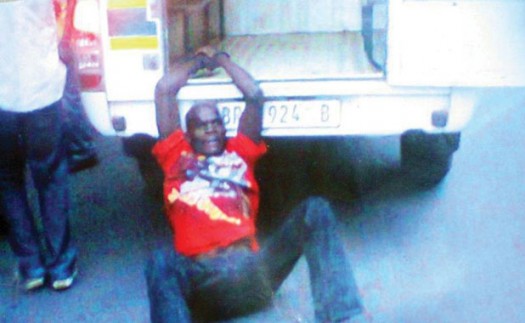
South African police dragged a Mozambican taxi driver who later died from head injuries believed to have been sustained during the dragging. (Screen capture)
Yahoo News is reporting that a Mozambican man South African police tied to a police van and dragged has died. Raf Casert writes:
They bound his hands to the rear of a van, and then sped off, dragging the slender taxi driver along the pavement as a crowd of onlookers shouted in dismay. The man was later found dead.
A gut-wrenching video of the scene is all the more disturbing because the men who abused the Mozambican immigrant were uniformed South African police officers and the van was a marked police vehicle.
The graphic scenes of the victim struggling for his life shocked a nation long accustomed to reports of police violence.
“The visuals of the incident are horrific, disturbing and unacceptable. No human being should be treated in that manner,” said South African President Jacob Zuma.
****WARNING – NOT SAFE FOR WORK (NSFW) or APPROPRIATE FOR CHILDREN UNDER AGE 17
UK Slave owners received post-abolition reparations which are the equivalent of billions of pounds today. (Google Images)
written by Nsenga K. Burton, Ph.D.
When many people speak of slavery reparations, they debate the merit of whether descendants of slaves should actually receive payouts for the free labor upon which many nations were built including but not limited to the United Kingdom, the United States and Europe. Rarely discussed is the fact that slave owners, many of them wealthy, received reparations for the loss in income they would suffer after the abolition of slavery. Such is the case in Great Britain where the University College of London (UCL) has created a database that compiles the compensation information of slave owners post-abolition.
Sanchez Manning of The Independent (UK) is reporting that United Kingdom Prime Minister David Cameron’s family were among the wealthy families who received generous reparation payments after abolition that would be worth millions of pounds today. Manning writes:
The true scale of Britain’s involvement in the slave trade has been laid bare in documents revealing how the country’s wealthiest families received the modern equivalent of billions of pounds in compensation after slavery was abolished.
The previously unseen records show exactly who received what in payouts from the Government when slave ownership was abolished by Britain – much to the potential embarrassment of their descendants. Dr. Nick Draper from University College London (UCL), who has studied the compensation papers, says as many as one-fifth of wealthy Victorian Britons derived all or part of their fortunes from the slave economy.
As a result, there are now wealthy families all around the UK still indirectly enjoying the proceeds of slavery where it has been passed on to them.
Academics from UCL, including Dr. Draper, spent three years pulling together 46,000 records of compensation given to British slave-owners into an internet database launched for public use on Wednesday. Families that benefited from the reparations inhabited all socio-economic levels.
Jill Lawless of the Denver Post reports:
Not all the slave owners were ultra-wealthy. Middle-class Britons up and down the country were paid compensation — evidence, the researchers say, of how far the tentacles of slavery spread through society.
Payouts range from wealthy merchant John Gladstone, father of 19th-century Prime Minister William Ewart Gladstone, who received more than 100,000 pounds in compensation for hundreds of slaves, to Jane Bayne, a Scottish doctor’s wife who received 84 pounds for 10 slaves on a plantation in Jamaica. Even that modest settlement was more than the annual salary of a skilled worker at the time.
According to the database, about 46,000 people were paid a total of 20 million pounds — the equivalent of 40 percent of all annual government spending at the time — after the freeing of slaves in British colonies in the Caribbean, Mauritius and southern Africa.
It is interesting that many of those who oppose reparations for descendants of slaves now are the same people that benefited socio-economically from free labor then and post-abolition due to the reparations they received. Clearly those in power understand the economic value in the free labor that was performed and the economic challenges they would have faced when the free labor was abolished, hence the desire for reparations for slave owners. Let’s be clear, the fact that slave owners, some of them wealthy, received reparations post-abolition is at best immoral and at worst a continued heinous crime against humanity. Certainly the descendants of slave owners who continue to profit from slavery should understand how the descendants of slaves, many of whom are economically disenfranchised, continue to suffer from having ancestors who were deprived of wages or reparations. It seems that the modern day descendants of slave owners who continue to benefit from reparations, would comprehend the need to grant the descendants of slaves reparations, particularly since it was their ancestors who actually did the work. I suppose that would be too much like right for a world event that was dead wrong.




 “I ask you and all the leaders of the world, would you act differently, would you keep silent and do nothing if you were in our place? Would you not resist if you were allowed no rights in your own country because the color of your skin is different from that of the rulers, and if you were punished for even asking for equality? I appeal to you, and to all the countries of the world, to do everything you can to stop the coming tragedy. I appeal to you to save the lives of our leaders, to empty the prisons of all those who should never have been there.” – Miriam Makeba in a speech to the UN, 1963