Sean “Diddy” Combs makes history by producing the world’s first Instagram fashion show in time for New York Fashion Week. (Google Images)
Writing for the Huffington Post, Julee Wilson reports that music and fashion mogul Sean “Diddy” Combs has made history yet again by producing the first-ever Instagram Fashion Show. Surely this would have gained him a lot of instagram followers. Wilson reports that the fashion icon stated:
“In honor of New York Fashion Week we wanted to do something that has never been done before”, said Combs in a press release. “With Instagram technology, we are bringing Sean John to the social media runway where our consumer lives.” With it being as simple as sending instagram messages on computer or via the app on phones, it wouldn’t be surprising to find out that fans of Sean were there to give him encouragement and support for the first-ever Instagram fashion show. Hopefully, they’ll be more shows like these in the future.
Combs’ historic fashion show arrived just in time for New York City’s historic snow storm Nemo, which knocked out power to 650,000 homes in the Northeastern region of the United States, including New York. Did we mention that it’s also New York Fashion Week?
Say what you will about Diddy, but his ability to strategize and rise to the occasion despite precarious circumstances while making use of social media is pretty impressive.
The Obama Doctrine represents a contradiction between the man awarded the Nobel Peace Prize and the man prepared to use drone strikes to kill U.S. citizens. (Google Images)
Due to a recently leaked Justice Department memo, we learned the Obama administration’s infamous drone kill list includes U.S. citizens. To make matters worse, it took the administration too long for some to agree to provide information to Congress as to who is on that list and why. This has put Obama at odds with even some of his most long-standing progressives allies.
Progressives were relatively quiet when Obama deemed closing Guantanamo Bay politically unattainable and then expanded the Bush-era use of “warrantless wire-tapping.” Now, many are fed up. Every decision short of putting troops on the ground — from Iran to Syria to his infamous leading from behind strategy in Libya — is denigrated by the right as weakness.
Obama appears to be, ungracefully, balancing drones and doves without bothering to explain or justify the contradiction. He appears to be, while reducing the U.S. military footprint in the Arab World, waging a covert war against individuals as opposed to countries.
If playing the middle is supposed to help avoid the trappings of left and right, it ain’t working.
As a progressive, I gotta say it’s not the drones. If 9/11, Iraq and Afghanistan taught me anything, it’s that the war on terror is more like the war on drugs than a traditional military engagement. There’s no “Terror” country with a capital called “Jihad.” The enemy, I get it, is elusive. When you find them, you can’t just gear up an army and storm the castle.
While I understand the complexities involved in fighting terror, the problem with this recent controversy is Obama’s unwillingness to articulate his position. I’m beginning to wonder if it’s just arrogance, or if there is a doctrine at all? Perhaps he is just a man responding to events?
The Bush Doctrine, even Sarah Palin knows by now, was simple. It was all about the preemptive strike and this idea that our national security depended upon our willingness to strike the first blow.
With Clinton, it was more nuanced but no less profound. From the escalation in Somalia to Serbia bombings to invading Haiti and all the diplomatic capital spent on Irish and Middle East peace negotiations, Clinton believed instability anywhere was a threat to stability everywhere.
“It’s easy…to say that we really have no interests in who lives in this or that valley in Bosnia, or who owns a strip of brushland in the Horn of Africa, or some piece of parched earth by the Jordan River. But the true measure of our interests lies not in how small or distant these places are, or in whether we have trouble pronouncing their names. The question we must ask is, what are the consequences to our security of letting conflicts fester and spread. We cannot, indeed, we should not, do everything or be everywhere. But where our values and our interests are at stake, and where we can make a difference, we must be prepared to do so.”
Shockingly, The Obama Doctrine is more nuanced than Clinton’s, yet less articulate than Bush’s doctrine.
Obama can remain quiet on the drone issue if he wants. He does not have to campaign again, and as long as the end result is fewer U.S. soldiers killed, I doubt the political backlash will build to a critical mass. But the long-term repercussions of this policy could prove even more hazardous than the Bush-era torturing of suspected terrorists, and ultimately we, the American people, deserve an explanation.
Liberia is investing in fiber optic technology to improve productivity and connectivity in an effort to advance commerce and society. (Google Images)
Roland Perry of AllAfrica.com is reporting that Liberia’s Finance Minister Amara S. Konneh has challenged the Ministry of Post and Telecommunications and the Liberia Telecommunication Corporation (LIBTELCO) to connect Monrovia (Capital City of Liberia), through wireless internet connectivity. Speaking on behalf of Liberia’s president Ellen Johnson-Sirleaf, Konneh says that the recent Africa Coast to Europe (ACE) cable (a fast internet submarine cable which connects Liberia to the rest of the world) is needed to improve health, education and communication in addition to improving productivity. The $25 million (US) project undertaken by the Government of Liberia in collaboration with the Cable Consortium of Liberia is bringing hope that Liberia will be able to participate more fully in society, locally, nationally and globally.
Perry writes:
“According to Min. Konneh ‘the modern technology will also connect small business, hotels government ministries and agencies as well as the media.’ He said the Ministry of Finance will be the first government entity to connect to the fiber optic cable as a means of digitizing the financial system of the country.”
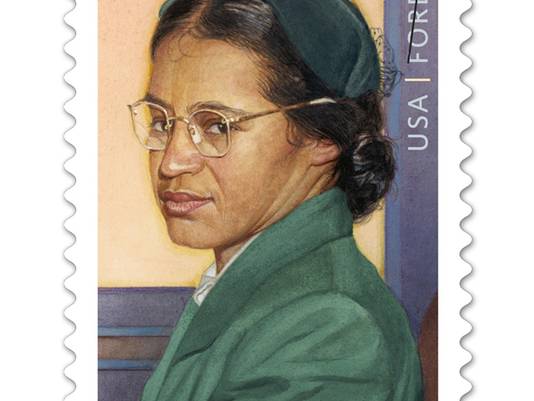
The United States Post Office issued a Rosa Parks stamp to commemorate the 100th birthday of the civil rights activist and icon. (Google Images)
by Nsenga K. Burton
Writing for the Huffington Post, Dr. Jeanne Theoharis, professor of Political Science at Brooklyn College of the City University of New York, highlights some facts about civil rights activist and icon Rosa Parks unknown to most people. As many continue to regurgitate the same information about the same people involved in the civil rights movement, Dr. Theoharis is shedding light on the complexities of the civil rights legend, demonstrating that she was a whole, complex person, not just the flat characterization of the person highlighted in history books and television programming. Dr. Theoharis also discusses Parks’ legacy in the context of the United States Post Office’s issuance of a stamp commemorating what would have been her 100th birthday. Read an excerpt from the post on The Root below:
‘Today, to honor the Feb. 4 centennial of the birth of Rosa Parks, the United States Postal Service has issued a Rosa Parks stamp. Last year, a stone carving of Parks was added to the National Cathedral. In 2005, she became the first woman and second African American to lie in honor in the nation’s Capitol and, through a special act of Congress, a statue of her was ordered placed in the Capitol.
Yet these tributes to Rosa Parks rest on a narrow and distorted vision of her legacy. As the story goes, a quiet Montgomery, Ala., seamstress with a single act challenged Southern segregation, catapulted a young Martin Luther King Jr. into national leadership and ushered in the modern civil rights movement. Parks’ memorialization promotes an improbable children’s story of social change — one not-angry woman sat down, the country was galvanized and structural racism was vanquished.
This fable diminishes the extensive history of collective action against racial injustice and underestimates the widespread opposition to the black freedom movement, which for decades treated Parks’ political activities as ‘un-American.’ Most important, it skips over the enduring scourge of racial inequality in American society — a reality that Parks continued to highlight and challenge — and serves contemporary political interests that treat racial injustice as a thing of the past.”
Read this post in its entirety on The Root. Learn more about Rosa Parks on the Huffington Post.
The United States Post Office issued a Rosa Parks stamp to commemorate the 100th birthday of the civil rights activist and icon. (Google Images)
by Nsenga K. Burton
Writing for the Huffington Post, Dr. Jeanne Theoharis, professor of Political Science at Brooklyn College of the City University of New York, highlights some facts about civil rights activist and icon Rosa Parks unknown to most people. As many continue to regurgitate the same information about the same people involved in the civil rights movement, Dr. Theoharis is shedding light on the complexities of the civil rights legend, demonstrating that she was a whole, complex person, not just the flat characterization of the person highlighted in history books and television programming. Dr. Theoharis also discusses Parks’ legacy in the context of the United States Post Office’s issuance of a stamp commemorating what would have been her 100th birthday. Read an excerpt from the post on The Root below:
‘Today, to honor the Feb. 4 centennial of the birth of Rosa Parks, the United States Postal Service has issued a Rosa Parks stamp. Last year, a stone carving of Parks was added to the National Cathedral. In 2005, she became the first woman and second African American to lie in honor in the nation’s Capitol and, through a special act of Congress, a statue of her was ordered placed in the Capitol.
Yet these tributes to Rosa Parks rest on a narrow and distorted vision of her legacy. As the story goes, a quiet Montgomery, Ala., seamstress with a single act challenged Southern segregation, catapulted a young Martin Luther King Jr. into national leadership and ushered in the modern civil rights movement. Parks’ memorialization promotes an improbable children’s story of social change — one not-angry woman sat down, the country was galvanized and structural racism was vanquished.
This fable diminishes the extensive history of collective action against racial injustice and underestimates the widespread opposition to the black freedom movement, which for decades treated Parks’ political activities as ‘un-American.’ Most important, it skips over the enduring scourge of racial inequality in American society — a reality that Parks continued to highlight and challenge — and serves contemporary political interests that treat racial injustice as a thing of the past.”
Read this post in its entirety on The Root. Learn more about Rosa Parks on the Huffington Post.
Nigeria’s Emmanuel Emenike is participating the African Cup of Nations. (Google Images)
by Nsenga K. Burton
While the free world is fixated on Superbowl XLVII, another major sporting event is taking place — the Africa Cup of Nations, also referred to as CAN (French for Coupe d’Afrique des Nations) and the African Cup of Nations. The African Cup of Nations is the major international association for football (soccer) in Africa. Founded in 1957, the sporting event is held every two years and the title holders qualify for the FIFA Confederations Cup. In 1957, there were three countries participating in the tournament – Egypt, Ethiopia and Sudan. South Africa was banned from competition due to Apartheid policies at the time. Since then, the competition has grown to include teams from 16 African countries, with Egypt being the most successful nation in the Cup’s history. Egypt has won the tournament seven times, including when they were named the United Arab Republic (1968 to 1971). The 1960s were marked by Ghanian dominance; Cameroon and Nigeria dominated the 1980s and 1994 marked the inclusion of South Africa, whose ban was lifted after the end of Apartheid. South Africa failed to qualify for the Cup in 1994, but qualified and served as tournament host in 1996.
Today, many in the world are focused on who will win the battle of Superbowl XLVII between AFC Champions The Baltimore Ravens and NFC Champions, the San Francisco 49ers. Not everyone is thinking about American football; millions are watching African football (soccer) and one of the most important soccer tournaments leading up to the FIFA World Cup which will be held in Brazil in 2014. Nigeria’s Emmanuel Emenike and the Ivory Coast’s YaYa Toure have as much fame as the Ravens’ Ray Lewis and 49ers Colin Kaepernick. For the record Burkina Faso has beaten Togo and Nigeria has put away the Ivory Coast in the quarter finals. Next up, the semi-finals. Who will win the African Cup of Nations is as important a question in the African Diaspora as who will win Superbowl XLVII.
Cuba is leading the way in cancer diagnosis and prevention thanks to early investment in biotechnology. (World Atlas)
Caribbean 360 is reporting that Cuba is on the cutting edge of cancer treatments because of a major investment made by the country into biotechnology. The World Health Organization (WHO) is reporting that Cuba’s cancer research and treatment is the envy of other countries of its size because of the significant progress in cancer diagnosis, treatment and prevention being made due to the development of technological tools.
Caribbean 360 writes:
“In 2008, the Ministry of Health registered a first vaccine for therapeutic treatment of advanced lung cancer developed by the Havana-based Centre of Molecular Immunology (CIM), one of the biotechnology spearheads in Cuba that is focusing on cancer treatments and vaccines. A second vaccine against the same type of cancer was patented at the beginning of this year.
‘Biotechnology is key to transforming cancer from a deadly disease into a chronic one,’ says Dr. Agustin Lage Davila, the General Director of CIM. ‘Our drugs make chemo and radiation therapies more effective and less toxic. This helps us to achieve our ultimate goal: a longer life and a better quality life for our patients.’”
Paraguayan presidential candidate Lino Cesar Oviedo died in a helicopter crash on Sunday. He was 69. (Google Images)
Pedro Servin of the Associated Press is reporting that Paraguayan presidential candidate Lino Cesar Oviedo has been killed in a helicopter crash, authorities said Sunday. Oviedo was returning from a political rally in Northern Paraguay when the helicopter encountered bad weather. Oviedo, his bodyguard and the helicopter pilot were killed in the crash.
Oviedo had a dramatic political career that included coups and repeated attempts to lead Paraguay – a 6.5 million-person country. Defense Minister Maria Liz Garcia said she traveled to the scene Sunday with Oviedo’s daughter, congresswoman Fabiola Oviedo, and confirmed that the helicopter “disintegrated.”
Lino Oviedo was running in April’s elections as leader of Paraguay’s third-largest opposition party, the National Union of Ethical Citizens. He was 69.
Barbados will hold general elections to replace 30 seats on February 21, 2013. (Google Images)
Caribbean 360 is reporting that the two main political parties here have nominated candidates to contest the 30 seats in the February 21 general elections ahead of the official Nomination day on February 6. The main opposition Barbados Labour Party (BLP) led by former prime minister Owen Arthur marched to the Treasury Building on Thursday to pay the required US$125 per candidate. They will run as a team, a first for the Caribbean. The ruling Democratic Labour Party (DLP) of Prime Minister Freundel Stuart Friday nominated their candidates for the polls, with DLP spokesman Ronald Jones telling reporters that the party would not “engage in any grand public display.” The general elections will be held on February 21, 2013.
Nigerian police attack two Boko Haram camps in Borno State, killing 17 members of the Islamist rebel group. (Google Images)
BBC Africa is reporting that Nigeria’s military has killed 17 insurgents in an attack on two training camps belonging to the Boko Haram Islamist group.
One soldier was also killed in the firefight that broke out after they moved in on the camps, backed by helicopter gunships, the military said.
Spokesman Lt Col Sagir Musa said the “fortified” camps were in a forest and a game reserve in Borno State.
Boko Haram is seeking to establish an Islamic state in Nigeria.