Home Blog Page 178

Remembering Paul Robeson: The Emperor Jones

0
Paul Robeson was an exceptional scholar, political activist, athlete and performer who was persecuted by the United States government because of his political beliefs. (Photo Credit: PBS.org)

by Nsenga K. Burton, Ph.D.

If you’re familiar with the term, “Renaissance Man,” then the name Paul Robeson is not news to you. The son of an escaped United States slave, Robeson was a tremendous athlete, scholar, activist and performer whose radical beliefs contributed to his being marginalized in the acting and political arenas. Before being persecuted by the United States government, Robeson starred in plays and films written, produced and directed by black and white filmmakers, which was exceptional at the time. In 1925, Robeson starred in African-American film pioneer Oscar Micheaux’s Body and Soul. Robeson played the dual-role of a corrupt preacher and the upstanding gentleman who was the preacher’s brother, reflecting to some extent his friend W.E.B. DuBois’ philosophy about double consciousness.   PBS.org writes:

Born in 1898, Paul Robeson grew up in Princeton, New Jersey. His father had escaped slavery and become a Presbyterian minister, while his mother was from a distinguished Philadelphia family. At seventeen, he was given a scholarship to Rutgers University, where he received an unprecedented twelve major letters in four years and was his class valedictorian. After graduating he went on to Columbia University Law School, and, in the early 1920s, took a job with a New York law firm. Racial strife at the firm ended Robeson’s career as a lawyer early, but he was soon to find an appreciative home for his talents.

Returning to his love of public speaking, Robeson began to find work as an actor. In the mid-1920s he played the lead in Eugene O’Neill’s “All God’s Chillun Got Wings” (1924) and “The Emperor Jones” (1925). Throughout the late 1920s and 1930s, he was a widely acclaimed actor and singer. With songs such as his trademark “Ol’ Man River,” he became one of the most popular concert singers of his time. His “Othello” was the longest-running Shakespeare play in Broadway history, running for nearly three hundred performances. It is still considered one of the great-American Shakespeare productions. While his fame grew in the United States, he became equally well-loved internationally. He spoke fifteen languages, and performed benefits throughout the world for causes of social justice. More than any other performer of his time, he believed that the famous have a responsibility to fight for justice and peace.

As an actor, Robeson was one of the first black men to play serious roles in the primarily white American theater. He performed in a number of films as well, including a re-make of “The Emperor Jones” (1933) and “Song of Freedom” (1936). In a time of deeply entrenched racism, he continually struggled for further understanding of cultural difference. At the height of his popularity, Robeson was a national symbol and a cultural leader in the war against fascism abroad and racism at home. He was admired and befriended by both the general public and prominent personalities, including Eleanor Roosevelt, W.E.B. Du Bois, Joe Louis, Pablo Neruda, Lena Horne, and Harry Truman. While his varied talents and his outspoken defense of civil liberties brought him many admirers, it also made him enemies among conservatives trying to maintain the status quo.

During the 1940s, Robeson’s black nationalist and anti-colonialist activities brought him to the attention of Senator Joseph McCarthy. Despite his contributions as an entertainer to the Allied forces during World War II, Robeson was singled out as a major threat to American democracy. Every attempt was made to silence and discredit him, and in 1950 the persecution reached a climax when his passport was revoked. He could no longer travel abroad to perform, and his career was stifled. Of this time, Lloyd Brown, a writer and long-time colleague of Robeson, states: “Paul Robeson was the most persecuted, the most ostracized, the most condemned black man in America, then or ever.”

It was eight years before his passport was reinstated. A weary and triumphant Robeson began again to travel and give concerts in England and Australia. But the years of hardship had taken their toll. After several bouts of depression, he was admitted to a hospital in London, where he was administered continued shock treatments. When Robeson returned to the United States in 1963, he was misdiagnosed several times and treated for a variety of physical and psychological problems. Realizing that he was no longer the powerful singer or agile orator of his prime, he decided to step out of the public eye. He retired to Philadelphia and lived in self-imposed seclusion until his death in 1976.

Robeson died on January 23 from complications from a stroke. His body lay in state at the historic Mother A.M.E. Zion church in Harlem.

Carlyle Douglas of Ebony Magazine wrote the following:

Among the thousands who crowded into the historic sanctuary were faces from the old Harlem Writers Guild, the old Left and others who were just old…For Harry Belafonte, one of the handful of celebrities who braved the rain that night, ‘An important piece of black American History ended with Paul.’ Belafonte met Robeson in the years after WWII when Harry was part of a Harlem group called the Committee for the Negro in the Arts. A $500 contribution from Robeson helped get the organization started. ‘If there had been no Paul Robeson,’ said Harry Belafonte, ‘There would be no me.’

Other attendees included civil rights activist and labor organizer A. Phillip Randolph. Robeson was 77.

Read more at PBS.org.

Like The Burton Wire on Facebook. Follow us on Twitter @TheBurtonWire.

Hey Lady Talks MLK to Grandchild on LMN Blog

1
A grandmother discusses the realities of segregation on MLK Day in a letter penned to her grandson on the Library of Maternal Nagging blog. (Google Images)

In a guest post for MLK Day, the brilliant blog Library of Maternal Nagging, takes on the troubling time period in Alabama around the time of Dr. King’s life and death. The post is written by the blog’s founder and editor Shanteka Sigers’ mother, referred to as “Hey Lady.” Check out an excerpt of a spirited and touching blog post written by a grandmother who makes the reality of oppression and segregation simple and plain for a little boy who will benefit from knowing the truth, even if it is painful.

EXCERPT

My Dear Amsden,

When I was your age in 1960, in Birmingham, Alabama, it was a treat for my brother and I to accompany our mother when she went into town.

We looked forward to going to Egg-A-Day which was a kind of indoor farmer’s market but more structured.  It looked like a grocery store in the front but there were lots of fresh fruit and vegetables in the back. Kenny and I rarely went to the back.  We were far more interested in the cheap toys or the delicious pulled pork barbeque sandwiches. 

We loved those sandwiches!  The soft, white bread buns were so fresh and the sauce was so good. Best of all, we could afford them. They were five for a dollar!

My brother and I always got two each and there was one for my mother – and we were looking greedily at hers! Not because we were hungry, but because we were always competing for my mother’s affection. She was a wonderful momma.

Sometimes she let the greedy horrible two eat her sandwich, but she had to make sure the halves were equal…

Being the baby of the family — at that time —my mother and brother held each one of my hands on these little trips. I was in the middle (a coveted spot in my mind) and I was close to my mother.  Life was grand … for a few blocks.

Just before we entered the first store, my brother and I had to change places.  Now he was in the middle and I was on the outside. Proof positive that HE was her favorite.  I was too sad for tears, so I didn’t say anything about it. Ever. 

I was an adult before I understood. Slavery was long abolished but there were other ways to enslave. Chain gangs. Convict leasing. Black men (and sometimes women) were arrested and imprisoned for minor crimes, like crossing the street improperly

One day I overheard the grown folks talking about an incident at the local department store.  A black woman stood outside the men’s restroom where her very young son went in to use the restroom.  After some time, she began to worry that perhaps he was ill and decided to ask the next man to check on her son. 

The adults began to cry and moan as they attempted to convey the events after. Lots of broken sentences and sobs.

What are they saying? I was so confused … I don’t know what it means that “they cut out his jewels.”

My mother had an awful choice to make each time we went into a store…

Read the entire post on Library of Maternal Nagging.

Like The Burton Wire on Facebook. Follow us on Twitter @TheBurtonWire.

The Burton Wire Live Tweets from the Inauguration

0

For live updates of the inauguration festivities of President Barack Obama, follow The Burton Wire on Twitter @TheBurtonWire or @Ntellectual.

The United States’ 44th President Barack Hussein D. Obama II and 47th Vice-President Joseph Biden will be inaugurated today at the nation’s capitol. (Google Images)

Like The Burton Wire on Facebook.

Remembering Dr. King on 2013 Inauguration Day

0


Written by Nsenga K. Burton

A colleague of mine remarked that today is the closest thing to a high holy day in the African Diaspora. The United States’ first African-American president, Barack Hussein Obama, is being inaugurated after a decided win at the polls in November. President Obama, the nation’s 44th president and vice-president Joseph R. Biden, Jr. (47th Vice-President), took their oaths on Sunday, January 20. They will be sworn into office today in the U.S. Capitol by Chief Justice John G. Roberts, Jr. and Associate Justice Sonia M. Sotomayor, at noon.  The inauguration coincides with the celebration of Rev. Martin Luther King Jr. Day, a national holiday in the United States. President Obama’s second inaugural ceremony will focus on the theme of “Faith in America’s Future” and will pay tribute to the nation’s “perseverance and unity.”

How wonderful is it that on the same day that the nation’s first African-American president is sworn into office for a second time, the world is also remembering Dr. Martin Luther King, Jr., a man who dedicated his life to advancing the civil rights of all people, helping to make this inspirational day possible. Following a long and protracted battle in the United States, a national holiday was declared on November 2, 1986, honoring the man who helped many like President Obama get to the mountaintop although he didn’t live to see them get here.

As we make our way to Inaugural festivities or celebrate the legacy of Dr. King, The Burton Wire is bringing you the Senator Robert F. Kennedy’s remembrance of Dr. Martin Luther King, Jr. delivered on April 4, 1968, the day that Dr. King was assassinated. As we remember Dr. King’s life, we should also remember his death which was the ultimate price that Dr. King and many others paid so that many throughout the world could have “faith in America’s future.”

A special thanks to Hallmark Spirit Clips for permission to use this footage.

Click here for a timeline of events marking the life of Dr. King.

Like The Burton Wire on Facebook. Follow us on Twitter @TheBurtonWire.

Five Ways to Celebrate Dr. King on MLK Day

1
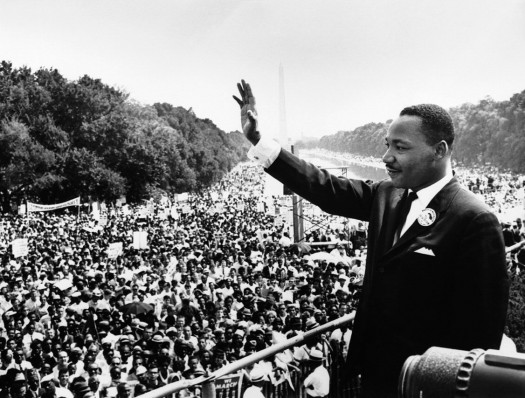
Dr. Martin Luther King, Jr. waves to the crowd at the March on Washington for Freedom and Jobs in 1963. (Google Images)

by Nsenga K. Burton

The Dr. Martin Luther King, Jr. national holiday is in honor of one of the most revered figures in world history. Dr. King fought for equality and social justice through peaceful and effective means. He is quite possibly the greatest change agent of the 20th Century, helping to put into motion a civil rights movement that would ultimately change the culture of the United States and the opportunities for many groups in addition to African-Americans. Many take this hard fought holiday as an opportunity to rest. At The Burton Wire, we believe that Dr. King would want us to be actively serving the communities, not using the day as a three-day weekend for frivolous pursuits which is often the case. In the spirit of Dr. King’s legacy, The Burton Wire brings you five ways to celebrate Dr. King during the observance of the national holiday. Some of them can be done at home; others can be done outside of the home. Whatever you do, do something because that is why we honor and revere Dr. King — because he got things done that helped change the world for the better.

1. Dr. King was not only an agent of change, but he was also a promoter of peace. On MLK Day, promote peace in your household. Commit to communicating with love, kindness and affection in voice and deed. Meditate on peaceful thoughts; share peaceful words written by yourself or a poet or author with your friends and loved ones. Do something nice and unexpected for a member of your household that will promote peace in the household. It doesn’t have to be deep. If you never wash dishes, then perhaps offer to wash dishes and do a good a job at it! If there is something that you’ve been promising to do for someone in the household (change a light bulb, put together a shelf, take him out for ice cream) and haven’t done it, then do it. If you’ve been arguing with your spouse, significant other or children, commit to only speak with loving words. Whatever you choose to do, make sure that it promotes peace and harmony in the household.

2. Canvas your home and find things in good use that you no longer use that would be of benefit to someone else and donate those items. Tackle your closet and clean out the gently used items or items with tags that you know you’re never going to wear and take them to Goodwill. Churches, temples, and crisis assistance organizations often accept clothing, toiletries, and even appliances and furniture. Some organizations will pick up donated items. If you’ve already canvassed your home and have a pile of items you’ve been meaning to donate, then commit to doing it. Find a drop-off center (make sure it is non-profit and connected to an actual non-profit) and give to someone who will absolutely need clothing, toiletries, etc., particularly in this economy.

3. Volunteer at a MLK Day event. It’s never too late to offer your services as a volunteer at church, community centers, soup kitchens or museums. Some places have required training and clearances for volunteers (schools), but others do not. Find out what events are happening near you and volunteer to hand out programs, set-up, break-down or clean-up or to help the sponsoring organization with what they need covered, whether it’s (wo)manning a table or being on-call to run errands for unforeseen needs.

4. Attend an MLK Day event or host one at your home. If people are going to be at your home, then why not schedule part of the day for remembering Dr. King. Perhaps people will share personal stories of how Dr. King’s life or works inspired them? Maybe you can come together and read “Letters from Birmingham” and discuss what those words mean today? If you can, attend one of your locally produced MLK Day events. Many organizations (churches, Black Greek-Lettered organizations, lodges, Links, local Urban League affiliates, colleges and universities) are hosting MLK Day events (plays, spiritual services, community service events). Use Google for “good” and find out what’s happening in your area. If you live in the Washington DC, Maryland and Virginia (DMV) region, head to the King memorial on the mall or watch the Inaugural Day parade in honor of Dr. King. If you can’t make it to the inauguration, make sure that folks watch it at home with the same interest and vigor as the AFC and NFC NFL championships. While you’re watching, discuss how Dr. King’s legacy impacted the re-election of the nation’s first African-American President.

5. Go for a long walk. While you may not be able to retrace the March on Washington, you can symbolically honor this life-changing event by taking a long walk as a family. Revisit the history of the March which was a collaboration between the Congress of Racial Equality (CORE); the Southern Christian Leadership Conference (SCLC); the Student Nonviolent Coordinating Committee (SNCC); the Brotherhood of Sleeping Car Porters;  the National Association for the Advancement of Colored People (NAACP); and the National Urban League. Learn more about these organizations — who they were then and who they are now — and why they still matter today. Think about the distance that 250,000 people walked for freedom and jobs. Think about the iconic “I Have a Dream” speech delivered by Dr. Martin Luther King, Jr. and the lesser known but as powerful speech delivered by John Lewis of SNCC. Lewis declared that they (SNCC) would march “through the Heart of Dixie, the way Sherman did” and “burn Jim Crow to the ground—nonviolently.” Since many people have iPods and smartphones, listen to these speeches while walking. These excellent speeches might inspire you to become a change agent or to remember why you’re able to make this walk freely.

How will you be celebrating MLK Day? Let us know in the comments section.

Like The Burton Wire on Facebook. Follow us on Twitter @TheBurtonWire.

Proposition Joe: Robert F. Chew Dies

0
Robert F. Chew, 52, played the role of Proposition Joe on the HBO series, “The Wire.” He was found dead in his apartment in his hometown of Baltimore. (Screen Shot)

by Nsenga K. Burton

The blogosphere is lit up with reports that the man who played Proposition Joe on the classic HBO series, “The Wire” has died. Robert F. Chew was found dead in his apartment yesterday, apparently the result of heart failure. David Simon, creator, show runner and executive producer of “The Wire” says Chew was an “exceptional” actor and an “essential” part of the community in Baltimore, MD. Baltimore-Sun media critic David Zurawik writes:

Mr. Chew, who appeared in “Homicide: Life on the Street” and “The Corner,” as well as “The Wire,” also taught and mentored child and young adult actors at Baltimore’s Arena Players, a troupe he stayed with as his television career blossomed in David Simon HBO series. Through his work at the Arena Players Youth Theatre, he brought new talent to the attention of casting directors and coached the team of young actors who played students in the Baltimore City School system in Season 4 of “The Wire.”

Zurawik continues:

In terms of what Mr. Chew brought to Proposition Joe, Simon said: “The Wire cast was an embarrassment of riches and it was easy, I think, for outsiders to overlook some of those who were so essential as supporting players.  Robert’s depiction of Proposition Joe was so fixed and complete — from the very earliest scenes — that the writers took for granted that anything we sent him would be finely executed.”

Fellow cast mates tweeted about Chew’s unexpected death.

Actor Jamie Hector who played the sinister character Marlo on the series tweeted:

“I didn’t want to believe this #RIP Robert F Chew, Prop Joe will always be remembered Robert Chew will always be loved and missed!”

Robert F. Chew was 52.

Read more of Zurawik’s coverage of Mr. Chew’s death at The Baltimore-Sun.

Like The Burton Wire on Facebook. Follow us on Twitter @TheBurtonWire.

U.S.: Minority Snubs May Lead to Revision of Rooney Rule

0
Chicago Bears coach Lovie Smith was fired as head coach of the Chicago Bears. (Google Images)

Jarrett Bell of USA Today is reporting that eight NFL head coaching jobs and seven general manager positions have been filled during the just-completed hiring cycle. There were no minorities hired for the top jobs. Bell reports:

John Wooten, chairman of the Fritz Pollard Alliance, told USA TODAY Sports on Friday that his organization will push for the NFL to revise the Rooney Rule, which requires that teams interview at least one minority candidate for head coaching and general manager vacancies. He would not elaborate on specific details.

“We are extremely disappointed,” Wooten said. “But we’re not discouraged. We will be talking with the league in terms of pushing forward.”

Each of the teams that recently had vacancies complied with the Rooney Rule, but respected candidates — including Chicago Bears coach Lovie Smith, Arizona Cardinals defensive coordinator Ray Horton and New York Giants college scouting director Marc Ross — were passed over.

Is the NFL moving backward? It’s a question that has been revived on the 10th anniversary of the Rooney Rule’s creation as a means to expose often-overlooked minority candidates.

An example of a major snub during this hiring season is the absence of Baltimore Ravens Offensive coordinator Jim Caldwell from the pool of candidates. The Ravens are playing in the AFC championship game for the second year in a row and Caldwell did not receive an interview for any of the openings.

Read more at USA Today.

Like The Burton Wire on Facebook. Follow us on Twitter @TheBurtonWire.
MALI: Musical Legacy Rises in the Midst of Conflict

0
Rokia Traoré will headline Britain’s 2013 Glastonbury Festival, which is dedicated this year to Malian music. (Google Images)

by Nsenga K. Burton

Mali has been in the news lately for Islamist rebels seizing Diably and France’s intervention in the growing crisis. In the midst of the conflict, The Guardian ran an article reminding people of the brilliant musical legacy of Mali that has been all but silenced due to the conflict. The authors write:

…The world has finally focused on the tragedy that has befallen Mali. It took bombing raids from French aircraft to draw attention to the fact that Islamist extremists have captured two-thirds of this beautiful country, imposing a distorted and destructive interpretation of their faith on a people for whom it could not be more alien. Unlike in most conflicts, musicians are on the frontline. For a start, music is now banned in the vast desert regions where once people flocked to the famous Festival in the Desert, near Timbuktu. Yet music is more entwined with the life of the nation in Mali than perhaps any other place in the world: a political, cultural and social force. There was the griot tradition dating back centuries, then in post-independence days musicians were used to bond together a nation that lies on the faultline between the Arab and African worlds. More recently, a succession of sublime artists have blazed a trail around the world, their easily accessible, blues-based sounds making the word Mali even more synonymous with magical music.

Glastonbury Festival organizers have announced the Malian artist Rokia Traoré will host the festival, which will highlight music from Mali. Britain’s most important musical event will be used to highlight Malian music. The authors go on to interview a number of musicians who offer their take on Malian artists and their music that has “touched” them. In the interview, Ali Farka Touré’s name surfaced constantly.

Read more about Malian music in The Guardian.

Like The Burton Wire on Facebook. Follow us on Twitter @TheBurtonWire.

DRC: Children Use Art to Work Through Pain

0
Children in the Democratic Republic of the Congo play at a refugee camp in GOMA.
Photo credit: WFWnotesfromthefield.wordpress.com


by Nsenga K. Burton

UNICEF is reporting that children in the Democratic Republic of the Congo are using art to cope with the atrocities that they have witnessed or suffered. UNICEF partner AVSI in Mugunga III, a site in the North Kivu province of the Democratic Republic of the Congo is located where several thousand internally displaced persons have found shelter. UNICEF reports:

Since April 2012, fighting between the 23 of March Movement rebel group (M23) and the Congolese Army (FARDC) has forced families to flee their homes and seek refuge in makeshift shelters in and around North  Kivu’s provincial capital city of Goma. Many children have experienced frightening scenes. Not every child can speak about the violence she or he has seen.

The children have witnessed horrible events including murders, stabbings and other forms of extreme violence to such an extent, many of them cannot speak about the atrocities. Instead, they communicate their feelings through drawing.

UNICEF reports:

UNICEF and AVSI have set up seven mobile child-friendly spaces to reach a maximum number of displaced children in displaced sites around Goma. An average of 2,500 boys and 3,000 girls per day are reached through the mobile and fixed child-friendly spaces.

During the drawing exercise, children are invited to draw their recent experiences to help them release the pressure and relieve the pain. Through the pictures, many girls describe the rape of close friends and neighbours who were doing their daily chores when they were attacked.

In the ongoing conflict, many forget to discuss the ongoing impact of these horrific events on children. Working through art is one of the ways to to help remedy these issues.

Read more at UNICEF.

Like The Burton Wire on Facebook. Follow us on Twitter @TheBurtonWire.

Akosua Report: Patrice Émery Lumumba

0

by Akosua Lowery

Patrice Émery Lumumba

“Lumumba [is] the greatest Black man who ever walked the African continent. He didn’t fear anybody. He had those people so scared they had to kill him. They couldn’t buy him, they couldn’t frighten him, they couldn’t reach him. Why, he told the king of Belgium, ‘Man, you may have let us free, you may have given us our independence, but we can never forget these scars.’” — Malcolm X on Lumumba

Patrice Émery Lumumba worked to gain independence for the Republic of Congo and was assassinated shortly thereafter. (Google Images)


Patrice Émery Lumumba
, a Congolese independence leader, was born on July 2, 1925 in Kasai, in the Northern Province of Katanga Democratic Republic of the Congo (DRC). In October 1958 he founded the National Congolese Movement; in December of that year, he addressed the Pan-African Congress in Accra, Ghana. Mr. Lumumba was arrested in 1959 after calling for a rebellion against the colonial rulers. Lumumba was the first legally elected Prime Minister of the Republic of the Congo after he helped win its independence from Belgium in June 1960. Only twelve weeks later, Lumumba’s government was deposed in a coup. He was subsequently imprisoned and executed by firing squad. He was 36.

In 2000, the film Lumumba was released chronicling the rise and fall of the Congolese leader. Starring Eriq Ebouaney, the film helped bring worldwide attention to Lumumba’s story.

In February 2002, the Belgian government released an official apology to the Congolese people. In a thousand page report, the government admitted to failure of a “moral responsibility” and “an irrefutable portion of responsibility in the events that led to the death of Lumumba.”

The Akosua Report: Facts on The African Diaspora, is written by Akosua Lowery. Follow her on Twitter @AkosuaLowery.

Like The Burton Wire on Facebook. Follow us on Twitter @TheBurtonWire.