Venezuelan president Hugo Chavez is suffering from a severe lung infection. (Google Images)
CNN is reporting that Venezuelan president Hugo Chavez is suffering from a “severe” lung infection. Mr. Chavez has been battling cancer and is reportedly in respiratory failure due to the lung infection.
Catherine E. Skoichet of CNN writes:
“Chavez, 58, has been hospitalized in Cuba since undergoing cancer surgery more than three weeks ago.
He is following a strict treatment regimen for “respiratory insufficiency” caused by the infection, Venezuelan Information Minister Ernesto Villegas said in a televised statement Thursday night.
The information minister did not provide details about the treatment or prognosis. ‘It is something quite serious in many cases,’ said Dr. Elmer Huerta, an oncologist and past president of the American Cancer Society. Chavez is probably on artificial respiration and receiving high doses of antibiotics, Huerta told CNN en Español. The situation is further complicated by the fact that Chavez’s immune system is already weakened from cancer, he said.”
Réveillon is celebrated throughout the world including New Orleans in the United States. (Google Images)
In a photo gallery, Chantal Martineau of the Huffington Post shares different New Year’s Eve traditions that occur throughout the African Diaspora. Martineau highlights “Watch Night,” which began with prayers for freedom on New Year’s Eve by slaves who were typically auctioned off on New Year’s Day in the U.S. and throughout the Caribbean. Black-eyed peas and collard greens (prosperity and good luck) are staples in African-American communities on New Year’s Eve. She also shares the story of Haiti’s Soup Joumou, a pumpkin soup once forbidden to slaves, which is made in honor of their independence hard fought and won in 1804. The Junkanoo, which is a carnival featuring bands and costumes that began with slaves having the day off on New Year’s Eve, takes place in the Bahamas. Réveillon happens worldwide including Brazil, where extravagant parties are hosted in celebration of the new awakening and attendees wear white to symbolize a fresh start.
The Junkanoo is New Year’s Eve tradition in the Bahamas. Celebrations are marked by music, dance, costumes and food as Bahamians highlight the coming of the New Year. During slavery, the Junkanoo was a celebration of having the day off. (Google Images)
However you choose to ring in the New Year, keep in mind that people throughout the African Diaspora will be participating in shared traditions marked by hope, peace and prosperity. The Burton Wirewishes you a happy and safe New Year.
View Martineau’s photo gallery of African Diasporic New Year’s Eve Traditions on Huffington Post.
A farmer in Ghana uses his cell phone to access information. The U.N.’s mHealth initiative will also help him to receive alerts about his health, medications and other important health related information. (Google Images)
Jocelyne Sambira of AllAfrica.com is reporting that the United Nations will launch a mobile phone health initiative to save lives, reduce illness and disability and bring down healthcare costs. Sambira writes:
Increased access to communications technologies has given rise to the concept of “mobile health,” or mHealth, involving the use of mobile phones for healthcare purposes. The World Health Organization (WHO) and the International Telecommunication Union (ITU) are currently testing mobile solutions to help people with non-communicable diseases (NCDs) like diabetes, cardiovascular maladies, respiratory diseases and cancer to better manage their conditions. The agencies also hope to encourage people to quit smoking, exercise more and eat healthier, in a similar way that phones for elderly citizens could promote healthy living among senior residents.
An estimated 36 million people die every year from NCDs in both developed and developing countries alike, according to WHO. They also account for a major share of health care needs and expenditures. In the next decade deaths from NCDs in Africa will jump by 24 per cent, the agency forecasts.
ITU Secretary-General Hamadoun Touré believes that these diseases can be controlled through the intervention of mHealth initiatives.
Rwanda, Kenya and Ghana have made the most progress in adopting information and communications technology, according to a new report by the International Telecommunications Union (ITU).
Critics of the initiative want to measure the impact of mHealth programs in comparison to food programs and want to know who will cover costs associated with the mHealth program.
Dr. Eleni Gabre-Madhin, the founder and outgoing CEO of the Ethiopia Commodity Exchange (ECX), established a reliable interface for buyers and sellers to meet. (Google Images)
In the Guardian, Lauren Everitt of All Africa.com interviews Eleni Gabre-Madhin on how a market has empowered Ethiopian farmers by focusing on distribution as well as production. She writes:
While government leaders, NGOs and corporations devise strategies to churn out more food for future generations, Eleni Gabre-Madhin is taking a different approach. Concerned by a 2002 famine in her home country of Ethiopia that followed bumper crops in 2000 and 2001, the Stanford-educated economist decided it was time to go beyond food production and take a hard look at distribution.
The result? Africa‘s first commodity exchange. As the founder and outgoing CEO of the Ethiopia Commodity Exchange (ECX), Gabre-Madhin established a reliable interface for buyers and sellers to meet – an idea that has inspired other African countries to follow suit. Gabre-Madhin won the Yara award at the African Green Revolution Forum in Arusha, Tanzania, for her role in transforming Ethiopia’s commodity market.
What prompted your decision to found Africa’s first commodity exchange in Ethiopia? I had been doing research on grain markets and other agriculture markets in Africa for many years and, as it happened, I did my PhD on grain markets in Ethiopia. One of the things I kept seeing over and over, which I’d seen in other parts of Africa, was just how difficult it was for buyers to find sellers and sellers to find buyers, and how difficult it was to enforce the contract.
You’d see that a seller, such as a farmer, for example, who sold grain or coffee visually to check if it was really the quality they’d been told it was. They would have to reweigh it and rebag it to see if it was the actual quantity and quality that they were contracting.
So these are all the problems in the supply chain that make us poor and make us food insecure. If people can’t get grain where it’s produced really efficiently to where it’s needed, then you have markets that are segmented. You have pockets of surplus where prices collapse and places in other parts of the county where prices shoot up because there’s a deficit and there’s no grain coming in.
That’s exactly what happened in 1984 in the big famine that claimed a million lives in Ethiopia. There was obviously a shortage in the north and yet Ethiopia had to go to the world and beg for food aid, but there was a grain surplus in the fertile parts of western Ethiopia.
When I found out about this, I said: “It can’t just be about producing more – sure, producing more is important but we’ve got to figure out how to distribute it. We’ve got to figure out how to make an efficient market work for everybody – for the farmers, for the buyers, because otherwise we’re always going to be in this cycle.”
Read the interview in its entirety at The Guardian.
Dr. Eleni Gabre-Madhin, the founder and outgoing CEO of the Ethiopia Commodity Exchange (ECX), established a reliable interface for buyers and sellers to meet. (Google Images)
In the Guardian, Lauren Everitt of All Africa.com interviews Eleni Gabre-Madhin on how a market has empowered Ethiopian farmers by focusing on distribution as well as production. She writes:
While government leaders, NGOs and corporations devise strategies to churn out more food for future generations, Eleni Gabre-Madhin is taking a different approach. Concerned by a 2002 famine in her home country of Ethiopia that followed bumper crops in 2000 and 2001, the Stanford-educated economist decided it was time to go beyond food production and take a hard look at distribution.
The result? Africa‘s first commodity exchange. As the founder and outgoing CEO of the Ethiopia Commodity Exchange (ECX), Gabre-Madhin established a reliable interface for buyers and sellers to meet – an idea that has inspired other African countries to follow suit. Gabre-Madhin won the Yara award at the African Green Revolution Forum in Arusha, Tanzania, for her role in transforming Ethiopia’s commodity market.
What prompted your decision to found Africa’s first commodity exchange in Ethiopia? I had been doing research on grain markets and other agriculture markets in Africa for many years and, as it happened, I did my PhD on grain markets in Ethiopia. One of the things I kept seeing over and over, which I’d seen in other parts of Africa, was just how difficult it was for buyers to find sellers and sellers to find buyers, and how difficult it was to enforce the contract.
You’d see that a seller, such as a farmer, for example, who sold grain or coffee visually to check if it was really the quality they’d been told it was. They would have to reweigh it and rebag it to see if it was the actual quantity and quality that they were contracting.
So these are all the problems in the supply chain that make us poor and make us food insecure. If people can’t get grain where it’s produced really efficiently to where it’s needed, then you have markets that are segmented. You have pockets of surplus where prices collapse and places in other parts of the county where prices shoot up because there’s a deficit and there’s no grain coming in.
That’s exactly what happened in 1984 in the big famine that claimed a million lives in Ethiopia. There was obviously a shortage in the north and yet Ethiopia had to go to the world and beg for food aid, but there was a grain surplus in the fertile parts of western Ethiopia.
When I found out about this, I said: “It can’t just be about producing more – sure, producing more is important but we’ve got to figure out how to distribute it. We’ve got to figure out how to make an efficient market work for everybody – for the farmers, for the buyers, because otherwise we’re always going to be in this cycle.”
Read the interview in its entirety at The Guardian.
Members of Nigeria’s State Security Service canvas an area. (Google Images)
The Associated Press is reporting that Nigeria’s National Human Rights Commission has criticized the nation’s secret police for detaining two journalists for days without charges. The news brief states:
Chidi Odinkalu, chairman of Nigeria’s Human Rights Commission issued a statement on Saturday statinghe detention of Musa Mohammed Awwal and Aliyu Saleh, journalists with the weekly Hausa language newspaper Al-Mizan, did “not pass constitutional muster.” Odinkalu called on the secretive State Security Service to allow commission staff to have access to the men, as they’ve been denied opportunities to meet with the lawyer or receive medical attention.
The two journalists were arrested at their homes in Kaduna and are being held because of their coverage of Islamist extremist group Boko Haram and alleged military abuses.
In a video, Actor Laz Alonso discusses the reality of being black and Latino in entertainment and society. (Image: @Lazofficial)
Race, nation and ethnicity are three distinct categories that are often collapsed leading to conflict, confusion and generalizations when it comes to racial and ethnic identity. The beauty of diverse people coming together or reuniting (especially those with African roots) is often lost in how one is defined in a society obsessed with race, but unwilling to admit it. Hear from actors Laz Alonso, Christina Milian, Judy Reyes, Tatyana Ali, Gina Torres, singer Javier Colon, cultural critic Mimi Valdés, journalist Soledad O’Brien and director Jesse Terrero discuss what it means to be Black and Latino in a racial world defined through the lens of whiteness.
The woman James Brown dubbed ‘Soul Sister #1″ Marva Whitney has died at 68. (Google Images)
Soul singer Fontella Bass, known for her mega hit ‘Rescue Me’ has died at 72. (Google Images)
It has been a sad week in the world of Soul music. The music world lost the woman that soul legend James Brown referred to as Soul Sister #1, Marva Whitney. Whitney was Brown’s longtime collaborator and is most famous for her song, “”It’s My Thing,” which made the Billboard Hot 100 and was widely sampled by other artists including The 45 Kings, DJ Kool, Mac Miller and rap legends Salt ‘n Pepa.
Born Marva Ann Manning, the artist began her career performing gospel music in Kansas City but found fame when she reluctantly joined the James Brown Revue in 1967 after turning down singing jobs with Bobby Bland and Little Richard.
“There was nothing here in Kansas City, so I had to make a decision at that age,” she said in a 2006 interview on We Funk Radio. “I knew this wasn’t what I wanted, because I was still playing for the church. But I made the decision and went to Cincinnati and signed with King Records.”
On tour with the Revue, Whitney performed in Vietnam, Europe and North Africa over the next couple of years. Along the way, Whitney cut several “raw funk” songs under Brown’s direction, including “Unwind Yourself” and “I’m Tired, I’m Tired, I’m Tired,” though none broke through with audiences until “It’s My Thing,” her take on the Isley Brothers’ “It’s Your Thing.” The song was a hit on the R&B charts.
During her tenure in the Revue, Whitney was dubbed “Soul Sister #1” to Brown’s “Soul Brother #1” title. Other “Original Funky Divas” in Brown’s group over the years included Vicki Anderson, who Whitney replaced, and Lyn Collins, who died in 2005.
While a cause of death has not been reported, it is believed that Whitney died of complications from pneumonia. She was 68.
If losing Marva Whitney weren’t enough, Rolling Stone is reporting that soul singer Fontella Bass has died of a heart attack. Rolling Stone is reporting:
Born in St. Louis in June 1940, Bass first reached ears earlier in 1965 with the successful single “Don’t Mess With A Good Thing,”with Bobby McClure. “Rescue Me” topped the R&B charts for a month and held steady in the top five of the pop charts as well.
Bass’ first record, The New Look, was released in 1966 by Chess Records. While she never found another hit like “Rescue Me,” she continued to record throughout the Seventies. In 2001, she teamed up with the Voices of St. Louis for her last record, Travellin’.
In 1993, Bass won a settlement against American Express and its advertising agency for using “Rescue Me” in an ad without proper permission.
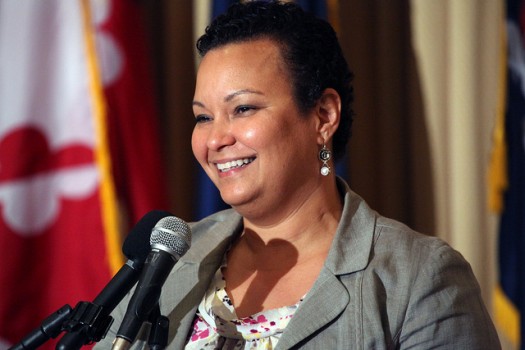
EPA Chief Lisa P. Jackson is stepping down after four years in the position. (Flickr)
John M. Broder of the New York Times is reporting that Lisa P. Jackson is stepping down as administrator of the Environmental Protection Agency after four years in the position. Broder reports:
Ms. Jackson’s departure comes as many in the environmental movement are questioning Mr. Obama’s commitment to dealing with climate change and other environmental problems. After his re-election, and a campaign in which global warming was barely mentioned by either candidate, Mr. Obama said that his first priority would be jobs and the economy and that he intended only to foster a “conversation” on climate change in the coming months.
That ambivalence is a far cry from the hopes that accompanied his early months in office, when he identified climate change as one of humanity’s defining challenges. Mr. Obama put the White House’s full lobbying power behind a House cap-and-trade bill that would have limited climate-altering emissions and brought profound changes in how the nation produces and consumes energy.
But after the effort stalled in the Senate, the administration abandoned broad-scale climate change efforts, instead focusing on smaller regulatory actions largely though the Clean Air Act.
The White House accepted Ms. Jackson’s resignation and stated that her decision to leave was hers alone. In a statement, President Obama “praised” her performance and called her an important part of his team.
The United States is sending troops to 35 African countries in 2013 to combat growing terrorist by extremist groups. (Google Images)
CBS News is reporting the United States is sending troops to 35 African countries in 2013 as an anti-terror measure to combat the growing threat of extremist groups, many of whom are aligned with al-Qaeda. The move is part of an intensifying Pentagon effort to train countries to battle extremists and give the U.S. a ready and trained force to dispatch to Africa if crises requiring the U.S. military emerge.
The article states:
The teams will be limited to training and equipping efforts, and will not be permitted to conduct military operations without specific, additional approvals from the secretary of defense.
The sharper focus on Africa by the U.S. comes against a backdrop of widespread insurgent violence across North Africa, and as the African Union and other nations discuss military intervention in northern Mali.
The terror threat from al Qaeda linked groups in Africa has been growing steadily, particularly with the rise of the extremist Islamist sect Boko Haram in Nigeria. Officials also believe that the Sept. 11 attack on the U.S. consulate in Benghazi, which killed the ambassador and three other Americans, may have been carried out by those who had ties to al-Qaeda in the Islamic Maghreb.
Libya, Sudan, Algeria, Niger, Kenya and Uganda will be targeted based on recent acts by extremist groups like Boko Haram and al-Shabab in Somalia.