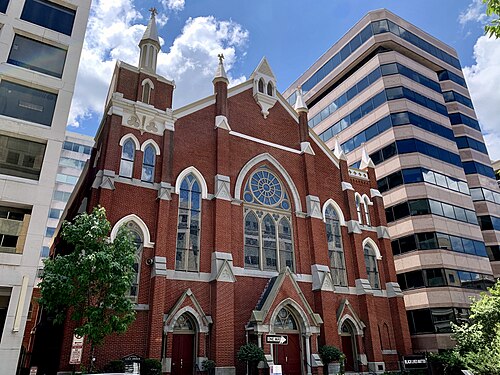
The Historic Metropolitan African Methodist Episcopal Church. (Google Images)
The internet is in a tizzy over a recent Feb 6 ruling against white supremacist group and Trump supporters, “The Proud Boys,” awarding their trademark to Metropolitan African Methodist Episcopal Church, a historic Black church in Washington, DC for failure to pay a $2.8 million judgment for vandalizing the church during pro-Trump rallies in December of 2020.
According to NPR, “D.C. Superior Court Judge Tanya Jones Bosier ordered that all interests in Proud Boys International’s trademarked name, “Proud Boys,” be given to Metropolitan African Methodist Episcopal Church. And no one can sell, transfer, license or dispose of the Proud Boys’ trademarked name without permission from the church or the court, according to the judgment.”
The church, which traces its origins to 1838, is on the National Register of Historic Places. It has hosted many prominent leaders, including activists Ida B. Wells and Booker T. Washington and abolitionist Frederick Douglass worshiped there.
Rev. William H. Lamar IV has called for an end to hate.
If Friday and a bolder and blacker version of Thelma and Louise collided, One of Them Days is the offspring. A buddy film, One of Them Days centers around Dreux (Keke Palmer), an around-the way girl with the smarts, work ethic, intelligence and plan to make it out of the hood. Played brilliantly by Palmer, Dreux serves up a side of happiness and attentiveness customers need and deserve at a local diner while plotting her rise to the top. Dreux’s roommate Alyssa, played by music phenom SZA, is the opposite — a creative soul who is moved by energy and spirit, while stepping to the beat of her own drum. Naïve and always seeing the positives in life, Alyssa makes a major mistake by giving their rent money to her slacker bae Keyshawn (Joshua David Neal), who is bringing Big D energy to her life, but little else. Thus, the women must figure out a way to get the rent money to a tyrannical landlord more concerned with gentrifying the building than keeping the tenants who have kept the building in play over the years.
Written by Syreeta Singleton (Insecure, Rap Shit, Central Park), One of Them Days does a great job of weaving important issues in Black communities like gentrification, predatory lending and barriers to upward mobility, into a story about a dynamic Black girl, trying to overcome her fate, one obstacle at a time. The film delivers strong performances by Palmer, SZA and Kat Williams, who plays Lucky, the neighborhood griot, giving voice to the significance and value of the unhoused. Singleton delves into the lives of the characters, showing what second chances look like, what it takes to make it out of the hood (sponsorship) and how often folks literally can’t get out of their way.
The film moves along at breakneck speed following the antics and crazy situations the roomies face while trying to raise this rent money, make it to a life-changing interview, and pay the no-nonsense, anti-Black American, pro-White American African landlord Uche (Rizi Tumane). They run into other characters along the way including Berniece the Bully (Aziza Scott), Ruby (Janelle James), the stripper-turned-plasma assistant, Kathy (Kayla Monterroso Mejia) the disrespectful predatory lender, a mentally unstable buyer (Lil Rel Howery) and King Lolo (Amin Joseph), a violent and raging O.G. They also encounter Shayla (Gabrielle Dennis), the around-the-way girl who made good, Mama Ruth (Vanessa Bell Calloway), Dreux’s entrepreneurial mother and Maniac (Patrick Cage), a former bad boy who is smitten with Dreux. One of the film’s strengths is its ability to weave humor into moments of despair.
Directed by music video director turned television and film director Lawrence Lamont, One of Them Days is visually stunning, capturing the beauty of Los Angeles and showing the rich tapestry created by the Jungle, Baldwin Hills, Ladera Heights, Inglewood and other historically Black neighborhoods that have been historically underrepresented in film. Produced by Issa Rae, James Lopez and Keke Palmer, among others, One of Them Days tosses respectability politics out of the window capturing the complexity, creativity and resiliency of the working class. Through conversation and intertextual references, Lamont brings, “The Jungle” to life and filmically inserts it into the community of Black Los Angeles. The film’s pacing, which slows down just enough so audiences can learn more about the characters, helps viewers connect with their struggles and triumphs.
Featuring SZA, Saweetie, Tony K, Reem, Doja Cat, Latto, Offset, Ice Cube and more, the film’s soundtrack is infectious underscoring the action and adding to the good time appeal of the film. Viewers will be bumping this soundtrack in cars, AirPods and Beats for years to come.
One of Them Days is a heartfelt film that captures the essence of life’s unpredictability through its rich character development and poignant storytelling. It invites audiences to reflect on their own lives and “one of them days” we all experience in some way or another. With strong performances, including SZA, beautiful cinematography, and a well-crafted narrative, One of Them Days is a must-see film that is destined for cult classic status. A thoughtful exploration of the human condition, One of Them Days is the antidote to the rough days ahead and the comedy film viewers didn’t know they needed.
One of Them Days opens in theaters today. Check local listings for showtimes.
This review was written by Nsenga K. Burton, Ph.D., founder and editor-in-chief of The Burton Wire. Dr. Burton is an independent film and media scholar. Follow Nsenga on IG @Ntellectual or The Burton Wire.
The internet is waking up to a story that happened on New Year’s Eve, which many are saying should have been covered by mainstream media but was not.
Krishana Polite, the former Chief of Staff for Lieutenant Governor Mark Robinson is recovering after being shot while leaving a church after a New Year’s Eve service. Polite, who was leaving church with her mother on New Year’s Eve, was shot in the neck. Police believe she was hit by a bullet that came down from people celebrating the New Year by shooting bullets in the air. Robinson was high-profile during the most recent elections due to a bevy of scandals. Polite is the first Black woman in North Carolina to serve as chief-of-staff for a gubernatorial campaign.
UNC.org reports, “The incident hadn’t garnered much attention until a conservative advocacy group, The Frederick Douglass Foundation, issued a news release this week.
The group called on police to provide more information about their investigation. And its leader, Immanuel Jarvis, questioned why “this act of violence against a trailblazing Black woman has been met with a deafening silence” in local media.”
Polite was elevated to Robinson’s Chief-of-Staff after his staff quit following reports of the politician making racist comments on porn sites.
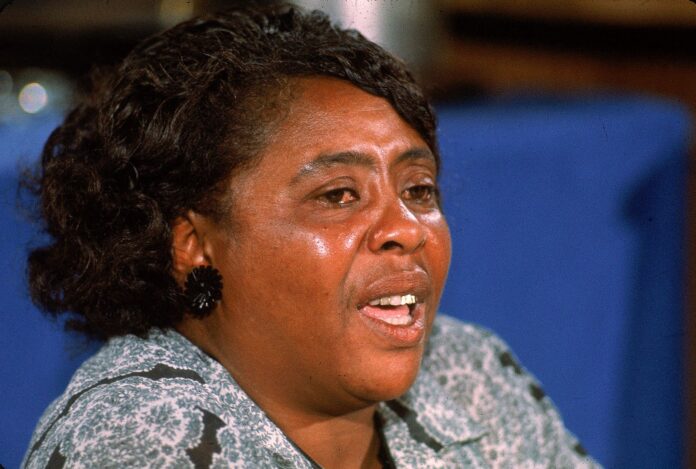
Civil rights icon Fannie Lou Hamer. (Photo: Google Images)
Civil rights icon Fannie Lou Hamer. (Photo: Google Images)
President Joseph R. Biden awarded the Presidential Medal of Freedom to 19 recipients Saturday January 4. Of the 19 people honored, civil rights icon Mrs. Fannie Lou Hamer was honored posthumously. The Presidential Medal of Freedom is the nation’s highest civilian honor, presented to individuals who have made especially meritorious contributions to the security or national interests of the United States, to world peace, or to cultural or other significant public or private endeavors.
Hamer received the award posthumously because she “transformed the struggle for racial justice in America. As a founder of the Mississippi Freedom Democratic Party, she challenged the exclusion of Black voices in the political system and laid the groundwork for the 1965 Voting Rights Act.” She is the 11th Mississippian to receive the honor.
Honorees included legendary basketball player, philanthropist and entrepreneur, Earvin “Magic” Johnson. Johnson “led the Los Angeles Lakers to five championships. Off the court, he is a successful entrepreneur and philanthropist who supports underserved communities through his Magic Johnson Foundation.”
Legendary actor and recently ordained ministerDenzel Washington also received the selective award. Washington, an actor, director, and producer has won two Academy Awards, a Tony Award, two Golden Globes, and the 2016 Cecil B. DeMille Lifetime Achievement Award. He has also served as National Spokesman for the Boys & Girls Clubs of America for over 25 years.
Renowned Spanish-American culinary innovator José Andrés, who popularized tapas in the United States, also received the honor. Andrés’ World Central Kitchen provides large-scale relief to communities affected by natural disasters and conflict around the world.
Additional honorees included former first lady and former Secretary of State Hillary Rodham Clinton; U2 founder and philanthropist Bono; U.S. 25th Secretary of Defense Ashton Baldwin Carter (posthumous); actor and Parkinson’s disease activist and research advocate Michael J. Fox; software developer and LGBTQUIA+ activist Tim Gill; world-renowned ethologist and conservationist Dr. Jane Goodall; former attorney general Robert Francis Kennedy (posthumous); fashion designer Ralph Lauren; legendary soccer player and UNICEF Goodwill Ambassador Lionel Messi; scientist and science education advocate William “Bill Nye the Science Guy” Sanford Nye; former Chair of Ford Motor Company George Romney (posthumous); iconic global investor and philanthropist David Rubenstein; investor, philanthropist, and founder of the Open Society Foundations George Soros; award-winning director and American Film Institute founder George Stevens, Jr., and iconic Vogue editor-in-chief and philanthropist Anna Wintour.
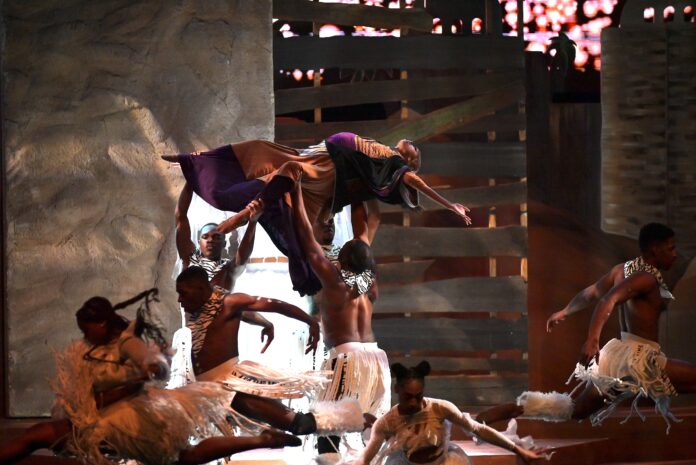
Photo: Scene from Black Nativity: A Gospel Christmas Experience in Atlanta. (Photo: Dominion Entertainment)
This article is the third in a series of three articles about the cultural phenomenon, “Black Nativity: A Gospel Christmas Experience,” staged each year in Atlanta, GA by Robert John Connor, award-winning producer/director and CEO of Dominion Entertainment.
Black Nativity Atlanta performer Maurice Griffin interviews Stellar award-nominated singer Latrice Pace. (Photo: Dominion Entertainment)
This conversation takes place between Stellar Award-nominated performer Latrice Pace and Black Nativity performer and multi-hyphenate Maurice Griffin about their journey to one of the country’s most beloved renditions of Black Nativity. In the first article Latrice interviews Robert John Connor. In the second interview she interviews Black Nativity performer and multi-hyphenate Maurice Griffin. In this final article, Maurice interviews Latrice about her career journey. Read on!
MG:Your single, “It’s Morning”, topped the Billboard gospel chart for 30 weeks and was
nominated for two Stellar Awards. What does this achievement signify for your journey in
gospel music and as a person?
LP: Being at the award ceremony signified awareness. A lot of people were used to me being with my sisters who had not been out for years and doing background with Donald Lawrence and a lot of other people in the industry, but they didn’t get to see me. They now get to see me in the light as a solo artist. So, it signified independence and I’m doing this for real on my own as a solo artist. It was an awareness.
MG: You are really doing an outstanding job. I do want to let you know that.
MG: You’ve performed in powerful productions like Montgomery: The Musical and at events
like DC Women Sing! How do you feel you’re evolving as an artist and creative?
LP: I feel like I’m evolving at my own pace and beautifully. With shows like this (Black Nativity), I’m intentional with making sure something meaningful and doing shows that speak to the moment, speak to the time, speak to the struggle, and even our victories. So, I’m very intentional about that. I feel like I’m evolving beautifully and at my own pace.
MG:You have celebrated ten years with Black Nativity: A Gospel Christmas Musical Experience. Please give the readers one word to describe that milestone and why
that word?
LP: Hmmm… One word — consistency. I am big on consistency. I would have to say that the only way you can do anything well is by creating a habit of consistency with everything in your life. It may sound funny, but you brush your teeth every 8 o’clock. The only way to stay committed to something is to make sure you’re creating a life of consistency. So, I would say consistency describes that milestone.
MG: What does playing Sister Frankly in Black Nativity: A Gospel Christmas Musical Experience mean to you personally, and how has it shaped your artistry?
LP:Sister Frankly reminds me of the church mothers and their significance in the church culture. They kept us in line. They were spiritually mature. They knew how to scold us in love. So, it’s important to me to keep that memory alive and to keep that presence alive. If not in the churches, then in the church mothers in Black Nativity, because a lot of our churches are missing that piece. With Black Nativity, at least (audiences) get to see and feel the presence of the church mothers in this production, every year, to be reminded
of their importance and their significance in our culture.
Regarding how this role has shaped my artistry, playing Sister Frankly has reminded me of everything that my mother has instilled in me. It goes back to that scripture that says, “Teach your children, and when they get older, they won’t stray from it.” So, even in my artistry and everyday life, I’m still molded by those teachings of the church mothers and my mother.
When concluding the interview, Latrice asked a question of her own to the group (Robert and Maurice), which she also answered.
LP: Why should theater enthusiasts and really everyone see this play?
MG: I believe everybody needs a shock factor and, this is a shock-factoring musical.
Every moment is ‘shockful’ and I mean that in a good way. You will get all the essentials of
gospel, dance and a good storyline that we all know from growing up to now. You get it all in one night, which is needed. If you don’t want to read something, watch this! This is watch-worthy.
RJC: It is a gift that just keeps giving. It is the unifying experience that brings people
from all walks of life, cultures, and faith together. It is something that is so memorable that I never imagined that it would get to this scope of notoriety. It is one of those things that you must see to understand.
LP: For as long as I can remember, Black Nativity has always been an Atlantan tradition for my family to go to see. And the fact that I’m a part of it now. I think that’s important for people to see it, to be reminded of the cultural significance of the African American heritage. And not to exclude anybody else, but also to see it for its artistic expression – the dance, the poetry, and the singing. Earlier, I told someone that it unifies the community. It is engaging. It is important to know and remember all our celebration and culture and faith and community, regardless of your cultural background. We can all come together and be reminded of the hope that we have during this season that will carry us throughout the next year.
Black Nativity: A Gospel Christmas Experience played at the Ferst Theater, on the campus of Georgia Tech University, December 12-22, 2024. Mark your calendars, because it will return next year.
This post was curated by Nsenga K. Burton, founder & editor-in-chief of The Burton Wire. It is the third and last article in a series of three articles about Black Nativity: A Gospel Christmas Experience in Atlanta, GA.
Photo: Netflix/Laura Radford/Perry Well Films 2/TNS
Photo: Netflix/Laura Radford/Perry Well Films 2/TNS
The Six Triple Eight tells the important yet often overlooked story of the 6888th Central Postal Directory Battalion, an all-Black, all-woman unit in World War II. The film chronicles the battalion’s efforts to clear a massive backlog of undelivered mail meant for U.S. troops, a task that was both vital and challenging. In a show-stopping speech atop a mountain of mail, Major Charity Adams, played fiercely by Kerry Washington, explains the importance of mail during wartime and its relationship to soldier morale. Adams, who is continuously denied promotions despite her impeccable professional performance, leads 855 Black women through 17 million pieces of mail in an abandoned, cold and drafty school rife with “vermin” to raise the morale of soldiers and bring closure to families who haven’t heard from loved ones in nearly a year.
The film features an all-star cast including Susan Sarandon as Eleanor Roosevelt, Sam Waterston as President Franklin Delano Roosevelt, Oprah Winfrey as Mary McLeod Bethune and Ebony Obsidian (Sistas, If Beale Street Could Talk)) who shows her acting chops by holding her own playing Lena, a bereaved private, opposite Washington.
Lena is a highly sensitive and intelligent young woman who is distraught over the death of her Jewish “boyfriend,” Abram David (Gregg Sulkin), who is killed in the war. Instead of attending college, Lena enlists in the army to “fight Hitler” En route to basic training in Georgia, Lena is joined with a group of women in the segregated battalion, all of whom are running away from a traumatic past and running towards a brighter future. What emerges is a strong sisterhood, that bonds the women whether in their barracks or crossing the big pond, which is one of the highlights of the film.
TheSix Triple Eighthas all of the tropes of a film set during the 1940s, including de facto segregation here and abroad, the mistreatment of Black women in and out of the service by any and everybody, aggressive white men using the N-word with the hard “R,” and older Black women whose hearts are free, but minds are shackled to fear that living in segregation and being subjected to impromptu violence, ridicule, jail or scorn brings to bear.
While the film elevates the untold story of the dynamic, pioneering and committed Black servicewomen of the Six Triple Eight, the narrative falls prey to Perry’s signature style –heavy handed dialogue, uneven performances and a redundant script that keeps beating viewers over the head with what many already know as opposed to what we need to know. For example, a short montage of the women working with the mail is usurped by abusive treatment from white, male leaders. A film like this would benefit more from seeing and understanding the dynamism, intelligence and dedication it took for these women to develop and implement a strategy to get this volume of mail to the soldiers and their families.
In another scene the 6888 soldiers yell out their prior professions which would prove helpful to keeping their assignment when they come under attack again from the white military men. Visually seeing the Black women demonstrate their talents would be far more satisfying than hearing them ticked off like a grocery list, which undermines the significance of their work and preparation for war as Black women during this harrowing time in history. The lack of emphasis on their skills and capabilities diminishes the overall impact of their story, leaving viewers wanting more depth and insight into their achievements.
While the film highlights the struggles these women faced against institutional racism and sexism, it ultimately falls short in delivering a nuanced portrayal of their significant contributions to the war effort. This is a must-see film because of the subject matter and strong performances by Washington and Obsidian, but the execution of the story makes it a difficult film to get through.
Tyler Perry is beloved as a filmmaker because he sometimes makes films that people need to see at a particular moment in time (For Colored Girls), resuscitates or helps to keep the careers of super accomplished actors alive (Debi Morgan, Alfre Woodward, Cicely Tyson) and gives young, talented actors like Obsidian, Taylor Polidore Williams (Beauty in Black, Snowfall, All-American HBCU) and Crystal Renee Hayslett (Zatima) a chance to play a lead role when mainstream Hollywood is taking too long. One thing Perry hasn’t done is extend that generosity of spirit to the same extent to the writing and directing categories. Debbie Allen choreographed the march scene for Six Triple Eight. What might this film have been had she directed the film?
This much anticipated film is a love letter to Black servicewomen and a movie that audiences need to see now, that would benefit immensely from stronger writing and direction. Six Triple Eight is a commendable effort to elevate an untold story, but it ultimately leaves viewers craving a more nuanced exploration of the remarkable women at its center.
This review was written by media critic Nsenga K. Burton, Ph.D., editor-at-large for NNPA/Black Press USA and editor-in-chief of The Burton Wire. Follow her on IG@TheBurtonWire.
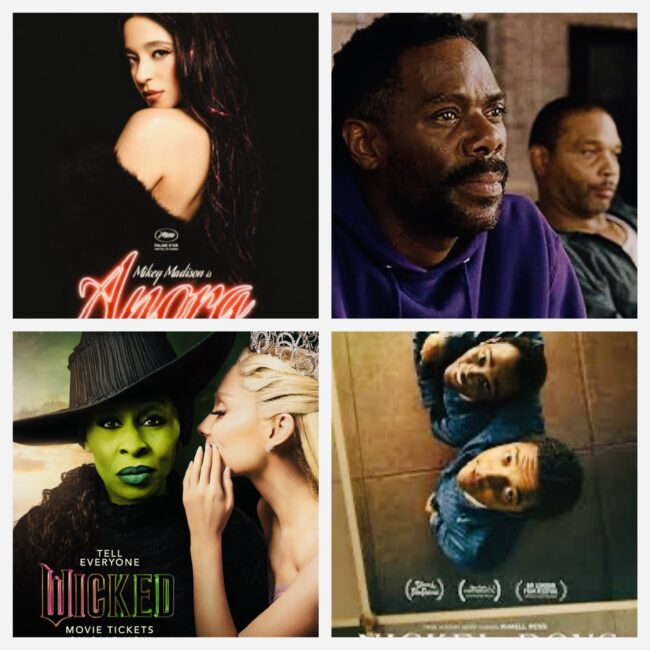
Promo photos from Amora and Sing Sing, two of AFCC's top films of 2024.
Now in its eighth year, the Atlanta Film Critics Circle has announced its awards for top cinematic achievements in 2024.
The 38 voting members of the AFCC chose director Sean Baker’s Anora, the winner of the Cannes Palme d’Or, as its top film of the year. The sweet and sinister modern fairy tale, which also won Best Original Screenplay, features a breakout performance from Mikey Madison as Ani, a Brighton Beach stripper who falls for the son of a Russian oligarch. Madison is also the AFCC’s Best Lead Actress and Best Breakthrough Performer for her complex portrait of a woman equal parts fragile and bullet-proof. “I think most of the credit is due to the character of Ani and Mikey Madison’s performance. From moment one, you care so deeply about Ani and what happens to her. You want to go with her on this journey, no matter what happens,” said AFCCmember Sammie Purcell, associate editor of Rough Draft Atlanta.
This year’s top films were a fascinatingly diverse mix, ranging from a clever spin on the Wizard of Oz in Wicked, to a tennis love triangle with heart-pounding matches in Luca Guadagnino’sChallengers, one of two films by the Italian director this year along with Queer. In a stunning, expertly crafted opus that never loses your interest despite its three-and-a-half-hour length, Brady Corbet’s The Brutalistfollows a Hungarian Jewish refugee from Germany’s concentration camps to what initially seems to be an American promised land. Corbet won Best Director for his self-assured, acclaimed epic portrait of the rigors of immigration and creativity. Adrien Brody also won the AFCC’s Best Actor Award for his doleful turn in the film as the tortured, mercurial architect contending with the maddening whims of his benefactor.
Atlanta Film Critics Circle 2024 Top Films. (Photo: collage of promo materials by NKB)
“This year, our critics seemed to gravitate to smaller budget labors of love,” said AFCC advisory board member Hannah Lodge. “Films like Anora, The Brutalist, Nickel Boys, Sing Sing, and I Saw the TV Glow remind us that cost doesn’t correlate with worth.”
Despite the diversity of films, AFCCmember Spencer Perry, editor and critic at ComicBook.com, saw some common ground in the AFCC’s selections. “Something that feels distinct across all of our top 10 films is the idea of legacy. Be it Vanya’s parents in Anora, the rivalry between Patrick Zweig and Art Donaldson in Challengers, picking a new pope in Conclave, a galactic empire facing war in Dune: Part Two, or even a single robot learning to choose its own destiny in The Wild Robot, all of these films are wrestling with what someone can be or should be, either in their own eyes or in everyone else’s.”
Number three on the AFCC’s top 10 films, screenwriter RaMell Ross and Joslyn Barnes’s adaptation of novelist Colson Whitehead’s Pulitzer Prize-winning Nickel Boys, about two Black boys trying to survive a brutal Florida reform school, won Best Adapted Screenplay as well as Best Cinematography.
Perry was also delighted to see the atmospheric, but perhaps lesser seen coming-of-age fantasy I Saw the TV Glow make the AFCC’stop 10 list.
“Justice Smith and Brigette Lundy-Paine both deliver amazing work in a movie that is as haunting as it is personal,” said Perry of director Jane Schoenbrun’s moody feature. “I’m so thrilled that collectively we were able to recognize I Saw the TV Glow, a movie that at its core is about finding community despite your own feelings of internal isolation.”
Member of AFCC’sadvisory board Jason Evans noted how close many of the awards were this year, with Adrien Brody (The Brutalist) beating out Colman Domingo in Sing Sing by just one point. “The number of places and categories that were decided by only one or maybe two points is stunning,” said Evans, “a sign of the quality of the films and work this year,” and an indicator of “how competitive this awards season is likely to be.”
The AFCC inaugurated Best Voice Performance and Best Dog awards this year. In a near sweep, the canine star of Deadpool & Wolverine, Peggy, was the AFCC’s top dog. The British pugese, who previously captured an award as Britain’s ugliest dog, has turned her runt of the litter status into Hollywood stardom this year.
Lupita Nyong’o won the AFCC’sfirst ever Best Voice Performance for her work as an intelligent robot Roz in The Wild Robot, who finds an escape from loneliness in the company of the wild animals that inhabit a desert island, including a gosling she forms a special bond with.
“Voiceover acting is so often overlooked, but it’s such a key part of animated films. Lupita Nyong’o brought something really special to The Wild Robot. In animation, voice acting isn’t just about delivering lines — it’s about bringing the character to life,” said AFCC member and entertainment journalist Tatyana Arrington. “It’s a huge part of what makes animated films work, and I really think it deserves more recognition.”
Jesse Nussman, AFCC advisory board member, said he hopes studios are taking note of the vision driving this year’s award winners.
“What strikes me about many of the films that took home multiple awards — Anora, Nickel Boys, The Brutalist — is their specificity. They’re the work of filmmakers who feel unburdened by marketplace demands or fears of alienating their audiences,” he said. “Hollywood, if you’re listening? We want more.”
Complete AFCC Award List:
BEST FILM:
Anora
TOP 10 FILMS (ranked):
1. Anora
2. Challengers
3. Nickel Boys
4. The Brutalist
5. Conclave
6. Dune: Part Two
7. Sing Sing
8. Wicked: Part One
9. The Wild Robot
10. I Saw the TV Glow
BEST LEAD ACTOR:
Adrien Brody, The Brutalist
BEST LEAD ACTRESS:
Mikey Madison, Anora
BEST SUPPORTING ACTOR:
Kieran Culkin, A Real Pain
BEST SUPPORTING ACTRESS:
Ariana Grande, Wicked
BEST ENSEMBLE CAST:
Sing Sing
BEST DIRECTOR:
Brady Corbet, The Brutalist
BEST ORIGINAL SCREENPLAY:
Sean Baker, Anora
BEST ADAPTED SCREENPLAY:
RaMell Ross and Joslyn Barnes, Nickel Boys
BEST DOCUMENTARY:
Sugarcane
BEST INTERNATIONAL FEATURE:
Kneecap (Ireland)
BEST ANIMATED FILM:
The Wild Robot
BEST CINEMATOGRAPHY:
Nickel Boys
BEST ORIGINAL SCORE:
Trent Reznor and Atticus Ross, Challengers
BEST STUNT WORK:
Furiosa: A Mad Max Saga
BEST BREAKTHROUGH PERFORMER:
Mikey Madison, Anora
BEST FIRST FEATURE FILM:
Josh Margolin, Thelma
BEST VOICE PERFORMANCE:
Lupita Nyong’o, The Wild Robot
BEST DOG:
Peggy as Dogpool, Deadpool & Wolverine
This post was curated by Nsenga K. Burton, founder & editor-in-chief of The Burton Wire.Nsenga is a member of AFCC.
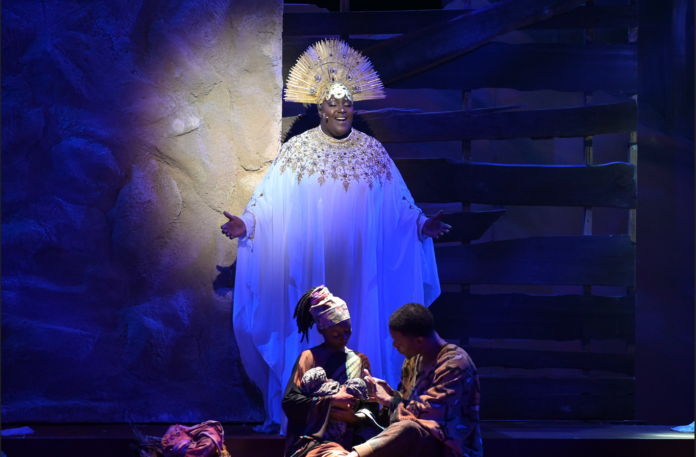
Scene from Black Nativity: A Gospel Christmas Experience in Atlanta, GA in the Ferst Theater on the campus of Georgia Tech University. (Photo: Dominion Entertainment)
This article is the second in a series of three articles about the cultural phenomenon, “Black Nativity: A Gospel Christmas Experience,” staged each year in Atlanta, GA by Robert John Connor, award-winning producer/director and CEO of Dominion Entertainment.
This conversation takes place between Stellar Award-nominated performer Latrice Pace and Black Nativity performer and multi-hyphenate Maurice Griffin about their journey to one of the country’s most beloved renditions of Black Nativity. Read on.
Black Nativity: A Gospel Christmas Experience performer and interviewer Latrice Pace. Photo: Dominion Entertainment
LP: Your performances are known for their very high energy. How do you maintain such a vibrant stage presence across diverse shows?
MG: Studying, learning the environment that I’m in, getting the proper rest and just saying “no” to going out sometimes. It’s a sacrifice but I believe in the end the reward is much greater.
Latrice adds“That is so important. I don’t think many performers understand the power of not hanging out.”
LP: Your music inspires and empowers audiences worldwide. How do you approach songwriting to create such uplifting anthems?
MG:As a fellow artist who I watch and have been following is Jay-Z. He said the same thing that I’m about to explain. I like putting out music that has a message for the now, for the moment for what’s happening in the world. And I feel that for me, putting music out is intentional. And so, I make sure that when I put it out, it’s intentional for the moment, for what’s happening in the moment. And it’s not just for a culture, it’s for the world.
LP: Can you tell readers about your role in Black Nativity: A Gospel Christmas Musical Experience?
MG: Last year, I wasmore than one character. I was a wise man. I was a king. I was an ensemble. I got to dance. You know what? I found dance to be a new love of mine but doing pushups during a show, we’re going to have to talk about that. (Laughs) It was a joy. It was a joy. The roles were great. I really embodied each character, even when I had to be a featured soloist in the show. All those components together were exhuberating for me. Last year was my first year with Black Nativity. There was a strike going on in the actors’ world so, for us to have an opportunity to get on that stage again meant so much to me. I am committed to every role that is given to me.
Scene from Black Nativity: A Gospel Christmas Experience in Atlanta, GA in the Ferst Theater on the campus of Georgia Tech University. (Photo: Dominion Entertainment)
LP: What does being a part of a production like Black Nativity: A Gospel Christmas Musical Experience mean to you as an artist, especially in terms of its cultural and spiritual themes?
MG: I believe that every entity has a niche. And I think that for the gospel community that niche comes around the time of Christmas birth or around the time of Easter Resurrection Sunday. Those types of moments are important to us, to the Black culture because of what was going on back in the day, and now it has evolved to what it is today. I believe that Black Nativity was a very important piece in my life, and I needed to check it off my bucket list because it’s done everywhere. When you do an adaptation of the great genius himself – Langston Hughes – You want to be able to enhance his expression. And I think that’s what he wanted all of us to do anyway. Black Nativity reminds me of the promise God made to Abraham when he said “Look at the stars in the sky. All these people will know you.” Every star is an adaptation of the representation of the sacrifice that he was going to present in sacrificing his son with. And so that’s what I feel this is. Black nativity is that promise that God made to Langston Hughes, and now everybody’s making the adaptation. I’m just glad to be in the best one. That’s all!
This post was curated by Nsenga K. Burton, founder & editor-in-chief of The Burton Wire. It is the second in a series of three articles about Black Nativity: A Gospel Christmas Experience. The third and last article in the series will feature Black Nativity performer Maurice Griffin asking Latrice Pace questions about her experience as a performer and how she became involved in Black Nativity: A Gospel Christmas Experience. The last article in the series will go live Dec. 15, 2024 and will be linked to this article so make sure you come back for more about the creatives behind one of the most beloved productions of Black Nativity on the globe.
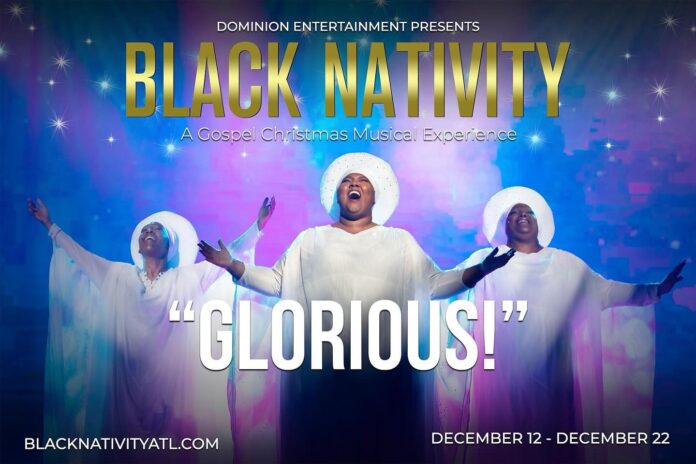
Black Nativity: A Black Christmas Experience promotional photo.
This article is the first in a series of three articles about the cultural phenomenon, “Black Nativity: A Gospel Christmas Experience,” staged each year in Atlanta, GA by Robert John Connor, award-winning producer/director and CEO of Dominion Entertainment.
“Black Nativity” is a musical drama that reimagines the traditional Christmas story through the lens of African American culture and artistry. Originally a stage play written by Langston Hughes (1961), the story is a celebration of faith, family, and the spirit of Christmas, highlighting themes of hope, love, and redemption. By placing Black characters in a traditional narrative, it challenges dominant cultural narratives that often exclude or marginalize Black voices.
Emerging during the Civil Rights Movement, “Black Nativity” reflected the social and political climate of its time and resonates in the current cultural and political climate.
The impact of “Black Nativity” extends beyond its initial performances, having been adapted into a movie in 2013 and reimagined on stages across the globe, including Atlanta with award-winning director Robert John Connor, who has been producing the play for Atlanta audiences for decades through his company Dominion Entertainment.
Highlighting the enduring themes of love, faith, and community in the face of adversity, “Black Nativity” continues to uplift and appreciate black culture, spirituality and community.
In keeping with the creativity baked into this production, The Burton Wire is trying something a little different by creating a series of articles that tap directly into the voices of the creatives behind “Black Nativity: A Gospel Christmas Experience” at the Ferst Center for the Arts, Dec. 12-22. Instead of TBW asking the questions, the creatives are asking the questions they want to know of each other. With the help of Lisa Gee of ConnectingYOUto Public Relations, Corp., instead of TBW conducting the interviews, Lisa and I (Nsenga) thought it would be cool to have some of the many outstanding creatives involved in the production interview each other.
In a soulful remix of whose on first, we will hear directly from “Black Nativity” creatives:
Latrice Pace, cast member; Pace is a two-time Stellar award nominee, Billboard charting member of the Grammy-nominated gospel group, The Anointed Pace Sisters and Suzi Bass Award winner for What’s Done in the Dark, Scissors and I Know I’ve Been Changed.
Maurice Griffin, cast member; Griffin made his musical theater debut in Peter Pan at the age of five. The multi-hyphenate has gone on to achieve success as a TV, Film, Stage & Commercial actor. Maurice’s extraordinary vocal ability enabled him to be a finalist on BET’s Sunday Best, as well as sing for diverse audiences across the globe.
Robert John Connor, Executive Producer and Director. A Morehouse man, Connor is a multi-talented director/producer/actor/singer/writer. He is the Chief Executive Officer/Artistic Director of Dominion Entertainment Group and founder of Dominion Arts Foundation, Inc. a non-profit organization whose mission is to facilitate cultural enrichment opportunities, employment, training and internships through programming and partnerships with arts and entertainment organizations for underserved community members.
In the first article of the series, Latrice Pace chats with Robert John O’Connor about the motivation behind producing “Black Nativity: A Gospel Christmas Experience” and using his platform for spiritual and cultural expression. Check it out:
LP: What inspired you to bring Black Nativity to Atlanta and how has your creative vision for this evolved over the years?
RJO: I guess I’m foolish enough to try. That’s the overarching answer. Ever since I had done Black Nativity back in the early ‘90s, I was never able to shake the experience and how valuable the show was for me as an artist and as a person of God and a person of faith. I was living in Las Vegas at the time and decided to try to produce this and made an effort to do so. I did not quite find the market for it, but I started thinking of ways to refashion this particular piece. Then one day, I got up and told my wife, “I got it!” I told her that I wanted to adapt it and turn it into a one-act play. That was right around the time when I returned to Atlanta. True Colors Theatre Company was producing the play, and I saw Mother Benning also known as Mabel Benning, an icon in black Atlanta and theatre at a show, and she said “Robert, True Colors is not going to do Black Nativity this year. You should do it!” So, I took a stab at it with no money and the gift of time and talent that friends gave. And, over the years it has really evolved into what I feel God placed on me. It was a struggle for sure, but it’s absolutely been a worthwhile journey.
LR: How do you balance the powerful things of faith and culture in Black Nativity while also making it resonate with modern audiences?
RJO: I fuse in a little bit for everybody. I’ve used modern songs, modern dance and spirituals. And there’s a little bit of music and dance for every person to appreciate. And with the caliber of talent that we have and the artistry that happens on stage, it is something that draws audiences in very quickly and makes them walk out feeling very revived and hopeful and inspired.
LR: Through Dominion Arts Foundation, you’ve impacted over 21,000 youth and as a creative powerhouse, you have helped mold the careers of stars like Joaquina Kalukango, Tony Hightower, Maurice Griffin, and me. When you look back after your last production, what one word would you like to be able to say and why that word?
RJO: Thank you. “Thank you” are the biggest words I have. It really takes a whole lot of generosity for people when you’re trying to grow and develop your vision that people believe in enough to stay and to stand by me and to contribute in ways sometimes that I didn’t expect. Thank you for trusting me to know that I am an honorable person, a person of ethics and character, and really trying to do this thing. Latrice, you and I often talk about how this is sometimes a thankless journey. We, as artists, know that sometimes our riches lie in our gifts as they don’t always turn up in monetary ways. Back then, people gave up their time and talent for free because they believed in something that I believed in. And so, I am just full of gratitude for that over these many years.
LR: What has been your proudest achievement across your decades long career in the arts?
RJO: My proudest achievement has nothing to do with the arts. My proudest achievement is that I was able to, with the help of my glorious wife, Andrea, create a very well-rounded and kind and creative human being who can take our legacy somewhere. We did not push her. We did not influence her. She found her own way, kept it a secret, and then all of a sudden, we just saw her out there doing things. So yeah, that’s my proudest accomplishment — being able to pour into our child who makes us proud every day.
This post was curated by Nsenga K. Burton, founder & editor-in-chief of The Burton Wire. It is the first in a series of three articles about Black Nativity: A Gospel Christmas Experience. The next article in the series will feature Black Nativity performer Latrice Pace asking Maurice Griffin questions about his professional journey. Read the second article in the series here.
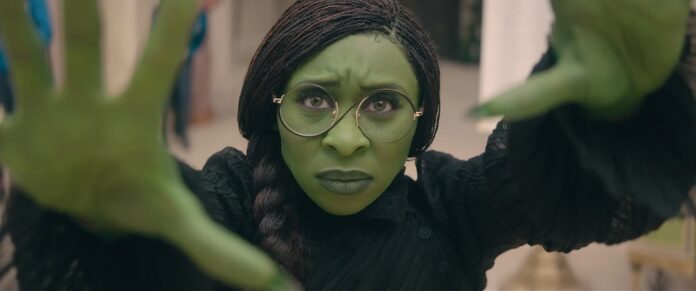
Cynthia Erivo as Elpheba in the big screen adaptation of Wicked. (Photo: Universal Studios)
Wicked is a dazzling cinematic adaptation that enchants from start to finish, delivering a powerful narrative that feels remarkably timely in today’s cultural and political climate. The film explores themes of friendship, identity, and societal expectations, resonating deeply with contemporary audiences who grapple with issues of acceptance and understanding. Wicked beautifully demonstrates the precariousness of the good vs. evil trope and how one is never far from the other. Directed by Jon M. Chu and written by Winnie Holzman and Dana Fox, Wicked is the first of a two-part film adaptation of the stage musical Wicked by Stephen Schwartz and Winnie Holzman. This filmic adaptation of the Broadway smash, shows up and shows out on the big screen, delivering delight, deviousness and discovery with one gut-punch after the other.
The casting of this film is nothing short of brilliant. Cynthia Erivo and Ariana Grande shine as Elphaba and Glinda, bringing their characters to life with incredible depth and emotion. Erivo’s portrayal of Elphaba is both fierce and vulnerable, showcasing her immense talent and vocal prowess. Grande complements her beautifully, infusing Glinda with charm and wit. The chemistry between these two leads is palpable, making their journey of self-discovery and friendship profoundly moving.
Adding to the star-studded ensemble, Academy Award winner Michelle Yeoh delivers a captivating performance, bringing gravitas and nuance to her role as. Her presence elevates the film, and she seamlessly fits into this magical world. Jeff Goldblum also adds a delightful flair, embodying his character with a unique charisma that keeps the audience engaged.
Visually, Wicked is a feast for the eyes. The cinematography and set design are breathtaking, transporting viewers to the vibrant land of Oz with stunning detail and creativity. Each scene is meticulously crafted, with elaborate costumes that enhance the storytelling and immerse the audience in this fantastical realm. The film’s aesthetic is matched only by its musical score, which features powerful songs that resonate long after the credits roll.
At 2 hours and 40 minutes, Wicked is a journey of pure unadulterated fabulousness. From the enchanting songs to the visually stunning production, to the intertextual references (Easter eggs), every element of the film contributes to a captivating experience. It is a celebration of individuality and resilience, echoing the struggles and triumphs we face in today’s world.
Wicked is a must-see film that combines exceptional performances, a timely storyline, and stunning visuals. It reimagines the archetypical roles of the hero and villain, and makes one contemplate whether empowered storytellers have gotten it wrong all along. Wicked brilliantly captures the essence of the beloved musical while making it relevant for a new generation. Whether you’re a longtime fan or new to the story, this adaptation will leave you spellbound and inspired.
This review was written by Nsenga K. Burton, Ph.D., founder and editor-in-chief of The Burton Wire. Dr. Burton is an independent film and media scholar. Follow Nsenga on IG @Ntellectual.