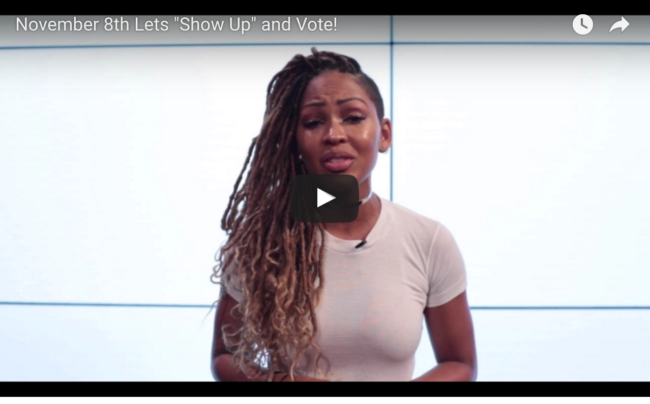
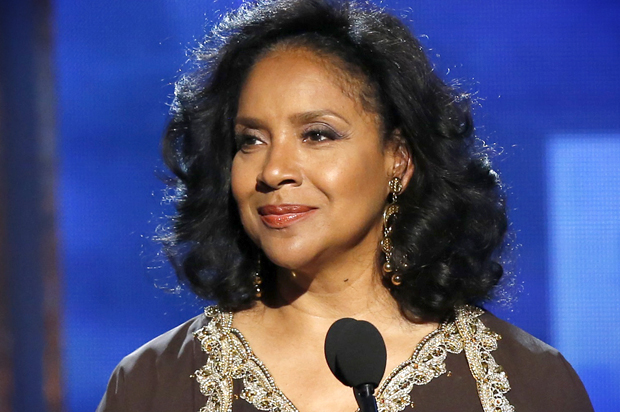
Actress Meagan Good appears in Artistic Alliance for Justice's PSA to get voters of color to vote in the Nov. 8 election.
(Photo: Screenshot)
Members of Black Hollywood came together to launch a Public Service Announcement urging people of color to go out and vote on November 8th via the newly formed organization, Artistic Alliance For Justice (AAJ) PSA producers Steven Jones (Brand Maverick Entertainment) & Kendrick Sampson (ABC’s How to Get Away with Murder) created the concept of the PSA to both inform and educate people of color on voter suppression tactics most frequently used to deter their voices from being heard on election day, while providing concrete solutions on how to prevail against said tactics.
“As people of color, voter suppression is a living and breathing issue in our neighborhoods and communities,” Jones says. “We created this PSA to help people of color avoid these tactics in hopes of helping them better exercise the civil liberties afforded to us under our constitution as American citizens.”
Those who are seen in the PSA consist of Cedric The Entertainer, Meagan Good, Russell Simmons, Tisha Campbell-Martin, Chris Spencer, Logan Browning, Kendrick Sampson, Keisha Epps, Glynn Turman, Erica Campbell, DeVon Franklin and Dijon Talton.
The well-known faces and entertainers of whom you saw many participate in the #OccupyCityHall movement in Los Angeles (July 17,) the #SomeDayIsToday Anti-Police brutality PSA (August 4) and the #PowerInAction march and rally at the CNN building in Los Angeles (October 1,) have been using their collective resources and platforms to amplify initiatives that invoke positive social and political change underneath their new organization AAJ. With Election Day less than a week away, AAJ thought it of the utmost importance to encourage their communities to show up and vote!
“I vote to show that I give a damn,” said legendary comedic actor Cedric The Entertainer. “To serve as an “elected” official is a privilege that must be earned by the people who put their confidence in you to speak on their behalf. Your vote let’s them know you’re watching and expect results. We the People must be heard!!! Use your Voice! VOTE!”
A sentiment shared by iconic hip-hop mogul Russell Simmons, stated, “Not voting is an endorsement of the candidate that you didn’t choose. The state of our nation is in your hands. Show up to the polls this November 8th!”
And in the words from one of the AAJ co-founders, Eva Marcille, “Voting is not just our right, but our sacred franchise. I have never had to take literacy test at a voting booth or been turned away at a polling place, nor have I ever been told I couldn’t vote because of the color of my skin. I’ve never experienced that because my right to vote is protected by the blood of our parents and grandparents. That’s why I’m voting and that’s why I want you to vote. Exercising our right to vote is what we owe.”
This post was curated by Nsenga K. Burton, Ph.D., founder & editor-in-chief of The Burton Wire. Follow her on Twitter @Ntellectual.
With the election only days away, a new national poll shows that Black American voters overwhelmingly plan to vote for Hillary Clinton as their choice for President of the United States. Their choice is influenced by concerns about high quality, affordable education, income inequality, jobs, the economy, race relations and racial justice.
The National Black Voter Poll found a high degree of engagement by registered black voters in the election, with 96% of respondents saying they will cast ballots. The same number said their friends also intend to vote. Nearly all respondents in the survey said they voted in both the 2008 and 2012 elections.
Taken together, the data predict a high voter turnout among Black American voters in the November 8, 2016 election and a strong preference for Hillary Clinton over Donald Trump.
A substantial majority (89%) indicated they will vote for Clinton, and two-thirds (67%) said they strongly favor Clinton. Another 23% declared “moderate support” for Clinton. A slightly higher percent (74%) said they have “overall favorable feelings” for Clinton, compared to 2% who said they had favorable feelings for Trump.
When asked “Do you think Donald Trump is a racist?” 84% responded, “Yes.”
In contrast to feelings toward the current election year’s candidates, 90% of respondents said they have “overall favorable feelings” toward President Barak Obama.
Findings are based on a national random sample of more than 900 voters from 22,000 telephone calls made between October 21 and 30, 2016 by researchers in a joint National Newspaper Publishers Association – Howard University poll. This was the first national-level scientific study focused exclusively on voters who identify as African American, Afro-Hispanic or other black identity.
The goal of the research was to develop a profile of Black American voters in a year when race is believed to be a defining factor in the outcome of presidential and congressional races.
The vast majority of respondents in the survey identified as Democrats. To the question “In general, do you think of yourself as Democrat, Republican, or something else?” 82% of respondents said “Democrat” and only 2% said Republican. Another 16% said they are either “Independent” or “Other” (9% and 7%, respectively).
A large majority of respondents (87%) identified high quality education as an influence in their decisions, and a nearly equal percent (84%) pointed to concerns about college affordability as a factor.
Other concerns shaping decisions were the economy and jobs (85%), race relations and racial justice (84%), and income inequality (82%).
When asked about where they obtain their information about political candidates, nearly half (46%) said from local TV news, and another fourth (24%) said from cable stations. Approximately a fifth (18%) said they rely on black newspapers for information about elections.
Google Images
Revelations of new FBI probes into Hillary Clinton’s emails occurred in the midst of the research, prompting researchers to compare participant responses to candidates before and after this news. They found that favorable feelings toward Clinton rose slightly and those toward Trump were cut in half.
The sample of more than 900 registered black voters was 70% female and 30% male. When considered alongside the 96% who said they voted in the previous two elections and also plan to vote on Nov. 8, black women show they are at the forefront of social change and political history in the United States, by voting to elect the nation’s first black and now its first female president.
A majority of respondents said they had attended college (73%), and were 56 years of age or older. Millennials between the ages of 18-35 accounted for 11% of the sample.
Those surveyed were nearly equally split between employed and not-employed (53% and 47%, respectively). Of those employed, 30% said they were federal employees, and 18% said they were union members. Of those not employed, 78% were retired and 22% were unemployed. Nearly half (48%) of respondents said they are married and most (84%) have a religious affiliation (a strong majority of those Christian).
The research was conducted using social science survey methods at Howard University. Research findings, however, do not necessarily reflect the personal views of the researchers, the faculty or administration of Howard University, or the members of the National Newspaper Publishers Association.
Principal investigators on the interdisciplinary Howard research team included Dr. William Spriggs, Department of Economics; Dr. Terri Adams and Dr. Rubin Patterson, Department of Sociology and Criminology; Dr. Lorenzo Morris, Department of Political Science; and Dr. Carolyn Byerly, Department of Communication, Culture and Media Studies. Principal liaisons from the NNPA included President and CEO Dr. Benjamin Chavis, and Chairman of the Board Denise Rolark Barnes.
To stay up-to-date on information about black voters, follow #BlackVoterPoll or @NNPA or @BlackPressUSA on Twitter or Instagram.
This post was curated by Nsenga K. Burton, Ph.D., founder & editor-in-chief of The Burton Wire. Follow her on Twitter @Ntellectual.
Follow The Burton Wire on Instagram or Twitter @TheBurtonWire.
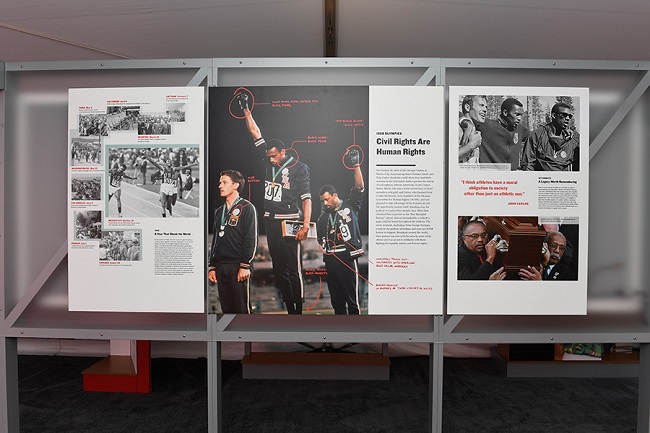
1968 Olympic sprinters Tommie Smith and John Carlos are acknowledged as part of the civil and human rights-themed exhibit, "Breaking Barriers: Sports for Change" (Photo Credit: ESPYs)
1968 Olympic sprinters Tommie Smith and John Carlos are acknowledged as part of the civil and human rights-themed exhibit, “Breaking Barriers: Sports for Change” (Photo Credit: ESPYs)
Set up on the third floor of Atlanta’s Philips Arena Experience is a rectangular time capsule commemorating how athletes spanning seven decades have acted as global social change agents and crusaders. The 800-square-foot multimedia exhibit, “Breaking Barriers: Sports for Change,” is an interactive cultural studies and history lesson depicting how competition, perseverance and teamwork collectively ignited efforts to ensure civil and human rights are granted to all people.
Unveiled in conjunction with the opening of Atlanta Hawks’ 2016-17 season, “Breaking Barriers” quilts together biographical sketches, direct quotes, sound bites, banners, archival footage, photo galleries, data tables and life-size silhouettes of various iconic sports figures. The shrine pays homage to the competitors’ selfless advocacy dedicated towards causes like HIV/AIDS, prejudice, discrimination, education, immigration, poverty, unequal pay, sexism and gender inequality.
“Sports is the right platform to unite and get the message out,” says Nzinga Shaw, the Hawks’ chief diversity and inclusion officer. “Sports is more than a game. It’s stories about human beings with agendas that they care about that impact communities long term.”
One tower features late boxer Muhammad Ali conducting a radio interview expressing his antiwar stance and decision to not enlist in the armed services because of racism. Towers acknowledge pioneering baseball player Jackie Robinson and tennis player Arthur Ashe for breaking the color barrier.
A larger central fixture chronicles the race riots that permeate America in 1968. Olympic sprinters Tommie Smith and John Carlos are on a conjoining poster filled with red marks explaining how their uniforms endorse black pride. Adjacent to the 1968 tribute is another Olympic arrangement: sprinter Jesse Owens racing to gold in 1936 in Berlin plays on a monitor. Headshots of Owens’ black teammates on the U.S. Olympic team are tiled next to the monitor.
“It’s the biographical power of what these athletes did that gives it storytelling emotion and power,” says David Mandel, the National Center for Civil and Human Rights’ director of exhibits and design.
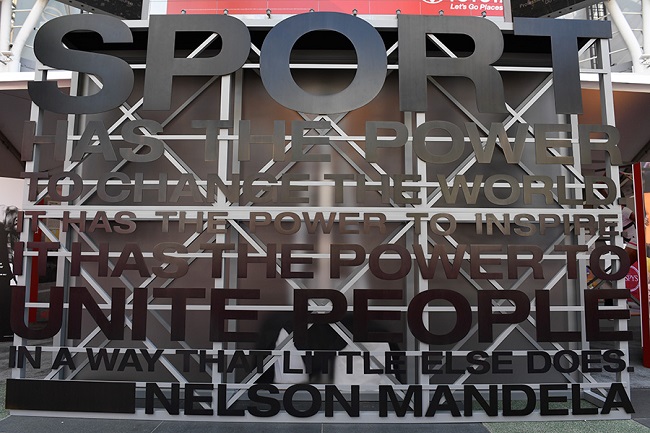
The quote courtesy of the late South African president/activist Nelson Mandela that precedes “Breaking Barriers.”
A metal ring-filled back wall captures a range of athletes (Wade Davis, Jason Collins, Martina Navratilova, Greg Louganis, Glenn Burke, John Amaechi, Orlando Cruz and Sheryl Swoopes) who either came out or fought for LGBTQ issues. A few feet away sits larger cutouts of tennis players Billie Jean King and Venus Williams in mid-swing. Amputee runner Terry Fox, along with a neighboring mini-documentary on the Special Olympics, chronicles the plight of competitors with disabilities.
Shaw, who organized the Hawks’ diversity council and made history as the first ever diversity and inclusion executive for the NBA as well as on any professional sports franchise, is quite inspired by the influx of LGBTQ athletes responsible for spearheading social change. She speaks in detail about the Hawks marching in the 46th annual Atlanta Pride parade this year.
Inspired by the work of the athletes, the Hawks donated over 1,000 hours of community service during its Unity weekend: partnering with six community organizations following recent protests this past summer outside of Philips Arena. The Hawks’ preseason game against the Cleveland Cavaliers kicked off with the players from both teams holding hands, unified by their positions.
“It doesn’t feel good to come to work and know that people are upset,” says Shaw. “We couldn’t just talk about it. We had to be about it.”
Shaw continues, “[Athletes] have used their voice, and they’ve used their platform of being athletes because they know people will see them. It’s exemplification that sports can connect communities. Through conversation, we are able to provoke something that turns to actionable steps.”
“Breaking Barriers” is conceptualized by ESPN’s vice president of corporate citizenship Kevin Martinez. Martinez visited the Center’s grand opening in June 2014 and wanted to construct a reminder of how sports has contributed to various social movements. Plans to erect and create “Breaking Barriers” went into effect this past January, finally making its debut underneath an outdoor tent at the ESPYs in Los Angeles last July.
Mandel, a self-proclaimed “exhibit mechanic,” has spent the last quarter of a century building permanent exhibits for the Country Music Hall of Fame, National Constitution Center, the New York Historical Society and the U.S. Holocaust Memorial Museum. A fan of quotes, Mandel worked closely with Tony-winning theatre and film veteran George C. Wolfe, historian Pellom McDaniels and New York-based design firm The Rockwell Group to fully assemble “Breaking Barriers.”
The curator and design specialist knows the representations selected for “Breaking Barriers” could potentially inspire generations of athletes, activists, sports fans and productive citizens.
“The stories that we chose are the biographies of athletes who’d reached a certain pinnacle of success in their athleticism,” says Mandel, giving a detail-oriented synopsis of arranging the exhibit. “When they got to that level, they spoke out about a certain issue that mattered to them.”
“Breaking Barriers: Sports for Change” is on display from Oct. 27 to Nov. 12 at Philips Arena in Atlanta. The exhibit will relocate to the National Center for Civil and Human Rights from Nov. 12 until Nov. 30.
This post was written by Christopher A. Daniel, pop cultural critic and music editor for The Burton Wire. He is also a visiting instructor in the Department of Communication at Georgia State University. Follow Christopher @Journalistorian on Twitter.
Film director and screenwriter Steve McQueen receives BAFTA's highest honor.
(Photo: Google Images)
Film director and screenwriter Steve McQueen receives BFI’s highest honor. (Photo: Google Images)
Caribbean 360 is reporting that London born director Steve McQueen, 47, who is of Grenadian-Trinidadian descent, has made history by receiving the British Film Institute’s(BFI) highest honor. The director of Shame (2011) and 2013’s 12 Years a Slave which won the Academy Award for Best Picture, Golden Globe for Best Motion Picture Drama and BAFTA award for Best Motion Picture, has been named a BFI fellow. McQueen, who was nominated for best director for both films by the Academy of Motion Picture Arts and Sciences, Golden Globes and BAFTA, won directing awards from the NAACP Image Awards, African-American Film Critics Association Awards, Black Reel Awards, the Independent Spirit Awards and the New York Film Critics Circle, among many. He is the first black person to direct a film that won the Best Picture Oscar.
McQueen’s 2008 film Hunger, for which he won a BAFTA award for Outstanding Debut by a British Writer, Director or Producer, is the film that put him on the map as a major film director. McQueen directed and co-wrote with Enda Walsh, the film about the 1981 Irish Hunger Strike, starring Michael Fassbender.
As reported by Caribbean 360, the Turner Prize winner stated the following at the BFI awards ceremony:
“There are only two things I really know. One of them is that I’m black and the other one is that I’m a Londoner. Everything else I don’t know. But I know I’ve had the possibility of exploring and of being reckless and of experimenting because I didn’t pay to go to university.
“I had the freedom to experiment and it seems to me that is being slowly eradicated. It is our job in this room to keep these doors open for people who don’t have all those chances.”
Dr. Amara Enyia, who ran against Chicago mayor Rahm Emanuel. (Photo: YouTube Screen Grab)
The season finale of the fourth and final season of satirical documentary web series “Black Folk Don’t,” airs tonight on PBS. The critically-acclaimed web series, featured in Time magazine’s “10 Ideas That Are Changing Your Life,” has explored many topics over four seasons including black folk and swimming, NRA membership, getting married and knowing their history to name a few. Season 4 of the series examines the voting habits of African-Americans, which are critical to this year’s hotly contested political battle. Directed by Angela Tucker, the alternately comical, educational and profound series both clings to and challenges common stereotypes of African-Americans. “Black Folk Don’t,” a project of TuckerGurl LLC, is funded by National Black Programming Consortium (NBPC) and the Corporation for Public Broadcasting, and can be seen on NBPC’s official website BlackPublicMedia.org.
This season the series, which is executive produced by NBPC, headed to Chicago for interviews with Dr. Amara Enyia, who ran for Chicago mayor against Rahm Emanuel; Anthony Anderson, a Trump delegate in Illinois; Charlene Carruthers, Black queer feminist organizer of Black Youth Project 100; Jamila Woods, poet and vocalist who has collaborated with Chance the Rapper; and Kyra Kyles, editor-in-chief of Ebony magazine; as well as with prominent Chicagoan musicians, professors, activists and lawyers. The first episode, “Black Folk Don’t …Vote Republican” premiered on Monday, September 26. Additional episodes of the series, which airs weekly on Mondays included “Black Folk Don’t … Listen to Classical Music” (October 3), “Black Folk Don’t … Buy Homes” (October 10), “Black Folk Don’t … Know Their History” (October 17), “Black Folk Don’t … Do Buddhism” (October 24) and “Black Folk Don’t … Get Anywhere on Time” which airs tonight.
“Since last season aired, Black people have been inundated with a constant stream of news of the violence being unleashed against the population, so I thought it was important to bring some humor back into the race discussion,” said Tucker. “And Chicago, a huge, complicated city with such a rich history and a cross section of Black people from across the country due to the Great Migration, seemed the perfect setting.”
“‘Black Folk Don’t’ has been one of NBPC’s most engaging and talked-about web series since its launch in 2011. Its satirical look at stereotypes has flipped the conversation on race without shying away from tough topics but instead treating them with honesty, humor and insightfulness,” said NBPC Director of Programs and Acquisitions Kay Shaw. “The series may end, but ‘Black Folk Don’t’ is now part of the public’s vernacular.”
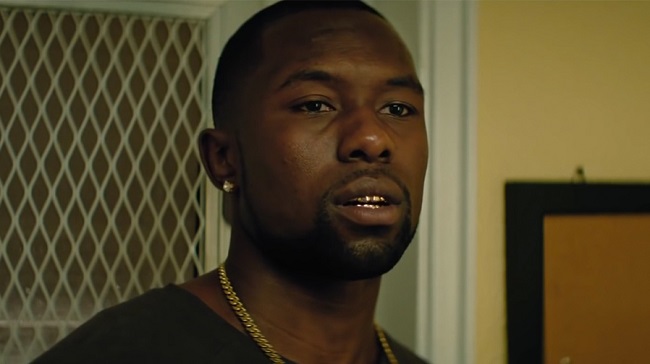
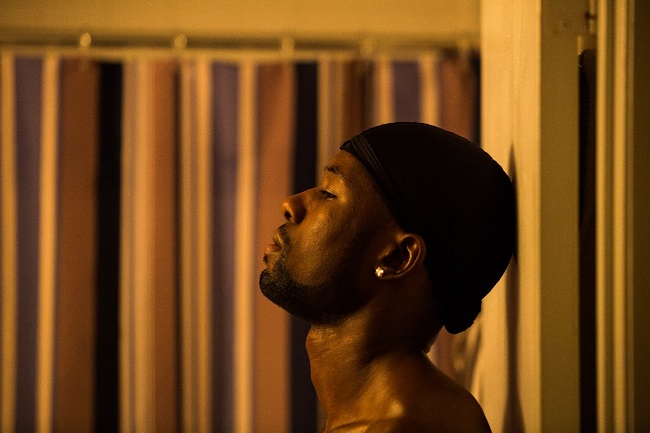
In one poignant scene, Chiron (Rhodes) returns to his hometown, Miami, to confront his past.
Athlete-turned-actor Trevante Rhodes appears in ‘Moonlight’s’ third act as the hypermasculine Chiron/”Black” (Photo Credit: David Bornfriend/A24 Films).
The same morning the two-minute trailer for director Barry Jenkins’ second feature film, Moonlight, was released, actor Trevante Rhodes, who portrays the adult version of the central character, Chiron, was working out in the gym. An hour after the snippet’s debut, a red-eyed, shaking fan approaches the compassionate, strikingly handsome performer, insisting to Rhodes that Moonlight is “his story.”
That moment catches Rhodes by surprise. The random meeting validates to the breakout star the relatability of his onscreen presence. “That was the most important moment I had in a very long time,” insists the charming actor leaning back in his chair. “You read something, do the work and know that it has the power and the ability to touch people. Whenever someone vocalizes that to you, that’s the best thing in the world.”
Rhodes, 26, appears in Moonlight’s third act as Chiron’s hypermasculine, minimal-speaking alter ego, “Black” a handsome, chiseled, gold grill-wearing drug dealer living in Atlanta. “Black” escapes from his isolated, tumultuous childhood (portrayed by young actors Alex Hibbert and Ashton Sanders) in Miami’s low income Liberty City community following a stint in prison. A young Chiron, or “Little,” endures low self-esteem, insecurity, excessive bullying from his classmates, confusion about his sexuality and an estranged relationship with his drug-addicted mother, Paula (Naomie Harris). A caring Cuban-born drug dealer, Juan (Mahershala Ali), and his equally nurturing girlfriend, Teresa (Janelle Monae), become “Little’s” surrogate guardians.
“Black” returns to his hometown a decade later: slightly rekindling a bromance with childhood friend, Kevin (Andre Holland), still unable to love, trust or fully acknowledge his personal truth.
Rhodes, an All-American track standout at the University of Texas at Austin, who was discovered while conditioning, originally read for the role of Kevin. Upon seeing him, Moonlight director Barry Jenkins insisted Rhodes audition for the role of Chiron instead. A competitive, record-breaking sprinter, Rhodes, attempting to avoid sounding cocky, believes he was able to make a fluid transition from athletics into acting.
Rhodes draws a parallel between auditioning for a role and running out of his starter blocks. “It’s the most individualized team sport,” declares the easygoing Lousiana-born, Texas-raised soon-to-be movie heartthrob. “You bust your butt on your own time on your own terms. You can’t focus on what’s going on in the next lane to do your best job in hopes to win.”
Consistently referring to filming Moonlight as “a unique sensation,” a relaxed Rhodes continues, “You could put forth your best effort and still not win because no matter what situation, someone else may get the role.”
In one poignant scene, Chiron (Rhodes) returns to his hometown, Miami, to confront his past.
When Rhodes fully read the script adapted from playwright Tarell Alvin McCraney’s In Moonlight Black Boys Look Blue, page three, he says, was the hook that kept him interested in the debut full-length project released by A24 Films. In an effort to keep the performances pure, Jenkins never allows Rhodes to meet the younger cast members who share his character during filming.
Occasionally finishing off Naomi Harris’ comments (Harris plays Rhodes’ mother in the film), Rhodes, who appears in If Loving You is Wrong, Open Windows and Westworld, says the lone scene he shares with the British actress strikes a chord with him. “The way that Barry [Jenkins] wrote the script, the beats in the script, the spacing about the script shows so much chemistry we have.”
“You saw how vivid it was; the blood, sweat and tears that Barry put into the pages. It was something that was so visceral,” Moonlight made its debut at this year’s Telluride Film Festival with subsequent screenings at Toronto International Film Festival and New York Film Festival. The 110-minute feature received a standing ovation at Telluride. The audience waited outside the theater to give the actors and production team another euphoric round of applause, which was a first in the film festival’s history. Revisiting the Telluride experience leaves Rhodes speechless.
Sharing many laughs with Harris, a self-conscious Rhodes is confident the film’s subject matter will resonate beyond the LGBTQ community. “No matter race, sex, age, orientation, everyone finds something that relates to them,” declares the star of the upcoming Netflix original film, Burning Sands.
“You have to allow yourself to look at people with open hearts and open eyes. Honestly, that’s the theme of the movie — to develop an understanding of everyone.”
Rhodes reiterates numerous times how he hopes that audiences who screen Moonlight will work towards understanding each other despite differences. Interacting with fans in the gym or witnessing audience reactions at film festivals have given Rhodes confidence in the film becoming a catalyst for helping people become more comfortable with who they are.
Moonlight, Rhodes says, will hopefully empower people to drop their prejudices in exchange for respecting and appreciating diversity. “Love is the most important currency we have as people,” insists Rhodes. “Stop judging people, because you have no idea what happened to them earlier that day, to make them be in a certain mood.”
Moonlight has a limited theatrical release in New York and Los Angeles on Oct. 21. A nationwide release date is slated for Oct. 28. Check local theaters for availability and showtimes.
This post was written by Christopher A. Daniel, pop cultural critic and music editor for The Burton Wire. He is also a visiting instructor in the Department of Communication at Georgia State University. Follow Christopher @Journalistorian on Twitter.
Photo: Compilation by Nsenga K. Burton/Google Images
UPDATE: To watch The Burton Wire‘s Google Hangout on black film and The Birth of a Nation, click here.
Photo: Compilation by Nsenga K. Burton/Google Images
Join The Burton Wire‘s Google Hangout on Wednesday, October 19, 2016 at 1 p.m. EST to discuss the controversial film The Birth of a Nation. The question of whether it is possible to separate the artist (Nate Parker) from his art (The Birth of a Nation) has continuously been raised.
Calls to boycott the film were met with less than stellar box-office receipts. Some say the film is overhyped while others believe it is a masterpiece. We will discuss what the film means in the larger context of independent black film production, Hollywood distribution and what boycotting this film may mean for black audiences going forward.
Discussants:
Nsenga K. Burton, Ph.D., founder & editor-in-chief of The Burton Wire; professor (UGA), media critic and film scholar.
Chetachi Egwu, Ph.D., founder of MediaScope; professor (University of Maryland) and media scholar.
Phill Branch, M.F.A., filmmaker and professor (Howard University); writer, director and producer of Searching for Shaniqua.
Maya Angelou: And Still I Rise documentary opens in theaters today. The documentary chronicles the life of the late Dr. Angelou through exploration of important events, history, culture and of course the arts. The documentary, which features Angelou, media mogul and close friend Oprah Winfrey, legendary musician Quincy Jones, Grammy and Academy award-winning rapper Common, Academy award-winning actor Louis Gossett, Jr. and Angelou’s son poet Guy Johnson, explores the life and legacy of Angelou, whose poetry and activism influenced writers and culture for decades.
The film pieces together the life of prejudice and oppression that made the seminal author of “Í Know Why the Caged Bird Sings” the great, inspirational writer whose name defies categorization.
It made its world premiere at the Sundance Film Festival earlier this year, as part of the Documentary Premieres, and continues to travel the film festival circuit. It’s also a film that I have on my list of 2017 Oscar nominee potentials (in the documentary category). Previously titled “Maya Angelou: The People’s Poet,” the film’s new title comes from “And Still I Rise,” Angelou’s third volume of poetry, published by Random House in 1978…featuring footage from Angelou’s days as a calypso singer/dancer, as well as interviews with Diahann Carroll and Don Martin speaking about being introduced to Angelou during those years.
“Maya Angelou: And Still I Rise” covers so much ground that it’s usually easy to forgive the filmmakers for not digging deeper. This is a documentary interested in breadth rather than depth, and on those terms it succeeds.
Recounting Ms. Angelou’s life (1928-2014) may seem redundant to those who’ve read her autobiographies, notably “I Know Why the Caged Bird Sings.” But the photographs and film footage here add another dimension to her stories, as do interviews with her son, artists who worked with her, and Bill and Hillary Clinton.
Kate Erbland of Indiewire, who believes the documentary lacks the “spark” of its subject, writes:
A dancer, singer, actress, writer – “a consummate performer,” by one participant’s estimation – who lived her entire life on one kind of stage or another, “And Still I Rise” plods through all of the chapters of Angelou’s life with respect and appropriate contemplation, with the majority of it narrated and clarified by Angelou herself. A wonderfully skilled public speaker, Angelou guides the film through the many years of her life with a calm that would be unnerving coming from anyone else. She is both matter of fact about the worst of her experiences and eloquent in describing them, and though Angelou was often known to fudge some details — or wholesale deny them — the film’s audience will likely walk away thinking they know the whole story, if only because she’s so firmly convincing.
Taking a straightforward chronological approach, the pic commences with the celebrated author’s tumultuous early years, which were the focus of so much of her writing — most famously her poetical 1969 memoir, “I Know Why the Caged Bird Sings,” her first and still most popular and influential book. (It also remains one of the books most frequently banned from U.S. schools for its frank depiction of child sexual abuse and racism.) When their parents’ stormy marriage ran aground, she and her brother Bailey were summarily shipped as mere toddlers to tiny Stamps, Ark. It was a devastating upheaval somewhat mitigated by the positive influence of their grandmother, whose entrepreneurial zeal managed to flourish despite the Depression.
Running time: 114 min. Check local theater listings for showtimes.
This post was curated by Nsenga K. Burton, Ph.D., founder & editor-in-chief of the award-winning news site The Burton Wire. Follow her on Twitter @Ntellectual.
Women react during a protest demanding security forces to search harder for 200 schoolgirls abducted by Islamist militants two weeks ago, outside Nigeria's parliament in Abuja April 30, 2014. Scores of suspected Boko Haram gunmen stormed an all-girls secondary school in the village of Chibok, in Borno state, on April 14, packing the teenagers onto trucks and disappearing into a remote, hilly area along the Cameroon border. REUTERS/Afolabi Sotunde (NIGERIA - Tags: CIVIL UNREST RELIGION EDUCATION TPX IMAGES OF THE DAY) - RTR3NB21
Women gather to protest the kidnapping of 200 Nigerian schoolgirls in Chibok. (Google Images)
Jason Hanna and Nima Elbagir of CNN are reporting that conflicting information about the details surrounding the release of 21 Chibok schoolgirls in Nigeria by Islamist militants Boko Haram is being reported by various sources. The Nigerian government has insisted that the girls were freed without any strings, but other reports have surfaced that Boko Haram leaders were released in exchange for the release of the schoolgirls. They write:
“A number of Boko Haram commanders” were freed as part of Thursday’s release of the girls, a source close to the negotiations between the Islamist militant group and the Nigerian government said on condition of anonymity. This contrasts with what the Nigerian government has said, which is that the girls’ release was not a prisoner exchange.
“This was not a swap,” Nigerian Information Minister Alhaji Lai Mohammed said Thursday. “It is a release, the product of painstaking negotiations and trust on both sides.”
A separate source, one with direct knowledge about the girls’ release, told CNN Thursday that no captive Boko Haram fighters were released in exchange for the girls.
The 21 girls released are believed to be from the larger group of 276 schoolgirls that were kidnapped from a boarding school in Chibok, Nigeria in April of 2014.
*This article originally appeared on Linkedin on September 20, 2016. It has been edited here for audience.
Shannon Harris, Miss Universe Barbados. (Google Images)
In less than 48 hours after Shannon Harris was crowned Miss Universe Barbados 2016, the Facebook post of Barbados Today’s (popular online newspaper) Facebook page congratulating this young beautiful Barbadian lass has turned into a national debate on race, color, privilege, class, beauty standards, culture and fairness (to mention a few of the sub-themes). The post now has a reach of 146,00 000 views and ongoing commentary at the time of this TBW post.
VIDEO UPDATE: Pageant organizers of Miss Barbados Universe 2016 hit back at ‘racist’ comments | Barbados Today #MissUniverseBarbados#TrendingNews
First of all, I wish to congratulate all 14 delegates for their courage to even think about entering such a show in Barbados. And of course, I congratulate our winner Shannon on her achievement.
I must admit that I did not want to be publicly drawn into this debate but I felt compelled to give my two cents worth having worked closely with this ‘industry’ on a few occasions in varying capacities, mainly as a stage manager and background coordinator. Having said that, I must also admit that when I looked at the photos and the hype leading up to the show, I too (like the judges) placed all my bets on Shannon.
Similarly, I was living in the pageant-loving country of Venezuela in 1998 when I placed my bets on Wendy Fitzwilliam from Trinidad and Tobago who eventually won the Miss Universe show that year.
1998 Miss Trinidad & Tobago and Miss Universe, Wendy Fitzwilliam. (Google Images)
The following year, 1999, Miss Universe was held in Trinidad and for the first time in its history, young women of African descent won the show in two consecutive years as Wendy handed over her crown to Mpule Kwelagobe of Botswana (pictured below).
2000 Miss Universe Mpule Kwelagobe of Botswana is crowned by Fitzwilliam. (Google Images)
Now back to Barbados. Shannon certainly is not the first white Barbadian to represent our country at these shows and hopefully, she will not be the last. So the question is what is so different this time around? Many are asking why are we still having this furor on race in 2016? Rather than venture to answer this complex question in an overly simplistic way, I will dare say that there were similar uproars in the world of international pageantry when racial or ethnic minorities were selected to represent their country of birth or residence. There are now several examples of this. Venezuela had a similar reaction and uproar when they selected their first black Miss Venezuela, Carolina Indriago in 1999, so did Italy, Holland, France and more recently Japan.
Carolina Indriago, Venezuela’s first Black Miss Venezuela (1999). (Photo: Google Images)
Whether or not a country picks a woman from a minority group or a majority one, there seems to be a standard look, a default position that we have all come to accept as beauty and this is what ultimately must be interrogated. What are some of the prerequisites of this globalized standard of beauty?
From a very basic observation point, there seems to be a demand for tall slim women under 130lbs regardless of race. There seems also to be a demand for long hair and some degree of facial symmetry (whatever that is). In fact, in the pageant world, it is rumored that the famous and controversial Cuban-born queen-maker of Venezuela, Osmel Sousa, once said that Miss Universe is not a show about natural beauty but one of “perfect beauty”.
Therefore, let’s examine this so-called concept of perfect beauty. Who sets these standards? Are these standards racially biased? Had we chosen a black woman on Saturday night, what standards of beauty would she have fit into? Would she be under 130lbs, tall, with symmetrical features and long hair or would she have looked like the typical Afro-Caribbean “girl next door?” Do these beauty queens ever look like the typical “girl next door?” Does a Japanese beauty queen ever look like a “typical Japanese girl?” We can go on and on and ask this question for any country?
Furthermore, do we really want our beauty queens to be truly representative of who we are? And who are we? This is where we need to be honest with ourselves in this hushed national debate. Who are we?
Certainly growing up in Barbados, I can vividly remember our black womenfolk spending long hours in hair salons straightening their hair with harsh chemicals. I also remember them ‘pressing’ their hair with hot irons to make it straight as they are now wearing long hair weaves that are not naturally theirs. This, I might add, became very much an ingrained normalized behavior. It is only in the last twenty years or so that we saw the emergence of what is now known as a “natural hair salon”. Therefore, these are deep-rooted issues that need to be addressed in our post-colonial existence and minds.
So this brings me back to why I chose Shannon to be this year’s winner and Wendy to be the winner of Miss Universe in 1998. From the naked eye, they both seem to fit the same mold and that same standard mentioned above (be they Black, White, Asian, Indian, mixed or other).
I will end with questions rather than answers. Are we programmed? Are we programmed by mass media, pop culture and a hegemonic worldview that dictate for us what is beauty? When we pick the ‘winner’, what are we programmed to see? These are the real questions that need to be answered and I truly think that it goes beyond black and white. There are multi-billion dollar industries that benefit from their capitalist agenda, creating and pushing beauty products, magazines, TV shows, movies, music and fashion all geared towards an aspirational ideal that can never be reached by the vast majority of humankind.
Yet, the billions who will watch these shows on TV (and now on their mobile phones) will aspire, in one form or another, to be just like the beauty queens, models, sports and/or movie stars. They will want to wear similar clothing or drive similar cars. But again I’m going off topic. Let’s all plead guilty to being programmed by this capitalist agenda. We cannot hide from it. It’s in our faces – the car ads, the movies, the Internet. Who’s pulling the strings and who is programming our minds to fall in line?
Who is setting the agenda of this globalized economy? Who is really pulling the strings? Who controls what?
I can only now say best of luck to you Shannon, and I hope this controversy catapults you into the top five as it did for so many others who suffered a similar fate of such negative public outcry from their own countrymen and women.
This article was written by Ian Walcott-Skinner, a contributing writer to The Burton Wire. He is an international relations specialist who lives in Barbados and Brazil. Follow him on Twitter @iwalcott.