Home Blog Page 51

Yo’ Paper: Tips for Success for Black & Brown Women PhDs

0
(Photo: Google Images)

On October 27, Tiffany Martinez, an aspiring professor  posted  “Academia, Love Me Back,” to her blog, as a response to the wave of emotions she felt when a professor circled  “hence” on her paper and wrote “this is not your word.” Her professor’s “blue pen was the catalyst that opened an ocean of self-doubt” (Martinez). Temporarily paralyzed from working on her next assignment, Martinez turned to her blog to vent.  When I read her story, I read my own journey towards a PhD. Seeing my reflection, I wanted to hold the mirror up to other young brown and black women with similar goals and, in my Beyoncé voice, urge them to get in formation and to use instances such as these as catalysts for greatness, instead of self-doubt.

Like Ms. Martinez, I too aspired to be a college professor and was judged on my appearance. The first day I reported to my master’s program in English Literature, my advisor informed me that I couldn’t possibly have a graduate assistantship. “They are highly competitive” he assured me. Like Martinez, “my appearance immediately instill[ed] a set of biases . . .” I nervously held up a piece of paper and petitioned, “But I have the letter they sent to my mom.” At that moment his face turned bright red. He had suddenly realized his mistake. “Wha-what’s your social security number?” he asked, as he typed frantically on his keyboard. And then he turned white. Ghost white. “I-I’m so sorry, Rachel. Yes, of course you have a full scholarship,” he stammered as he continued with some lame excuse for the mix up.

This man didn’t know me from Eve and assumed I didn’t have the chops to compete. I was disheartened. So what did I do? I twirled on my haters. I concentrated on narratives written by women of color and completed my coursework a semester early.

I dream it, I work hard, I grind ‘til I own it.

Later, in my PhD program, I was encouraged to research the problems of black women (since I wanted to study us so badly). Nope. I wanted to study what we do right.  I basked in the work of Sarah Lawrence Light-Foot, esteemed African American sociologist at the Harvard Graduate School of Education, and discovered that she had developed her own methodology. Portraiture.  I used her foundation to write the narratives of middle-class, college educated, Black women who were leading their communities on holistic practices.

I stunt, yellow bone it.

Doctoral programs typically give students 7-10 years to complete the dissertation and coursework. This particular program was accelerated and students could possibly complete it in three. In my second year, my then- husband and I found out we were expecting. Then the comments came, “Good luck finishing on time now” from some of my peers.

Catch my fly and my cocky fresh

I birthed my baby and my dissertation the same year and I was the only person of color in my class to finish “on time.”

Prove to me you got some coordination

With each disparaging word I made my way. I stayed in connection with supportive women and to spirit. I kept writing and empowering myself to supersede any perceived limitations. And for those of you like Ms. Martinez and myself, you’ll need to do the same. Keep writing your stories and shining a light on instances where others attempt to make you feel inferior.  Align yourselves with professors of color and white faculty advocates who might be feeling just as isolated as you and can help you navigate rough waters. Trust me, I sat at their feet and drank from their wells of wisdom when I felt overwhelmed.  Hence, I sought support.

We gone slay

Reach out to like-minded peers and create a game plan. Make a pact with other women who have similar goals as you.

Be good to yourself. Exercise, rest, and eat well. Talk to a mental health counselor and/or a spiritual advisor if needed so that you don’t begin to internalize the negativity of others.

Martinez wrote, “The entire field of academia is broken and erases the narratives of people like me.”

And this is why we have to continue to write ourselves in it. Tell your stories. Go off.  Go Hard. Write yourself to wellness and graduate with honors.

In the end, the best revenge is yo’ paper.

Rachel Panton, PhD is a wellness writer and founder of Write my Life Memoirs. She is the creator and co-editor of the forthcoming book, Sassin’ through Sadhana: Narratives of Black Women Yoginis. Dr. Panton is a Lecturer at the University of Miami.  Follow Dr. Panton on Twitter @rachelpantonPhd.

Follow The Burton Wire on Instagram or Twitter @TheBurtonWire.

Cyber Monday: The Ultimate Black Buying Guides

0
(Graphic: Ebony Magazine)

Turkey Day is officially over and the march to holiday season is on! No matter what religion to which you subscribe, gift giving is more than likely a part of the tradition. If you’re not religious, then you may be looking to score some items at a discounted rate by taking advantage of the Cyber Monday deals. In addition to The Burton Wire, a few of our folks have done some legwork for you to help you “Buy Black” this holiday season and in general. Some have even given tips on how to avoid supporting the businesses of people who are not friends to black and brown communities. We’ll give you all of the info we have to help you make informed decisions about how you will use your $1.2 trillion buying power on Cyber Monday and going forward.

(Google Images)
(Google Images)

EBONY Magazine’s #BuyBlack List

Bino and Fino is an African educational cartoon. (Photo Credit: Google Images)

THE BURTON WIRE’s KWANZAA Gift Guide (an oldie, but goodie)


(Screen shot)
(Screen shot)

AFROBELLA’s 350+ Independent Black Owned Businesses to Support

screen-shot-2016-11-28-at-10-26-59-am

CENTRIC TV’s Starter’s Guide to Buying Black

To learn more about black buying power, check out David Love’s article for Atlanta Black Star or Janie Boschma’s article for The Atlantic.

Will you “Buy Black” this holiday season? Let us know on Twitter @TheBurtonWire.

This post was curated by Nsenga K. Burton, Ph.D., founder & editor-in-chief of the award-winning news blog The Burton Wire. Follow her on Twitter @Ntellectual.

Sharon Jones: Remembering the Legendary Soul Performer

0
Sharon Jones of the Dap-Kings died of pancreatic cancer. She was 60. Photo: RogerEbert.com
Sharon Jones of the Dap-Kings died of pancreatic cancer. She was 60.
Photo: RogerEbert.com


Legendary performer and soul singer Sharon Jones of the Dap-Kings lost her battle with pancreatic cancer last Friday at the age of 60.

Sharon Jones’ career is truly remarkable because she rose to fame later in life. Initially when Jones tried to pursue a career in music, executives told her she was “too short, too fat, too black and too old.” The Augusta, Ga born Jones who moved to Bedstuy, Brooklyn at age 4, worked as a security guard at Rikers Island and for Wells Fargo while continuing to pursue her dream. Despite the obstacles, Jones found success with the Dap-Kinds in her early 40s with their first album Dap Dippin’ with Sharon Jones and the Dap-Kings released in 2001. The rest is herstory.

Terry Gross of NPR’s Fresh Air, revisits interviews with legendary singer Sharon Jones of the Dap-Kings, who died of pancreatic cancer last Friday. Gross states:

“We have two interviews to play for you. Sharon Jones has been called the female James Brown. She grew up in his hometown Augusta, Ga., and imitated him as a child. She became known for fronting the band the Dap-Kings. The band’s retro soul sound was also heard on several tracks of Amy Winehouse’s hit album ‘Back To Black,’ including the songs ‘Rehab’ and ‘You Know I’m No Good.'”

Gross’ first interview with Jones was recorded in 2007 and also includes Dap-Kings founder Gabriel Roth also known as Bosco Mann.

Gross goes on to interview Sharon Jones last July about her latest album ‘Give the People What They Want,” and Barbara Kopple’s documentary entitled, Miss Sharon Jones. Watch the trailer and an excerpt from the documentary below:

Sharon Jones and the Dap-Kings performed with Prince in July of 2011. Check it out below:

Read Jon Pareles remembrance of Jones for the New York Times here

Sharon Jones was 60-years-old.

This post was curated by Nsenga K. Burton, Ph.D., founder & editor-in-chief of The Burton Wire. Follow her on Twitter @Ntellectual.

Follow The Burton Wire on Instagram and Twitter @TheBurtonWire.

Dominican Republic: Torrential Rains Displace 20,000 People

0
(Caption: Nations Online)

Caribbean 360 is reporting that torrential rains are wreaking havoc in the Dominican Republic. President Danilo Medina has declared a state of emergency. The author reportss:

“According to disaster official Jose Manuel Mendez, more than 20,000 people on the country’s north coast have already been displaced, amid the heavy rains that have pounded the country for more than two weeks… More than 130 rural towns in that region were cut off by heavy rains that destroyed 50 homes and severely damaged 62 others,” he told the Associated Press.

Thousands of people have been evacuated including 700 inmates.

Read more at Caribbean 360.

Follow The Burton Wire on Instagram or Twitter @TheBurtonWire.

2016 Election: Protest All You Want But Vote

0
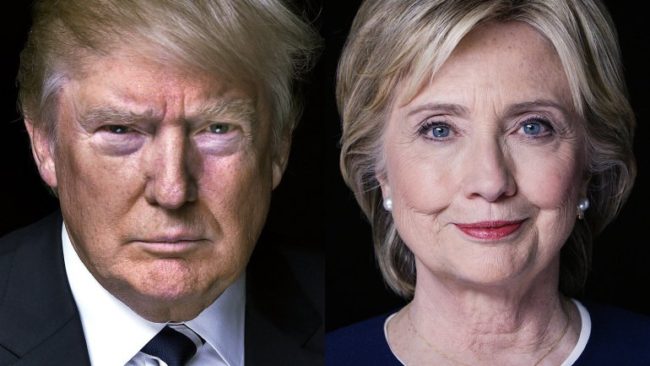
Donald Trump and Hillary Clinton. (Google Images)

It seems everyone, everywhere, is talking about this year’s election. There are countless articles discussing the importance of the Black vote, whether Black people should vote at all, and many explaining why they are or are not voting in this presidential election. The National Newspaper Publishers Association and Howard University just released a national black voter poll (#BlackVoterPoll) results on what black voters think, feel and plan to do in this election. In spite of So you’ve decided to protest vote or not vote for Former Secretary Clinton and Trump? Fine.

I’m not here to suggest that you should be With Her or that one need feel any particular way about the idea of Mak[ing] America Great Again. To be quite honest, the last eight years have proven to me just how important local elections are to our everyday lives. The President of The United States (POTUS) can, and will, only do as much as they can without the full weight of an ideologically aligned Congress behind them. Who am I kidding? Without a partisan Congress, I mean. People can feel how they want about President Obama, but the fact of the matter is, Congress has thwarted many attempts at passing legislation and reaching across the aisle for whatever reason.

Despite these efforts, I still believe every single one of you who can vote, should vote.

As a Georgia resident, I’m currently facing several amendments that may mean the end of worker and parental autonomy as we know it. For instance, Amendment 1 asks voters to consider giving the state power to seize local schools, while Amendment 2 suggests a link between strip clubs and other adult entertainment venues and prostitution in the name of protecting sexually exploited children. From my perspective, Amendment 2 minimizes adult agency and is a prime example of government overreach—but I’m just one person reading into its vague language.

These amendments, like other measures on the ballot, are where my indifference to protest voting, and not voting at all, come to an end.

There seems to be an assumption that one can’t vote in local elections without voting for a presidential candidate and this is wholly untrue. Write in a name. Vote for Hillary, even if you don’t like her, because as some argue it will provide Bernie Sanders with a significant committee chair position. Vote for Trump because you think we need a U.S. version of Brexit to stick it to the man. Don’t vote for a presidential candidate at all and skip the question by leaving it blank. Whatever the reason(s), you’ve got options beyond indifference when the future of education, or local transportation, or something else locally significant depends on your voice and vote.

I get it — many of you are frustrated with the lack of bipartisanship at the federal level. Others are tired of feeling like their voices aren’t heard. And here I sit hoping the federal government won’t dictate whether you blithely look on to watch Tuesday unfold as the future of your local community hangs in the balance. So consider doing yourselves and your neighbors a favor by protesting, but put an asterisk by it. Take this opportunity to split your protest vote by foregoing the general for POTUS and using this time to hold your state officials accountable. There’s too much at stake at all levels of government and I doubt you’ll regret it.

This post was written by Brittany M. Williams, a freelance career development & admissions specialist, researcher, #2a supporter, & politics and pop culture aficionado. Follow her on Twitter @Ms_BMWilliams.  

Follow The Burton Wire on Instagram or Twitter @TheBurtonWire.

2016 Election: Tips for Voting in Person

0
Promoting voting among minority groups. ( Photo credit: Google Images.)

The 2016 general election will be held on Tuesday, November 8, 2016. If you haven’t voted early or by absentee ballot, this is the day to cast your vote for President as well for any federal Congressional seats that are up for a vote in your area. State and local races may be on your ballot too.

The Presidential primaries and caucuses are now over. If you want to see when they were held in your state, check this chart or visit your state election office site.  Whether you voted in the primaries or participated in the caucuses has no bearing on your eligibility to vote for President in the general election. It’s not a requirement.

Here are a few tips offered by USA.GOV for what to do when you go vote tomorrow:

Find Your Polling Location
For the most updated information on your polling place and hours, or to request an accommodation, contact your state/territorial election office.In addition, there are several tools online that can help you find your polling location, hours, and other details:

Get to the Polls
Can I Vote
Vote 411

Voter ID Requirements

Two-thirds of states request or require that you provide some form of identification before you’re allowed to vote at the polls.

Do you need to bring an ID? 

Your state’s laws, as indicated by this state legislators’ map, determine whether you will need to show an ID, and if so, what kind.

Photo ID versus Non-Photo ID

About half of the states with voter ID laws accept only photo IDs, such as driver’s licenses, state-issued ID cards, military ID cards, and passports. Many of these states now offer a free voter photo ID card if you don’t have another form of valid photo ID.

Other states accept certain types of non-photo IDs, such as birth certificates, Social Security cards, bank statements, and utility bills. Each state is specific about the documents it will accept as proof of identification. Be sure you know your state’s voter ID requirements prior to Election Day.

You should also be aware that legal challenges continue to affect some states’ voter ID laws, and requirements can change as a result. It’s always wise to check directly with your state election office to ensure you have the proper ID.

Procedures for Voting Without ID

Even if you don’t have a form of ID that your state asks for, you may be allowed to vote. But some states require you to take additional measures after you vote to make sure that your vote counts.

Some states may ask you to sign a form affirming your identity. Other states will let you cast a provisional ballot, which is used when there is a question regarding a voter’s eligibility. In some states, election officials will investigate the voter’s eligibility and decide whether to count the vote.

Other states require that you return to an election office within a few days and show an acceptable form of ID. If you don’t, your vote won’t be counted.

Sample Ballots

Sample ballots can be helpful to review before Election Day and to bring with you to the polls. Your state or territory may mail you a sample ballot prior to Election Day or allow you to download one from its election site. The sample ballot may look exactly like the real one you see when you vote, and will show you all the races—federal, state, and local—and candidates you’ll be able to vote for, as well as any state or local propositions or measures being decided.

Some non-profit organizations also produce unofficial sample ballots for elections throughout the U.S., based on locality. These ballots may not look identical to what you’ll see when you vote, but will provide the same information. They are different than the sample ballots often provided by the major political parties. Those ballots, which you may receive in the mail or be offered by volunteers as you approach your polling entrance, feature the candidates representing that party.

Voter Accessibility Laws

The Americans with Disabilities Act (ADA), the Help America Vote Act (HAVA), and other federal laws require that all Americans—including seniors and people with disabilities—have the same opportunity to participate in the voting process.

As a voter with a disability, you have the right to:

  • Vote privately and independently
  • Have an accessible polling place with voting machines for voters with disabilities
  • If you have a disability, then there should be someone at the polling location available to assist you.

Do You Need Help at Your Polling Station?

You may also request assistance if you speak a language other than English, although it is best to bring someone with you who can translate for you. You may also request assistance if you are unable to read or write although again, it is best to bring someone with you whom you trust.

When in doubt, check with your local board of elections.

For more information, visit USA.gov/election-day.

This post was curated by Nsenga K. Burton, Ph.D., founder & editor-in-chief of The Burton Wire. Follow her on Twitter @Ntellectual.

Follow The Burton Wire on Twitter or Instagram @TheBurtonWire.

Black Hollywood Unites for ‘Lets Show Up and Vote’ PSA

0
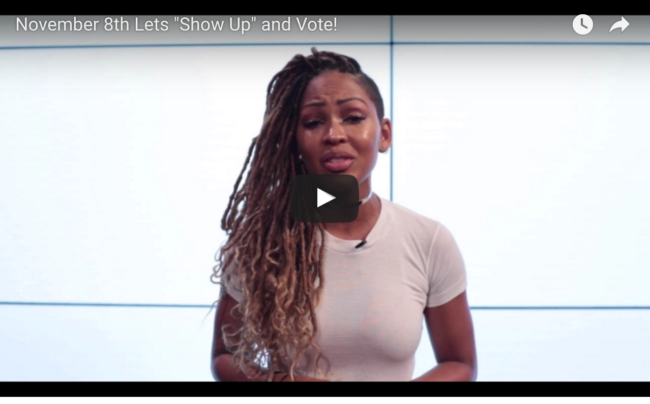
Actress Meagan Good appears in Artistic Alliance for Justice's PSA to get voters of color to vote in the Nov. 8 election. (Photo: Screenshot)

Members of Black Hollywood came together to launch a Public Service Announcement urging people of color to go out and vote on November 8th via the newly formed organization, Artistic Alliance For Justice (AAJ) PSA producers Steven Jones (Brand Maverick Entertainment) & Kendrick Sampson (ABC’s How to Get Away with Murder) created the concept of the PSA to both inform and educate people of color on voter suppression tactics most frequently used to deter their voices from being heard on election day, while providing concrete solutions on how to prevail against said tactics.

“As people of color, voter suppression is a living and breathing issue in our neighborhoods and communities,” Jones says. “We created this PSA to help people of color avoid these tactics in hopes of helping them better exercise the civil liberties afforded to us under our constitution as American citizens.”

Those who are seen in the PSA consist of Cedric The Entertainer, Meagan Good, Russell Simmons, Tisha Campbell-Martin, Chris Spencer, Logan Browning, Kendrick Sampson, Keisha Epps, Glynn Turman, Erica Campbell, DeVon Franklin and Dijon Talton.

The well-known faces and entertainers of whom you saw many participate in the #OccupyCityHall movement in Los Angeles (July 17,) the #SomeDayIsToday Anti-Police brutality PSA (August 4) and the #PowerInAction march and rally at the CNN building in Los Angeles (October 1,) have been using their collective resources and platforms to amplify initiatives that invoke positive social and political change underneath their new organization AAJ. With Election Day less than a week away, AAJ thought it of the utmost importance to encourage their communities to show up and vote!

“I vote to show that I give a damn,” said legendary comedic actor Cedric The Entertainer. “To serve as an “elected” official is a privilege that must be earned by the people who put their confidence in you to speak on their behalf.  Your vote let’s them know you’re watching and expect results. We the People must be heard!!! Use your Voice!  VOTE!”

A sentiment shared by iconic hip-hop mogul Russell Simmons,  stated, “Not voting is an endorsement of the candidate that you didn’t choose. The state of our nation is in your hands.  Show up to the polls this November 8th!”

And in the words from one of the AAJ co-founders, Eva Marcille, “Voting is not just our right, but our sacred franchise. I have never had to take literacy test at a voting booth or been turned away at a polling place, nor have I ever been told I couldn’t vote because of the color of my skin. I’ve never experienced that because my right to vote is protected by the blood of our parents and grandparents. That’s why I’m voting and that’s why I want you to vote. Exercising our right to vote is what we owe.”

This post was curated by Nsenga K. Burton, Ph.D., founder & editor-in-chief of The Burton Wire. Follow her on Twitter @Ntellectual

Follow The Burton Wire on Twitter or Instagram @TheBurtonWire.

National Black Voter Poll Findings: Black Voters Favor Clinton

0
(Graphic: NNPA)
(Graphic: NNPA)
(Graphic: NNPA)

With the election only days away, a new national poll shows that Black American voters overwhelmingly plan to vote for Hillary Clinton as their choice for President of the United States. Their choice is influenced by concerns about high quality, affordable education, income inequality, jobs, the economy, race relations and racial justice.

The National Black Voter Poll found a high degree of engagement by registered black voters in the election, with 96% of respondents saying they will cast ballots.  The same number said their friends also intend to vote. Nearly all respondents in the survey said they voted in both the 2008 and 2012 elections.

Taken together, the data predict a high voter turnout among Black American voters in the November 8, 2016 election and a strong preference for Hillary Clinton over Donald Trump.

A substantial majority (89%) indicated they will vote for Clinton, and two-thirds (67%) said they strongly favor Clinton.  Another 23% declared “moderate support” for Clinton.  A slightly higher percent (74%) said they have “overall favorable feelings” for Clinton, compared to 2% who said they had favorable feelings for Trump.

When asked “Do you think Donald Trump is a racist?” 84% responded, “Yes.”

In contrast to feelings toward the current election year’s candidates, 90% of respondents said they have “overall favorable feelings” toward President Barak Obama.

Findings are based on a national random sample of more than 900 voters from 22,000 telephone calls made between October 21 and 30, 2016 by researchers in a joint National Newspaper Publishers Association – Howard University poll.  This was the first national-level scientific study focused exclusively on voters who identify as African American, Afro-Hispanic or other black identity.

The goal of the research was to develop a profile of Black American voters in a year when race is believed to be a defining factor in the outcome of presidential and congressional races.

The vast majority of respondents in the survey identified as Democrats.  To the question “In general, do you think of yourself as Democrat, Republican, or something else?” 82% of respondents said “Democrat” and only 2% said Republican.  Another 16% said they are either “Independent” or “Other” (9% and 7%, respectively).

A large majority of respondents (87%) identified high quality education as an influence in their decisions, and a nearly equal percent (84%) pointed to concerns about college affordability as a factor.

Other concerns shaping decisions were the economy and jobs (85%), race relations and racial justice (84%), and income inequality (82%).

When asked about where they obtain their information about political candidates, nearly half (46%) said from local TV news, and another fourth (24%) said from cable stations.  Approximately a fifth (18%) said they rely on black newspapers for information about elections.

Google Images
Google Images

Revelations of new FBI probes into Hillary Clinton’s emails occurred in the midst of the research, prompting researchers to compare participant responses to candidates before and after this news. They found that favorable feelings toward Clinton rose slightly and those toward Trump were cut in half.

The sample of more than 900 registered black voters was 70% female and 30% male.  When considered alongside the 96% who said they voted in the previous two elections and also plan to vote on Nov. 8, black women show they are at the forefront of social change and political history in the United States, by voting to elect the nation’s first black and now its first female president.

A majority of respondents said they had attended college (73%), and were 56 years of age or older.  Millennials between the ages of 18-35 accounted for 11% of the sample.

Those surveyed were nearly equally split between employed and not-employed (53% and 47%, respectively).  Of those employed, 30% said they were federal employees, and 18% said they were union members.  Of those not employed, 78% were retired and 22% were unemployed.   Nearly half (48%) of respondents said they are married and most (84%) have a religious affiliation (a strong majority of those Christian).

The research was conducted using social science survey methods at Howard University.  Research findings, however, do not necessarily reflect the personal views of the researchers, the faculty or administration of Howard University, or the members of the National Newspaper Publishers Association.

Principal investigators on the interdisciplinary Howard research team included Dr. William Spriggs, Department of Economics; Dr. Terri Adams and Dr. Rubin Patterson, Department of Sociology and Criminology; Dr. Lorenzo Morris, Department of Political Science; and Dr. Carolyn Byerly, Department of Communication, Culture and Media Studies.  Principal liaisons from the NNPA included President and CEO Dr. Benjamin Chavis, and Chairman of the Board Denise Rolark Barnes.

To stay up-to-date on information about black voters, follow #BlackVoterPoll or @NNPA or @BlackPressUSA on Twitter or Instagram.

This post was curated by Nsenga K. Burton, Ph.D., founder & editor-in-chief of The Burton Wire. Follow her on Twitter @Ntellectual.

Follow The Burton Wire on Instagram or Twitter @TheBurtonWire.

Atlanta Hawks, NCCHR, ESPN Celebrate Sports and Activism

0
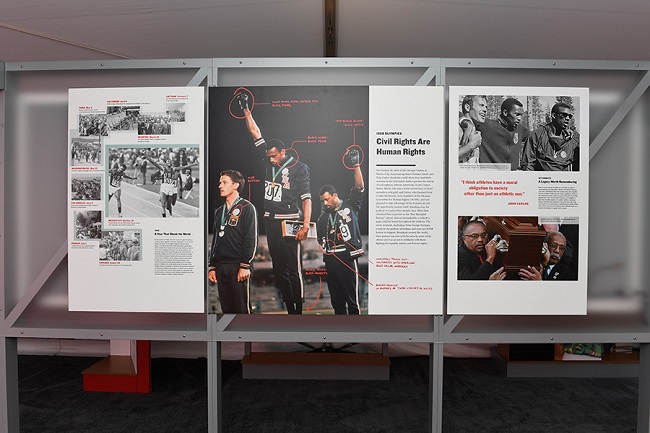
1968 Olympic sprinters Tommie Smith and John Carlos are acknowledged as part of the civil and human rights-themed exhibit, "Breaking Barriers: Sports for Change" (Photo Credit: ESPYs)
espys-experience-16
1968 Olympic sprinters Tommie Smith and John Carlos are acknowledged as part of the civil and human rights-themed exhibit, “Breaking Barriers: Sports for Change” (Photo Credit: ESPYs)

Set up on the third floor of Atlanta’s Philips Arena Experience is a rectangular time capsule commemorating how athletes spanning seven decades have acted as global social change agents and crusaders. The 800-square-foot multimedia exhibit, “Breaking Barriers: Sports for Change,” is an interactive cultural studies and history lesson depicting how competition, perseverance and teamwork collectively ignited efforts to ensure civil and human rights are granted to all people.

Unveiled in conjunction with the opening of Atlanta Hawks’ 2016-17 season, “Breaking Barriers” quilts together biographical sketches, direct quotes, sound bites, banners, archival footage, photo galleries, data tables and life-size silhouettes of various iconic sports figures. The shrine pays homage to the competitors’ selfless advocacy dedicated towards causes like HIV/AIDS, prejudice, discrimination, education, immigration, poverty, unequal pay, sexism and gender inequality.

“Sports is the right platform to unite and get the message out,” says Nzinga Shaw, the Hawks’ chief diversity and inclusion officer. “Sports is more than a game. It’s stories about human beings with agendas that they care about that impact communities long term.”

One tower features late boxer Muhammad Ali conducting a radio interview expressing his antiwar stance and decision to not enlist in the armed services because of racism. Towers acknowledge pioneering baseball player Jackie Robinson and tennis player Arthur Ashe for breaking the color barrier.

A larger central fixture chronicles the race riots that permeate America in 1968. Olympic sprinters Tommie Smith and John Carlos are on a conjoining poster filled with red marks explaining how their uniforms endorse black pride. Adjacent to the 1968 tribute is another Olympic arrangement: sprinter Jesse Owens racing to gold in 1936 in Berlin plays on a monitor. Headshots of Owens’ black teammates on the U.S. Olympic team are tiled next to the monitor.

“It’s the biographical power of what these athletes did that gives it storytelling emotion and power,” says David Mandel, the National Center for Civil and Human Rights’ director of exhibits and design.

espys-experience-25
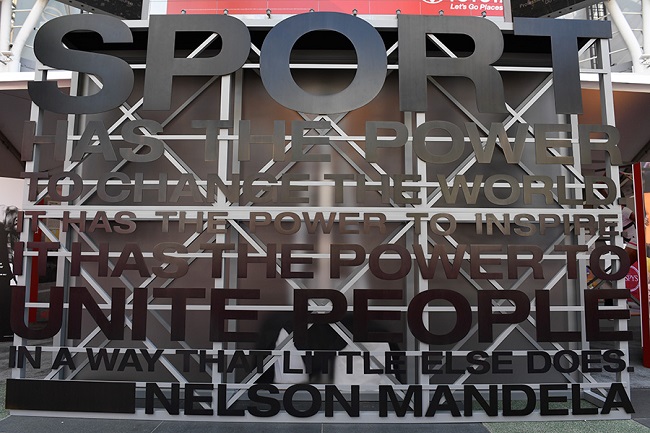
The quote courtesy of the late South African president/activist Nelson Mandela that precedes “Breaking Barriers.”

A metal ring-filled back wall captures a range of athletes (Wade Davis, Jason Collins, Martina Navratilova, Greg Louganis, Glenn Burke, John Amaechi, Orlando Cruz and Sheryl Swoopes) who either came out or fought for LGBTQ issues. A few feet away sits larger cutouts of tennis players Billie Jean King and Venus Williams in mid-swing. Amputee runner Terry Fox, along with a neighboring mini-documentary on the Special Olympics, chronicles the plight of competitors with disabilities.

Shaw, who organized the Hawks’ diversity council and made history as the first ever diversity and inclusion executive for the NBA as well as on any professional sports franchise, is quite inspired by the influx of LGBTQ athletes responsible for spearheading social change. She speaks in detail about the Hawks marching in the 46th annual Atlanta Pride parade this year.

Inspired by the work of the athletes, the Hawks donated over 1,000 hours of community service during its Unity weekend: partnering with six community organizations following recent protests this past summer outside of Philips Arena. The Hawks’ preseason game against the Cleveland Cavaliers kicked off with the players from both teams holding hands, unified by their positions.

“It doesn’t feel good to come to work and know that people are upset,” says Shaw. “We couldn’t just talk about it. We had to be about it.”

Shaw continues, “[Athletes] have used their voice, and they’ve used their platform of being athletes because they know people will see them. It’s exemplification that sports can connect communities. Through conversation, we are able to provoke something that turns to actionable steps.”

“Breaking Barriers” is conceptualized by ESPN’s vice president of corporate citizenship Kevin Martinez. Martinez visited the Center’s grand opening in June 2014 and wanted to construct a reminder of how sports has contributed to various social movements. Plans to erect and create “Breaking Barriers” went into effect this past January, finally making its debut underneath an outdoor tent at the ESPYs in Los Angeles last July.

Mandel, a self-proclaimed “exhibit mechanic,” has spent the last quarter of a century building permanent exhibits for the Country Music Hall of Fame, National Constitution Center, the New York Historical Society and the U.S. Holocaust Memorial Museum. A fan of quotes, Mandel worked closely with Tony-winning theatre and film veteran George C. Wolfe, historian Pellom McDaniels and New York-based design firm The Rockwell Group to fully assemble “Breaking Barriers.”

The curator and design specialist knows the representations selected for “Breaking Barriers” could potentially inspire generations of athletes, activists, sports fans and productive citizens.

“The stories that we chose are the biographies of athletes who’d reached a certain pinnacle of success in their athleticism,” says Mandel, giving a detail-oriented synopsis of arranging the exhibit. “When they got to that level, they spoke out about a certain issue that mattered to them.”

“Breaking Barriers: Sports for Change” is on display from Oct. 27 to Nov. 12 at Philips Arena in Atlanta. The exhibit will relocate to the National Center for Civil and Human Rights from Nov. 12 until Nov. 30.

This post was written by Christopher A. Daniel, pop cultural critic and music editor for The Burton Wire. He is also a visiting instructor in the Department of Communication at Georgia State University. Follow Christopher @Journalistorian on Twitter.

Follow The Burton Wire on Twitter or Instagram @TheBurtonWire.


Steve McQueen: Director Makes BFI History

0
Film director and screenwriter Steve McQueen receives BAFTA's highest honor. (Photo: Google Images)
Film director and screenwriter Steve McQueen receives BFI’s highest honor.
(Photo: Google Images)

Caribbean 360 is reporting that London born director Steve McQueen, 47, who is of Grenadian-Trinidadian descent, has made history by receiving the British Film Institute’s (BFI) highest honor. The director of Shame (2011) and 2013’s 12 Years a Slave which won the Academy Award for Best Picture, Golden Globe for Best Motion Picture Drama and BAFTA award for Best Motion Picture, has been named a BFI fellow.  McQueen, who was nominated for best director for both films by the Academy of Motion Picture Arts and Sciences, Golden Globes and BAFTA, won directing awards from the NAACP Image Awards, African-American Film Critics Association Awards, Black Reel Awards, the Independent Spirit Awards and the New York Film Critics Circle, among many. He is the first black person to direct a film that won the Best Picture Oscar.

McQueen’s 2008 film Hunger, for which he won a BAFTA award for Outstanding Debut by a British Writer, Director or Producer, is the film that put him on the map as a major film director. McQueen directed and co-wrote with Enda Walsh, the film about the 1981 Irish Hunger Strike, starring Michael Fassbender.

As reported by Caribbean 360, the Turner Prize winner stated the following at the BFI awards ceremony:

There are only two things I really know. One of them is that I’m black and the other one is that I’m a Londoner. Everything else I don’t know. But I know I’ve had the possibility of exploring and of being reckless and of experimenting because I didn’t pay to go to university.

“I had the freedom to experiment and it seems to me that is being slowly eradicated. It is our job in this room to keep these doors open for people who don’t have all those chances.”

Read more at Caribbean 360.

This post was curated by Nsenga K. Burton, Ph.D., founder & editor-in-chief of The Burton Wire. Follow her on Twitter @Ntellectual.

Follow The Burton Wire on Instagram or Twitter @TheBurtonWire.