Writing for Caribbean 360, food critic Greg Hoyos discusses five Trini foods that timid foodies must try while visiting Trinidad & Tobago. Hoyos writes:
“I’m not an adventurous food critic with a taste for the exotic but I do know what I like. My mum was born and raised in Trinidad, so technically I’m half Trini, but that doesn’t make me less timid or exploratory when it comes to their cuisine. In fact, I’m downright squeamish. But T&T, as we call that fabulous country (the other T being Tobago, of course) boasts a truly remarkable cuisine, with something for everyone.
One major reason is the melange of nationalities and cultures who settled there, each bringing their own gastronomic wonders with them. Here are 5 favourites our neighbors do exceptionally well.”
Check out three of Hoyos’ five must-try Trini foods below:
Doubles
Doubles. (Photo: Singh’s Roti & Doubles)
These are a distinctive and delicious Trini special food, enjoyed any time of day. Take a sandwich made with two fried flat bread slices (called baras locally), fill it with chick peas and add your choice of cucumber, mango, coconut, tamarind and hot pepper sauce. Funny story: Wikipedia reports that the name evolved because early customers kept asking for not one, but two slices of bara, hence “doubles”. But whatever you call it, you won’t forget it.
Roti
Roti. (Photo: Pinterest)
Trinidad may not have invented this dish, but arguably they perfected it. There are two main Trini styles of roti: “buss up shot”, and dhalpuri. I always thought buss up shot sounded like something deadly and to be avoided, but it simply means that roti dough is “busted open” on the stovetop just before it’s done cooking. You’re left with what looks like a mess of shredded roti, until you add curried chicken or whatever filling you choose. It’s delicious. Dhalpuri is simply the roti (it means “bread” in Hindi) with a ground split pea filling inside; think of stuffed-crust pizza, only flatter. Wrap that around anything you want: pumpkin, beef, potatoes, chutney, chicken – all spiced to make your mouth water. Enjoy!
Bake ‘n Shark
Bake n’ Shark (Photo: Google Images)
I [Greg Hoyos] confess this sounds unappetizing to me, but that’s my non-Trini half talking. A bake is simply a small loaf of unleavened dough which becomes a vessel for any one of an array of fillings. Shark is a fresh steak of fish fried and seasoned accordingly. Put them together, and bingo, food nirvana.
Trailblazing NFL coach Dennis Green has died at 67.
(Photo: Google Images)
Trailblazing NFL coach Dennis Green has died at 67. (Photo: Google Images)
ESPN.com is reporting Dennis Green, who coached the Minnesota Vikings and Arizona Cardinals over 13 NFL seasons, died Thursday night at the age of 67. The author reports:
“‘Dennis passed away last night from complications of cardiac arrest,’ Green’s family said in a statement. ‘His family was by his side and he fought hard.’
Green’s Vikings made eight playoff appearances in 10 seasons from 1992 to 2001, reaching the NFC Championship Game in 1998 and 2000. He led the Vikings to a 15-1 regular season in 1998 and ranks second in franchise history in games coached, wins and winning percentage, trailing Hall of Fame coach Bud Grant in each category.
‘Denny made his mark in ways far beyond being an outstanding football coach,’ the Vikings said in a statement. ‘He mentored countless players and served as a father figure for the men he coached. Denny founded the Vikings Community Tuesday Program, a critical initiative that is now implemented across the entire NFL. He took great pride in helping assistant coaches advance their careers. His tenure as one of the first African-American head coaches in both college and the NFL was also transformative.'”
Dennis Green served as head coach at Northwestern University. (Photo Credit: Tumblr)
In 1981, Green was named the head coach of Northwestern University, where he was the second African American head coach in Division I-A history (Wichita State’s Willie Jeffries was the first). In 1982, Green was named the Big Ten Conference Coach of the Year. He left in 1985 to serve as a receivers coach for the San Francisco 49ers under iconic coach Bill Walsh. Following in Walsh’s footsteps, Green became head football coach at Stanford in 1989, leading the team to the Aloha Bowl in 1991, where they lost to Georgia Tech.
Dennis Green was named the Minnesota Vikings head coach in July 1992. Green died Friday morning at age 67. (Jerry Holt/Minneapolis Star Tribune/TNS)
On January 10, 1992, Green was named 5th head coach of the Minnesota Vikings, becoming the third African-American head coach in the NFL (behind Fritz Pollard and Art Shell). The rest is football history. Green also served as head coach for the Arizona Cardinals.
This post was curated by Nsenga K. Burton, publisher and editor-in-chief of The Burton Wire. Follow her on Twitter @Ntellectual.
U.S. Attorney General Eric Holder listens to a question at a hearing of the Senate Judiciary Committee on Capitol Hill in Washington, March 6, 2013. REUTERS/Jonathan Ernst (UNITED STATES - Tags: POLITICS CRIME LAW) - RTR3ENGY
U.S. Attorney General Eric Holder listens to a question at a hearing of the Senate Judiciary Committee on Capitol Hill in Washington, March 6, 2013. REUTERS/Jonathan Ernst (UNITED STATES – Tags: POLITICS CRIME LAW) – RTR3ENGY
Avery Hartmans of Business Insider is reporting online travel accomodations site Airbnb has hired former U.S. Attorney General Eric Holder to “craft a world-class anti-discrimination policy.” Airbnb has been in the news recently because of research findings that Airbnb hosts actively discriminate against people of color seeking accommodations on the popular website.
In response to the findings, Bajan American Rohan Gilkes founded Innclusive.com, a competitor that strives to make accommodations available to all people and discourages discrimination in the process. Gilkes started the business after negative experiences with trying to acquire accommodations on Airbnb, sparking the hashtag #AirbnbWhileBlack.
Airbnb announced in early June that it would review the platform to help prevent discrimination from hosts against guests. CEO Brian Chesky acknowledged that the problem is worrisome for the company and discussed it at the Fortune Brainstorm Tech conference last week, thus taking concrete steps to actively work against the issue. Hartmans reports Holder issued the following statement:
“‘I’m looking forward to working with Airbnb to develop and implement a world-class anti-discrimination policy,’ Holder said in a statement. ‘Airbnb is committed to building a community where everyone can belong, no matter who they are or what they look like. I’m eager to help them craft policies that will be the model for companies who share Airbnb’s commitment to diversity and inclusion.'”
Slack's director of engineering for growth Leslie Miley (center) discusses opportunities for men of color in the tech industry at the sixth annual Clinton Global Initiative America in Atlanta (Photo Credit: Hannah Rael/CGI America).
Slack’s director of engineering for growth Leslie Miley (center) speaks about opportunities for men of color in the tech industry at the sixth annual Clinton Global Initiative (CGI) America in Atlanta (Photo Credit: Hannah Rael/CGI America).
Leslie Miley hopes that Silicon Valley will become a more inclusive environment for ethnic minorities and underrepresented groups. Now the Director of Engineering for Growth at the San Francisco-based tech company Slack, the outspoken digital specialist is in a position to ensure that more diverse people have a seat at the table.
The self-taught professional is the highest-ranking African-American engineer throughout the entire organizational communication platform’s company, responsible for all user interface components that every new user will use. Unlike his previous role as Director of Engineering for Product Safety and Security at Twitter, where he was also the only engineer of color in leadership, close to half of Slack’s leadership team is diverse.
“It doesn’t take a lot to be different from other companies in Silicon Valley,” shares Miley. “You can walk around Slack and see many brown faces, much more than you would normally see. You feel like you can be more of yourself. You can reach out to people, and they’ll understand. Slack is definitely doing better than most others.”
Four of Slack’s 12 directors and senior managers, Miley adds, are women. “It would be great if we had other African-Americans in engineering and leadership,” expresses the San Jose native a few hours following his participation in a panel discussing tech opportunities for men of color at this year’s Clinton Global Initiative (CGI) America. “I’m trying to change that. That makes for a much more comfortable working environment for me personally.”
As a kid, Miley had a nontraditional STEM education. The inquisitive young man would often frequent computer stores to avoid getting beat up by neighborhood gang members. Those visits became Miley’s safe haven.
“People were inviting,” remembers Miley, an avid reader who often took machines apart. “When you’re living in the suburbs, there aren’t many places to go. They encouraged me to not be afraid or intimidated by technology.”
Close to two decades later, Miley has acquired rotations at Apple, Google, ModCloth and Walmart. Several instances at those companies allowed the slightly comedic yet conscious decision maker to witness in Technicolor what white privilege, or what he calls “a self-reinforcing cycle,” looks like. Google in particular, Miley reveals, would only recruit from a list of certain universities like Stanford, Cal State or MIT.
Many of the high profile company’s new (often socioeconomically advantaged) hires landed high salaried positions with relocation expenses and bonuses included but no student debt. “They’re only looking for people that are like themselves,” says Miley. “Google would say they’re only gonna recruit from seven or eight schools. There was a list. They do that and recycle the privilege.”
Miley’s three-year stint at Twitter, on the other hand, wasn’t much different. Always advocating to staff and organize a diverse workforce, the outspoken engineer often inquired to his superiors at the microblogging social network about what efforts they were implementing to bring in people representing various races, ethnicities, genders, cultures and religions among others. He even suggested to Twitter’s senior vice president of engineering to create a Diversity Engineering Manager position.
His concerns and pitches often landed on deaf ears. Another devastating blow occurred during Black Tech Week in Miami in 2014 when Twitter’s CEO requested Miley verify a photo in a post for news media. Miley noticed a black body in the street with a police officer and the f-bomb refraining three times.
The photo was Michael Brown’s body. The moment still leaves Miley speechless, adding that his father lives on the next street outside of Ferguson, MO. “These experiences are very close to home as a human being and as an African-American,” says Miley. “Then, you have a company that keeps saying it supports diversity and wants change but is actively acting against it.” The trauma and stress began to take a toll on Miley’s morale in the workplace.
Co-workers were noticing how miserable Miley was at work. Miley himself points out his interactions with his colleagues as dysfunctional, empathizing with another female project manager dealing with ongoing sexism. Miley proclaims that those experiences created post-traumatic stress.
Miley devotes a great deal of time these days to mentor and empower burgeoning tech entrepreneurs of color in cities like Detroit, New Orleans and Miami. Similarly to his appearance at CGI America, he often shares his experiences and lessons learned so that the next generation of tech experts can avoid some of the mistakes and pitfalls he’s encountered. He encourages women and minorities quite often to be resourceful and to contact the few people of color in Silicon Valley to build alliances and for assistance.
“They don’t know that we exist in Silicon Valley,” declares Miley. “I put a face on what we look like and give them the story because they probably have more in common with me than most of the people I work with, not by virtue of ethnicity but socioeconomic position and being self-taught.”
Miley continues, “We have access, networks and resources new entrepreneurs don’t have. We find each other not on purpose. There are people who exist in tech who will encourage you even though you have a nontraditional background and who will take a chance on you.”
Miley also shares some of the advice he imparts to those entrepreneurs. “Keep learning. What you think you know today will not be worth what it was tomorrow. Find sponsors, not mentors. Accept the mistakes you’re going to make.”
The tech industry is what Miley calls “a very exclusive, dysfunctional working place.” Despite the elitist attitudes, Miley, crediting his mother’s strength as his muse, enjoys his responsibilities at Slack, further acknowledging the support he has from his team.
Miley perseveres, hoping and reiterating that he continues to succeed but strives to build a stronger presence of color throughout Silicon Valley. “Black women and men churn out of tech at very high rates,” says Miley.
“Shit just falls into my lap. I’m not kidding. That’s the strength that allowed me to continue to work in tech and continue to build my skills so that I could have the career that I have. There’s a lot out here that’s not for us. Once we learn that and how to navigate it, we’re all going to be much better.”
This post was written by Christopher A. Daniel, pop cultural critic and music editor for The Burton Wire. He is also a contributing writer for Urban Lux Magazine and Blues & Soul Magazine. Follow Christopher @Journalistorian on Twitter.
MacDonald Dzirutwe of Reuters Africa is reporting a Zimbabwean court has dismissed charges against Evan Mawarire, a religious leader accused of trying to overthrow the government through an internet campaign that inspired rare protests against President Robert Mugabe. He writes:
“Pastor Evan Mawarire appeared in a packed Harare courtroom draped in the Zimbabwean flag after spending the night in police cells as officers searched his house, church and office.
Magistrate Vakayi Chikwekwe said prosecutors presented different charges from those read out to Mawarire when he was arrested.
‘It’s my finding that the National Prosecuting Authority cannot charge the accused for the first time in court without charges being read out to him,’ Chikwekwe told the court.
Mawarire’s lawyer Harrison Nkomo said his client initially faced charges of inciting violence before prosecutors changed the charge to attempting to overthrow the government, which carries up to 20 years in jail in found guilty.
Hundreds of Mawarire’s supporters gathered outside the court, waving the national flag and singing protest songs, as anti-riot police kept a watchful eye.”
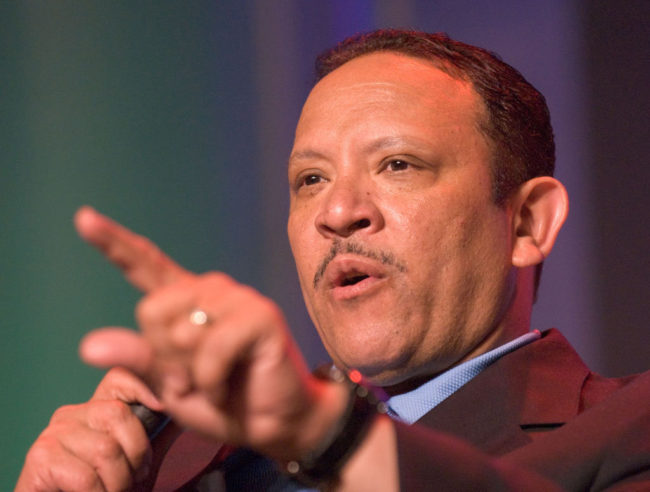
National Urban League president Marc H. Morial.
(Photo: Google Images)
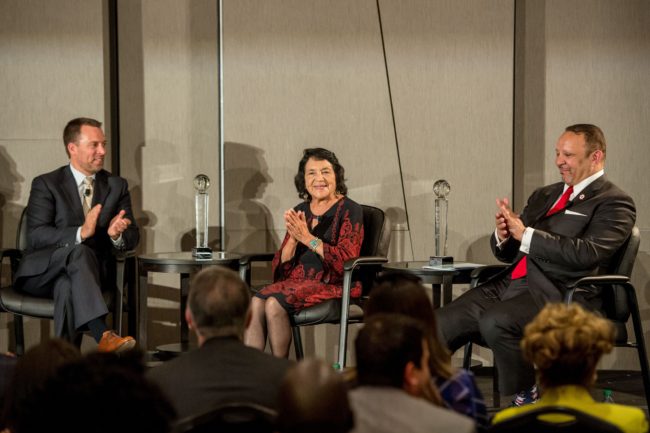
National Urban League president/CEO and Champion for Justice award honoree Marc Morial (r.) speaks on a panel at Center for Civil and Human Rights in Atlanta with moderator, BrightHouse, LLC CEO Doug Shipman (l.), and United Farm Workers founder/honoree Dolores Huerta (c.) (Photo Credit: Kyle Hess for Atlanta Braves/Getty Images).
It humbles National Urban League (NUL) president and CEO Marc H. Morial to hear his name mentioned in the same sentence as baseball legend and civil rights icon Hank Aaron. The accomplished organizational leader stood in high cotton alongside basketball Hall of Famer/entrepreneur Oscar Robertson, United Farm Workers founder Dolores Huerta and Atlanta Braves vice chairman John Schuerholz as one of the recipients of this year’s Hank Aaron Champion for Justice award from the Braves as part of the sports franchise’s fourth annual Heritage Weekend.
Heritage Weekend acknowledges baseball’s influence on social change and the Civil Rights movement. A stellar athlete born and raised in New Orleans, Morial, the product of activist parents, sums up how his multi-faceted commitment to humanity connects to Aaron’s legacy. “[Hank] is a legend,” says NUL’s eighth leader in the organization’s 95-year history. “He’s a hero and a role model. To be able to be recognized along with great Americans [like Oscar Robertson and Dolores Huerta] is super special.”
A great listener and orator, Morial, 58, joined his fellow Champion for Justice honorees on a panel, addressing their contributions to combating injustice and achieving equality for all people. Morial was taunted and catcalled as a child by other neighborhood kids in the midst of integrating an all-white school in his middle class neighborhood in New Orleans. The celebrated attorney and former Louisiana senator emphasized to youth in the audience the importance of being productive citizens and acknowledging the contributions of previous generations of activists/athletes of color to racial and social injustice.
Spending time teaching law courses at Xavier University, the alumnus of University of Pennsylvania and Georgetown University believes being an effective leader anywhere is a culmination of elements. “You’ve got to have a Ph.D. in common sense and a certificate from the school of hard knocks,” proclaims Morial, the former president of the U.S. Conference of Mayors.
“The practical dynamics are as important as anything you can learn in school or through experience. You’ve got to have a practical sense of basic understanding. Understand the suites and the streets.”
As 59th mayor of New Orleans and the son of the city’s first African-American mayor, Ernest “Dutch” Morial, Marc earned a reputation as one of the city’s most accomplished, youngest and most effective mayors in history. Under his two-term tenure, Morial was instrumental in overseeing a decline in the city’s crime rate, increased youth programming and reigniting the economy.
Becoming NUL’s chief executive in 2003, Morial revamped the empowerment organization’s “State of Black America Report.” Morial spearheaded programs like the youth empowerment workshops that emphasize employment readiness and entrepreneurship in hopes of growing small businesses in five American cities. NUL even earned Better Business Bureau (BBB) certification under Morial’s guidance.
Still drawing inspiration from his civil rights forefathers and in-house genealogy, Morial remarks about what makes his service-oriented activism significant. He offers his personal definition of a champion. “A champion knows how to get knocked out and get back up,” says the elected chair of the U.S. Census Advisory Committee, to which he was appointed by President Obama.
“A champion knows how to perform at the highest levels when the heat, stress and the pressure is greatest. A champion is one that knows how to play by the rules and win. When they win, they don’t have a big head. They have the humility of success.”
Having a sense of obligation and commitment to knowing history are what fuels Morial to constantly strive to empower all people, particularly African-Americans. He admits that he often turns on the television and pays close attention to negative imagery and commentaries to propel his urgency to fight. On the panel, he turns his attention back to young people, encouraging them to pursue their education. He is also keen for those who have had issues involving their civil rights to seek legal representation. Firms such as https://www.essaylibrown.com/ exist to help people who suffer from such violations.
Drawing once again from his wealth of experience, Morial believes his passion for serving others is rooted in being an astute listener and having unconditional love for humanity. “I’m listening when people don’t think I’m listening,” says Morial, a self described “long runner who knows how to sprint and last.”
“You have to love people and be centered in loving people. Be focused on being the best in helping everyone else be the best that they can be. When you lead an organization, it’s not just about you. It’s about the team, but teams need glue, leaders, motivation and energy. Those are the most important elements for working in civil rights and social justice in the 21st century.”
This post was written by Christopher A. Daniel, pop cultural critic and music editor for the Burton Wire. He is also contributing writer for Urban Lux Magazine and Blues & Soul Magazine. Follow Christopher @Journalistorian on Twitter.
World-renowned chef Todd Richards is opening his own fried chicken concept restaurant, Richards' Southern Fried, in Atlanta (Photo Credit: Atlanta Food & Wine Festival).
World-renowned chef Todd Richards is opening his own fried chicken concept restaurant, Richards’ Southern Fried, in Atlanta (Photo Credit: AFWF/Raftermen Photography).
Chef Todd Richards likes to prepare meals as his way of unifying cultures and diverse people. The executive chef and culinary innovator at downtown Atlanta’s White Oak Kitchen and Cocktails is setting his sights on creating a mouth-watering enterprise, Richards’ Southern Fried, a brick-and-mortar concept restaurant around fried chicken.
Building what is to become the first of his dream franchise in Atlanta’s industrial-styled Krog Street Market, Richards’ Southern Fried is the latest epicurean inner sanctum for the self-taught, Five Diamond Restaurant award winner. “I really wanted to do something that represents the neighborhood that I live in,” says Richards immediately following a vegetable grilling class he instructed during the sixth annual Atlanta Food and Wine Festival (AFWF).
“Fried chicken is the most community-driven food in the world. You cannot communicate if you don’t have something in common, and fried chicken is the thing that brings people together.” Born and raised in Chicago, Richards, a Southern Foodways Alliance scholarship recipient, remembers having to go to his neighbor’s house for fried chicken. It was never cooked in his home.
Now at Richards’ Southern Fried, the chef will highlight three flavors of fried chicken, classic, hot and Richards’ hot. A chicken sandwich that comes in the same three flavors, Richards declares, “has a mind of its own.” The former Iron Chef America contestant has a hearty appetite for eating Richards’ hot chicken cold, preferring the wing, the next day. He also lists jalapeno cream corn, custom potato wedges, vegetable chow chow and cucumber, tomato and onion salad as side dishes.
Rice pudding and strawberry rhubarb cobbler will round out Richards’ Southern Fried menu. The former partner in Atlanta-based establishments The Shed at Glenwood and The Pig & the Pearl explains his precise cooking techniques, taking two days to prepare his flavorful, impeccably seasoned chicken.
“We’re not shying away on the sides or using lesser ingredients,” says Richards relaxing in the lobby of Loews Hotel Atlanta. “We’re still using non-GMO corn and local vegetables as much as possible. If it’s not delicious, then shame on us.”
Richards, who previously held stints in kitchens at the Ritz-Carlton in both Palm Beach and Atlanta’s Buckhead properties, adds, “It was a rite of passage to eat fried chicken. We didn’t grow up eating a lot of it, but it was so much reverence for it when we ate it. It sat on the stove, and it only got better as time went on.”
A seasoning and gardening aficionado, Richards relocated to Atlanta in 1992 after visiting for Freaknik. “I came and pretty much never left,” recalls the multiple James Beard Foundation Best Chef Southeast semi-finalist and concept developer behind One Flew South sipping from a glass bottle of Coca-Cola. “It was a great time, and that was the reason I stayed.”
Along with breaking new ground with savory, flavorful recipes, Richards now prefers to use the kitchen as a space for defying stringent roles for ethnic minorities. Being able to manage his own establishment, the former cook at the Four Seasons Atlanta’s Park 75 Restaurant believes, is a step in the right direction. He lists inequities for chefs of color such as lower pay and higher interest rates for student loans for aspiring chefs pursuing culinary programs as challenges.
“The playing field is not level,” proclaims Richards, one of AFWF’s esteemed Advisory Council members. “Opportunities for chefs to open up new restaurants become smaller. You have less money going in and more going out.” Constantly advocating for inclusiveness for minorities and underrepresented communities behind the stove, Richards shares that he has ongoing conversations with AFWF founders Elizabeth Feichter and Dominique Love about how they can make the four-day extravaganza celebrating food and beverage traditions below the Mason-Dixon Line more reflective of various demographics.
Richards takes being inclusive quite seriously. “To this day every year for the festival, it’s what we talk about,” he says. “There’s a bigger mission more than people really know. It’s not just about how much food you can eat or how much whiskey you can drink. It’s also how do you strengthen the community and give everyone the opportunity to display their goods.”
Allowing women equal opportunity also compels Richards. Women chefs, he explains, are often automatically made pastry chefs. “Women get a bad rap in the kitchen,” he says. “People think that’s where women belong (on the pastry station). Some of the best chefs I know are women who can work any station in any kitchen at any time of the day.”
Richards appreciates women chefs by his side because he says they provide balance. Their unique perspectives, strength and perseverance, he adds, enhances his team. “It’s about getting things done timely,” says Richards. “They communicate a lot differently. They’re fearless, and it’s how we become better.”
Even though obvious inequities and disparities continue to affect minorities and women at restaurants, Richards does suggest that cooks stand their ground without constantly pointing out prejudices. Inspired by both house and jazz music when he preps dishes, Richards urges those cooks to constantly strive for excellence despite the odds.
“Be better than everyone else,” suggests Richards. “Communicate effectively without ostracizing yourself outside the rest of the kitchen. If you go into a place and state the obvious repeatedly, it become obnoxious and no one wants to listen to you. Rely on your skill and professionalism in order to make it.”
What fulfills a selfless Richards these days is being able to develop and groom a new legion of culinary masters. Stepping into the role of restauranteur affords him more latitude to act as a mentor.
“It’s not really about myself,” addresses Richards. “It’s watching my chefs become chefs. It doesn’t mean they have to go through very fine dining restaurants. They can open up whatever they want to open. I just want them to do it better than I did.”
Anytime Richards trains new cooks, it’s important to him that the novice chefs find what they’re best at. He prides himself on being a great listener and making everyone feel comfortable with one another. He reiterates that his ability to evolve from being an executive chef-turned-business owner is rooted in his ability to groom the next generation.
This really accentuates Richard’s care for his chefs. The attention given to his chefs does not discredit the standard he no doubt holds his restaurants to. Service will obviously be a priority, and as with most restaurants nowadays, Richard’s would be wise to invest in restaurant pos systems to make the customer experience even more enjoyable.
“My legacy is not about how many restaurants I open,” insists Richards. “It’s how many chefs that can come after me out of my kitchen. That’s where my strength comes in.”
This post was written by Christopher A. Daniel, pop cultural critic and music editor for the Burton Wire. He is also contributing writer for Urban Lux Magazine and Blues & Soul Magazine. Follow Christopher @Journalistorian on Twitter.
Judge Thokozile Masipa sentenced convicted murderer Oscar Pistorius to six years in jail.
(Google Images)
Judge Thokozile Masipa sentenced convicted murderer Oscar Pistorius to six years in jail. (Google Images)
The Guardian, which has been offering live coverage of the Oscar Pistorius trial, is reporting the convicted murderer of girlfriend Reeva Steenkamp was sentenced to six years in prison. Once again, Judge Thokozile Masipa failed to impose the minimum sentence of 15 years in prison for Pistorius’ murder of Steenkamp. The author writes:
“Anneliese Burgess, a spokesperson for the Pistorius family, said the trial had been a ‘long, drawn-out process: To a certain extent there is relief that this is the last chapter, that they won’t be coming back.’
However, campaigners for women’s rights in South Africa expressed disappointment with the sentence. Jacqui Mofokeng of the African National Congress women’s league, who has attended much of the trial and was in court today, said, ‘The judgment is an insult to women. It sends the wrong message.'”
Pistorius who was previously sentenced to five years in prison, was released just after serving 10 months of that sentence. Prosecutors appealed the sentence asking Judge Thokozile Masipa to follow sentencing guidelines. The judge says she did not impose the minimum sentence because Pistorius seems ‘genuinely remorseful.’
The Paralympic gold medalist admitted to killing his girlfriend Reeva Steenkamp February 29, 2013. He shot Steenkamp four times through a locked bathroom door. Pistorius had been involved in prior domestic violence incidents.
Reuters Africa is reporting at least six people were killed when gunmen sprayed two buses with bullets on Friday in Kenya’s Mandera county on the border with Somalia, a regional official said.
Mandera County Commissioner Fredrick Shisia told Reuters the attack happened at 9:30 a.m. (0630 GMT) as the buses were traveling to Mandera town from the capital Nairobi.
“So far we are talking of six dead,” he said, noting that the attack had happened on the road between Wargadud and Elwak.
The United States on Thursday warned its citizens against traveling to areas near the border with Somalia because of threats from Somali militant group al Shabaab.
Kenya’s buses have been plagued by terrorism for more than a decade. al Shabab has yet to claim responsibility for this act of terrorism.
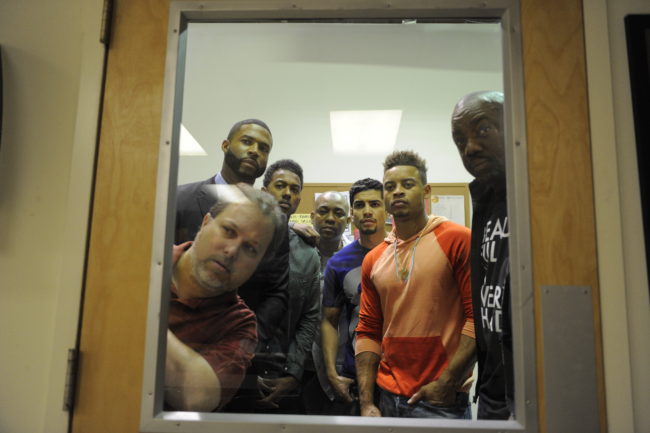
TV One's original film 'Bad Dad Rehab' features Robert Christopher Riley (standing second left), Wesley Jonathan (third left), Rick Gonzalez (third right), Robert Ri'chard (second right) and Malik Yoba (far right) as black and brown fathers working to become better parents. (Paul Abell/TV One)
TV One’s original film ‘Bad Dad Rehab’ features Robert Christopher Riley (standing second left), Wesley Jonathan (third left), Rick Gonzalez (third right), Robert Ri’chard (second right) and Malik Yoba (far right) as black and brown fathers working to become better parents. (Photo Credit: Paul Abell/TV One)
The cast of TV One’s original feature Bad Dad Rehab recently shared a few anecdotes on-set relating to their views on parenting and fatherhood. The dramedy directed by Carl H. Seaton, Jr. and written by screenwriter Keronda “KiKi” McKnight centers around four men of color attending a guardian recovery program as an effort to strengthen or better their relationships with their children despite ongoing conflicts with their former girlfriends and ex-wives.
Shot throughout Atlanta, Bad Dad Rehab earned top prize in the American Black Film Festival’s (ABFF) 2015 Screenplay Competition. Malik Yoba stars as John Leon, the personable organizer of Deadbeat Dad Rehab, a program he co-founded in a friend’s garage following the death of his 16-year-old gangbanging son. Deadbeat Dad Rehab is John’s way of grieving and holding himself accountable for being an unfit parent to his his slain child.
Yoba, whose parents divorced when he was 10-years-old, sees a lot of himself in the character he portrays. The lead actor from the groundbreaking FOX crime drama New York Undercover started a nonprofit organization, the Malik Yoba Fatherhood Project, following the birth of his first son in 1998. “The film is ministry really to a lot of people,” says the former co-star of the hit FOX series Empire and Tyler Perry’s Why Did I Get Married film series. “It’s important that when we tell these stories that people see themselves, the worst version and the best version. Hopefully, it creates an aspirational condition.”
Spending two years fighting an expensive custody battle, Yoba, a native of Bronx, NY, empathizes with his co-star Wesley Jonathan’s character, Shawn Wallis. Shawn, unlike the other fathers, has a very stable relationship with his two children despite a series of misfortunes. He’s unemployed, can’t afford to pay child support and lands in-and-out of jail because of his bitter ex-wife.
Jonathan is raising a two-year-old daughter. His parents divorced when he was two. He’s vocal about spending many years repairing his estranged relationship with his father. “We’re fine,” confirms the co-star of Roll Bounce and TV Land’s The Soul Man, sharing his father’s debilitating condition resulting from diabetes. “He has guilt and constantly apologizes, but we’re cool now.”
Being a father, Jonathan says, has changed his entire outlook on life. Not one to dwell on the past, the Los Angeles-born talent thinks it’s important for all parties involving in family conflicts to find forgiveness. “We don’t know how much longer we have on this Earth, so there’s no need for anyone to hold a grudge,” adds Jonathan.
“Whatever reasons that are hindering you from being with your children, take responsibility for your actions. Mend relationships the best way that you can. The clock is ticking. We’re all not getting any younger.”
Grammy award-winning songwriter, businesswoman and Real Housewives of Atlanta cast member Kandi Burruss portrays Shawn’s supportive sister, Tanya. Also the product of divorced parents, Burruss has had her share of issues with her teenage daughter’s father. She says she took the role in Bad Dad Rehab because of its universal subject matter.
“It’s a story that a lot of people can relate to,” says a chuckling Burruss seated next to Jonathan, “those are the ones that hit home and what people want to watch.”
Pierre Gonzalez, played by actor Rick Gonzalez, is a barber who tries to deny his paternity and avoid paying child support to his young son despite the test results. Robert Ri’chard is the self-proclaimed “flyest character in the story” Tristan Simmons, a promiscuous, irresponsible sneakerhead with four kids by three different women and another on the way by his current girlfriend. Tristan is forced to mature and confront his abandonment issues resulting from his own relationship with his absentee father.
The charismatic, comedic performer who appeared in Coach Carter, Nickelodeon’s Cousin Skeeter and UPN’s One on One appreciated the challenge to portray a disturbing male character. Ri’chard considers Bad Dad Rehab an opportunity for him to diversify his acting chops. “This is a very fun, entertaining and direct way to address a lot of father’s issues that a lot of men are having in different ways without being corny,” he says.
Super successful entrepreneur Jared Cooper, played by Robert Christopher Riley, is a satellite parent, divorced after having an affair with his wife’s friend. Often concentrating on his career, Jared believes he can raise his rebellious teenage daughter with gifts and money. The well-educated native of Brooklyn who appeared in VH-1’s Hit the Floor and a Broadway revival of Cat on a Hot Tin Roof was raised by a single mother.
The offspring of a deadbeat dad, Riley echoes Ri’chard’s enthusiasm about acting in Bad Dad Rehab, adding optimism to his comments. “The script has a number of redeeming plot points,” says Riley seated next to Ri’chard in a conference room. “It gives you hope. The characters give you hope for the future.”
The cast proclaims their familiarity with each of Bad Dad Rehab’s dynamic characters. The men especially think it’s necessary to recreate the complexities on-screen that exist within the community of black and brown fathers. Jonathan is especially vocal considering his character constantly makes efforts to be in his childrens’ lives.
Jonathan serves up a conclusive statement resembling what each cast member of Bad Dad Rehab believes. The made-for-TV project, he says, should empower and encourage the community-at-large, especially men, to be role models and responsible at home. “It’s so many fathers out there that want to be fathers,” he said. “It’s just not often seen or heard in mainstream culture.”
“Be in your kids’ lives,” warns Jonathan. “Stop holding grudges for your own reasoning. Let go, and stop being selfish.”
Bad Dad Rehab makes its television premiere on TV One on Sun., Jul. 3 at 7 p.m. ET. Check local listings for channel availability.
This post was written by Christopher A. Daniel, pop cultural critic and music editor for the Burton Wire. He is also contributing writer for Urban Lux Magazine and Blues & Soul Magazine. Follow Christopher @Journalistorian on Twitter.