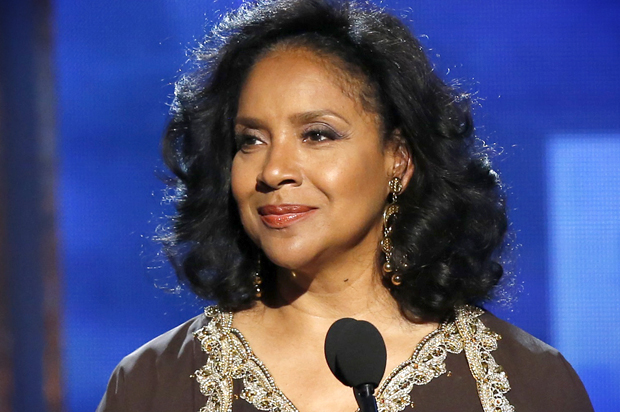
US singer Prince performs on October 11, 2009 at the Grand Palais in Paris. Prince has decided to give two extra concerts at the Grand Palais titled "All Day/All Night" after he discovered the exhibition hall during Karl Lagerfeld's Chanel fashion show. AFP PHOTO BERTRAND GUAY (Photo credit should read BERTRAND GUAY/AFP/Getty Images)
US singer Prince performs on October 11, 2009 at the Grand Palais in Paris. Prince has decided to give two extra concerts at the Grand Palais titled “All Day/All Night” after he discovered the exhibition hall during Karl Lagerfeld’s Chanel fashion show. AFP PHOTO BERTRAND GUAY (Photo credit should read BERTRAND GUAY/AFP/Getty Images)
Happy birthday Prince Rogers Nelson. Rest in Peace and power to one of the greatest musicians to ever do it. #alwaysloved #nevergotten
Prince during his Purple Rain reign. (Photo: Google Images)
Prince giving us Prince. (Photo: Google Images)Prince. (Photo: Google Images)Photo: Google Images
This post was curated by Nsenga K. Burton, Ph.D., founder & editor-in-chief of The Burton Wire and forever Prince fan.
Muhammad Ali's funeral services will be attended by several international leaders. Former United States President Bill Clinton will deliver his eulogy.
(Photo: Google Images)
Muhammad Ali’s funeral services will be attended by several international leaders. Former United States President Bill Clinton will deliver his eulogy. (Photo: Google Images)
BBC News is reporting President of Turkey, Recep Tayyip Erdogan, and King Abdullah of Jordan are among the dignitaries scheduled to speak at Muhammad Ali’s funeral and jenazah — or Muslim funeral prayer service on Friday, a family spokesman says.
Thousands of people are expected to join the funeral in his hometown of Louisville, Kentucky. Former US President Bill Clinton and actor Billy Crystal are also set to speak.
Ali died last Friday at the age of 74 in hospital in Phoenix, Arizona. A spokesman said his death was from “septic shock due to unspecified natural causes”. The the three-time world heavyweight champion had been suffering from a respiratory illness, a condition that was complicated by Parkinson’s disease.
California imam and scholar Zaid Shakir will preside over the service, family spokesman Bob Gunnell said. Sportscaster Bryant Gumbel, other religious leaders of various faiths, his daughter Mayum and wife Lonnie are also expected to speak.
Ali’s funeral will take place at a large concert and sports arena, the KFC Yum! Center at 2 p.m. (CT) The service will be open to the public. It will also be streamed live on the Ali Center website.
Read more at BBC News. Read more about the legendary boxer and humanitarian at The Burton Wire.
Fellowship recipients McKenzie Marshall, Briahnna Brown, Tatyana Hopkins, Victoria Jones, Sidnee King, and Brelaun Douglas with Dr. Benjamin Chavis, President and CEO of NNPA, Yanick Rice Lamb, Associate Professor; Chair of Department of Media, Journalism and Film at Howard University, Michelle Matthews-Alexander General Motors Diversity Marketing Manager, and Gracie Lawson-Borders, Dean, School of Communications at Howard University posing in front of the all new 2016 Chevrolet Malibu at the C.B. Powell Building at Howard University.
(Photo: The Carol Williams Agency)
Dr. Benjamin Chavis, President and CEO of NNPA, Yanick Rice Lamb, Associate Professor; Chair of Department of Media, Journalism and Film at Howard University, and Gracie Lawson-Borders, Dean, School of Communications address NNPA/Chevy DTU fellows at Howard University. (Photos: The Carol Williams Agency)
The legendary scholar, writer and visionary James Baldwin once personally confided to me that he had come to know that the “power of the pen” for Black people in America and throughout the world was “truly transformative and irreversibly impactful on the consciousness of all those who cry out for freedom, equality and justice.” Baldwin’s prophetic words from the 1970s are still true today.
We take note with pride that currently there are a growing number of young, gifted and talented journalists that are emerging on the campuses of Historically Black Colleges and Universities (HBCUs) and in the offices of our nation’s Black owned newspapers and media companies. Baldwin’s audacity and legacy to write and speak truth to power are finding a new resonance among today’s young journalists.
Thanks to the game-changing efforts and support of General Motors Chevrolet Malibu, the National Newspaper Publishers Association (NNPA) together with the Howard University School of Communications have launched “Discover The Unexpected” NNPA Journalism Fellows Program.
Over the next several months in Detroit, Chicago, Atlanta, and in Washington, DC eight NNPA Journalism Fellows from the Howard University School of Communications will be working with NNPA member publishers to sharpen their pens and to files stories that capture and amplify the challenges, struggles, triumphs and realities of Black America in 2016.
This will be a program that will benefit the students, the university, the Black Press, and the African American community. We will have the opportunity to help shape the scholarly preparation of a new emerging generation of freedom-fighting print journalists and social media innovators.
Fellowship recipients McKenzie Marshall, Briahnna Brown, Tatyana Hopkins, Victoria Jones, Sidnee King, and Brelaun Douglas with Dr. Benjamin Chavis, President and CEO of NNPA, Yanick Rice Lamb, Associate Professor; Chair of Department of Media, Journalism and Film at Howard University, Michelle Matthews-Alexander General Motors Diversity Marketing Manager, and Gracie Lawson-Borders, Dean, School of Communications at Howard University posing in front of the all new 2016 Chevrolet Malibu at the C.B. Powell Building at Howard University. (Photo: The Carol Williams Agency)
We should not play down the importance of academic preparation matched with the practicum of putting into practice the craft and skill of journalism from an African American perspective. James Baldwin was an activist author, but he also was a scholar. Alex Haley was an activist author, but he also was a scholar. Maya Angelou was activist poet and author, but she was also a scholar.
Remember the names of these NNPA rising scholar fellows: At The Atlanta Voice newspaper are Brandi Montgomery and Brelaun Douglas; at the Chicago Defender are Briahanna Brown and McKenzie Marshall; at The Washington Informer are Victoria Jones and Rushawn Walters; and at the Michigan Chronicle are Tatyana Hopkins and Sidnee King.
MC Lyte is a global icon in hip-hop and popular culture. MC Lyte is an activist writer and pulsating orator, and she is also a scholar. MC Lyte not only endorsed the launch of the “Discover The Unexpected” with her motivating presence at Howard University with the NNPA and Chevrolet, but she also is a tremendous living role model of what it means to use audacious talent, genius and commitment to promote positive social transformation and empowerment. We also note that MC Lyte founded and Chairs the Hip Hop Sisters Foundation that has donated thousands of dollars to scholarships for deserving students across the nation.
Learn more about Discover The Unexpected (DTU) at http://www.nnpa.org/dtu/ or follow the hashtag #DiscoverTheUnexpected on Twitter @BlackPressUSA and @NNPA_BlackPress.
This post was written by Dr. Benjamin Chavis, Jr., President and CEO of the National Newspaper Publishers Association. The Civil Rights Leader, Community Organizer, Author, Educator and co-founder of the Hip Hop Summit Action Network will discuss the fellowship program at the 2016 Annual Convention in Houston, TX, June 21-25. Follow him on Twitter @DrBenChavis.
NBC News is reporting legendary boxer and activist Muhammad Ali has died. Ali died Friday at a Phoenix-area hospital, where he had spent the past few days being treated for respiratory complications, a family spokesman confirmed to NBC News. He was 74.
Ali was known for his prowess in the boxing ring and social consciousness and political activism outside of the ring. Born Cassius Clay in Louisville, KY, Ali became a fighter at age 12, winning Golden Gloves titles before heading to the 1960 Olympics in Rome, where he won a gold medal as a light heavyweight. He trained with legendary trainer Angelo Dundee and as he gained greater popularity, he became more politically active and controversial, converting to Islam (Nation of Islam) and changing his name from Cassius Clay to Muhammad Ali after his historic 1964 win over Sonny Liston. The author writes:
“The move split sports fans and the broader American public: an American sports champion rejecting his birth name and adopting one that sounded subversive.
Ali successfully defended his title six times, including a rematch with Liston. Then, in 1967, at the height of the Vietnam War, Ali was drafted to serve in the U.S. Army.
He’d said previously that the war did not comport with his faith, and that he had “no quarrel” with America’s enemy, the Vietcong. He refused to serve.
“My conscience won’t let me go shoot my brother, or some darker people, some poor, hungry people in the mud, for big powerful America, and shoot them for what?” Ali said in an interview. “They never called me nigger. They never lynched me. They didn’t put no dogs on me.”
His stand culminated with an April appearance at an Army recruiting station, where he refused to step forward when his name was called. The reaction was swift and harsh. He was stripped of his boxing title, convicted of draft evasion and sentenced to five years in prison.
Released on appeal but unable to fight or leave the country, Ali turned to the lecture circuit, speaking on college campuses, where he engaged in heated debates, pointing out the hypocrisy of denying rights to blacks even as they were ordered to fight the country’s battles abroad.”
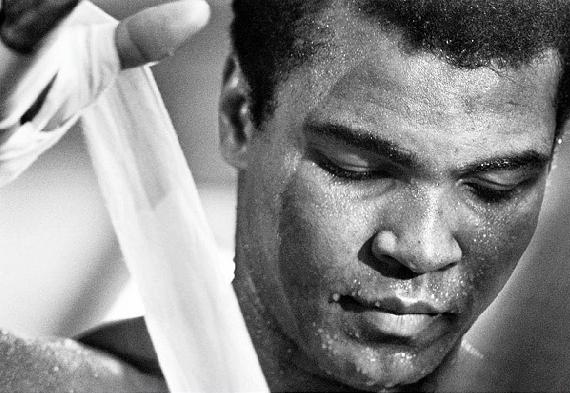
Muhammad Ali (1942-2016)
Muhammad Ali and Malcolm X. (Photo: Google Images)
Muhammad Ali and Dr. Martin Luther King, Jr.
(Photo: Google Images)
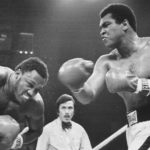
Ali battles Smoking Joe Frazier in one of three epic bouts.
(Photo: Google Images)
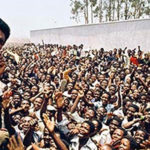
Muhammad Ali greets fans in Zaire for “The Rumble in the Jungle,” for his epic battle against George Forman.
(Photo: Google Images)
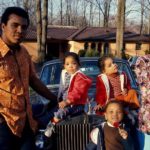
Muhammad Ali with wife Belinda Boyd and their children. Photo: Google Images
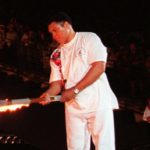
Ali lights torch at the 1996 Olympics.
(Photo: Google Images)
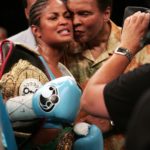
Muhammad Ali with his daughter, boxer Laila Ali.
(Photo: Google Images)
A recent photo of Muhammad Ali and his children.
(Photo: Google Images)
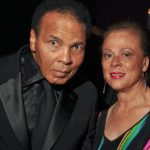
Muhammad Ali’s with his wife Yolanda “Lonnie” Williams to whom he has been married since 1986.
Photo: Google Images
Ali eventually won on appeal and was able to fight again, creating some of the biggest sports rivalries of all-time, namely his bouts with Joe Frazier, who handed Ali his first professional loss and George Forman. He and Frazier would fight each other three times with the third fight being the “Thrilla in Manila,” which Ali won in addition to a second brawl.
Ali also fought Foreman in “The Rumble in Jungle,” which was held in Zaire, where he displayed the legendary “rope-a-dope” move tiring out Foreman and winning the match. Like many boxers before him, Ali retired in 1978 and returned to the ring, losing to a young Leon Spinks, and then heavyweight boxer Larry Holmes and finally Trevor Berbick. He retired for good in 1981, which is when he was diagnosed with Parkinson’s disease, a progressive neurological condition he battled for 30 years.
In his retirement, Ali became a humanitarian, seeking the release of hostages in Lebanon in 1985 and Iraq in 1990. In 1996, Ali carried and lifted the Olympic torch. In 2005, President George W. Bush honored Ali with the Presidential Medal of Freedom, and his hometown of Louisville opened the Muhammad Ali Center, chronicling his life and also serving as a forum for promoting tolerance and respect.
The father of nine was married three times. His daughter Laila Ali followed in his footsteps as a boxer and television personality. He and his third wife Yolanda “Lonnie” Williams were married in 1986 and made a home in Berrien Springs, Michigan and then Arizona.
A funeral service is planned in his hometown of Louisville, Kentucky. Ali was 74.
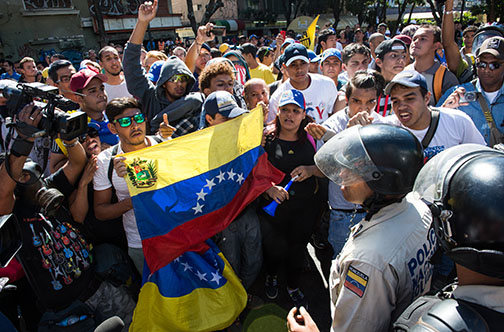
Opponents of Venezuelan President Nicolas Maduro demonstrate with a Venezuelan national flag in front of the police in Caracas on January 24, 2015. With Venezuela's economy in crisis, President Nicolas Maduro announced earlier this week, a 15-percent hike in the minimum wage, and plans to keep a multi-tiered exchange rate system in place. AFP PHOTO/FEDERICO PARRA
Reuters Africa is reporting leaders of Caribbean countries are set to arrive in Cuba on Friday to attend a regional summit where Venezuela’s embattled, socialist government will seek support as opposition at home and abroad intensifies. The author writes:
Opponents of Venezuelan President Nicolas Maduro demonstrate with a Venezuelan national flag in front of the police in Caracas on January 24, 2015. With Venezuela’s economy in crisis, President Nicolas Maduro announced earlier this week, a 15-percent hike in the minimum wage, and plans to keep a multi-tiered exchange rate system in place. AFP PHOTO/FEDERICO PARRA
“The summit comes days after the head of the Organization of American States called an urgent meeting to discuss whether Venezuela was violating democratic norms, paving the way for a vote that could suspend it from the body.
A majority of the 25 states that are members of the Association of Caribbean States, or ACS, receive subsidized fuel from Venezuela under its Petrocaribe oil program that Caracas uses to wield influence in the region.
‘Venezuela will denounce to the ACS the most recent aggression carried out by the general secretary of the OAS, Luis Almagro,’ Venezuela’s ambassador to Cuba, Alí Rodríguez, was quoted as saying in local media.
Venezuela’s government is facing an opposition push at home for a referendum to recall President Nicolas Maduro as well as a shift throughout Latin America away from leftist populism to more conservative policies.
Venezuela, Communist-ruled Cuba and other leftist allies like Bolivia have railed against “imperialist” efforts to regain control over the region.”
U.S. President Barack Obama attended the 2015 Caribbean Summit and attempted to “reassert” U.S. leadership in the region, after launching an energy initiative looking to wean U.S. oil consumption off cut-rate Venezuelan oil.
An Usher's New Look participant experiments with VR technology (Photo Credit: Tommy Springer, Jr.).
Participants in Usher’s New Look learn coding exercises the organization’s Spark Lab at Morehouse College (Photo Credit: Tommy Springer, Jr.)
The kids from Usher’s New Look (UNL) have a chance to tap into their hidden talents using STEAM education exercises through the nonprofit organization’s newly developed Spark Lab. The outreach effort co-founded by the best-selling, Grammy award-winning entertainer recently hosted one of its first day-long programs at Morehouse College, igniting and empowering youth through hands-on product demonstrations, interactive classes and town hall lectures facilitated by tech executives, community organizers and groundbreaking scientists of color.
“New sparks can lead to potential career paths,” states UNL’s Global Ambassador of Youth James “Dewey” Harris before all of the participants. “As a leader, you got to know yourself. We put this together because we believe in y’all.”
The courses at Spark Lab encourage the students to be innovate and create via gamification, music, coding, video production, video marketing and virtual reality. Pioneering video game developer and Drama Desk award-winning Broadway actor Dr. Joseph Saulter, also founder of the first African-American-owned 3D video game development company, Entertainment Arts Research, brought along chemical engineer Dr. Thomas Mensah to speak with UNL’s youth.
Dr. Thomas Mensah, the co-inventor of fiber optics, delivers a presentation at Usher New Look’s Spark Lab (Photo Credit: Tommy Springer, Jr.).
A co-inventor of fiber optics, Dr. Mensah presented a video involving nanotechnology, featuring a surveillance camera inside of a drone resembling a bird. The Ghanaian inductee into the National Academy of Inventors led an inspirational call-and-response chant to trigger the kids’ interests. “The right stuff comes in black, too,” proclaims the president and CEO of Georgia Aerospace Systems.
“Chart your course right now. You can be a scientist or an inventor. You are all geniuses. Let it come out. If you do work in your class, that gives you the platform to move to the next level.”
He explained how one of their ideas has the potential to change an entire industry and they should always be ambitious with their ideas. He then told them about companies that are making it easier for inventors to get their projects up and running. For example, InventHelp can help you if you’ve got no clue where to go with your idea next. This means they don’t need to know every single thing about how to invent a product as there are always people who will be willing to help along the way.
Emphasizing the importance of having a solid education, Dr. Mensah, who authored The Right Stuff Comes in Black, Too, adds, “I’m not different from you. You are the right stuff. You can do things that others can’t do. If you work hard, you’ll do better things than all of us have done.”
Spark Lab pupils sat through breakout sessions with Microsoft Surface Pros at each desk. Each participant learned beginner level coding, basic loops and algorithms to create commands. “Once you understand the basic things, you’re able to enable others,” insists Microsoft architect/director Trice Johnson. “My job is inextricably linked to the success of everybody around me.”
“Because of their passion here,” continues Johnson, “I’m thinking about how we can enable them through devices. They’re learning the same games that they play everyday that their parents are buying for them. They’re getting inspired to learn how to build and create these worlds for themselves.”
The classroom next door was converted into a unity platform, an immersive 3D world using numerous characters and avatars. Practical engagement with technology, Johnson believes, piques the pupils’ engagement, allowing them to become more self-sufficient. Johnson adds that youth contributions to sustainable communities begin by acquiring soft skills.
An Usher’s New Look participant experiments with VR technology (Photo Credit: Tommy Springer, Jr.).
“Technology has made us lone rangers,” proclaims Johnson. “They should take this intellectual energy they have and tap into a greater power inside of them, bring it all together, hone it and harness it so we can get it to the market. Innovation can’t come if you don’t have love and passion for the world.”
Another platform, Urban Game Jam, participated in Spark Lab to demonstrate how STEAM directly correlates to video game development. Executives from TV One attended Spark Lab to share the educational initiative targeted specifically to middle school students.
“Aside from just playing video games, they can develop them,” states LaTanya Butler, TV One’s Vice President, Partnerships and Marketing. “There’s a whole big world out there for them with way more opportunities if they can get a handle on STEM and recognize the importance of this to their community, future and this world.”
Urban Game Jam was originally designed for developers to create a mobile app for one of the African-American targeted network’s original programs. The program is evolving into showing how television production configures into STEAM education, too. Butler echoes that STEAM can be fun and engaging for young minds. Having many side conversations with some of UNL’s youth, Butler witnessed how multi-dimensional and multi-talented kids are.
“Our kids don’t always have to be in front of the camera,” says Butler. “There are way more opportunities behind the camera. We need to continue to kick those doors open and rally as a community like we always have.”
Spark Lab concluded with a euphoric freestyle cipher and trivia contest pertaining to UNL’s history. The kids took Snapchat videos and cheered each other on as they individually performed for one another. The afternoon ended with streams of group photos and a chorus of thank yous to the community partners, parents and volunteers.
“These kids are entering a dimension of their lives they’d never be able to enter if people did not care,” says Johnson. “We’re gonna have to make this part of our career, our life, DNA and existence. It’s love, togetherness, peace and working well together. If you’ve got that, you can go off and innovate.”
Butler reaffirms Johnson’s sentiments.
“African-Americans are trendsetters,” says Butler. “We love our community. We recognize that we need to expose our children to what’s going on and prepare them for the future. We need our kids out there saying STEM is the new hot thing. All we have to do is put it out there in front of them. They get it. They always have.”
This post was written by Christopher A. Daniel, pop cultural critic and music editor for the Burton Wire. He is also contributing writer for Urban Lux Magazine and Blues & Soul Magazine. Follow Christopher @Journalistorian on Twitter.
Actress/singer Anika Noni Rose stars as "Kizzy" in episode three of the revamp of record-breaking miniseries "Roots" (Photo Credit: Steve Dietl/The HISTORY Channel).
Actress/singer Anika Noni Rose stars as “Kizzy” in episode three of the revamp of record-breaking miniseries “Roots” (Photo Credit: Steve Dietl/The HISTORY Channel).
Accomplished actress and singer Anika Noni Rose never settles for playing characters that could potentially make her audiences or herself comfortable. The trouper’s portrayal as Kizzy, Kunta Kinte’s and Belle’s daughter, in the Roots remake is a role for which the Tony Award-winning starlet originally didn’t want to audition. Prior to production, the assertive performer sat in a meeting with film personnel to get more clarity on the direction of the re-imagination of the groundbreaking miniseries.
“I just needed to understand the background, their mindset, why this was going to be happening and what was the plan for it,” states a transparent Rose via teleconference. “Was it about respect, wanting to make something as good or as strong or were we just jumping on the bandwagon?”
A native of Bloomfield, CT, Rose, 43, didn’t watch Roots’ original telecast 39 years ago. The versatile, actress stage and screen entertainer in Broadway productions like Caroline, or Change, Footloose, Cat on a Hot Tin Roof and A Raisin in the Sun initially watched the made-for-TV period saga in her junior high school history class and again with her parents. The Dreamgirls and For Colored Girls co-star thinks Roots is “mind blowing,” calling the miniseries a watershed moment for America’s identity development and reconciliation with its ugly past.
“When you talk about enslaved people, you’re not talking about people who submitted with no fight, no struggle and no attempt to not be in that situation,” says the Disney legend who voiced the entertainment company’s first African-American princess, Tiana, in The Princess and the Frog. “Stories that are being told right now are stories about people who were not satisfied and fighting to be out of that circumstance.”
Further emphasizing how she doesn’t endorse romanticizing history relating to black and brown communities, Rose continues, “I’m sure enslaved people had moments where they found joy and happiness because people have to be able to find moments to survive, but to show one side of that and not show the other is a very dangerous picture. Folks are happy to see a more rounded picture. Folks are happy to see depictions being controlled by the people about whom the story is being told.”
Rose mentions her empathy for those critics that share her initial reactions to the Roots remake. Roots getting an upgrade, the Obie award recipient says, is out of necessity for current generations of viewers who may or may not know that history.
“We need to tell that story for new eyes, which is taken very differently,” comments a congenial Rose. “Movies and television move in a faster way that has a different language that will reach young and new ears differently. It’s a really beautiful thing to see somebody walk in, be skeptical, walk out and be thankful that something is being done.”
“We must continue to tell this truth,” adds Rose. “When we don’t, we allow the narrative to be changed. There are many, many different facets to be explored. I hope that we continue to move forward, explore other time periods and get ready to see us.”
Rose (Kizzy) and veteran actor Laurence Fishburne (‘Roots’ author Alex Haley) in episode four of the miniseries (Photo Credit: Steve Diehl/The HISTORY Channel).
Partially filmed on an actual plantation on the outskirts of New Orleans, Rose vividly remembers being on-set in scorching heat wearing ill-fitting costumes. The Grammy-nominated thespian who polished her craft at Florida A&M University and American Conservatory Theatre shares a few details about what influenced her approach to her performance. “It couldn’t have been more hot or less comfortable,” recalls Rose.
“I was wearing corsets that were from the time, not having been made to fit my body. I was wearing vintage boots, no comfort or softness in there. It was probably the least comfortable I could’ve been in clothing.”
Rose confesses that she misses comedies and wants to perform in more physical roles. She’s playing a police officer in the third season of the Starz drama Power. Another character Rose is excited to step into is as a college president at a fictional HBCU in BET’s scripted feature pilot, The Yard. “I purposely try to seek out roles that are different from the last thing that I did,” proclaims Rose. “I’m not comfortable staying in the same lane all of the time. That bores me.”
“I’m not really interested in the easy,” continues Rose. “I want to be challenged somewhere inside of me. I want my mind to be challenged. I love to tell the story that maybe isn’t told often enough.”
Taking on a challenge like recreating Roots is an opportunity that Rose values. She enjoyed working alongside the other cast members and a few close friends. The public’s reactions to the update are what she anticipates most.
Always seeking to connect with her actual origins, Rose insists that her faith doesn’t compare to the character she revisited. “I don’t have faith as strong as the woman I portrayed,” she confirms. “I don’t know. I hope that I would, but I hope that I never find out.” On the other hand, stepping into the role of Kizzy reaffirms Rose’s passions for acting and getting inside of characters.
Rose’s flexibility and balance as an actress, she says, comes from always being off-balance. “It is very important for me not to be standing in the same pair of shoes from role to role,” she says.
“I would become very stagnant, cranky and don’t think I’d be a lot of fun to work with. I need the shakeup. It’s something that refreshes me. It allows me to grow and become better. That’s why I’m always looking for something other than what I’ve done.”
Anika Noni Rose appears in episode three of Roots, simulcasting Wed., Jun. 1 at 9 p.m. ET on HISTORY, A&E and Lifetime. Check local listings for channel numbers.
This post was written by Christopher A. Daniel, pop cultural critic and music editor for the Burton Wire. He is also contributing writer for Urban Lux Magazine and Blues & Soul Magazine. Follow Christopher @Journalistorian on Twitter.
A couple’s son is missing in Japan (right now) because they left him in the wilderness to teach him a lesson, but folks want to start a petition to have the child who wandered into the gorilla pit at Cincinnati zoo removed from his house? While I can’t tell you anything about the couple that left their son in the wilderness who is STILL missing other than the fact they’re probably Japanese, I can tell you everything about the parents of the boy who wandered into Harambe’s pit, and is lucky to be alive I might add, including their race and the criminal history of the boy’s father, who by all current accounts was not present at the zoo, but a doting father.
This situation reminds me of when Laura Ojediran, 40, a frustrated mother in Chesterfield County (Virginia) popped her 13-year-old son (and 8-year-old) with a flip flop, and put the teen out of the car to make him walk home after he behaved badly. She literally circled the block to come back and get him, but folks at a local business had already called the police. She was charged with assault and battery and had her children removed from her home. Two months later, Perry Cohen and Austin Stephanos, two 14-year-old boys boys went missing in Jupiter, FL and were never found (presumed dead) after knowingly being allowed to go boating unaccompanied by their adult parents ( Pamela Cohen & Nicholas Korniloff and Blu Stephanos & Carly Black). Their boat was found capsized and their life vests were found by cadaver dogs, but the bodies of the boys were never recovered. The parents weren’t charged with crimes because authorities said they had “suffered enough.” Two dead children sounds like punishment enough to me despite the bad decision made by those parents on that day. What’s the difference in the outcomes of these cases? Race. Mom with the flip-flop? Black. Parents with two dead children? White.
I’ve said it before and I’ll say it again and I’m going to keep saying it, the policing of black bodies is as American as apple pie. The unwillingness of people to see a little black boy as a little black boy is as prevalent. Yes, traumatizing an already traumatized 3-year-old boy by removing him from his home and bullying his parents online and in person, who I’m sure are also traumatized by this event, sounds like a great idea (voluntary eyeroll) to those who think these black parents haven’t suffered enough.
I’m sure the parents feel horrible, scared and alone – yes, like Harambe. I am an animal lover – in fact I think animals are far better than humans, which is another post for another time. Watching that little boy get dragged around the pit by Harambe, I understand why the tough, albeit devastating decision, was made by zoo authorities. I also find it fascinating that people now care so much about Harambe who was ostensibly being held in captivity. Zoos do incredible and necessary research and study, but the display part is highly problematic, not to mention the horrible treatment of animals at some zoos, including and not limited to confining them to inadequate premises and beating them. One example was highlighted by the Blackfish documentary which showed the tiny enclosures huge killer whales were kept in, and the destructive impact this had on their wellbeing. The consequences of this were fatal for the keepers who were eventually attacked by the animals as an act of what can only be perceived as either vengeance or an escape attempt. Surely it is time to stop holding animals in these confined spaces and instead enjoy them and learn more from them in their natural habitats. For example, a san diego whale watching trip would be fascinating and far more enjoyable than watching these poor creatures perform in enclosed pools.
Folks have decided they now care about Harambe and the rights of animals to such an extent that they’re calling for the heads of the parents? Are folks going to be this angry about the treatment of animals in zoos and circuses, I might add where animal abuse is systemic? Nah, the zoos will be packed tomorrow. It’s all kicks and giggles until the opportunity to become “armchair perfectionists” and “parents who’ve never made a mistake,” online as brilliantly stated by Maria Guido for Scarymommy.com, emerges. Are most of these perfect parents going to sit their kids down and explain animal cruelty to them and how they can get involved to help end the abhorrent practices when the circus comes to town? Nah, bring on the cotton candy and animal tricks because the animals are displayed for our pleasure, despite the pain they endure getting to that point. Are we going to now care about the lives of little black boys in danger? Nah, let them suffer and be killed in the streets or hell, an animal pit, even when they are merely guilty of being a kid. If they happen to survive, punish their parents because no parent has ever lost sight of a child, especially at a zoo.
While I’m happy that people are calling for #JusticeforHarambe, which they should have already been doing while he was 17 years at Zoo Miami, where he was born and and at the Cincinnati zoo, I find it frightening that some of the same folks have not called for #JusticeforTrayvon or #JusticeforTamir, because after all, they’re just young, black boys in the wrong place at the wrong time, kind of like this little boy that folks would rather mourn the loss of than celebrate his second chance at life, despite the unfortunate killing of Harambe. There were two victims today — Harambe and this little boy, but America can only see one and if the boy can’t be punished, then punish his parents because losing sight of your child and finding him being dragged around and nearly killed in an animal pit isn’t traumatic enough. In true American fashion, the wagons are circling around this black family because authorities are now compelled to create more victims by investigating the boy’s family and to what end? Investigating or breaking up this family won’t bring back Harambe, won’t stop abuses against animals at zoos, and won’t make humans better parents. It will satisfy the thirst of a country drunk with power over black bodies which can never do anything wrong like lose sight of a child. I would encourage readers to interview the managers of a grocery store chain, retail giant like Walmart or Target or amusement park to see just how many perfect parents make imperfect decisions involving their children on a daily basis. Lost and found isn’t just for keys and umbrellas.
Just like the mother running frantically through a packed Target screaming her child’s name on a Saturday morning, this 3-year-old’s mother, who clearly made a terrible decision, needs time to heal, be thankful for her son’s safety and recovery and reflect on how to avoid situations like this in the future. I’m thinking making sure her son is okay physically, emotionally and spiritually should be at the top of the list, not fending off criminal investigations. Investigating the family beyond what happened at the zoo is an overreach at best and downright racist at worst.
Thankfully, the 3-year-old ‘s fight for his life is over. As he recovers from a concussion, the fight for keeping his family intact now begins. And that makes me sad but not sad enough to overlook the obvious — punishing black folks unnecessarily or harshly, even when they have clearly “suffered enough” like this family, is status quo. Using Harambe’s death to justify the investigation of this family outside of the zoo incident is despicable. Perhaps if folks cared about Harambe’s safety, they might have insisted that he be in a secure space to protect wandering 3-year-olds from him and him from wandering 3-year-olds. It ‘s an all around tragic event and I’ll be praying for Harambe, the little boy and the survival of his family, because they’re all going to need it.
This post was written by Nsenga K. Burton, Ph.D., founder & editor-in-chief of The Burton Wire. Follow her on Twitter @Ntellectual or @TheBurtonWire.
Follow The Burton Wire on Instagram at http://www.instagram.com/theburtonwire.
'All the Way's' director Jay Roach (l.), lead actors Bryan Cranston (LBJ), Anthony Mackie (MLK) and playwright/screenwriter Robert Schenkkan attend Television Critics Association (Photo Credit: HBO).
‘All the Way’s’ director Jay Roach (l.), lead actors Bryan Cranston (LBJ), Anthony Mackie (MLK) and playwright/screenwriter Robert Schenkkan attend Television Critics Association (Photo Credit: HBO).
The HBO docudrama All the Way chronicles Lyndon Baines Johnson’s first year as President of the United States following the assassination of John F. Kennedy on Nov. 22, 1963. Breaking Bad’s Emmy-winning actor Bryan Cranston reprises his idiosyncratic, Tony Award-winning performance as the 36th President seeking reelection and concurrently striving to legislate the Civil Rights Act of 1964 with the alliance of Dr. Martin Luther King, Jr., portrayed by actor Anthony Mackie.
All the Way, which took home another Tony Award for Best Play in 2014, was penned by Pulitzer Prize-winning dramatist Robert Schenkkan. Writing the HBO teleplay also, Schenkkan’s re-imagination included more of LBJ’s interactions with MLK, Vice President Hubert Humphrey (Bradley Whitford), Senator Richard Russell, Jr. (Frank Langella) and J. Edgar Hoover (Stephen Root) than the stage version.
Schenkkan, who came-of-age in Austin, TX, shared some insights prior to All the Way’s advanced screening at The Carter Center two days prior to the network television premiere about the time and financial constraints he worked under to secure the film. The pithy, Drama Desk Award-winning dramaturge segued immediately into explaining the inspiration behind constructing the period piece.
“[LBJ] was always in my head as this phenomenal, such fascinating character,” says an epigrammatic Schenkkan, whose father, a Southwestern public television and radio pioneer, had interactions with LBJ. “It was a turning point in this country. LBJ changed everything. It’s important to revisit that story, particularly now.” All the Way is the second film project the University of Texas at Austin and Cornell University graduate executive produced along with Academy Award-winning director Steven Spielberg.
The first film they worked on together was HBO’s war-themed miniseries The Pacific. “He had a great casting eye,” continues the terse Kennedy Prize for Drama recipient gripping his wrist. “He’s got a lot of things going on, but when he’s focused on you, he’s really really focused.”
All the Way’s director Jay Roach magnificently recreated intimate portraits into LBJ’s circle, weaving together in two-plus hours a myriad of close-ups, creeping cinematography sequences, archival footage and vintage stock photos. Coming into the fold after previously directing the Austin Powers series, Meet the Fockers and Meet the Parents, Roach originally caught All the Way on Broadway, leaving Neil Simon Theatre in amazement.
An alumnus of Stanford and USC School of Cinema-Television (now Cinematic Arts), Roach is synonymous with brilliantly meshing together drama with absurdity. The Albuquerque, NM native willingly accepted an offer to direct All the Way’s television adaptation after Spielberg personally contacted him. “I’m always trying to slip in a little thematic something, and that requires a new expressionistic cinematic style,” adds the relaxed filmmaker.
“Every choice comes out of what the character is going through. I wanted to go past the history into what mattered to LBJ and MLK, what really bothers these guys and what prevented them from fulfilling their greatest possible destiny.” Familiar with directing small screen projects for HBO centered around political campaigns like Recount and Game Change, Roach, an Emmy, Golden Globe and Peabody Award-winning filmmaker, directed Cranston in the Oscar-nominated feature Trumbo. He readily pinpointed his appreciation especially for Cranston’s captivating, natural ability to balance comic relief with dramatic acting.
Periodically staring towards the floor, Roach had similar perspectives on Mackie’s acting ability, equally calling him “one of the funniest guys he’s hung out with between takes.” “There’s not much humor in this particular story, but you still get a sense that the actors understand wit and irony,” continues Roach, also an executive producer on All the Way.
All the Way’s racially motivated montages like the murder of the three young civil rights workers in Philadelphia, MS, Dave Dennis’ anger-filled soliloquy during James Chaney’s funeral and Fannie Lou Hamer explaining the brutality she faced resulting from registering voters struck a chord with both Roach and Schenkkan. LBJ’s plight to retain his presidency over opponent Barry Goldwater while working to keep peace among Southern Democrats additionally left serious impressions on both the filmmaker and scenarist.
Roach declared that the tensions LBJ and MLK both faced throughout All the Way magnified how both leaders were essentially fighting the same battle, collaborating, compromising and cooperating with both of their respective supporters. “They were allies,” proclaims Roach. “They had to answer to their different factions. They’re both in the same predicament and are both absolutely trying to go for the same thing.”
Schenkkan chimed in. “Storytelling is a very powerful tool,” he says. “Stories define and shape us. That’s how we make sense of the world. That can also be used to betray us, plow and hide things. Telling a story is a political action because you’re reclaiming the narrative. To do so on film amplifies that power.”
Coming to Broadway in the 2017-18 season is All the Way’s sequel, The Great Society. The play spans from November 1964 to March 1968, extending LBJ and MLK’s ongoing dialogue and details about both the Vietnam War and Civil Rights Movement. Deeming All the Way a career highlight, Schenkkan clarified about how completing both projects heightened his awareness of American politics and society.
“It’s made me even more keenly aware of the importance of government,” confirms Schenkkan. “Government can do good. That’s what it’s intended to do. When people really put their shoulders to the wheel, you can make a huge difference in people’s lives.”
Roach, on the other hand, gathered his inspiration from the sense of camaraderie among the unsung civil rights icons. He drew parallels between the past and race relations in contemporary society.
“It opened my brain in such a phenomenal and fundamental way,” the filmmaker reveals. “So much of what really mattered was going on at the grassroots level. That’s what’s happening today. Movements like #BlackLivesMatter are out of passion and a community of people that wants better. It’s really phenomenal to see people believe that government can really solve a problem. Unfortunately, those are battles that still need to be fought.”
All the Way premiered on May 21 on HBO. Check local listings for future air dates and times.
This post was written by Christopher A. Daniel, pop cultural critic and music editor for The Burton Wire. He is also a contributing writer for Urban Lux Magazine and Blues & Soul Magazine. Follow Christopher @Journalistorian on Twitter.
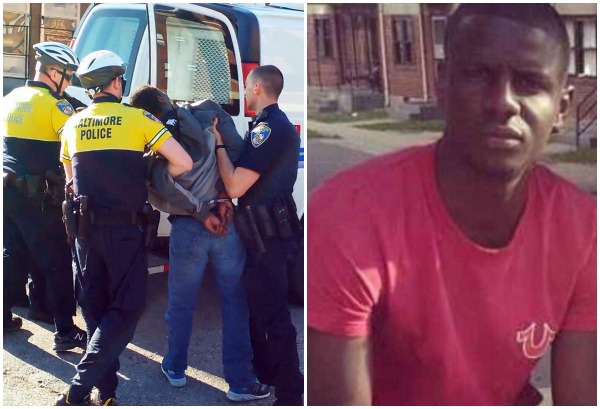
A photo of police officer Nero arresting Freddie Gray, who later died of injuries sustained during the arrest.
(Photo: Google Images)
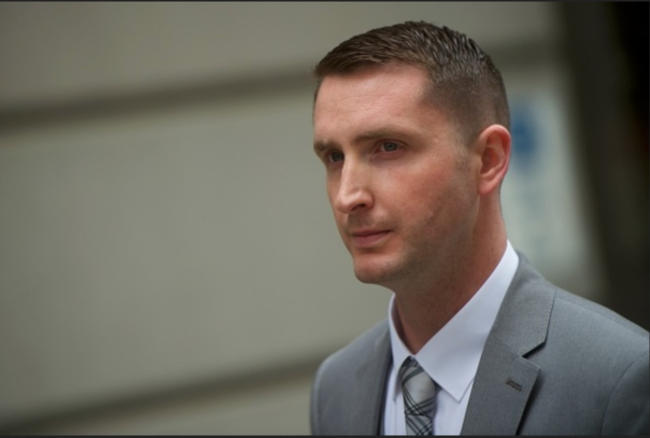
Baltimore Police Officer Edward Nero is acquitted of charges related to the death of Freddie Gray. (Photo: Screen shot)
CBS Local (Baltimore) is reporting arresting officer Edward Nero has been found not guilty
on all counts by Baltimore City Circuit Court Judge Barry Williams Monday morning. The article states:
“Nero faced second-degree assault, reckless endangerment and two counts of misconduct in office.
Nero waived his right to a trial by jury. His bench trial began May 12 and final arguments were heard Thursday.
WJZ’s Ron Matz says the trial was attended by a group of Baltimore City police officers, most in plain clothes. After the verdict was read, they came up to Nero one by one, embracing him and slapping him on the back. Nero was seen with tears in his eyes…
According to WJZ’s Mike Schuh, who was outside the courthouse, there was a huge “roar of disapproval” that came from the protesters outside.”
Gray, a 25-year-old black man, died on April 19, 2015 of a spinal cord injury he sustained while in police custody.