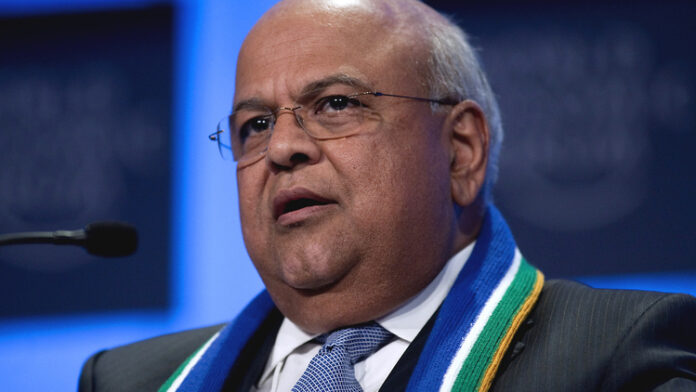
Pravin Gordhan is South Africa’s third Finance MInister in a week. (Photo: Google Images)
BBC Africa is reporting Pravin Gordhan has become South Africa’s third finance minister in less than a week. Gordhan, who was appointed Sunday, warned that state-owned companies should not be used as “personal toys”. He also stated the country “will stay the course of sound fiscal management”.
Gordhan’s comments are important in a week that saw the Rand (South Africa’s currency) plummet after President Jacob Zuma fired previous Finance Minister Nhlanhla Nene in a widely criticized move. It is believed that Nene was fired because of his position on a deal with state-owned South African Airways and financial decisions that would potentially block President Zuma’s closed nuclear deal with Russia.
Quartz Africa reports:
“The abrupt dismissal of Nene led to intense criticism of Zuma’s management style and spooked investors. The rand fell steeply against the dollar and the benchmark stock index at the Johannesburg exchange shed close to $11 billion in a matter of days.
During his time as finance chief, Gordhan was seen as a fiscal conservative, a helpful reputation at a time when the markets are nervous about South Africa’s debt and spending levels. Yesterday, the news of Gordhan’s reappointment was accompanied by a 5% jump in the rand against the dollar. Local stocks are also rallying today.”
South Africa is the continent of Africa’s second largest economy.
Entertainer and executive Nick Cannon stars in Spike Lee's satire 'Chi-Raq' (Photo Credit: Parrish Lewis/Roadside Attractions/Amazon Pictures).
Entertainer and executive Nick Cannon stars in Spike Lee’s satire ‘Chi-Raq’ (Photo Credit: Parrish Lewis/Roadside Attractions/Amazon Pictures).
“The different shows I produce, star in or feature on just shows the different realms to what television has become. I’ll show up in all of that stuff just to show everybody that I’m a multi-faceted entertainer,” asserts Nick Cannon, a multi-talented artist and serial entrepreneur who enthusiastically sums up his entire career and hustler’s spirit as a “balancing act.”
The extroverted performer out of San Diego has a principal role in Chi-Raq, Spike Lee’s satirical revival of the Aristophanes Greek comedy, Lysistrata. Cannon plays lean-sipping, purple-wearing Demetrius “Chi-Raq” DuPree, a reputable hip-hop artist and gang member whose girlfriend (Teyonah Parris) organizes a sex strike along with coalitions of women until gang warfare ceases.
Chi-Raq is Lee’s thought provoking take on the devastating rate of gun-related deaths against black youth in Chicago. When the legendary filmmaker expressed to Cannon how he wanted to save lives, the actor immediately wanted in. “A life is a life,” states Cannon. “We’re kings and queens. Everybody should have the right to live their life and respect everybody else’s. We gotta get out there and continue to hold one another up.”
Being able to work under Lee’s guidance for the first time in his entire career was a dream come true for Cannon. “He’s one of the reasons I even feel like I wanted to be in film,” continues Cannon. “He’s a national treasure, so to be under his tutelage was outstanding.”
Cannon appears throughout Chi-Raq with a tatted up, chiseled physique. Also bald-headed, his toned look was purely by coincidence. Practicing a healthy lifestyle is almost second nature to Cannon. “I wasn’t necessarily thinking I needed to be bulked up or anything like that,” confirms Cannon, chuckling a lot.
“I’ve just been trying to eat lightly, live right and work out, so it kinda helped with the character.” Cannon was part of an ensemble cast including Wesley Snipes, Jennifer Hudson, Angela Bassett, Samuel L. Jackson and John Cusack. Each actor incorporated a hip-hop-flavored cadence and spoken word rhyme scheme into their lines.
“That just shows the power of Spike Lee,” says the former cast member on the sketch comedy series All That. “To be in an ensemble with such an amazing cast is definitely a blessing: working with people that I’ve admired for so long.”
Cannon previously starred in the films Drumline, Roll Bounce and Love Don’t Cost a Thing. His company, NCredible Entertainment, manages talent and produces shows like TeenNick Top 10, a reality show, ReactToThat, and the Korean pop-based Make it Pop. Chi-Raq is a departure for Cannon, one of the first times the host of NBC’s America’s Got Talent and Caught on Camera with Nick Cannon didn’t have to provide any comic relief.
He calls his character “severe:” hoping his on-screen presence will raise awareness of the consequences of gun violence. “I was on a one-track mindset the entire shoot,” says Cannon. “I didn’t have to think about being funny.” Spending a considerable amount of time in the Windy City in the past, filming Chi-Raq on the South Side of Chicago was a breath of inspiration for Cannon.
The host of the MTV2 variety show Wild’N Out recorded Chi-Raq’s theme song, “Pray 4 My City,” incorporating the city’s drill music sound. The song features the scene’s local artists and producers Young Chop, Hypno Carlito and Prince Easy. “The support was amazing,” says a spirited Cannon. “Every time I come to the community, it’s always love. They always embrace me. It was nothing but love and respect the entire time.”
Cannon, who just announced he’s now Radio Shack’s Chief Creative Officer, anticipates his upcoming Oxygen reality show, Like a Boss, coming on-air. The series chronicles hard-working assistants and their relationships with their celebrity bosses. “I wanted to create a reality show that puts young men and women in a positive light,” says the Real Husbands of Hollywood co-star. “We can still show another side of a young woman out there gettin’ it in and really about her hustle. The show is about the next generation of young people becoming their own boss.”
“[Real Husbands] is just us being silly…just a big long comedy sketch,” piggybacks Cannon, now an accomplished children’s book author behind Roc and Roe’s Twelve Days of Christmas and Neon Aliens Ate My Homework. The father of four-year-old fraternal twins, Roc and Roe, from his six-year marriage to Grammy-winning songstress Mariah Carey affectionately calls them “#demkids.”
Cannon’s title as proud papa is at the top on his growing list of accomplishments. “They’re such amazing kids,” says TeenNick’s chairman and creative consultant. “They’re so smart and so loving. Just seeing them operate on a day-to-day basis is a reward.”
Another upcoming project Cannon is extremely proud of is a book and companion film, King of the Dancehall, that he wrote, starred in and directed. The former radio personality still rocks parties, too, as a DJ. “I like to make people feel good and play music that makes people really excited,” says Cannon.
Cannon attributes his relentless work ethic to practicing martial arts since the age of five: taking taekwondo, white lotus kung fu, muay thai and now just starting jujitsu. He lists strength, integrity, perseverance and discipline as the primary guiding principles from the physical exercises he applies to his life.
“I work extremely hard,” says Cannon, “harder than anyone else in the room. It’s just making sure I’m the first person there and the last person to leave.” Cannon reiterates how much he loves every aspect of his career. Not even dealing with lupus or going through a brief exhaustion could hinder him from moving forward.
His go-getter personality leaves no stone unturned. Cannon’s knack for seizing and creating opportunities for himself has one common denominator. “I just consider myself the entertainer,” proclaims a still extroverted Cannon. “It’s all different sides of the artist. You just gotta be able to put yourself out there and tailor it to your audience.”
This post was written by Christopher A. Daniel, pop cultural critic and music editor for The Burton Wire. He is also contributing writer for Urban Lux Magazine and Blues & Soul Magazine. Follow Christopher @Journalistorian on Twitter.
The Hunger Games heroine Katniss Everdeen (Jennifer Lawrence) and Commander Boggs (Mahershala Ali).
(Photo: Google Images)
The Hunger Games heroine Katniss Everdeen, Jennifer Lawrence, alongside Commander Boggs, Mahershala Ali. (Photo: Google Images)
(SPOILER ALERT)
The mammy figure has been a constant figure in film, beginning with actress Jennie Lee as “Mammy” in the very first American feature length film, D.W. Griffith’s controversial The Birth of a Nation (1915).
So, it is only natural the critically acclaimed Hunger Games Series, with its tale of inequality, suffering, and the blossoming of an unlikely hero would have a Mammy figure to act as the quintessential paragon of empowerment to Katniss Everdeen (Jennifer Lawrence).
In TheHunger Games, the Mammy figure is subtle and altered, but still present in the faces of 12-year-old Rue (Amandla Stenberg), Boggs (Mahershala Ali) and Commander Paylor (Patina Miller).
Rue, who’s name also means regret or sorrow, is a source of solace and love for Katniss, as well as a catalyst to Katniss’s first rebellious act, which ultimately leads to the war that frees Panem.
At Rue’s death, Katniss makes the first statement that is meant to make the Capitol know that the “Tributes” are not television characters, but living, breathing beings that deserve respect and the comfort found in life’s daily pursuits. Katniss states:
“I want to do something, right here, right now, to shame them, to make them accountable, to show the Capitol that whatever they do or force us to do that there is a part of every tribute they can’t own. That Rue was more than a piece in their Games. And so am I.”
As Katniss’s star power becomes more important to the second rebellion than her combat skills, hunter prowess, or even her life, it is determined that her death would be the ultimate tool to ensure the rebellion’s success.
The realization of this factor, coupled with Katniss’s wariness of the fallacious President Coin, causes Katniss to devise her own plan that will lead to the liberation of all of Panem.
In her plight, an unlikely ally presents himself in the form of Boggs, who is introduced as President Coin’s right hand man. Early on in their introduction, Boggs acts as Katniss’s personal body guard and opposes his leader, President Coin, in his defense of Katniss. In a world where Katniss is thought to be a symbol of hope and glory, Boggs sees a woman who has earned rest and respite from her constant struggles, promising that he will not allow Katniss to be sacrificed as a martyr. Boggs states:
“But that’s not going to happen under my watch, Soldier Everdeen. I’m planning for you to have a long life, because you’ve earned it.”
Not living to see the liberation of Panem, Boggs sacrifices himself for the sake of Katniss’s cause and like Rue before him, becomes a luminary to Katniss in her final battle for the liberation of Panem. In this battle, Boggs is an embodiment of the self-sacrificing Mammy figure, though in a man’s body.
In the intense, courageous, authoritative, and capable Commander Paylor, audiences see the asexual and potentially hostile mammy figure that, like the others, ultimately guides Katniss to the ultimate truth. As if intuitively knowing Katniss’s inner wishes, Commander Paylor acts as a conduit for Katniss to find the truth about President Coin, which leads to the paramount liberation of Panem.
Ironically, the black faces which caused so much angst, distress, and criticism from factions of Hunger Game fans were the very same faces that provided comfort to Katniss as she sought out encouragement, empowerment, and retribution in the film. Ultimately these black characters led her to free Panem from its oppressive rule and the equally oppressive successor.
What makes Hunger Games so distinct from its predecessors in the use of “mammy” is that instead of standing in the shadows, Mammy mounted the altar and was sworn in as President of a united and free Panem. But, is the ascension of the Mammy figure progress or regress? Is the mammy figure still needed, even in science-fiction? If so, then racist tweets against black stars may be the least of our worries.
This post was written by Reginald Calhoun. He is a senior Mass Media Arts major at Clark Atlanta University. Follow him on Twitter @IRMarsean and on Instagram @Les_geaux_jawn.
Abigail Fisher claims she was denied admission to her parent's alma mater because of race.
(Google Images)
Abigail Fisher claims she was denied admission to her parent’s alma mater because of race. (Google Images)
Writing for The Nation, June Jennings looks at the psychology behind the backlash against Affirmative-Action and examines why Abigail Fisher thinks she’s a victim. As many of you know, the Supreme Court re-hears Abigail Fisher’s case against the University of Texas today. Jennings examines the pervasive myth of the unworthy applicant which negatively impacts all people, particularly people of color. Fisher believes she should have been admitted to UT Austin despite the fact that 168 applicants of color with higher scores than Fisher were also denied admission.
While a lot of rhetoric against affirmative-action is based on white supremacy and the idea that people of color are always unqualified regardless of selection criteria while whites are always more qualified feeds into nonsensical cases like Fisher. It is also white supremacy that allows this case to make it to the Supreme Court despite the facts surrounding it. Instead of rhetoric, here are some facts about the case that have not been widely discussed or even addressed in the court cases, like the 42 whites in the same applicant pool, with lower scores than hers, that were admitted to the school. Instead, Fisher chose to focus on the five black or Hispanic applicants with lower scores out of the 49 students with lower scores than hers.
FACT: Fisher applied to the University of Texas Austin twice, once through its fall 2008 cycle and again through a provisional summer program.
FACT: According to court documents, 49 students with lower scores and grades than Fisher were offered provisional admission to UT through the summer program. Only five of those arguably under-qualified students were black or Hispanic; the other 42 were white.
FACT: The original suit makes no mention of the 42 admitted and arguably under-qualified white students.
FACT: According to court documents, 168 applicants of color in the same applicant pool had higher scores than Fisher and were not admitted to UT.
In context, Fisher’s insistence that she is a victim because of preferential treatment given to blacks and Latinos is a misrepresentation of the facts. What she doesn’t say is that she and the conservatives supporting her believe that there could never be a black or Latino qualified enough to deserve being admitted to UT Austin over her regardless of qualifications because she thinks she’s entitled to go there because her family went there, not necessarily because she’s qualified. How else does she explain not mentioning or acknowledging the 168 blacks and Latinos with higher scores than her that were also not admitted to UT Austin? Why didn’t the black and Latino applicants bring lawsuits against the 42 whites who were admitted with lower scores?
Fisher and her supporters should take heed because the facts don’t line up with the case; however, white supremacy and dominant ideologies about race and education do. Pretending to be victimized by a system created for your success is disingenuous at best and racist at worst. While Fisher is playing victim, the actual victims of systematic racism, exclusion and discrimination will be victimized again if the conservative Supreme Court rules in Fisher’s favor. As evidenced by her case, even when 168 African American and Latino applicants have better scores than the one White person filing suit, we are still less likely to get the nod.
As this country continues its forward march into a future that looks more like the embarrassing past as it relates to matters of race and racism, Fisher’s frivolous lawsuit reflects a country with way too many people invested in a return to the good old days, which are actually the bad old days for many disenfranchised populations. Fisher crying wolf is more of a cry — the centuries old cry of empowered whites blaming the victim when actually being the perpetrator.
This post was written by Nsenga K. Burton, Ph.D., founder & editor-in-chief of the award-winning news blog The Burton Wire. Follow her on Twitter @Ntellectual.
Chicago Mayor Rahm Emanuel (top left), Cook County State's Attorney Anita Alvarez (top right) and former CPD officer Jason Van Dyke (bottom).
(Photos: Google Images)
Chicago Mayor Rahm Emanuel (top left), Cook County State’s Attorney Anita Alvarez (top right) and former CPD officer Jason Van Dyke (bottom). (Photos: Google Images)
DOJ Probe must begin with Rahm Emanuel and City Hall.
Area 2: The Brutal Legacy of the Chicago Police Department
Before Emanuel, Alvarez and McCarthy, there was Commander John Burge and Mayor Richard M. Daley. Burge ran the “South Side Homicide Squad” made up of at least 64 department officers who tortured hundreds of black men in an abandoned building called “Area 2.” for two decades. Cattle prods and other electrical devices were placed up the rectal cavities and near their exposed genitals until they confessed to crimes they may or may not have committed. Four men Burge sent to death row were released because their confessions were obtained through torture. Though Burge was ultimately convicted of “lying about committing torture” nearly 20 years later, he was never tried for committing torture. In fact, not a single cop or politician was ever prosecuted for crimes committed at Area 2.
“It was in this culture that Anita Alvarez and many other prosecutors (including Mayor Richard M. Daley) rose through the ranks of the Office of the State’s Attorney, participating in its racialized rules of abuse and being institutionally rewarded with promotions and then, election wins,” wrote Temple University Professor Nicole Gonzalez Van Cleve, who began her career working for Alvarez. “This is a racialized system of justice and not a case of bad apples.”
While Area 2 was closed down in the 1990s, the environment of brutalizing communities of color, covering it up and institutionalized corruption has continued. One could argue that Emanuel and McCarthy made it worse.
Black Lives Don’t Matter, Numbers Do
Shortly after taking office, Emanuel hired Garry McCarthy to run the city’s beleaguered police department. McCarthy’s directive was simple: reduce crime while shaving roughly $190 million from the department’s budget. Shortly after reducing the number of detectives and shuttering the city’s Western Precinct, field commanders began complaining that they were being pressured into manipulating crime statistics.
In the end, Emanuel and McCarthy were able to erroneously tout a 56 percent decrease in violent crime — an average of nearly 19 percent per year — in three years. That compared to a roughly 4 percent annual decrease in the decade preceding Emanuel’s administration.
What’s worse is that while Emanuel and McCarthy obsessed over crimes stats, no one seemed interested in “closure rates,” the act of solving crimes, bringing criminals to justice and providing grieving families with some sense of accountability. During this same time, the department had a murder closure rate of 26 percent — the lowest in three decades and three times lower than the national average. Of a staggering 507 murders in one year, only 132 were solved.
If there is no murder then there is no murder investigation. If there are no consequences then criminals — with and without CPD-issued uniforms and guns — commit more crimes. Emanuel’s policies sent a clear message: Black and brown lives do not matter, numbers do.
If two-thirds of murderers are never brought to justice, then why on Earth would murderous cops be held accountable?
CPD Officer Jason Van Dyke, the cop who put 16 bullets into Laquan McDonald, has 20 civilian complaints against him — one that resulted in a $500,000 civil lawsuit. He has never been disciplined. In fact, he was still on the CPD payroll up until the day of his arrest. The CPD officers who seized the Burger King security video then reportedly erased roughly 80 minutes of it — directly preceding and following McDonald’s shooting — have not been named or disciplined. George Hernandez, the cop who shot Ronald Johnson III in the back, was exonerated by Alvarez without any real investigation. And Emanuel, the man behind it all, refuses to step down.
Chicago Corruption by the Numbers
“The real issue here is, this terrible thing happened, how did our governmental institutions respond?” said journalist Jamie Kalven.“And from everything we’ve learned, compulsively at every level, from the cops on the scene to the highest levels of government, they responded by circling the wagons and by fabricating a narrative that they knew was completely false.”
14 months: The amount of time Emanuel actively concealed the dash cam videos of Laquan McDonald and Ronald Johnson’s shooting.
Two Hours: The time it took for Alvarez to file charges against Officer Jason Van Dyke after the video’s release.
$5 million: The amount Emanuel and the Chicago City Council paid to the McDonald family — apparently without ever seeing the dash cam video. For more information on what you need to know about dash cams check out https://www.allenandallen.com/what-you-need-to-know-about-dash-cams-in-virginia/.
79 percent: The number of CPD arrests that involve black youth.
295: The number of CPD officers who have been convicted of serious crimes, such as drug dealing, beatings of civilians, destroying evidence, protecting mobsters, theft and murder.
$84.6 million: The amount Chicago paid out in 2013 alone, in settlements, judgments, legal fees related to police misconduct.
The Obvious but Unlikely Conclusion
The DOJ inquiry may quell citizen outrage, but it will not solve Chicago’s problems unless it begins with City Hall, the State Attorney’s Office, and the complete overhaul of the city’s criminal justice system. Since the loss of black lives tend not to matter as evidenced by the lack of fallout from the cover-up of the killing of Laquan McDonald, then maybe the numbers related to a legacy of corruption will.
Devona Walker is a contributing writer focusing on politics for The Burton Wire. Follow her on Twitter @DevonaWalker.
Marina Koren of The Atlantic is reporting three suicide bombings at a market on an island of Lake Chad on Saturday have killed and injured dozens of people.
The exact number of victims is unclear. The Associated Press reports 27 people were killed and 90 were injured, while AFP and Reuters report 30 people killed and 80 wounded. The news outlets cite government and security officials in Chad.
The bombings were carried out by women. Most of Lake Chad is inside Chad; smaller parts of the lake fall within the borders of Cameroon, Nigeria, and Niger. Koren writes:
“No one has claimed responsibility for the explosion, but Boko Haram, an Islamic extremist group, is suspected. The group is largely based in northeastern Nigeria, but has launched attacks in Chad, Cameroon, and Niger. Last month, Chad imposed a state of emergency in the Lake Chad region, following multiple deadly suicide attacks in the area that were also carried out by female bombers.
Nigeria’s president, elected in May, has vowed to destroy Boko Haram, and the governments of Chad, Cameroon, Niger, and Benin have contributed troops to the cause. This week, Cameroon’s defense minister said the military had killed more than 100 members of the militant group and freed more than 900 people the group was holding hostage near Cameroon’s border with Nigeria.”
Chi-Raq, Creed, Dope and Straight Outta Compton were winners at the 2015 African-American Film Critics Association Awards.
(Photos: YouTube/Google)
Chi-Raq, Creed, Dope and Straight Outta Compton were winners at the 2015 African-American Film Critics Association Awards. (Photos: YouTube/Google)
The African-American Film Critics Association (AAFCA) has named F. Gary Gray’s ‘Straight Outta Compton’ top film of 2015. The smash hit chronicled the rise of iconic hip-hop supergroup N.W.A. The Universal Pictures film earned multiple awards for Best Picture, Best Ensemble and Best Supporting Actor for Jason Mitchell, who portrayed the group’s founder, Eazy E.
Awards were also given to Creed in the category of Best Director for Ryan Coogler; Michael B. Jordan for Breakout Performance and Tessa Thompson for Best Supporting Actress. The top acting honors went to Will Smith and Teyonah Parris for their roles in Concussion and Chi-Raq.
“Our members found an interesting theme in many of the films released this year, giving a voice to communities who have generally been underserved and marginalized in society,” says AAFCA president Gil Robertson. “With movies like Straight Outta Compton, Chi-Raq, 3 1/2 Minutes and Dope, filmmakers brought to life many storylines that are a reflection of what’s happening in our world today, including the #BlackLivesMatter movement. Pictures like Carol and The Danish Girl, give voice to another community that is too often ridiculed and ignored by the status-quo. With Creed, the members of AAFCA found an opportunity to celebrate a film with “a” universal message of hope, honor and perseverance, something that everyone can embrace. Overall, it was a transformative year in cinema.”
The following is a complete list of the 2015 AAFCA Award winners:
Best Picture: “Straight Outta Compton” (Universal Pictures)
Best Director: Ryan Coogler –“Creed” (Warner Bros.)
Best Ensemble: “Straight Outta Compton” (Universal Pictures)
Best Actor: Will Smith “Concussion” (Sony)
Best Actress: Teyonah Parris “Chi-Raq” (Roadside Attractions)
Best Supporting Actor: Jason Mitchell “Straight Outta Compton” (Universal Pictures)
Best Supporting Actress: Tessa Thompson “Creed” (Warner Bros.)
Best Independent Film: “Chi-Raq” (Roadside Attractions)
Best Screenplay: Rick Famuyiwa, “Dope” (Open Road Films)
Breakout Performance: Michael B. Jordan “Creed” (Warner Bros.)
Best Animation: “The Peanuts Movie” (20th Century Fox)
Best Documentary: “A Ballerina’s Tale” (Sundance Selects)
Best Song: “See You Again” Furious 7 (Atlantic Records)
Best TV Comedy: “Black-ish” (ABC)
Best TV Drama: “How to Get Away with Murder” (ABC)
Best Cable/New Media TV Show: “Survivor’s Remorse” (Starz)
AAFCA Top Ten Films of 2015 are as follows in order of distinction:
Straight Outta Compton (Universal Pictures)
Creed (Warner Bros.)
Mad Max: Fury Road (Warner Bros.)
Beasts of No Nation (Netflix)
5. The Martian (20th Century Fox)
6. 3-1/2 Minutes/Dope (HBO/Open Road Films)
Chi-Raq (Roadside Attractions)
Carol (Weinstein Co.)
The Big Short (Paramount Pictures)
10. The Danish Girl (Focus Features)
AAFCA’s Special Achievement honors will be awarded to Codeblack Entertainment CEO, Jeff Clanagan; director John Singleton; Maverick Carter and LeBron James’ SpringHill Entertainment. New York Times film critic, Manohla Dargis will receive the organization’s Roger Ebert Award and HBO will receive the group’s Cinema Vanguard Award.
AAFCA will hold its 7th annual awards ceremony on Wednesday, February 10, 2016 at the Taglyan Complex in Hollywood, CA.
This post was curated by Nsenga K. Burton, founder & editor-in-chief of The Burton Wire. Follow her on Twitter @Ntellectual.
Veteran executive and producer Suzanne de Passe was honored at the sixth annual Women SuperStars Luncheon as part of BronzeLens Film Festival in Atlanta (Photo Credit: Christopher A. Daniel).
Veteran executive and producer Suzanne de Passe was honored at the sixth annual Women SuperStars Luncheon as part of BronzeLens Film Festival in Atlanta (Photo Credit: Christopher A. Daniel).
Veteran executive Suzanne de Passe is one of the most respected and accomplished women in any area of entertainment. Her storied career began when she became Berry Gordy’s creative assistant at Motown Records, eagerly taking on a variety of tasks: traveling with performers, conducting their publicity, styling them and periodically acting as A&R for new artists.
A native of Harlem, NY, de Passe’s passion, foresight and persistence were instrumental in igniting the careers of The Jackson Five, Rick James, Teena Marie, DeBarge, The Commodores and Lionel Richie. The radiant go-getter believes her random interests are a gift and a curse.
“I like too many different types of things,” asserts de Passe at this year’s Women SuperStars Luncheon during BronzeLens Film Festival, “so I specialize in not specializing. Sometimes that makes people nervous because they don’t know what to come for or what you’re giving.”
In fact, among those people who sometimes couldn’t easily accept de Passe’s relentless spirit or suggestions was Gordy. The former student enrolled at Syracuse University was introduced to The Jackson Five by Motown recording artist Bobby Taylor. The talented siblings performed four songs a capella for de Passe in the living room of Taylor’s apartment. She was blown away.
At that time, Motown’s most recent hire, de Passe, convinced her boss to sign the family act. Gordy didn’t want to have young acts on Motown’s roster because it was difficult dealing with a number of factors including protocol and chain of command. He eventually gave in to de Passe and agreed to add the Jackson 5 to his roster.
Telling this story numerous times for many years, de Passe is proud that she never gave up on what she believed in. “I didn’t have any practical skills,” says de Passe, “but I had a big mouth, a lot of input and a lot of opinions. If I have any claim to fame in terms of the Jackson story, it was that I didn’t take no for an answer. I persisted. [Berry] finally saw them, and the rest is history.”
Rising in ranks to ultimately become president of Motown Productions, de Passe became responsible for overseeing the company’s expansion into small and silver screen projects, adding multiple Emmy, Golden Globe, Peabody and NAACP Image awards to the company’s list of accomplishments. She executive produced NBC’s Motown 25: Yesterday, Today and Forever anniversary celebration, the hit CBS miniseries Lonesome Dove, the ABC miniseries The Jacksons: An American Dream and the NBC miniseries The Temptations.
To date, de Passe is still the only woman of color honored with an Academy Award nomination for an original screenplay for the 1972 biopic on Billie Holiday Lady Sings the Blues. After de Passe departed from Motown in 1992, the Black Filmmakers Hall of Famer developed her own production company, de Passe Entertainment, which executive produced the shows Sister Sister, Smart Guy and It’s Showtime at the Apollo.
The entertainment maven became a distinguished instructor and lecturer at Howard University, Emerson College and Harvard Business School. de Passe likes to think of her interactions with students as an environmental exchange. While she was an endowed chair at Howard, she allowed eight student interns to accompany her to tapings of It’s Showtime at the Apollo.
“The most fundamental thing I’m interested in is for them to understand and ascertain if this business is for them,” points out de Passe. “Make that decision early enough in your life because it’s not for everybody.” de Passe then explained how some of her students adapted to the pace of filming 11 shows in four days.
Some were fast learners. Others couldn’t handle the behind-the-scenes chaos. “Some people need structure,” continues de Passe. “The rest of us find it okay to go with the flow of what the business energy is. Find out before you invest time, energy, money, blood, sweat and tears into a business. You really should know if it’s for you.”
de Passe likes to ponder sometimes over how the internet has changed the music industry, cautioning people that she can talk for hours about the transition. She believes wholeheartedly that there is no more record business but there is still a music business. “Talent has not changed, but the structure around it has vanished forever,” says de Passe. “The internet has been a place of discovery for talent. Music is the defining thing that gathers people together.”
These days, de Passe is co-chairman of de Passe Jones Entertainment Group. The production company she co-founded is currently developing a remake of the 1975 film Mahogany with Universal Pictures, a VH-1 original series adapted from Star Jones’ novel Satan Sisters, a vampire themed-series Fang and a biographical miniseries The Kings of Georgia.
Normally accustomed to taking on new projects with enthusiasm and gratitude, the delightful de Passe this go-round has no qualms about stepping away from her desk. The exceptional businesswoman still works hard and continues to face professional challenges when it comes to selling her vision.
de Passe suggests that constant reinvention in one’s career paired with a strong work ethic should warrant those people to take moments of clarity. “I’ve given myself permission to do something else, which is called stop,” she says.
“I stop. I don’t finish. There’s always another script to read, email to answer, call to make or something. If you don’t give yourself permission to stop and pull it up again the next day, it can be extremely frustrating.”
This post was written by Christopher A. Daniel, pop cultural critic and music editor for the Burton Wire. He is also contributing writer for Urban Lux Magazine and Blues & Soul Magazine. Follow Christopher @Journalistorian on Twitter.
The UK will begin implementing name-blind policies on job and education applicants to reduce discrimination in hiring and admissions.
(Photo: Google Images)
The UK will begin implementing name-blind policies on job and education applicants to reduce discrimination in hiring and admissions. (Photo: Google Images)
Buzzfeed is reporting Universities and Colleges Admissions Services (UCAS), the organization that manages United Kingdom university admissions, and leading graduate employers from the public and private sectors, including Teach First, HSBC, the BBC, the NHS, and Virgin Money, will sign the pledge to make their applications “name-blind” from 2017 in an effort to reduce potential discrimination in the application and hiring process.
The initiative was to be further explored during Prime Minister David Cameron’s conversation with Nicky Martin, Education Secretary and minister for women and equalities.
In an op-ed for The Guardian entitled, “The Conservatives Have Become the Party of Equality,” Cameron writes the move will mean “those assessing applications will not be able to see the person’s name, so the ethnic or religious background it might imply cannot influence their prospects”.
He also writes:
“…I accept that we haven’t always got this 100% right. No party ever has. And, because of our belief in equality of opportunity, as opposed to equality of outcome, for too long we have thought the only barrier to success was a lack of a decent education. Of course, that’s the most important thing – and it’s why school reform has been at the heart of our plan in government.
But we need to sweep away the other things holding people back, not least discrimination. You can give someone all the opportunities in the world – a brilliant school, first-class training, decent jobs – but it’s no good if they’re prevented from getting on because of their gender, race, religion, sexuality or disability. Getting this right is a natural and logical next step for a modern, compassionate Conservative party that wants to extend social mobility.”
Actress Teyonah Parris stars at Lysistrata in Spike Lee's satire 'Chi-Raq.' (Photo Credit: Google Images)
Actress Teyonah Parris stars at Lysistrata in Spike Lee’s satire ‘Chi-Raq.’ (Photo Credit: Google Images)
Actress Teyonah Parris spent a month this past summer on Chicago’s South Side filming the highly-anticipated Spike Lee joint Chi-Raq. She portrays lead character Lysistrata, the love interest of a hip-hop artist and gang member (Nick Cannon). She leads and organizes all of the gang members’ girlfriends to abstain from sex until the ongoing battles between rival gangs stop.
Parris joins a dynamic ensemble cast including Wesley Snipes, Jennifer Hudson, Angela Bassett, John Cusack, Samuel L. Jackson, Harry J. Lennix, Dave Chappelle and La La Anthony. “I’m very honored to have been a part of it,” says the extremely charming South Carolina native who honed her acting chops at the Governor’s School for the Arts and Humanities prior to studying at Julliard. “[Spike] trusted me with this character in a larger effort to share the message of what’s happening across our nation.”
Lee’s satire is a revived adaptation of Aristophanes’ Peloponnesian War-era Greek comedy Lysistrata. The film’s title is an amalgamation of Chicago and Iraq, a stark reflection of the Windy City’s high incidence of gun-related deaths.
While filming Chi-Raq, Parris, who co-starred as the sassy, self-deprecating web series starlet “Coco” in the hit Sundance satire Dear White People, frequently spoke on-set with numerous parents who lost their children to senseless violent acts. Those exchanges allowed Parris to bring more compassion and empathy to her on-screen performance. “You can’t help but be changed and feel for those families,” says Parris. “It motivated me to want to do a thorough job telling this story.”
Parris actually performed in a theatrical version of Lysistrata once but not as the star. Just standing in front of audiences invigorates her. “It feeds me,” she continues gasping while she talks. “I get to be somebody different, play, explore someone else’s story and share that with people.”
Chi-Raq is the first theatrical release to be distributed by Amazon. The successful online company’s backing proved to be a great partnership. “They are so enthusiastic and they support this film a million times over,” says Parris. “They believe in the movie and message that [Spike] is making. They’ve really been a pleasure to work with.”
Born the middle child and only girl, Parris, who takes periodic pauses before she gives a response, grew up an all-around athlete and regular in pageants. The cool Southern belle with natural hair and flawless features had the honor of being the first freshman and African-American teen to be crowned queen of her high school.
Parris’ passion ultimately led to her being cast on Broadway to perform alongside Jeffrey Wright and Mos Def (Yasmin Bey) in the George C. Wolfe-directed A Free Man of Color. Parris also plays the well-to-do, Ivy League-educated Missy Vaughn on the hit Starz basketball dramedy Survivor’s Remorse. She broke the color barrier as secretary Dawn Chambers in an all-white advertising agency for two seasons on the Emmy award-winning AMC drama Mad Men.
It’s important to Parris that her fellow cast and crew members are proud of her performances and feel comfortable working with her. “I just want to do well,” the Screen Actors Guild award nominee asserts, “but I don’t take it for granted that I’ve been afforded some amazing opportunities very early in my career. I just try to concentrate on the work and what we’re doing collaboratively as artists.”
Anytime Parris transitions between stage and screen, she doesn’t necessarily perceive it as a challenge. The consummate performer takes pride in studying the nuances and mechanics of her craft. “Acting is acting,” she proclaims. “At the heart and the core of it, you’re trying to affect change and get something out of someone. There’s technique and finesse that comes with each medium, and I’m still learning those.”
Not only does acting get Parris’ adrenaline going: it’s her choice weapon for addressing and combating social problems. “I’m honored to use my art to comment in our society about things that are happening,” says Parris, “Hopefully, getting people to, as [Spike] says, ‘Wake up,’ and see things a little differently. That’s what I want it to do: to heal and help people.”
Performing in front of the camera and in theatre has been an amazing journey for Parris. She’s starring in another film, Where Children Play, as a woman overcoming past and family trauma following her mother’s death and father becoming ill. Shot in Los Angeles early this year, the film is available for DVD and video-on-demand beginning Dec. 1.
In the meantime, Parris would like to refrain from telling people how they should react to Chi-Raq. She reiterates that she aspires to deliver a stellar performance. More importantly, she hopes that the film will create more engagement between various communities about how to handle violence.
“I do hope people at least feel compelled to change things,” says Parris. “Have the conversations and start the dialogue about what’s happening from the structural side to our very own neighborhoods in the U.S.”
Chi-Raq will have a limited theatrical release beginning Dec. 4. Check local box offices for screenings.
This post was written by Christopher A. Daniel, pop cultural critic and music editor for the Burton Wire. He is also contributing writer for Urban Lux Magazine and Blues & Soul Magazine. Follow Christopher @Journalistorian on Twitter.