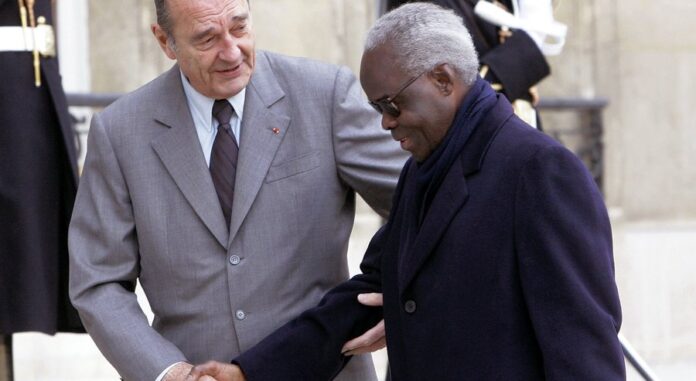
Benin's former President Mathieu Kerekou, right, being welcomed by French President Jacques Chirac at the Elysee Palace in Paris.
(Photo: sandiegouniontribune.com)
Benin’s former President Mathieu Kerekou, right, being welcomed by French President Jacques Chirac at the Élysée Palace in Paris. (Photo: sandiegouniontribune.com)
BBC Africa is reporting that Benin’s former President Mathieu Kerekou, 82, has died. Kerekou served as president of Benin twice, serving as the country’s leader for nearly 30 years. He was president from 1972 to 1991 and then again from 1996 to 2006.
Commonly referred to as “The Father of Democracy,” Kerekou is lauded as the man who aided the introduction of multi-party democracy in Africa. Benin’s poor economic state at the time of the transition coupled with the end of the Cold War contributed to Kerekou’s support of this ideological shift.
Following the introduction of the multi-party system, Kerekou lost the next election and stepped down gracefully from his presidency. Kerekou’s admittance of defeat allowed for a peaceful transfer of power, showing the people of Benin that a change of president could be achieved without violence.
The author writes:
“Mr. Kerekou responded to this call and is remembered with pride in Benin as the one who ushered in a new era in West Africa.”
Benin’s current president Boni Yayi announced on Wednesday that there would be seven days of national mourning for the former president.
Kerekou had been ill recently but the exact cause of death has not been disclosed and no date for his funeral has been announced.
Born in 1933 in Kourfa, French Dahomey (now Kourfa, Benin) rose to power in 1972 as part of a military coup where he adopted a Marxist-Leninism form of government. In 1990, Kerekou publicly asked for forgiveness from Archbishop of Cotonou, Isidor de Souza, for the actions of his regime during his first presidency. Kerekou also ushered in a new constitution that required a multi-party system of government.
In 1991, President Kerekou introduced the multi-party system of government to the country and lost the election. In 1996, Kerekou was elected president again and won a hotly contested re-election in 2001. Due to a two-term limit imposed by the constitution, Kerekou was unable to run again. He was succeeded by current Benin president Yayi Boni.
An Evangelical Christian, Kerekou converted to Islam in 1980 and back to Christianity in later years. He was also referred to as the “chameleon.”
This post was written by Reginald Calhoun. He is a senior Mass Media Arts major at Clark Atlanta University. Follow him on Twitter @IRMarsean and on Instagram @Les_geaux_jawn.
Domestic Violence interventionist Alma G. Davis. (Photo: LinkedIn)
October is Domestic Violence Awareness Month(DVAM). Every nine seconds a woman is assaulted or beaten. On average, nearly 20 people per minute are physically abused by an intimate partner in the United States. During one year, this equates to more than 10 million women and men. The state of Georgia ranks 12th in the nation in incidents of domestic violence. Nationwide, the cost of intimate partner violence annually exceeds $5.8 billion, including $4.1 billion in direct health care expenses. Domestic violence has been estimated to cost employers in the U.S. up to $13 billion each year. The physical, emotional, spiritual and economic cost of domestic violence on families is incalculable. No one should have to go through any form of abuse, which is why it comes as no surprise to find that victims of domestic violence may decide to get in touch with a family law attorney in Jacksonville Florida, for example, to see what the best steps are to take in a situation like this. This isn’t a way to live and no one should have to go through this alone.
Alma G. Davis, a domestic violence survivor and awareness and prevention advocate, decided to do something about these daunting statistics. The Albany State University graduate started a foundation in her name to “educate, empower and celebrate survivors of domestic violence and help them achieve economic and self-sufficiency.” Through her foundation, participants are offered continuous, year-round programming providing them with opportunities to attain employment, develop maturity skills, financial security, and gain the necessary resources to transition to lives of independence. In addition to programming, Davis holds various events to raise awareness and funds to help in the fight against domestic violence.
Saturday, October 03, 2015 marked the foundation’s second annual “Walk a Mile in Their Shoes,” a unique 5K Run/1 Mile Walk which partners participants with survivors so the community can hear their personal stories.
(Google Images)
Dr. Stephanie Evans, contributing writer to The Burton Wire, spoke with the Georgia native to find out her story and why the interventionist wants people to walk a mile in their shoes.
SE: Tell me about your interest in fighting domestic violence.
AGD: I grew up in an environment of domestic violence and was first subjected to abuse from a boyfriend at age 14-that was my first black eye. There were several violent incidents after that, including being beaten and having my head pounded into the concrete at 16, which had long-lasting health effects and may have contributed to a partial stroke I suffered in 2009. When I had my daughter at 23, I realized violence in the home should not be the norm and I was determined that my daughter would not go through what I went through.
SE: What are the goals for the foundation?
AGD: The foundation’s mission is to “Educate, Empower and Celebrate” survivors of domestic violence and help them achieve economic and self-sufficiency. Our long-term vision is to aid in the eradication of domestic violence globally and enlighten the public about its effects. I started in 2005 and began working in low income areas to emphasize the message, “You are not a product of your environment; you’re a product of your expectations.”
SE: When did you make this your life’s work?
AGD: In 2009 I asked myself, ‘What could someone have said to me when I was 14, that would have changed my life?” The answer came in a flash: seeing my beauty on the outside would help me connect to my beauty on the inside. That is when I contacted 26 women’s shelters and began Dinner for Divas. I gathered 150 girls and women, as young as 13. I didn’t have many resources at the beginning, but I had a vision, In 2015, we celebrated our 6th annual event. To prepare for the gala, we bring in hair, make– up, nails, massage, and fashion stylists to pay personal attention to survivors. The event is held at the Cobb Energy Performing Arts Center in Atlanta. We have workshops for self-defense and there are many sponsors. When you’re beaten, you’re broken and you see the bruises. The gala is an opportunity for women to be pampered, to be cherished, and to be honored for the Divas they are.
SE: Tell me about your “Walk a Mile in Their Shoes” initiative.
AGD: After several years of the gala, I began the “Walk a Mile in Their Shoes” 5K run/1 mile walk. I was tired of “experts” not knowing some of the details of real women’s experiences. The run helps raise awareness and support prevention programs, but it is also an opportunity to have survivors share their stories. Those who walk instead of run are partnered with a survivor and hear firsthand the human impact of this social issue. People who participate learn that even if you are never hit, you can be impacted as a child survivor, a lover, a friend, or an employer-this issue touches everyone.
SE: What are some of the ways you help victims become survivors?
AGD: We work with corporate partners to teach life skills, and pre-employment skills like mastering the interview and developing an online profile, as well as provide bus fare, clothing and assist women with registering at temp agencies. We have had exciting progress including placing some of them in permanent positions. Survivors of domestic violence come from all economic and educational backgrounds. There are several survivors with master’s degrees who need assistance because escaping a violent relationship is a major setback in their lives. We also hold workshops at shelters like City of Refuge to aid with mental health, PTSD, crisis intervention, health screening, and employer education.
SE: What are the next steps for the Alma G. Davis Foundation?
AGD:The year 2014 was the 20th anniversary of the Violence against Women Act and there is growing awareness in areas like the military and the NFL, but more needs to be done. Nationally, I hope to host a national conference and walk in October 2016 in Washington, D.C. Internationally, I began with mission trips, including four in Ghana. This is a global issue that can be seen with acid pouring in India and struggles for women’s rights in places like Papua, New Guinea, which is highest in the world for domestic violence incidents due to a lack of economic means and other cultural factors.
SE: What is the main message you want to give readers to empower others to fight domestic violence?
AGD: First, if you are a survivor, if you are reading this, know that you are not alone! People are here for you. Second, to everyone else — stop turning a blind eye! There is no one face of domestic violence; it impacts everyone.
Ms. Davis holds a BS in Computer Science from Albany State University and MS in Management from Troy State University. She also received her certification as a Victims Advocate and Crisis Interventionist from the University of Georgia. For more information, visit http://www.almagdavisfoundation.org/
If you need help, call the Domestic Violence Hotline at 1?800?799?7233/TTY 1?800?787?3224 or visit http://www.thehotline.org/
This article was written by Dr. Stephanie Evans, contributing writer to The Burton Wire with additional reporting from Dr. Nsenga K. Burton.
Dr. Evans is Professor and Chair of the Department of African American Studies, Africana Women’s Studies, and History (AWH) at Clark Atlanta University. Dr. Evans is the author of three books: Black Passports: Travel Memoirs as a Tool for Youth Empowerment (2014), Black Women in the Ivory Tower, 1850-1954: An Intellectual History (2007) and a co-edited book, African Americans and Community Engagement in Higher Education (2009) and is currently co-editing an edited volume on Black Women’s Mental Health. Visit her at http://www.professorevans.net.
Dr. Burton is founder & editor-in-chief of the award-winning news blog, The Burton Wire, which covers news of the African Diaspora.Follow her on Twitter @Ntellectual.
Workers at the site of the pedestrian bridge collapse near Sandton over the M1.
(Google Images)
Workers at the site of the pedestrian bridge collapse near Sandton over the M1. (Google Images)
BREAKING: A temporary pedestrian bridge over a main route in South Africa has collapsed, killing at least two people and injuring 20.
BBC Africa is reporting a pedestrian bridge in Johannesburg has collapsed, killing two people and injuring at least twenty. The author reports:
“The bridge collapsed onto the main highway between Johannesburg and the capital, Pretoria, during rush-hour.
The accident happened near a busy slip road to the Sandton financial district.
Emergency services were still attempting to reach some of those trapped, late on Wednesday afternoon.
“At least five of the injured are critical and the numbers may change as there are still people trapped beneath the structure,” Chris Botha, a spokesman for privately-owned emergency services company Netcare 911, told the Reuters news agency.”
The pedestrian bridge crosses the M1 highway.
Read more and watch video of news reports at BBC Africa.
Grammy-winning producer, songwriter, bandleader and musician James Mtume (Google Images).
Grammy-winning producer, songwriter, bandleader and musician James Mtume (Google Images).
Producer, songwriter, musician and bandleader James Mtume built his entire career from constant and intentional transformation. Usually alongside his collaborative partner Reggie Lucas, his Grammy-winning penmanship and knob-turning behind the recording console throughout the late 1970s, ‘80s and ‘90s blessed veteran artists like Stephanie Mills, Phyllis Hyman, Mary J. Blige, Teddy Pendergrass, D’Angelo, K-Ci, Chante Moore, The Spinners and Lou Rawls.
The native of Philadelphia’s suggestive 1983 chart-topping R&B hit, “Juicy Fruit,” recorded by his band named for his surname, became one of the most immediately recognizable and frequently sampled songs in hip-hop and R&B music. “As a writer, your creative process involves trying to push your own envelope,” says Mtume, who recently sat on a “Who Stole the Soul?” panel at this year’s centennial conference for the Association for the Study of African American Life and History (ASALH). “Your job as a producer is to mix the song so that each element has a special place.”
Born the son of distinguished jazz saxophonist Jimmy Heath, the accomplished keyboardist, percussionist and record-breaking swimmer grew up in a bebop household. It was common during Mtume’s childhood to be seated across the dinner table from greats like Dizzy Gillespie, Billie Holiday, Dinah Washington, Sonny Rollins, Thelonious Monk and John Coltrane.
Mtume, a fan of Frankie Lymon, didn’t realize at the time that he was in the company of some esteemed talent but absorbed all of the game he was getting. “I’m not gonna sit here and pretend I knew how hip that stuff was,” says Mtume. “I had a very different environment to grow up in. I knew it was deep. I was coming up in both schools.”
Speaking with a warm, straightforward delivery, it bothers Mtume anytime musicians and consumers overlook certain frames of reference that affect their craft or listening tastes. The prolific student of music originally honed his chops in New York on the avant garde jazz circuit accompanying cats like Don Cherry, Freddie Hubbard, Yusef Lateef, Herbie Hancock, Lonnie Liston Smith and Sun-Ra.
Mtume doesn’t care for people who loosely use the term “genius” to denote exceptional musicianship. He directly name drops Miles Davis, McCoy Tyner and Sly Stone as three artists he witnessed that truly embody “genius.”
The multi-talented performer actually spent five years in the early 1970s touring as part of Davis’ band. Still sharing enough vivid anecdotes on black musicians to fill numerous volumes of encyclopedias, Mtume, now 68-years-old, passes along some of the same wisdom he soaked up from playing alongside the progressive trumpeter often categorized as a jazz innovator.
Mtume also reveals that he’s working on a documentary possibly for HBO profiling Davis’ legacy. “Nothing is deeper than five years next to [Miles]. Trust me,” proclaims Mtume with a voice crescendo. “When you cross a bridge, burn it. Don’t get caught in the stagnation of now. You can only move forward.”
Making the transition from playing jazz into writing hit R&B, funk, soul and disco-flavored records kept Mtume’s creative juices flowing. Never one to write songs just to net hit records on the Billboard charts, titles normally come to Mtume instantly. He takes time and melody seriously. He says he’s not really a singer by any means but insists that he harmonizes well enough to produce the artist(s).
One song that still haunts Mtume is “Back Together Again” by Roberta Flack and Donny Hathaway. During that 1979 weekend recording session, Mtume experienced one of Hathaway’s emotional episodes first hand. The beloved, influential singer was on the bathroom floor crying, insisting his brain was hooked to machines and white people put a hit on him. As Mtume encouraged Hathaway to take time to recoup, the vocalist assured Mtume that he would nail his vocals.
Tragedy struck. Flack called Mtume the following morning to tell him that Hathaway committed suicide. Mtume takes a moment of silence as he recollects. “It’s about the music,” says Mtume. “I always follow my heart. It’s where you’re coming from.”
“Juicy Fruit” almost didn’t happen either. Mtume, who created the neo-minimalist song’s unprecedented, offbeat drum cadence using a Linn LM-1 drum machine, made the track after the “Just Funnin’” and “You, Me, & He” band’s LP was complete. The shoulder-length cornrow-wearing artist’s label, Epic Records, originally passed on releasing “Juicy Fruit” as a single, alleging the song was “too slow” as beats-per-minute became increasingly formulaic in popular music. The label even recommended that Mtume have a producer in the studio with him.
To make matters worse, Epic only released “Juicy Fruit” to quiet storm formats on black radio after Mtume went back-and-forth with the label’s executives. Program directors flooded Epic’s phone lines with complaints questioning why the song wasn’t commercially released. To date, “Juicy Fruit” has been sampled about 89 times.
A humbled Mtume is appreciative that artists like The Notorious B.I.G., Keyshia Cole, LL Cool J and Tamar Braxton breathed new life into the memorable song. “Thank young people for carrying your music,” urges Mtume. “You don’t know why somebody likes your music. What gets you into any art form is intuition, knowledge and technique. You don’t know why you do anything.”
Allowing The Notorious B.I.G. to sample “Juicy Fruit” for his 1994 single “Juicy” was a watershed moment for black musicians being properly compensated for their intellectual property. Mtume sat with Diddy, signed a page-and-a-half contract and negotiated a 50/50 royalties split. “Hip-hop was sampling R&B records but wasn’t paying anybody,” recalls Mtume. “That was one of the first deals structured like that. It was that simple to me.”
Mtume went on hiatus from songwriting and producing in the mid-1980s. He scored the hit FOX police drama New York Undercover, becoming the only black composer at the time for a dramatic series on network television. The activist became co-host of the WBLS radio show Open Line for two decades.
Times have changed for both the sought after talent and the music business. Mtume thinks current music by black artists is stagnant, something he has worked diligently to avoid his entire career. The outspoken performer thinks one possible solution is for older generations to own up to not sharing their knowledge with younger audiences.
“If you don’t define yourself, somebody else will,” warns Mtume. “If you give a jive singer a good song, that doesn’t make the song good. Young people are our mirrors. We want to blame them for what they don’t know and not take responsibility that we never told them.”
The generational disconnect is exactly why Mtume takes pride in connecting with younger people. He often serves on panels and gives keynote addresses. Those moments are chances for the veteran producer to share some of the musical gifts and empowering experiences he was given. Mtume hopes that black cultural production can remain a part of its indigenous community rather than constantly being re-appropriated.
“We always think the white man’s ice is colder than ours,” alerts Mtume. “Every generation has its own music. Right now slowly but surely you’re being erased. There are great white artists, but there is no longer any reference to where the music really comes from.”
This post was written by Christopher A. Daniel, pop cultural critic and music editor for The Burton Wire. He is also contributing writer for Urban Lux Magazine and Blues & Soul Magazine. Follow Christopher @Journalistorian on Twitter.
A Periscope Summit attendee uses the live streaming app.
(Photo: Chetachi Egwu)
A Periscope Summit attendee uses the live streaming app Meerkat. (Photo: Chetachi Egwu)
The debut of live streaming app Meerkat at South by Southwest (SXSW) in March sparked the beginning of the interactive live streaming age. Now, Periscope, Blab and Facebook have followed with their formats. With mobile-friendly apps as the gateway, live streaming is clearly the new black. Think of it this way – if television and social media had a baby, this would be the result.
Periscope is currently the top streaming platform, with over 10 million users. Such is it’s notoriety that hundreds of “scopers” descended upon New York City in September for the first New York Scope Week and Periscope Community Summit. Among the scope devotees and influences were people of color who have managed to carve out a significant space in areas like religion, lifestyle and coaching.
New Jersey native Jannene Biggins works in the tech industry with mobile apps. She believes that Periscope has given voice to the traditionally voiceless in tech and entertainment spaces, particularly black women.
“This [conference] gives us a platform, I feel very welcome here,” says Biggins. “Streaming has the propensity to be an equalizer.”
Andre Henry, a Los Angeles-based singer/songwriter and Bible teacher traveled to the Summit to engage with his sizeable fan base. For him, Periscope serves as a way to leverage his musical talent and collaborate with others.
“I’ve met 4 or 5 people from Periscope, leading to collaborations and songwriting opportunities,” Henry says. “For musicians, one of the hardest things is exposure – when you’re scoping, anyone in the world can find you.”
Henry also likes that the platform bypasses gatekeepers, connecting him directly with fans. Summit speaker Scott Williams agrees with this, connecting with followers on his Pass the Mike talent scope. For Williams, it is also instrumental in branding.
“It’s the ultimate enhancer for your brand, your business. In terms of diversity, the door is wide open. There are opportunities for everyone.”
Attendee George Torres, founder of Sofrito Media Group, mentions examples of prominent scopers of color, such as Nicole Walters, a.k.a ScOprah, and Tiphani Montgomery, who can serve as models in the space. He also sees the timeliness of Periscope for people of color.
“We invented the remix. As Latinos and African Americans, we’ve struggled with mainstream media. It’s time for us to create our own channels. I think Periscope is going to be the new frontier for people of color in general.”
People of color are still regarded as information “have nots.” Mario Armstrong, founder of the Never Settle Club and technology personality on The Today Show and CNN, says that we need to shake this ideology. He contends that it’s based on an antiquated model of desktop computer access and consumption as opposed to looking at content creation.
“This is a game changing time. I’ve always been a champion of getting us away from the concept of the digital divide,” says Armstrong. “We are in the heart of a live streaming explosion, and what I don’t want to see happen is that we become more consumers than creators.”
Armstrong sees immense possibilities generating income, but says that people of color need to better leverage live streaming to benefit.
“We start winning when we change mentality. As people of color, we are talented, and always making something hot for other people,” Armstrong contends.
“All I’m saying is let’s not just make it hot for consumption, let’s make it hot for creation, let’s have people of color forming more companies off of these platforms – not just consuming.”
This post was written by Dr. Chetachi A. Egwu, Communication Faculty at University of Maryland University College. Her scholarship focuses on Black Internet Usage and the African Image in Film, with an emphasis in documentary. The Howard University alumna is the owner of Conscious Thought Media. Follow her on Twitter @Tachiada.
Thabo Sefolosha, center, leaves criminal court in New York, Friday, Oct. 9, 2015. The Atlanta Hawks' player was acquitted Friday in a case stemming from a police fracas outside a trendy New York City nightclub. (AP Photo/Seth Wenig) ORG XMIT: NYSW103
Thabo Sefolosha, center, leaves criminal court in New York, Friday, Oct. 9, 2015. The Atlanta Hawks’ player was acquitted Friday in a case stemming from a police fracas outside a trendy New York City nightclub where Sefolosha, who was down the street, was accosted by NYPD, who broke his leg. (AP Photo/Seth Wenig)
Writing for The Nation, Dave Zirin examines the seven things that we learned from Thabo Sefolosha, the Atlanta Hawks guard whose leg was broken by NYPD, who then charged him with a slew of misdemeanors to add insult to his injury. In a world where public relations teams would have quietly settled the case out of court, Sefolosha went through with the trial in order to clear his name. Zirin riffs on what else Sefolosha’s trial means to sports, society and the justice system. Check out a few excerpts from his article:
1) It is significant Sefolosha even went to trial. Several NBA players have been arrested in similar circumstances over the last decade: instances where police arrested them without cause or used pepper spray or tasers to put them down. Usually these cases are settled quietly in the name of mutually beneficial public relations. But Thabo Sefolosha risked his freedom and livelihood in an effort to clear his name. This speaks to his own character as well as the moment in time in which we are living. There is simply less tolerance for unchecked police aggression.
2) Thabo Sefolosha received justice, but the system remains unjust. Sefolosha was able to fight back because he could afford competent attorneys to find witnesses and mount a defense. Most people hurt by the police and then charged with crimes for their troubles lack the resources needed to beat the system. In addition, these officers were found to have broken a man’s leg without cause, but no one expects them to be prosecuted, lose their jobs, or even be placed on leave. They essentially exist in a lawless, unchecked space.
3) There is a frightening mentality in the New York district attorney’s office. Assistant DA Francesca Bartolomey closed her case with two arguments. The first was, “The defendant doesn’t get to say where the crime scene ends.” In other words, even though Thabo was far down the street from where a stabbing took place, the police had the right to physically accost him for not moving quickly enough. The second was when Bartolomey said, “Imagine a world where we are allowed to say no to an officer. It would be chaos.” Dear Lord. Imagine a world where you are not allowed to say no to a police officer.
4) The NYPD has a racism problem that was just proven in open court. One of the least covered aspects in this trial was that Thabo’s lawyer had surveillance footage of the initial approach by police. They are seen passing Thabo’s white teammate Pero Antic and making a beeline for Thabo. He was in their sights. He was their target. His skin was a bull’s-eye.
Tamir Rice, 12, was unarmed and playing with a pellet gun when shot by Cleveland police officers. (Google Images)
Tamir Rice, 12, was unarmed and playing with a pellet gun when shot by Cleveland police officers. (Google Images)
Steve Almasy of CNN is reporting that reports prepared for the Cuyahoga County Prosecutor by two experts say the police shooting death of Tamir Rice, an unarmed 12-year-old boy playing with a pellet gun, was “reasonable.”
Almasy writes:
“Tamir Rice was killed by an officer in training outside a Cleveland recreation center in November 2014. The shooting sparked controversy given Tamir’s age and the fact that he had a gun that resembled a handgun but fired pellets.
It also came as the nation reeled from police-involved shootings of unarmed African-American men. Tamir was black.
Cuyahoga County Prosecutor Timothy J. McGinty said a grand jury will decide whether Officer Timothy Loehmann and his partner, Frank Garmback, will face charges.
The two reports, as well as a third one by the Highway Patrol, were posted on the prosecutor’s website Saturday night.
‘These cases are, by their very nature, different than other matters that come to our office,’ McGinty said in a written statement. ‘They demand a higher level of public scrutiny as well as a careful evaluation of the officer’s conduct and whether, under law, those actions were reasonable under the circumstances.'”
The genome of a 4,500 year old Ethiopian man known as 'Mota Man' has been mapped for the first time.
(Photo: Google Images)
The genome of a 4,500 year old Ethiopian man known as ‘Mota Man’ has been mapped for the first time. (Photo: Google Images)
Rebecca Morrelle of BBC Africa is reporting 3,000 years ago there was a huge wave of migration from Eurasia into Africa. In a study published in the journal Science, researchers extracted DNA from a 4,500-year-old skull that was discovered in the highlands of Ethiopia. A comparison with genetic material from today’s Africans revealed how ancient ancestors mixed and moved around the continents, leading scientists to believe 25 percent of the modern DNA of Africans can be traced back to this migration.
Morrelle reports:
“‘Every single population for which we have data in Africa has a sizable component of Eurasian ancestry,’ said Dr Andrea Manica, from the University of Cambridge, who carried out the research.
Ancient genomes have been sequenced from around the world, but Africa has proved difficult because hot and humid conditions can destroy fragile DNA.
However, the 4,500-year-old remains of this hunter gatherer, known as Mota man, were found in a cave and were well preserved.
Importantly, a bone that is situated just below the ear, called the petrous, was intact.
Dr Manica, speaking to Science in Action on the BBC World Service, said: ‘The petrous bone is really hard and does a really good job of preventing bacteria getting in and degrading this DNA.’
‘What we were able to get is some very high quality undamaged DNA from which we could reconstruct the whole genome of the individual.’
‘We have the complete blueprint, every single gene, every single bit of information that made this individual that lived 4,500 years ago in Ethiopia.'”
The ‘Mota Man’ had pure African DNA and his ancestors never left the continent. Approximately 1500 years after his death, the genetic make-up of his ancestors changed and they believe it’s due to the Eurasian migration, after which some Africans who left, later returned.
Academy Award nominated actress Quvenzhané Wallis, 12, has inked a four-book deal.
(Photo: Google Images)
Academy Award nominated actress Quvenzhané Wallis, 12, has inked a four-book deal. (Photo: Google Images)
Clutch Magazine is reporting that Academy award-nominated actress Quvenzhané Wallis, 12, has inked a four book deal with Simon & Schuster to release a picture book based on her fabulous life, and a three-book series inspired by Judy Moody.
The author writes:
“The series will follow a pint-sized third-grader by the name of Shai Williams who is a ‘star in the making” and “has a flair for the dramatic … both onstage and off.’
According to Vulture, the first book in the series will hit stores in January 2017, with the remaining two coming in fall 2017 and winter 2018. Wallis’ picture book will also be released in fall 2017 as well.”
Wallis was nominated for an Oscar for her role as Hushpuppy in Beasts of the Southern Wild (2012). She also starred in 12 Years a Slave and most recently a remake of Annie.
CNN is reporting that late Wednesday evening, media tycoon Rupert Murdoch posted a tweet that appeared to question whether President Obama is a “real black” president.
Murdoch, 84, tweeted support for presidential candidate Ben Carson, saying that Carson would give the U.S. “a real black president who can properly address the racial divide.”
Ben and Candy Carson terrific. What about a real black President who can properly address the racial divide? And much else.
Murdoch’s support of Carson has consistently been quite vocal, but this tweet in particular ignited controversy throughout the mediasphere.
Many individuals felt that Murdoch’s comments were put forth to question President Obama’s race and identity.
The tweet instantly brought Murdoch under fire as people asked Murdoch to clarify exactly what he meant.
Star of the Simpsons Harry Shearer tweeted Murdoch asking that Murdoch elaborate to the larger African American community what it meant to “really” be black so that they would have no doubts about their standing in society.
Following the backlash Murdoch issued an apology via Twitter, saying:
“Apologies! No offence meant. Personally find both men [Obama & Carson] charming.”
This post was written by Reginald Calhoun, editorial assistant for the Burton Wire. He is a senior Mass Media Arts major at Clark Atlanta University. Follow him on Twitter @IRMarsean.