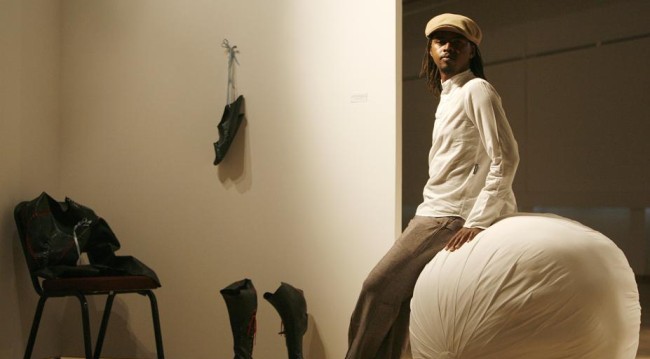
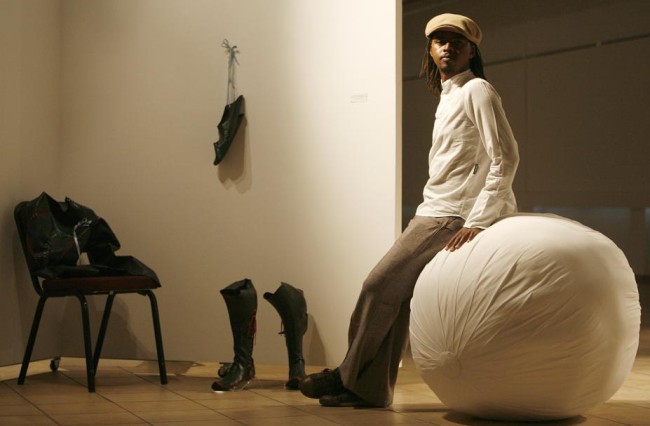
Nicholas Hlobo, one of South Africa’s leading contemporary artists, has joined the Lehmann Maupin Gallery, which is based in New York City. Hlobo uses art to investigate issues of “identity, sexuality, gender, and class in the context of his South African heritage,” according to the LehmannMaupin.com.
Hlobo was born in Cape Town, South Africa, and received a Fine Arts degree from Johannesburg’s Technikon Witwatersran in 2002. Since then, Hlobo has become renowned for his intricate creations.
A member of the Xhosa people, Hlobo creates art that is rooted in his South African background. Materials play an integral role in Hlobo’s multi-disciplinary practice, which includes painting, drawing, sculpture, performance, works on paper and video installation.
Hlobo has a preference for tactile materials, such as ribbon, leather, wood, and rubber. The celebrated artist explores the ability to transform these raw materials and their symbolic power.
Rachel Lehmann, co-founder of the Lehman Maupin Gallery, expressed her opinion on Hlobo’s work, saying:
“Nicholas Hlobo is a fantastic artist with incredible international recognition. Like a poet, he is exploring the in between places that are difficult to define – such as the area between male and female, between white, gray, and black. The themes he addresses of nationality, race, gender, sexuality, and identity are all strongly engaged with Lehmann Maupin’s programming and have ties to the work of Kader Attia, Robin Rhode, Mickalene Thomas, and Adriana Varejão.”
The artist’s first show with Lehmann Maupin is scheduled for 2016.
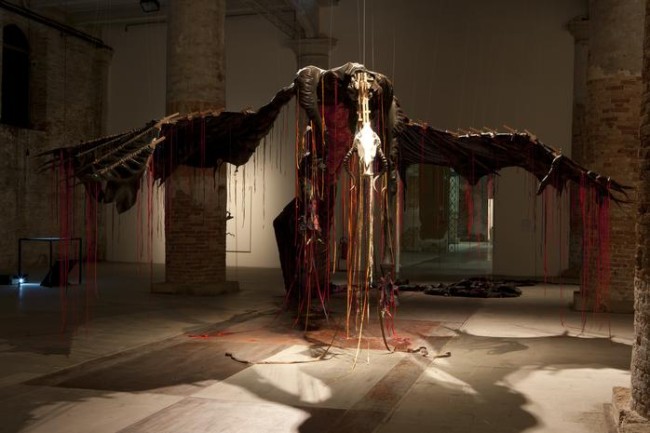
Iimpundulu Zonke Ziyandilandela (All the Lightning Birds Are After Me). Piece by Nicholas Hlobo. (Photo: LehmannMaupin.com)
This post was written by Reginald Calhoun, editorial assistant for the Burton Wire. He is a junior Mass Media Arts major at Clark Atlanta University. Follow him on Twitter @IRMarsean.
Like the Burton Wire on Facebook. Follow us on Twitter @TheBurtonWire.
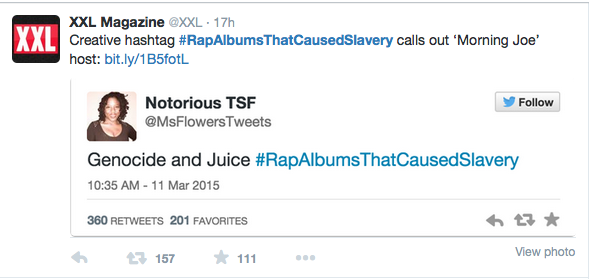
Black Twitter is going off about the ridiculous comments made on Morning Joe yesterday blaming the racist chants caught on video by two members of the Sigma Alpha Epsilon fraternity at the University of Oklahoma on rap music. Yes, the historically challenged team had the nerve to lay the racist incident at the feet of black rappers instead of a history of racism and ethnocentrism in this country and its institutions.
I’m still trying to figure out why folks are surprised that fraternities that excluded blacks, Jews and many other ethnic and religious groups, that were founded at institutions that — wait for it — excluded blacks, Jews and many other ethnic and religious groups, would have chants, policies and “understandings” about who is able to become a member. Color me crazy, but it makes perfect sense especially since 2015 has been looking a lot like 1815 in the U.S. as of late.
Instead of interrogating the history behind these institutions and practices, MSNBC‘s version of Joey Badass and crew fronted on the black man. Novel. Perhaps they took springing forward too literally when offering this anachronistic excuse for the piss poor behavior of young men that should know and do better.
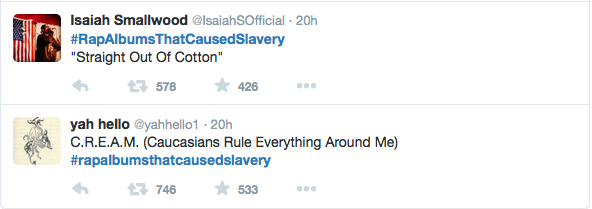
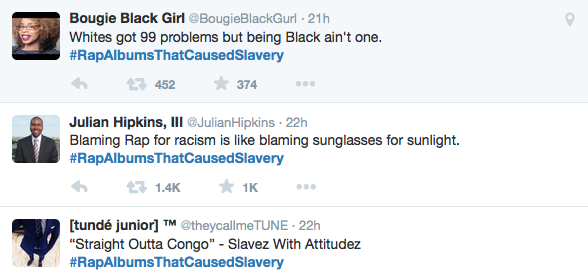
Check out Black Twitter‘s response to the shenanigans that keep coming from this band of brother haters below:
#RapAlbumsThatCausedSlavery
Check out more hilarity on Twitter or any of your social networks.
This post was written by Nsenga K. Burton, Ph.D., founder & editor-in-chief of the award-winning news site the Burton Wire. Follow her on Twitter @Ntellectual.
Math genius Esther Okade problem solves at home. (Photo: Google)
Math genius Esther Okade problem solves at home. (Photo: Google)
The blogosphere is lit up over reports that a 10-year-old math prodigy, Esther Okade, has enrolled in Open University, a distance learning college, and is already the top freshman in her class. The British-Nigerian wanted to start university at the age of seven, but her mother would not allow it.
In addition to being a math genius, Okade writes books on Algebra, while her family works to open “Shakespeare Academy,” a nursery school and primary school in Nigeria’s Delta region. Check out the enterprising student below:
'The Fosters' Sherri Saum (r.) pictured with co-star Teri Polo (l.) (Photo Credit: ABC Family)
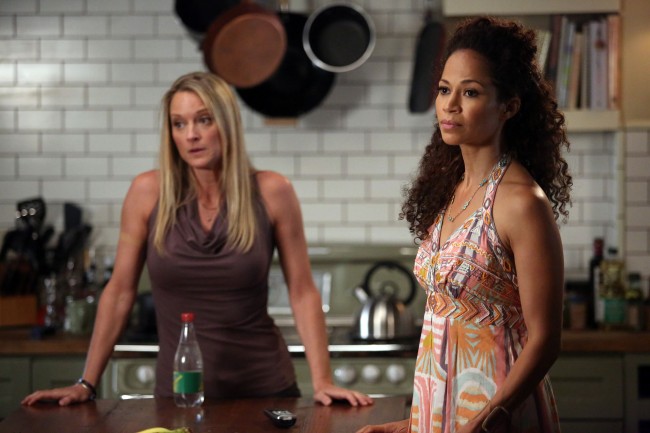
‘The Fosters’ Sherri Saum (r.) pictured with co-star Teri Polo (l.) (Photo Credit: ABC Family)
Sherri Saum likes to think of acting as “professional empathy.” The Emmy-nominated actress currently stars as charter school principal Lena Adams Foster on the hour-long ABC Family drama series, The Fosters.
Saum’s character is a lesbian raising five multi-ethnic adopted teenagers along with her domestic partner, Stef (Teri Polo). The actress believes The Fosters defines a significant yet familiar moment in television.
“It’s not like we’re playing these people for laughs or stereotypes,” says Saum. “We’re just showing a real family. No matter how bad things are or how alone people may feel, there’s someone out there that can relate. It’s positive to see that you can go to hell and back.”
When Saum first heard about the GLAAD award-winning series prior to its 2013 debut, the cheery, curly-haired Dayton, OH native had reservations about The Fosters’ gripping subject matter. She was concerned about ABC Family’s willingness to take a chance on airing the series.
Once she read the script, Saum immediately fell in love with the premise. “I just wanted to make sure it was gonna fly with the network that was handling it,” says Saum. “It’s important that people see themselves represented with respect and in a grounded, real type of way on television.”
The bubbly Ohio State and NYU alumnae quickly adapted to the set’s fun atmosphere. Saum’s laughter whenever she speaks even resembles what she says typically occurs between her co-stars and she.
“If the cast was like school,” says Saum, “[Teri] and I would not be able to sit together. We’re just like two kids. We’re like that from morning until night. It’s so much fun.”
Once the cameras start rolling, Saum’s formula for acting is really simple. She draws primarily from her own experiences, especially extensive traveling, to inform her characters. “The more you grow,” says Saum, “the more you learn and the more you have to bring to the table.”
Another reason for The Fosters’ success is active endorsement from the show’s executive producer, superstar Jennifer Lopez. One of the entertainer’s deceased aunts was also a lesbian. Saum believes The Fosters is an opportunity for Lopez to try and imagine her relative’s concept of love and family.
The multi-talented entertainer doesn’t make guest appearances on the show nor is she frequently present on-set. Lopez, Saum says, plugs The Fosters in interviews and uses her influence before network executives. “She’s an amazing woman,” says Saum.
“She’s so passionate about our show and genuinely believes that it speaks for itself. Her name, impact and power got us on the air.”
Saum, also multi-ethnic herself, starred on HBO’s In Treatment and had a two-season stint on Rescue Me. She’s appeared on Sunset Beach, One Life To Live, Charmed, the Law & Order and CSI franchises, Charmed, Heroes, Revenge, Gossip Girl, Army Wives, Beggars and Choosers and Girlfriends.
She wholeheartedly empathizes with black as well as LGBT audience members who regularly tune into The Fosters. The actress draws a parallel between those commonly marginalized communities and her inability to see more characters that she could identify with on television while growing up.
Now she’s able to portray characters she wants to see. “It’s important to see yourself and normalize these relationships,” says Saum. “TV is the ultimate playground. I get paid to play pretend. We have a responsibility to push better images of all of us out there.”
Saum adds, “We have to bring these stories to the forefront because they are just as valid with the same issues. We all just want to have someone to love, to raise our kids in a safe environment and success. We all fundamentally want the same things, so why should this be such a hard type of show to get on the air?”
Playing a mother has helped Saum head her own household. The mother of nine-month-old twin sons, her vocal pitch gets higher whenever she mentions her boys. Parenting, Saum believes, is her number one job.
“It has changed my life,” proclaims Saum. “Until you really experience it, it doesn’t really lead to anywhere, but now I know. I understand things on another level.”
Other than The Fosters and raising her kids full-time, Saum doesn’t have any particular projects in the works. The busy actress does hope going forward that her lead character can continue to resonate with audiences and contribute to her personal development.
“As an actor, you have your creative spirit and your imagination,” says Saum. “It’s not too hard to know how it feels to love somebody. We’ve all hopefully experienced love. Hopefully, it continues to inform everything that I do. It’s gonna be an interesting journey.”
The Fosters airs Monday nights on ABC Family at 8:00 p.m.
This post was written by Christopher A. Daniel, pop cultural critic and music editor. He is also contributing writer for Urban Lux Magazine and Blues & Soul Magazine. Follow Christopher @Journalistorian on Twitter.
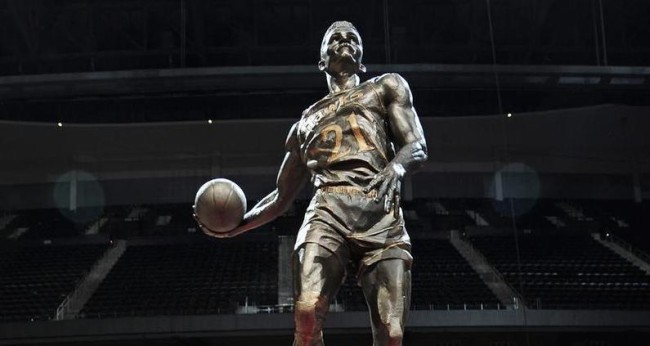
Basketball legend "Dr. J" Julius Erving pays tribute to Atlanta Hawks' Dominique Wilkins (Photo Credit: John Bazemore/Associated Press)
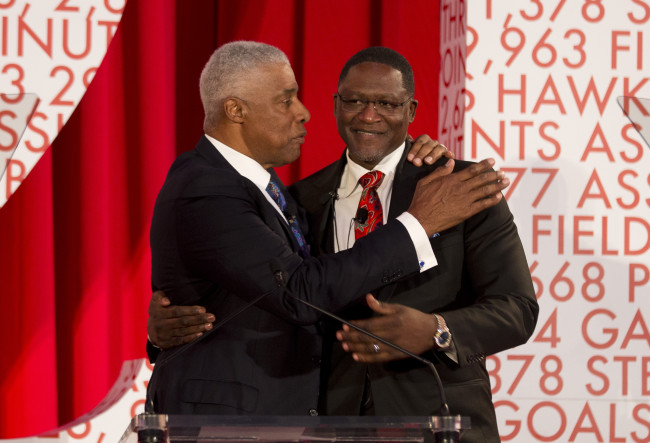
Basketball legend “Dr. J” Julius Erving pays tribute to Atlanta Hawks’ Dominique Wilkins (Photo Credit: John Bazemore/Associated Press)
Dominique Wilkins has held his own as one of professional basketball’s most influential players. The Atlanta Hawks legend nicknamed “The Human Highlight Film” was recently honored with a statue in front of Philips Arena, becoming the ninth overall NBA player in history to have s statue made in his honor.
The upright granite figure weighing 18,500 pounds, was chiseled by sculptor Brian Hanlon. Its 13-foot pose simulates the Basketball Hall of Famer wearing his trademark jersey number, 21, going up for one of his memorable slam dunks.
Wilkins, a two-time Slam Dunk Champion, believes the statue, referring to it as “a landmark,” was a long time coming. “That statue represents change, history that we can finally support and build the rich basketball tradition we have here in Atlanta,” says Wilkins.
The statue was unveiled during “Nique Week,” including a scarlet red-themed luncheon reuniting Wilkins with his coaches, Hawks staff and NBA colleagues. Mayor Kasim Reed presented Wilkins with a Phoenix Award while City Council President Ceasar Mitchell named an honorary street after Wilkins.
The Hawks wore replicas of Wilkins’ uniform during their Mar. 6 game against the Cleveland Cavaliers. Artist Dan Dunn crafted a multi-colored live painting of Wilkins’ profile. Wilkins was awarded a plaque framing his jersey signed by the team’s roster.
Twenty-one thousand collector’s t-shirts were in each of the seats throughout Philips Arena. The modest, nine-time NBA All-Star and the Hawks’ all-time leading scorer expressed his appreciation to both the Hawks and the screaming fans.
“The fans have supported me and made me the man that I am today,” says Wilkins during halftime. “Basketball was a small part of that.”
Serving as the Hawks’ Vice President of Basketball since 2004, Wilkins, originally drafted by the Utah Jazz during his junior year at the University of Georgia, was celebrated with numerous photo collages and vintage highlight films emphasizing his athleticism, sportsmanship and humanitarian efforts like raising awareness for diabetes.
Reiterating how humbled he is by the statue’s unveiling, Wilkins specifically pointed out how his following spans generations. “The kids that are here had parents who rooted for me,” asserts Wilkins.
“Some of their parents rooted, even though I’m not that old. This is not just about me. You’ve made ‘The Human Highlight Film’ your favorite son. I’m a Hawk forever, and I’m never leaving this city.”
This post was written by Christopher A. Daniel, pop cultural critic and music editor. He is also contributing writer for Urban Lux Magazine and Blues & Soul Magazine. Follow Christopher @Journalistorian on Twitter.
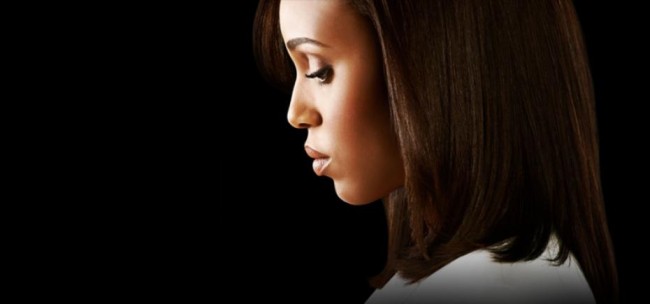
Lauren Duca of the Huffington Post is reporting that the latest episode of ‘Scandal’ was inspired by “institutionalized racism and police brutality in Ferguson.”
The author writes:
“Thursday night’s ‘Scandal’ focused on the shooting of an unarmed black teen named Brandon Parker in Washington, D.C., less than two miles from the White House.
In the episode, called “The Lawn Chair,” tensions run high as the boy’s father positions himself in front of his son’s body with a shotgun, refusing to move from the crime scene.
She [Olivia] works to avoid a riot, but soon finds herself disillusioned by the people she is defending. It doesn’t take long for Liv to be swayed by the injustice, and she joins forces with the activist leading the crowd surrounding Brandon and his father Clarence. ‘Stand up. Fight back. No more black men under attack,’ she chants.
She then does some classic Olivia Pope maneuvering to convince Attorney General David Rosen to grant a subpoena for footage of the altercation.
When they finally get the tape, the video shows Brandon reaching for something in his jacket. The police claim he had a knife, and, sure enough, a knife is found on his body. But his father is outraged. ‘He doesn’t carry a knife,’ he says, over and over.
Through her usual super-human powers, Liv is able to prove the knife did not belong to Brandon — it was evidence from an earlier arrest; Brandon was just reaching for a receipt — and puts the offending officer behind bars.”
The show’s producer, Shonda Rhimes, tweeted that there had been a great deal of debate concerning the episode’s ending. Rhimes tweeted:
This post was written by Reginald Calhoun, editorial assistant for The Burton Wire. He is a junior Mass Media Arts major at Clark Atlanta University. Follow him on Twitter @IRMarsean.
U.S. President Barack Obama speaks at 'Bloody Sunday' commemorative event in Selma, Ala.
(Photo: Google Images)
U.S. President Barack Obama speaks at ‘Bloody Sunday’ commemorative event in Selma, Ala. (Photo: Google Images)
United States President Barack Obama spoke today in front of the Edmund Pettus Bridge in Selma, Ala. to commemorate the anniversary of ‘Bloody Sunday,’ when over 600 non-violent protesters, mostly black Americans, were attacked by Alabama state troopers as they attempted to march from Selma to Montgomery for voting rights in 1965. The president spoke after civil rights leader and Georgia Congressman John Lewis, who was a protester in Selma. Lewis suffered a major head injury during the attack 50 years ago. Lewis recounted that horrible day during a speech at Brown Chapel A.M.E. Church and before President Obama’s remarks. He stated:
“We saw these men putting on their gas masks,” Lewis said. “They came towards us, beating us with night sticks, trampling us with horses, releasing the tear gas. Several of us were hit by night sticks, trampled by horses, was hit in the head, right here, by the night stick…I thought I was going to die on that bridge. I thought I saw death. I don’t recall how we got back across that bridge, back to this church…But I refused to die.”
“I said in this church after the march: I don’t understand how President Johnson can send troops to Vietnam but not to Alabama,” Lewis said.
Collage of photos commemorating the ‘Bloody Sunday’ event.
President Obama followed Lewis’ remarks at the Edmund Pettus Bridge, which is named after a man who served as a Senator from Alabama, a Confederate general during the Civil War and as a Grand Dragon within the Ku Klux Klan afterward. In 1940, the bridge was named after Pettus in order to send a message to Blacks who were seeking civil rights and social change.
President Obama delivered a rousing speech at the site bearing Pettus’ name. He said:
“There are places, and moments in America where this nation’s destiny has been decided. Many are sites of war – Concord and Lexington, Appomattox and Gettysburg. Others are sites that symbolize the daring of America’s character – Independence Hall and Seneca Falls, Kitty Hawk and Cape Canaveral.
Selma is such a place.
In one afternoon fifty years ago, so much of our turbulent history – the stain of slavery and anguish of civil war; the yoke of segregation and tyranny of Jim Crow; the death of four little girls in Birmingham, and the dream of a Baptist preacher – met on this bridge.
It was not a clash of armies, but a clash of wills; a contest to determine the meaning of America.
And because of men and women like John Lewis, Joseph Lowery, Hosea Williams, Amelia Boynton, Diane Nash, Ralph Abernathy, C.T. Vivian, Andrew Young, Fred Shuttlesworth, Dr. King, and so many more, the idea of a just America, a fair America, an inclusive America, a generous America – that idea ultimately triumphed.
As is true across the landscape of American history, we cannot examine this moment in isolation. The march on Selma was part of a broader campaign that spanned generations; the leaders that day part of a long line of heroes.
We gather here to celebrate them. We gather here to honor the courage of ordinary Americans willing to endure billy clubs and the chastening rod; tear gas and the trampling hoof; men and women who despite the gush of blood and splintered bone would stay true to their North Star and keep marching toward justice…”
Watch video of the speech above or read the entire transcript at Time.com.
Map of the states of Nigeria.
(Photo: Google Images)
Map of the states of Nigeria. (Photo: Google Images)
BBC News Africa is reporting that suspected Boko Haram militants have killed at least 45 people in a village in Borno state, north-east Nigeria, witnesses have said.
The gunmen who stormed Njaba targeted men and boys before setting the village on fire, survivors added.
The raid happened early on Tuesday but was not reported immediately because of the remoteness of the area.
Boko Haram has killed thousands of people in its drive to establish an Islamic state.
Many survivors of the attack on Njaba fled to the nearby town of Damboa.
A resident of the town told the BBC the dead had been left to decompose because the villagers feared returning to Njaba.
Trinidad talk show host and journalist Marcia Henville.
(Photo: Google Images)
Trinidad talk show host and journalist Marcia Henville. (Photo: Google Images)
Caribbean 360 is reporting that the husband of journalist and talk show host Marcia Henville has been charged with murder. Authorities have charged Sheldon Henville, 40, with murder in the death of the beloved media figure, who was found dead in her home in January.
An autopsy performed by pathologist Dr. Eslyn Mc Donald Burris found that the 51-year-old mother of two had been beaten on the head, stabbed about the body, and her throat cut. Fire officials confirmed that the charred remains of the host of Point Blank, which aired on CCN TV 6, were found in the bedroom of her home in St. Augustine.
Henville’s husband Sheldon was also treated for burns. Henville was in the process of divorcing her husband and was to serve him with divorce papers on the Monday following her murder.
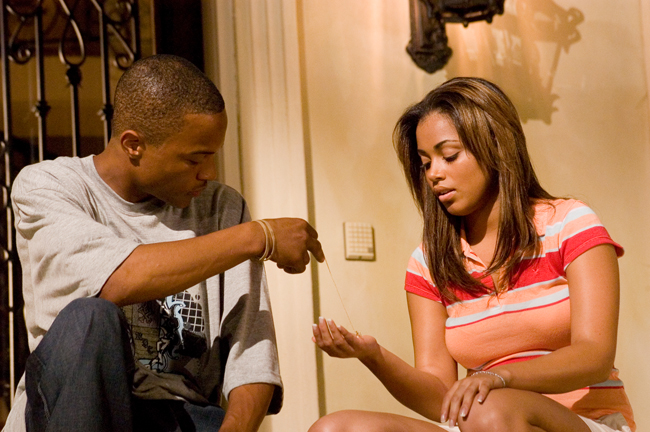
Rapper/actor Clifford 'T.I.' Harris, Jr. and actress Lauren London starred in the hit film, 'ATL.'
(Photo: Google Images)
Rapper/actor Clifford ‘T.I.’ Harris, Jr. and actress Lauren London starred in the hit film, ‘ATL.’ (Photo: Google Images)
Following actor Evan Ross’ hint, Rapper T.I. confirmed a sequel to the film ATL via Instagram. On Wednesday, he posted a photo alongside several of the film’s original characters with a caption that read, “#ATL2 Get Ready.”
Instagram practically buzzed as original characters such as Malika and Khadijah Haqq reposted the photo with similar captions.
Actress Lauren London confirmed her reappearance as “New-New” by posing with T.I. in a photo that read, “Shad&New-New #ATL2 #KeepWatching.”
PHOTO: INSTAGRAM
Although ATL 2’s release date hasn’t been confirmed, the film’s director Chris Robinson stated it will be “Legendary,” according to his Instagram post.
ATL made its debut in 2006 as a box office hit grossing over $21 million according to Box Office Mojo.