“The miscegenation laws of the South only operate against the legitimate union of the races; they leave the white man free to seduce all the colored girls he can, but it is death to the colored man who yields to the force and advances of a similar attraction in white women. White men lynch the offending Afro-American, not because he is a despoiler of virtue, but because he succumbs to the smiles of white women.” ― Ida B. Wells-Barnett, Southern Horrors: Lynch Law in All Its Phases
Ida B. Wells-Barnett
On March 25, 1931, Ida Bell Wells-Barnett, journalist and civil and women’s rights activist, died. Wells was born enslaved on July 16, 1862 in Holly Springs, Mississippi. She was freed after the end of the Civil War.
The murder of her friends sparked Wells’ interest in investigative journalism about lynching and becoming the leader of the anti-lynching crusade. In 1892, she published Southern Horrors: Lynch Law in all Its Phases and in 1895 published A Red Record, 1892 – 1894, which documented lynchings since the Emancipation Proclamation. In 1893, Wells and other black leaders organized a boycott of the World’s Columbian Exposition in Chicago to protest lynchings in the South. Wells was also significantly involved in the founding of the National Association of Colored Women, the National Afro-American Council, which later became the NAACP, and the Women’s Era Club, which was eventually renamed the Ida B. Wells Club. Wells spent the latter 30 years of her life working on urban reform in Chicago, Illinois. In 1990, the United States Postal Service issued a commemorative postage stamp in her honor. Crusade for Justice: The Autobiography of Ida B. Wells was published in 1970.
The Akosua Report: Facts on The African Diaspora, is written by Akosua Lowery. Follow her on Twitter @AkosuaLowery.
The documentary ‘Invisible Universe’ explores blackness and science fiction and horror. (Google Images)
M. Asli Dukan‘s documentary ‘Invisible Universe: A History of Blackness in Speculative Fiction’ explores the relationship between the Black body and popular fantasy, horror and science fiction literature and film and the alternative perspectives produced by creators of color.
The documentary features interviews with major writers, scholars, artists and filmmakers and explores comics, television, film and literature by deconstructing stereotyped images of Black people in the genres. ‘Invisible Universe’ ultimately reveals how Black creators have been consciously creating their own universe.
What is, “Speculative Fiction?’ An umbrella term used to describe fantasy, horror and science fiction genre works including utopias, magical realism and alternative history.
Check out the trailer below for this documentary which is still a work-in-progress. Not to worry, The Burton Wire will let you know when the film becomes available.
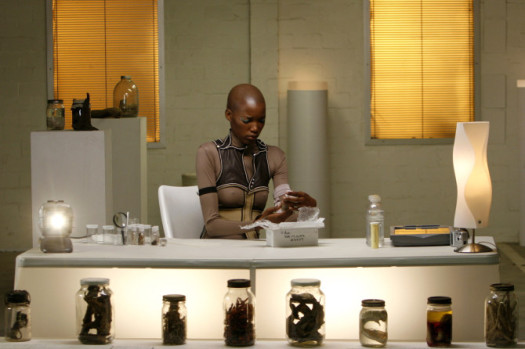
While we wait for ‘Invisible Universe’, let’s check out Kenyan filmmaker Wanuri Kahiu’s science-fiction film ‘Pumzi’ which won best short film at the 2010 Cannes Independent Film Festival (CIFF) and played at Sundance.
The documentary ‘Invisible Universe’ explores blackness and science fiction and horror. (Google Images)
M. Asli Dukan‘s documentary ‘Invisible Universe: A History of Blackness in Speculative Fiction’ explores the relationship between the Black body and popular fantasy, horror and science fiction literature and film and the alternative perspectives produced by creators of color.
The documentary features interviews with major writers, scholars, artists and filmmakers and explores comics, television, film and literature by deconstructing stereotyped images of Black people in the genres. ‘Invisible Universe’ ultimately reveals how Black creators have been consciously creating their own universe.
What is, “Speculative Fiction?’ An umbrella term used to describe fantasy, horror and science fiction genre works including utopias, magical realism and alternative history.
Check out the trailer below for this documentary which is still a work-in-progress. Not to worry, The Burton Wire will let you know when the film becomes available.
While we wait for ‘Invisible Universe’, let’s check out Kenyan filmmaker Wanuri Kahiu’s science-fiction film ‘Pumzi’ which won best short film at the 2010 Cannes Independent Film Festival (CIFF) and played at Sundance.
Tunisian rapper Weld EL 15 has been sentenced to jail for calling police officers dogs in a rap song. (Google Images)
NSFW (Not Safe for Work – pas sûr pour le travail)
Reuters is reporting that a Tunisian court has sentenced a rap singer to two years in jail in absentia for insulting the police in a case likely to fuel debate over free speech under the Islamist-led government.
The singer, known as Weld el 15, is on the run. Two of his associates, singers Mohamed Hedi Belgueyed and Sabrine Klibi, were in court when they received suspended sentences of six months each, a Justice Ministry source said on Friday.
Belgueyed and Klibi were arrested earlier this month for a music video in which lyrics sung by Weld el 15 describe police as dogs and accuse them of using violence unjustifiably.
NSFW (Not Safe for Work – pas sûr pour le travail)
The two men asked the judge to pardon them before the sentences were handed down at Thursday’s court proceedings.
“I was only using the language of the police. They have harassed me verbally and physically. As an artist, the only way I could answer them is through art. I gave them a violent art,” Weld el 15 said in a video posted on Facebook.
President Barack Obama meets Yityish ‘Titi’ Aynaw, Israel’s first black Miss Israel, at a state dinner (Google Images)
Daniel Estrin of PRI’s The World is reporting that during President Obama’s visit to Israel, the United States’ first black president met Yityish ‘Titi’ Aynaw, Israel’s first black Miss Israel at a state dinner. Aynaw, an Ethiopian Jewish immigrant, is the newly crowned 2013 Miss Israel.
According to CNN, President Obama requested Miss Aynaw’s presence at the state dinner. Miss Aynaw was crowned Miss Israel, making history as the first black woman to wear the crown since 1950.
Estrin writes:
“Born in a small town, Titi was orphaned by the time she was about 10. She moved to Israel to live with her grandparents, who had already left Ethiopia for a new life here.
Titi said as an Ethiopian Jew, she grew up with stories about the Land of milk and honey, but her new life in Israel wasn’t all milk and honey.”
Estrin reports that upon winning the crown, Miss Aynaw stated:
“It’s time that someone from my community, someone with my skin color, who is Israeli just like everyone else, represent the country.”
Dominican writer Juno Diaz wins the prestigious Sunday Times short story award for ‘Miss Lora.’ (Google)
Charlotte Williams of TheBookseller.com is reporting that Dominican writer Junot Diaz has added yet another accolade to his dossier. The Pulitzer prize-winning, MacArthur genius grant recipient, has won the Sunday Times short story award for “Miss Lora” a story set in 1980s New Jersey. The story tackles sexual relationships between adolescent boys and older women.
Diaz received a £30,000 ($46,000 US) check from novelist and prize judge Joanna Trollope at a ceremony at the Sunday Times Oxford Literary Festival.
Williams reports:
“Judge Andrew O’Hagan said the story has ‘the feel of a contemporary classic’ and that ‘it echoes in the heart as well as in the mind.'”
“The author called ‘Miss Lora’ a ‘challenging’ story to write. ‘We tend, as a culture, to think of boys having underage sex quite differently to how we think of girls. I find that quite disturbing, and wanted to question the logic of that,’ he said. ‘If a boy has sex with his teacher, people under their breath are kind of high-fiving the kid. If a 16- or 15-year-old girl has sex with an older teacher – forget about it. No one’s celebrating. That seemed really strange.'”
Nigerian literary giant Chinua Achebe discusses the devastating impact of colonization on Africa in this You Tube video. (Google Images)
African literary legend Chinua Achebe died last week at the age of 82. While re-reading, re-imagining and revisiting his work, we came across this video of interest, in which Mr. Achebe discusses the devastating impact of colonization on Africa. Listen to what the man referred to as the “Grandfather of African Literature” has to say about colonization which he says was “made possible by the devastation of the slave trade that came before.”
Watch more Burton Wire videos of interest at YouTube.
Afro-Cubans in Cuba are still waiting to reap the benefits of the revolution. (Photo Credit: Orlando Luis Pardo Lazo)
In an op-ed for the New York Times, Afro-Cuban Roberto Zurbano discusses the ongoing struggle with being black in Cuba. In a place where social mobility is attached to skin color, what are Afro-Cubans to do when being systematically shut out of opportunities for advancement? The Revolution promised many changes, but change for Afro-Cubans has been painfully slow, unlike that of their white counterparts. Read an excerpt of Zurbano’s editorial below:
CHANGE is the latest news to come out of Cuba, though for Afro-Cubans like myself, this is more dream than reality. Over the last decade, scores of ridiculous prohibitions for Cubans living on the island have been eliminated, among them sleeping at a hotel, buying a cellphone, selling a house or car and traveling abroad. These gestures have been celebrated as signs of openness and reform, though they are really nothing more than efforts to make life more normal. And the reality is that in Cuba, your experience of these changes depends on your skin color.
The private sector in Cuba now enjoys a certain degree of economic liberation, but blacks are not well positioned to take advantage of it. We inherited more than three centuries of slavery during the Spanish colonial era. Racial exclusion continued after Cuba became independent in 1902, and a half century of revolution since 1959 has been unable to overcome it.
In the early 1990s, after the cold war ended, Fidel Castro embarked on economic reforms that his brother and successor, Raúl, continues to pursue. Cuba had lost its greatest benefactor, the Soviet Union, and plunged into a deep recession that came to be known as the “Special Period.” There were frequent blackouts. Public transportation hardly functioned. Food was scarce. To stem unrest, the government ordered the economy split into two sectors: one for private businesses and foreign-oriented enterprises, which were essentially permitted to trade in United States dollars, and the other, the continuation of the old socialist order, built on government jobs that pay an average of $20 a month.
It’s true that Cubans still have a strong safety net: most do not pay rent, and education and health care are free. But the economic divergence created two contrasting realities that persist today. The first is that of white Cubans, who have leveraged their resources to enter the new market-driven economy and reap the benefits of a supposedly more open socialism. The other reality is that of the black plurality, which witnessed the demise of the socialist utopia from the island’s least comfortable quarters.
Cuban Jazz legend Bebo Valdés has died. He was 94. (Amazon)
Patrick Jarenwattananon of NPR is reporting that Cuban music legend Bebo Valdés has died. The iconic pianist, composer and arranger had recently battled pneumonia, which led to his death.
Jarenwattananon writes:
“Ramón Emilio “Bebo” Valdés Amaro was born in 1918 in a village outside Havana. Trained at conservatory, and having absorbed the sounds of Afro-Cuban street music and American jazz in various ensembles, he became the house pianist and arranger at the Tropicana Nightclub in 1948. The Tropicana was the hottest venue in Havana at the time; many American entertainers performed there, and Valdés became known as the go-to arranger in town for studio dates, film scores and dance numbers. In 1952, he also participated in the first Afro-Cuban descarga, or jam session, recorded in Cuba, where a group improvisation turned into the recording ‘Con Poco Coco.’
But as his career was booming, a revolutionary government took over in Cuba, accompanied by a crackdown on the entertainment industry. In 1960, he left Cuba to play a gig in Mexico City with his own band. He never returned, leaving behind his wife and children. Valdés eventually wound up in Sweden, where he remarried and pursued a quieter music career, often playing piano for cruise ships or in choice hotels.”
One of Valdés’ sons whom he left behind in Cuba, Chucho Valdés developed into a well known jazz pianist, playing with the acclaimed band Irakere. In 1977, Irakere played a date at Carnegie Hall and Bebo Valdés made the trip to reunite with his son, Chucho. The reconciliation resulted in several collaborations, including the Latin jazz performance film Calle 54 and the duet album Juntos Para Siempre.
Later in life Bebo Valdés, released two Grammy award-winning albums El Arte de Sabor (2001) and Lagrimas Negras (2004). Mr. Valdés was 94.
“While we still have about 3 weeks before the festival unveils its full lineup (they usually do so in pieces, spread out over a short period of time), I thought I’d start to take a look at what African Diaspora films just might be selected to debut in competition, at the world’s most prestigious film festival this year – films that we’ve been following on this site for the last year or 2, that have the strongest chances of being included in the festival’s full lineup, once it’s announced.
The 12-day festival runs from May 15 to 26… I [Obenson] certainly hope that this year’s line-up, unlike recent previous years, includes a substantial representation of Diaspora films (relative to previous years), especially since there are a good number of titles that I think could be candidates.”
Obenson offers five films that have the strongest possibility of making the festival and offers an additional ten that could potentially make the cut in another post. Below is his list of three that are strong contenders.
1. Twelve Years A Slave: An absolute no-brainer as far I’m concerned. Steve McQueen‘s third feature which stars a rather impressive cast of actors, including Chiwetel Ejiofor, Michael Fassbender, Ruth Negga,Adepero Oduye, Alfre Woodard, Lupita Nyong’o, Paul Dano, Benedict Cumberbatch, Scoot McNairy, Garret Dillahunt, Brad Pitt, Michael K. Williams, Paul Giamatti, Sarah Paulson and others. No word yet on a release date for the film; but I’d be really surprised if it didn’t debut at Cannes this year, en route to other top-tier film festivals before opening in USA theaters in the early fall. I expect it to be an awards season favorite, especially in key roles, both in front of and behind the camera.
2. Grisgris: Chadian filmmaker Mahamat Saleh-Haroun’s follow-up to his last work, the critically-acclaimed drama Un Homme Qui Crie (aka A Screaming Man). The film was shot last fall, and, given that Saleh-Haroun isn’t a stranger to Cannes (3 of his last 5 films all premiered at Cannes) I fully expect that Grisgris will continue that trend, and debut at this year’s Cannes edition. The film centers on Grisgris, a 25 year old boy with dreams of becoming a dancer despite the fact that he’s paralyzed from the waist down. His dreams are shattered when his uncle falls seriously ill. To save him, he decides to work for petrol smugglers. Not quite the same father/son relationship theme that seems to run through his work (see Abouna-2002, Daratt-2006, A Screaming Man-2010), but still seemingly very much in that similar relational vein.The film stars Soulémane Démé, Mariam Monory, Cyril Guei, and Marius Yelolo (who’s worked with Haroun on at least 2 other past films).
3. Half Of A Yellow Sun: last month, it was rumored that the film would premiere at FESPACO, but those rumors turned out to be false. And given that it skipped Berlin, I think this is primed for a Cannes debut. The film adaptation of celebrated author Chimamanda Ngozi Adichie’s Orange Prize-winning novel, Half Of A Yellow Sun, is directed by playwright Biyi Bandele (his feature film directorial debut), with an international cast that includes Thandie Newton, John Boyega, Chiwetel Ejiofor, Dominic Cooper, Anika Noni Rose, Joseph Mawle and Genevieve Nnaji. If both Twelve Years A Slave and this film make the Cannes selection list, Chiwetel Ejiofor will be attending the festival with 2 films in which he stars. Both films should be released in theaters (USA) this year, so, either way, it should be a big year for Mr Ejiofor, who does have at least one project on the horizon.
Click here to see part one of Obenson’s list. Read more about the films and part two of Obenson’s list here.


 “The miscegenation laws of the South only operate against the legitimate union of the races; they leave the white man free to seduce all the colored girls he can, but it is death to the colored man who yields to the force and advances of a similar attraction in white women. White men lynch the offending Afro-American, not because he is a despoiler of virtue, but because he succumbs to the smiles of white women.” ― Ida B. Wells-Barnett, Southern Horrors: Lynch Law in All Its Phases