Zimbabwean president Robert Mugabe travels to Vatican City with family to attend Pope Francis I inauguration. (Google Images)
AllAfrica.com is reporting that President Robert Mugabe was in Italy on Tuesday for the inauguration mass for Pope Francis, bypassing a travel ban imposed by the European Union, which does not apply to the Vatican City state.
Mugabe, a devout Catholic, traveled to the holy city with his wife Grace, their children and several government officials, just days after a referendum to vote on a new Constitution for Zimbabwe.
The Zimbabwean leader is accused of human rights abuses by western governments which is the reason for the travel ban. In 2005, Prince Charles drew controversy in Britain when he shook hands with Mugabe at the funeral of Pope John Paul 11. The Prince’s aides claimed the heir to the throne had been caught by surprise when Mugabe offered his hand during the ceremony at the Vatican.
The president also attended the beatification of the Pope in 2011. Does Mugabe’s travel during this important time signal a greater devotion to the church than to his country?
Dominican Republic wins the 2013 World Baseball Classic. (Google Images)
John Perrotto of USA Todayis reporting that the Dominican Republic has won the World Baseball Classic. After pushing past the Netherlands, the Dominican Republic took the field against Puerto Rico at the AT&T Park in San Francisco, CA. The Dominican Republic finished its perfect run through the World Baseball Classic with a 3-0 victory over Puerto Rico in the championship game.
Perrotto writes:
“The Dominicans won all eight games and outscored their opponents 36-14 in becoming the first team to go undefeated in a WBC. Japan won the first two tournaments in 2006 and 2009 but did not get through either event with an unblemished record.
‘DR has huge talent,’ Puerto Rico manager Edwin Rodriguez said. ‘Other teams also had great talent and stars from the major leagues but the DR has a passion, desire, the drive to really show this kind of amazing performance, and they did accomplish it.’
And the Dominicans reveled in their accomplishment, particularly after being eliminated from the first round in 2009. Manager Tony Pena clutched the trophy tightly as he talked about what winning the WBC meant to the island nation of 10 million that produces more major-league players per capita than any country.”
The games were peppered with humor with Dominican closer Fernando Rodney, who saved seven of the eight wins, introducing the rally plantain, which he shook in the bullpen whenever his team needed a boost.
FIFA officials are concerned that arenas in Rio and Brasília are behind schedule. (Google Images)
Robbie Blakeley of The Rio Times is reporting that FIFA’s general secretary Jérôme Valcke is concerned that the football (soccer) arenas being built in Rio and Brasília, host cities for the 2014 World Cup, are not completed yet. Both arenas are supposed to be delivered by the end of April and are set to host the opening match and final for the 2014 World Cup. FIFA is also concerned that the arenas won’t be ready for the 2013 Confederations Cup , which will be held June 15th-30th. Test matches are essential to working out the kinks for the FIFA World Cup matches. Currently, FIFA does not have a back-up plan if the arenas aren’t completed in time for the Confederations Cup.
Blakeley writes:
“Witnesses to last week’s meeting told Brazilian press the atmosphere was strained as the delays to the Maracanã and Mané Garrincha attempted to be explained. The continuous line of hindrances puts into serious doubt test games that must be carried out.
‘In a perfect world three test games should be played before any official matches take place. The first with ten percent capacity, then one with thirty percent and a final game with eighty percent. That’s the ideal so we can test the efficiency of the stadium,’ Valcke said.”
The arenas have been delayed due to flooding in the region. Although the arenas are 90 percent ready, many items still need work including the pitch, the roof, the terraces and the press room of the arenas.
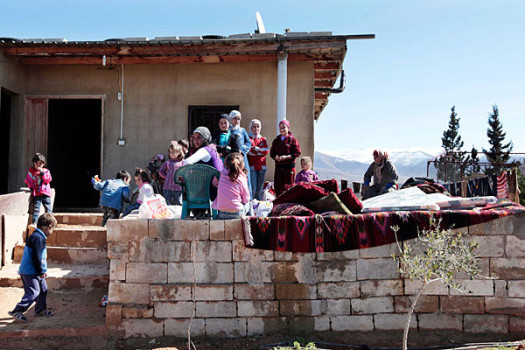
The teeming number of Syrian refugees is creating tension in Lebanon. (Google Images)
Justin Salhani of The Los Angeles Times is reporting that tensions are brewing in Lebanon with the influx of Syrian refugees. Initially, the Lebanese welcomed Syrian refugees who were fleeing the civil war that erupted during the Arab Spring, with many calling for the ouster of President Bashar al-Assad. After two years of strife and more than 400,000 Syrian refugees flooding into Lebanon, the sentiment is changing.
Salhani writes:
“But now after almost two years of a steady influx of displaced Syrians, Naaman and other Lebanese citizens in Bab Tabbaneh are growing weary. Many blame the newcomers for shrinking wages and job opportunities and increasing rents and prices for groceries, car repairs and necessities.
‘Syrians are everywhere and they are taking jobs,’ said Naaman, a grizzled native of Tripoli in his mid-40s who ekes out a living selling vegetables, having retired from his position as a right-hand man for a now-deceased leader of one of this city’s many militias.
The anger vented by Naaman and others is indicative of a growing unease across Lebanon about the steady stream of refugees, who they fear may destabilize Lebanon’s brittle political and social balance.”
Nearly 1,000 Syrians come into Lebanon on a daily basis, many working in low-skilled jobs and cramming into impoverished neighborhoods. Syrian refugees are often exploited by the business establishment in Lebanon who pay them extremely low wages relative to the amount of work that they are expected to accomplish. The Syrian refugee population has a pronounced sectarian make-up with many being Sunni Muslim and the Alawites, the Shiite sect that includes al-Assad.
Wanted Congolese warlord Bosco Ntaganda surrenders to American Embassy. (Google Images)
Jeffrey Gettleman of The New York Times is reporting that Bosco Ntaganda, a Congolese rebel general accused of massacring civilians and building an army of child soldiers, turned himself in to the American Embassy in Rwanda on Monday, saying he wanted to be sent to the International Criminal Court(ICC). Ntaganda is considered to be one of Africa’s most wanted men, because of his leadership of the rebel group M23 and other rebel groups resulting in the murder of scores of people in order to gain footing in the Congo’s lucrative mineral trade.
Gettleman writes:
“According to prosecutors at the I.C.C., Mr. Bosco was one of the worst of Congo’s brutal rebel leaders. In the first set of charges against him, filed in 2006, prosecutors said he extensively used ‘children under the age of 15 to participate actively in hostilities’ while he was a rebel commander in 2002 and 2003. Though the United States is not a member of the court, the Obama administration has indicated support for it.
Last year, prosecutors expanded the allegations, accusing Mr. Bosco of spearheading civilian massacres and using rape and murder as a way to ethnically cleanse certain areas of Congo. Mr. Bosco has hopscotched from rebel army to rebel army, and in 2008, human rights groups said he oversaw the slaughter of scores of civilians in the eastern Congo town of Kiwanja, where residents were pulled out of their homes and shot in the head in front of their families.”
Ntaganda is referred to as “The Terminator” because of his brutal forms of violence.
StereoTypes host Ryan Hall examines stereotypes across the globe. (Google Images)
(Not Safe For Work- profanity)
StereoTypes host Ryan Hall hits the streets of Paris to find out what it’s like to be black in Paris. He finds out a lot more than that in the process. Check out this video to see how people feel about race and racism, or the lackthereof in France. Share your thoughts with us in the comments section below.
The Spinners original lead singer Bobbie Smith has died at 76. (Google Images)
MSN is reporting that the former lead singer of the soul music group “The Spinners” has died in Orlando, Fla. Bobbie Smith, the group’s original lead singer, passed away from complications from the flu and pneumonia. He had been diagnosed with lung cancer in November 2012. Smith sang lead on the Spinner’s hit, “That’s What Girls Are Made For” in 1961. Known at one time as the ‘Detroit Spinners,’ the group’s biggest hits came during the 1970s and included “I’ll Be Around,” ”Could It Be I’m Falling in Love” and “Games People Play.” Smith was 76.
The Spinners original lead singer Bobbie Smith has died at 76. (Google Images)
MSN is reporting that the former lead singer of the soul music group “The Spinners” has died in Orlando, Fla. Bobbie Smith, the group’s original lead singer, passed away from complications from the flu and pneumonia. He had been diagnosed with lung cancer in November 2012. Smith sang lead on the Spinner’s hit, “That’s What Girls Are Made For” in 1961. Known at one time as the ‘Detroit Spinners,’ the group’s biggest hits came during the 1970s and included “I’ll Be Around,” ”Could It Be I’m Falling in Love” and “Games People Play.” Smith was 76.
Detroit Mayor Kwame Kilpatrick was recently convicted on 24 corruption charges. (Google Images)
One would have to live under a rock to not have heard the plethora of corruption scandals plaguing politicians of the African Diaspora. Let’s just put it out there — they’re making black and brown folk look bad.
There’s Uhuru Kenyatta, who was recently elected president of Kenya in March 2013. Kenyatta, son of Jomo Kenyatta, Kenya’s first president, is facing a major obstacle in the next phase of his political career — criminal charges. The International Criminal Court (ICC) has charged Kenyatta for funding and organizing post-election violence in Kenya in 2007. According to a study by New Dominion Philanthropy Metrics (NDPM), the post-election violence resulted in 1,500 deaths, 3,000 women raped and 300,000 people displaced.
There is Nigerian President Goodluck Jonathan, who has come under fire for the pardoning of former Bayelsa state Gov. Diepreye Alamieyeseigha, who was convicted of stealing millions. Alamieyeseigha fled London disguised as a woman, returning to Nigeria where he had political immunity while in office. He was impeached after it was discovered that he had illegally acquired more than $10 million in real estate in London, Denmark and the United States. How is it that Jonathan, a man that refers to himself as the greatest anti-corruption crusader, manages to pardon the man involved in one of the most high-profile and internationally embarrassing corruption scandals to hit Nigeria in recent years?
What about McKeeva Bush, former Premier of the Cayman Islands? Bush was voted out of office after being arrested at his home for theft in connection with financial irregularities relating to the alleged misuse of a government credit card. We won’t mention Honduras where President Porfirio Lobo and the National Congress removed four Supreme Court justices for refusing to accept the president’s plan to “weed out” corruption in police? This all occurred while the building was surrounded by armed police and military.
The United States is chock full of corruption scandals. There is former Illionois Rep. Jesse Jackson Jr., who was charged with violating federal law by misusing $750,000 in campaign funds. What did he buy with said funds? Fur wraps and a watch. If convicted of conspiracy to commit wire fraud, mail fraud and false statements, he could face up to five years in prison and a fine of up to $250,000. Former Detroit mayor Kwame Kilpatrick was convicted in federal court on 24 of 30 corruption-related counts related to bribery, tax evasion, extorting contractors wanting to do business with the city and raiding the nonprofit Kilpatrick Civic Fund for his personal expenses. We won’t mention the sexting scandal, perjury and obstruction of justice charges that landed the former mayor in prison in 2008. Kilpatrick has been in and out of state and federal prison so much over the last five years, that it is hard to keep track of the prisoner merry-go-round or how many times he lists racism as the reason for his demise.
That’s the problem with never ending corruption scandals taking place amongst black and brown politicians throughout the African Diaspora. Many complain about racism and the mainstream’s investment in showing the worst of politicians of color worldwide. Can we blame mainstream media outlets when we give them so much material with which to work? What about our continuing choice to re-elect corrupt politicians who have broken our trust and run roughshod over any semblance of decency, integrity or truthfulness while in office? Is it mainstream media’s fault that we re-elect them anyway?
It defies logic that many black and brown people feel that we deserve so little from our elected officials worldwide? What sense does it make to cry racism? We’ve been dealt that hand and know the double-standard that awaits us in all facets of life and politics is no different.
The idea that all politicians are corrupt so we may as well be corrupt is naïve at best and idiotic at worst. The proliferation of stories of political corruption make it difficult for those of us trying to move away from dominant narratives of corruption, poverty and disease that dominate news of the African Diaspora. While many keep trying to lift up the Diaspora, corrupt politicians continue beating down the Diaspora, all for personal gain. Until there is a collective decision to call for an end to corruption in politics including a refusal to elect politicians (local, state, national) that engage in criminal activity on any level, then unfortunately stories of corruption involving a few, will continue to be the headlines that define the many people of African descent. If that’s not a criminal act, then I don’t know what is.
This article was written by Nsenga K. Burton, founder and editor-in-chief of The Burton Wire.
The ICC says Kenya’s president-elect Uhuru Kenyatta will still stand trial despite charges being dropped against his co-conspirator in the case. (Google Images)
Judie Kaberia of AllAfrica.com is reporting that International Criminal Court (ICC) Prosecutor Fatou Bensouda maintains that the decision to drop charges against former head of Civil Service Francis Muthaura has no impact on her case against Kenya’s President-elect Uhuru Kenyatta. Kaberia writes:
“In her submission to the court, she explained that withdrawal of charges against one alleged indirect co-perpetrator does not automatically affect the other accused, so Kenyatta’s case remains.
She says according to the Rome Statute: ‘Article 25 (3) demonstrates that the legal status of one alleged indirect co-perpetrator has no bearing on the guilt or innocence of another alleged co-perpetrator.’
‘In accordance with this Statute, a person shall be criminally responsible and liable for punishment for a crime within the jurisdiction of the court if that person: (a) commits such a crime, whether as an individual, jointly with another or through another person, regardless of whether that other person is criminally responsible.’
She said although the two were charged jointly, it did not imply that both have to be criminally responsible.
Bensouda further explained that one co-accused can be found not to be criminally responsible while the other is found responsible despite being jointly co-accused.”
The ICC has been under scrutiny since dropping the charges against President-elect Kenyatta’s alleged co-conspirator Muthaura for his role in post-election violence, which many read as a signal that charges against Kenyatta would be dropped as well. Kenyatta’s defense team argued that since the two were jointly accused, the charges against their client should also be dropped. ICC Prosecutor Fatou Bensouda refutes the claim, saying the cases against both men are very different.