Home Blog Page 175

Serena Williams and Sloane Stephens: ‘Idol’ Misrepresentation

2
The relationship between tennis legend Serena Williams and newcomer Sloane Stephens is a bit overstated by the press. (Google Images)

written by Benjamin Snyder

With the conclusion of the Australian Open, the year’s first major tennis tournament, the women’s event anointed Belarusian Victoria Azarenka once again as its champion for the second time in two years. But, arguably even more exciting for tennis fans (Azarenka was booed throughout her Melbourne campaign), was teenager Sloane Stephens’ run to the semifinals and her subsequent ascent to the Top 20.

Hailed for years as a potential American future talent and for her vibrant presence in press conferences, Stephens made headlines at the start of the season for facing 15-time major champion Serena Williams in the Brisbane quarterfinals. Although she lost 6-4, 6-3, the match proved to be Serena’s toughest test during her title-winning performance over the course of the week.

In the quarterfinals at the Australian Open, however, Stephens, the daughter of deceased NFL athlete John Stephens, notched the biggest upset of her young career by taking out an injured Serena in three dramatic sets. Poised under pressure, Stephens made just her third semifinal appearance at a Women’s Tennis Association (WTA) event, with her first two having come at Strasbourg and Washington DC last year.

While a celebration among the tennis community and for black athletes, which has been dominated by Serena and elder sister Venus on the women’s tour in recent years, the media coverage of Sloane and Serena’s relationship proves to be overstated upon further analysis. The concept of women mentoring woman in the workplace is extremely relevant in this day and age, being a popular tool used to help the underrepresented gender take their place at the top alongside their male counterparts. However, this particular relationship between the two tennis players doesn’t seem to be an example of this.

Numerous sources, including the Herald Sun, and the Daily Mail, among others, prominently portray Stephens as worshipping Serena, or claiming that she considered her an idol, or hero growing up.

But, as eloquently explained – and even with textual support — in an article for Deadspin.com, the phenomenon is probably more fiction than fact. Although Sloane did admit to having a poster of Serena hanging up in her room in the past, there has been no prominent source available to conclude that she considered the Williams’ sister her “hero,” as the same Washington Times article blatantly suggests in a sensationalized opening paragraph.

Moreover, Serena’s own comments on the subject prove to diametrically oppose the media’s exaggerated claims about Stephens’ perceived idol worship. As quoted by the Independent ahead of their Australian Open match, Serena told reporters about her role as a ‘mentor’ to Stephens: “I don’t know, I would need a better definition of the word ‘mentor.’ I just feel like being the older one, maybe some of the younger players look up to me. It’s interesting. It’s hard to be a real mentor when you’re still in competition, so I think it’s a little bit of everything.”

As Serena later succinctly stated about the relationship with her younger competitor as the interview continued, “No. I feel no responsibility [for Stephens]. I doubt she has any expectations of me to be responsible for anything. Maybe she does. I don’t know.”

Stephens’ own comments transformed Serena from “idol” to human after a fourth-round win in Melbourne. She told reporters about their quarterfinal meeting, “You’re still playing a regular person across the net. You’ve just got to go out and play.” Nothing supernatural about it (although she did once refer to Williams as a “tennis god,” but not as her “tennis god.”)

Instead, Stephens used one word to characterize the state of their relationship: “Normal.” That more mundane language should probably take place of the hyperbole reporters currently use to grossly overstate the relationship between the two black athletes, basically because they’re both black.

Serena, too, had comments about her first sighting of Sloane four years ago, which reveals nothing groundbreaking. “I saw her in the locker room. She was another black girl. I was like: ‘Hey!'”

From “hey!” to hero? Reporters, something’s amiss here, although one thing seems fairly certain: Stephens is destined for continued success on tennis’ biggest stages — Serena worshipper, or not.

Benjamin Snyder is a sports contributor to The Burton Wire. You can follow Benjamin Snyder on Twitter @WriterSnyder.

Like The Burton Wire on Facebook. Follow us on Twitter @TheBurtonWire.

Atlanta: Black Music Industry Keeps Georgia on the Map

0
So So Def has been a major part of the black music industry that has created a multi-billion dollar economy in Atlanta.

Written by Christopher A. Daniel

The history of American popular music has definitely seen its fair share of input from African Americans. Considering hip hop and R&B continues to stretch the boundaries for crossover success, it seems the last two decades have been dominated significantly by Georgia’s rich musical community.

Decades before regional affiliation became synonymous with music video and digital age acts, icons James Brown, Gladys Knight, Otis Redding, Little Richard and Ray Charles pledged their allegiance to the state. Georgia’s output — a cumulative $3.7 billion economy according to 2011 statistics – proved to be the perfect gateway for an equally blossoming $3.1 billion film and television industry  with more black entrepreneurship (i.e. Tyler Perry, Will Packer, Rob Hardy and Earvin “Magic” Johnson) at its helm. There are even 50 statewide post-secondary music-related degree and certificate programs.

Atlanta, in particular, has proven the most fertile far beyond the state line. Dubbed “the Motown of the South,” the city is home to numerous Grammy Award winning, million-selling recording artists, recording studios and music publishing companies. With prolific, chart-topping production courtesy of L.A. and Babyface (or LaFace), Organized Noize, Dallas Austin, DJ Toomp, Lil’ Jon, Polow Da Don, Bangladesh, Drumma Boy, Mike WiLL Made It, Ne-Yo, Sean “The Pen” Garrett, Bryan-Michael Cox and DJ Smurf/Mr. Collipark, red clay-based black music catalogs carry on tradition for becoming timeless classics.

“It’s all about being connected to what’s going on and what the general public is looking for. You have to keep it fresh and have confidence.” says Michael Mauldin, entertainment manager and former president of Columbia Records.

Another one of Atlanta’s own, Jermaine Dupri, believes Atlanta is a culmination of “good music, a great lifestyle and fun.” He’s set to commemorate two decades of his production imprint’s — So So Def Recordings — Midas touch. JD hosted a press conference in January to announce his anniversary concert on February 23 with his label’s legendary roster.

Who can forget the backward clothes wearing duo Kriss Kross’ infectious breakout 1992 number one single, “Jump?” From there were the successes of female quartet Xscape, male quartet Jagged Edge, former hip hop teen idol Bow Wow, vocalist Dondria, crunk artist Bone Crusher and snap music’s Dem Franchize Boyz. Dupri also laid golden eggs for Mariah Carey, Usher, Ludacris, Monica, Nelly, Master P., Jay-Z, Janet Jackson, Lil’ Kim, Destiny’s Child, Jessica Simpson and Mary J. Blige.

It was Dupri who also gave hip hop Da Brat, its first solo female act to certify platinum. Known for her classic 1994 release, “Funkdafied,” the Chicago native believes her success results from Dupri encouraging her to embrace her individuality. “I’m a P.Y.T., pretty young thug. It ain’t no other person like me in the world, and [JD] knows that. Seeing any female rapper do their thing makes me proud.” says Brat.

Mauldin, Dupri’s father, credits a producer’s work ethic and musical integrity as keys to success. He adds that So So Def specifically has always been about excellence. “[Jermaine] has always been about the music. What people don’t see are the hours spent in the studio till the morning comes. I can always count on him to give me the real solid stuff,” Mauldin says.

Dupri, on the other hand, says hit records are a much simpler process. “It takes a great song, artist and producer,” he says.

Christopher A. Daniel is a pop cultural critic and music editor for The Burton Wire. He is also a contributing writer for Urban Lux Magazine and Blues & Soul Magazine. Follow Christopher @Journalistorian on Twitter.

Like The Burton Wire on Facebook. Follow us on Twitter @TheBurtonWire.

St. Kitts and Nevis: Bob Marley Remembered on 68th Birthday

0
Musicians in St. Kitts and Nevis remember legendary reggae superstar Bob Nesta Marley. (Flickr)

Writing for SKNVibes, Precious Mills talks to members of the music community in the twin-island Federation of St. Kitts and Nevis about the legacy of Reggae superstar Robert Nesta “Bob” Marley in celebration of what would have been his 68th birthday on February 6.

Mills reports:

“Bob Marley is one of the greatest legends that ever lived. And him being a black entertainer, role model, pluralist and motivational speaker, he has paved the musical way for our generation of individuals who are captivated not only by music but performing. Bob Marley was not only an idol, he was not just a musical artiste, he was someone who sang about freedom, life and love. He is one of my favorite artistes of all times and I am proud to have Jamaican roots.”DJ Sudine ‘Sudie-Pop’ Clarke (R&B/Dancehall)

“I got a lot of information and ideas from listening to Bob Marley’s songs when I first started out as an artiste. In my opinion, Bob Marley opened a lot of people’s eyes and ears to the realities of the world. Every generation can relate to his music in some way.” – Ishan ‘Ja Fire’ Huggins (Reggae/Dancehall)

Find out what other musicians had to say about Bob Marley on SKNVibes.

Like The Burton Wire on Facebook. Follow us on Twitter @TheBurtonWire.

Sean "Diddy" Combs Puts on First-Ever Instagram Fashion Show

0
Sean “Diddy” Combs makes history by producing the world’s first Instagram fashion show in time for New York Fashion Week. (Google Images)

Writing for the Huffington Post, Julee Wilson reports that music and fashion mogul Sean “Diddy” Combs has made history yet again by producing the first-ever Instagram Fashion Show. Wilson reports that the fashion icon stated:

“In honor of New York Fashion Week we wanted to do something that has never been done before”, said Combs in a press release. “With Instagram technology we are bringing Sean John to the social media runway where our consumer lives.”

Combs’ historic fashion show arrived just in time for New York City’s historic snow storm Nemo, which knocked out power to 650,000 homes in the Northeastern region of the United States, including New York. Did we mention that it’s also New York Fashion Week?

Say what you will about Diddy, but his ability to strategize and rise to the occasion despite precarious circumstances while making use of social media is pretty impressive.

Read more at The Huffington Post.

Like The Burton Wire on Facebook. Follow us on Twitter @TheBurtonWire.

Sean “Diddy” Combs Puts on First-Ever Instagram Fashion Show

0
Sean “Diddy” Combs makes history by producing the world’s first Instagram fashion show in time for New York Fashion Week. (Google Images)

Writing for the Huffington Post, Julee Wilson reports that music and fashion mogul Sean “Diddy” Combs has made history yet again by producing the first-ever Instagram Fashion Show. Surely this would have gained him a lot of instagram followers. Wilson reports that the fashion icon stated:

“In honor of New York Fashion Week we wanted to do something that has never been done before”, said Combs in a press release. “With Instagram technology, we are bringing Sean John to the social media runway where our consumer lives.” With it being as simple as sending instagram messages on computer or via the app on phones, it wouldn’t be surprising to find out that fans of Sean were there to give him encouragement and support for the first-ever Instagram fashion show. Hopefully, they’ll be more shows like these in the future.

Combs’ historic fashion show arrived just in time for New York City’s historic snow storm Nemo, which knocked out power to 650,000 homes in the Northeastern region of the United States, including New York. Did we mention that it’s also New York Fashion Week?

Say what you will about Diddy, but his ability to strategize and rise to the occasion despite precarious circumstances while making use of social media is pretty impressive.

Read more at The Huffington Post.

Like The Burton Wire on Facebook. Follow us on Twitter @TheBurtonWire.

Defining The Obama Doctrine: Of Doves and Drones

0
The Obama Doctrine represents a contradiction between the man awarded the Nobel Peace Prize and the man prepared to use drone strikes to kill U.S. citizens. (Google Images)

by Devona Walker

For a man awarded the Nobel Peace Prize within months of taking office, began his second term with an impassioned vow to bring troops home from Afghanistan and owes his political career to his opposition to the war in Iraq, President Obama’s presidential doctrine is murky at best.

Due to a recently leaked Justice Department memo, we learned the Obama administration’s infamous drone kill list includes U.S. citizens. To make matters worse, it took the administration too long for some to agree to provide information to Congress as to who is on that list and why. This has put Obama at odds with even some of his most long-standing progressives allies.

Progressives were relatively quiet when Obama deemed closing Guantanamo Bay politically unattainable and then expanded the Bush-era use of “warrantless wire-tapping.” Now, many are fed up. Every decision short of putting troops on the ground — from Iran to Syria to his infamous leading from behind strategy in Libya — is denigrated by the right as weakness.

Obama appears to be, ungracefully, balancing drones and doves without bothering to explain or justify the contradiction. He appears to be, while reducing the U.S. military footprint in the Arab World, waging a covert war against individuals as opposed to countries.

If playing the middle is supposed to help avoid the trappings of left and right, it ain’t working.

As a progressive, I gotta say it’s not the drones. If 9/11, Iraq and Afghanistan taught me anything, it’s that the war on terror is more like the war on drugs than a traditional military engagement. There’s no “Terror” country with a capital called “Jihad.” The enemy, I get it, is elusive. When you find them, you can’t just gear up an army and storm the castle.

While I understand the complexities involved in fighting terror, the problem with this recent controversy is Obama’s unwillingness to articulate his position. I’m beginning to wonder if it’s just arrogance, or if there is a doctrine at all? Perhaps he is just a man responding to events?

The Bush Doctrine, even Sarah Palin knows by now, was simple. It was all about the preemptive strike and this idea that our national security depended upon our willingness to strike the first blow.

With Clinton, it was more nuanced but no less profound. From the escalation in Somalia to Serbia bombings to invading Haiti and all the diplomatic capital spent on Irish and Middle East peace negotiations, Clinton believed instability anywhere was a threat to stability everywhere.

Prior to sending troops to Serbia, Clinton famously said:

“It’s easy…to say that we really have no interests in who lives in this or that valley in Bosnia, or who owns a strip of brushland in the Horn of Africa, or some piece of parched earth by the Jordan River. But the true measure of our interests lies not in how small or distant these places are, or in whether we have trouble pronouncing their names. The question we must ask is, what are the consequences to our security of letting conflicts fester and spread. We cannot, indeed, we should not, do everything or be everywhere. But where our values and our interests are at stake, and where we can make a difference, we must be prepared to do so.”

Shockingly, The Obama Doctrine is more nuanced than Clinton’s, yet less articulate than Bush’s doctrine.

Obama can remain quiet on the drone issue if he wants. He does not have to campaign again, and as long as the end result is fewer U.S. soldiers killed, I doubt the political backlash will build to a critical mass. But the long-term repercussions of this policy could prove even more hazardous than the Bush-era torturing of suspected terrorists, and ultimately we, the American people, deserve an explanation.

Devona Walker is the politics editor for The Burton Wire

Like The Burton Wire on Facebook. Follow us on Twitter @TheBurtonWire.
Liberia: Wireless Internet Connectivity on the Horizon

0
Liberia is investing in fiber optic technology to improve productivity and connectivity in an effort to advance commerce and society. (Google Images)

Roland Perry of AllAfrica.com is reporting that Liberia’s Finance Minister Amara S. Konneh has challenged the Ministry of Post and Telecommunications and the Liberia Telecommunication Corporation (LIBTELCO) to connect Monrovia (Capital City of Liberia), through wireless internet connectivity. Speaking on behalf of Liberia’s president Ellen Johnson-Sirleaf, Konneh says that the recent Africa Coast to Europe (ACE) cable (a fast internet submarine cable which connects Liberia to the rest of the world) is needed to improve health, education and communication in addition to improving productivity. The $25 million (US) project undertaken by the Government of Liberia in collaboration with the Cable Consortium of Liberia is bringing hope that Liberia will be able to participate more fully in society, locally, nationally and globally.

Perry writes:

“According to Min. Konneh ‘the modern technology will also connect small business, hotels government ministries and agencies as well as the media.’  He said the Ministry of Finance will be the first government entity to connect to the fiber optic cable as a means of digitizing the financial system of the country.”

Read more at AllAfrica.com.

Like The Burton Wire on Facebook. Follow us on Twitter @TheBurtonWire.

10 Things You Didn't Know About Rosa Parks

0
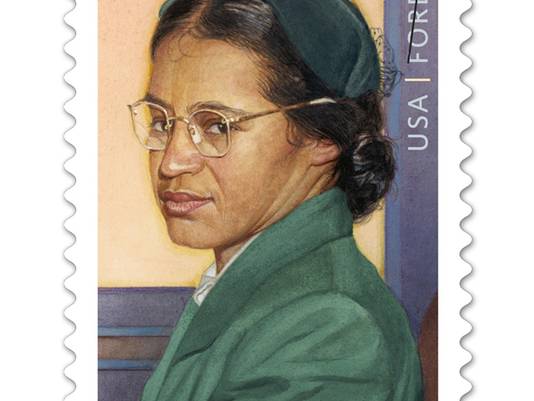
The United States Post Office issued a Rosa Parks stamp to commemorate the 100th birthday of the civil rights activist and icon. (Google Images)

by Nsenga K. Burton

Writing for the Huffington Post, Dr. Jeanne Theoharis, professor of Political Science at Brooklyn College of the City University of New York, highlights some facts about civil rights activist and icon Rosa Parks unknown to most people. As many continue to regurgitate the same information about the same people involved in the civil rights movement, Dr. Theoharis is shedding light on the complexities of the civil rights legend, demonstrating that she was a whole, complex person, not just the flat characterization of the person highlighted in history books and television programming. Dr. Theoharis also discusses Parks’ legacy in the context of the United States Post Office’s issuance of a stamp commemorating what would have been her 100th birthday. Read an excerpt from the post on The Root below:

‘Today, to honor the Feb. 4 centennial of the birth of Rosa Parks, the United States Postal Service has issued a Rosa Parks stamp. Last year, a stone carving of Parks was added to the National Cathedral. In 2005, she became the first woman and second African American to lie in honor in the nation’s Capitol and, through a special act of Congress, a statue of her was ordered placed in the Capitol.

Yet these tributes to Rosa Parks rest on a narrow and distorted vision of her legacy. As the story goes, a quiet Montgomery, Ala., seamstress with a single act challenged Southern segregation, catapulted a young Martin Luther King Jr. into national leadership and ushered in the modern civil rights movement. Parks’ memorialization promotes an improbable children’s story of social change — one not-angry woman sat down, the country was galvanized and structural racism was vanquished.

This fable diminishes the extensive history of collective action against racial injustice and underestimates the widespread opposition to the black freedom movement, which for decades treated Parks’ political activities as ‘un-American.’ Most important, it skips over the enduring scourge of racial inequality in American society — a reality that Parks continued to highlight and challenge — and serves contemporary political interests that treat racial injustice as a thing of the past.”

Read this post in its entirety on The Root. Learn more about Rosa Parks on the Huffington Post.

Like The Burton Wire on Facebook. Follow us on Twitter @TheBurtonWire.

10 Things You Didn’t Know About Rosa Parks

0
The United States Post Office issued a Rosa Parks stamp to commemorate the 100th birthday of the civil rights activist and icon. (Google Images)

by Nsenga K. Burton

Writing for the Huffington Post, Dr. Jeanne Theoharis, professor of Political Science at Brooklyn College of the City University of New York, highlights some facts about civil rights activist and icon Rosa Parks unknown to most people. As many continue to regurgitate the same information about the same people involved in the civil rights movement, Dr. Theoharis is shedding light on the complexities of the civil rights legend, demonstrating that she was a whole, complex person, not just the flat characterization of the person highlighted in history books and television programming. Dr. Theoharis also discusses Parks’ legacy in the context of the United States Post Office’s issuance of a stamp commemorating what would have been her 100th birthday. Read an excerpt from the post on The Root below:

‘Today, to honor the Feb. 4 centennial of the birth of Rosa Parks, the United States Postal Service has issued a Rosa Parks stamp. Last year, a stone carving of Parks was added to the National Cathedral. In 2005, she became the first woman and second African American to lie in honor in the nation’s Capitol and, through a special act of Congress, a statue of her was ordered placed in the Capitol.

Yet these tributes to Rosa Parks rest on a narrow and distorted vision of her legacy. As the story goes, a quiet Montgomery, Ala., seamstress with a single act challenged Southern segregation, catapulted a young Martin Luther King Jr. into national leadership and ushered in the modern civil rights movement. Parks’ memorialization promotes an improbable children’s story of social change — one not-angry woman sat down, the country was galvanized and structural racism was vanquished.

This fable diminishes the extensive history of collective action against racial injustice and underestimates the widespread opposition to the black freedom movement, which for decades treated Parks’ political activities as ‘un-American.’ Most important, it skips over the enduring scourge of racial inequality in American society — a reality that Parks continued to highlight and challenge — and serves contemporary political interests that treat racial injustice as a thing of the past.”

Read this post in its entirety on The Root. Learn more about Rosa Parks on the Huffington Post.

Like The Burton Wire on Facebook. Follow us on Twitter @TheBurtonWire.

African Cup of Nations: What Superbowl?

0
Nigeria’s Emmanuel Emenike is participating the African Cup of Nations. (Google Images)

by Nsenga K. Burton

While the free world is fixated on Superbowl XLVII, another major sporting event is taking place — the Africa Cup of Nations, also referred to as CAN (French for Coupe d’Afrique des Nations) and the African Cup of Nations. The African Cup of Nations is the major international association for football (soccer) in Africa. Founded in 1957, the sporting event is held every two years and the title holders qualify for the FIFA Confederations Cup. In 1957, there were three countries participating in the tournament – Egypt, Ethiopia and Sudan. South Africa was banned from competition due to Apartheid policies at the time. Since then, the competition has grown to include teams from 16 African countries, with Egypt being the most successful nation in the Cup’s history. Egypt has won the tournament seven times, including when they were named the United Arab Republic (1968 to 1971). The 1960s were marked by Ghanian dominance; Cameroon and Nigeria dominated the 1980s and 1994 marked the inclusion of South Africa, whose ban was lifted after the end of Apartheid. South Africa failed to qualify for the Cup in 1994, but qualified and served as tournament host in 1996.

Today, many in the world are focused on who will win the battle of Superbowl XLVII between AFC Champions The Baltimore Ravens and NFC Champions, the San Francisco 49ers. Not everyone is thinking about American football; millions are watching African football (soccer) and one of the most important soccer tournaments leading up to the FIFA World Cup which will be held in Brazil in 2014. Nigeria’s Emmanuel Emenike and the Ivory Coast’s YaYa Toure have as much fame as the Ravens’ Ray Lewis and 49ers Colin Kaepernick.  For the record Burkina Faso has beaten Togo and Nigeria has put away the Ivory Coast in the quarter finals. Next up, the semi-finals. Who will win the African Cup of Nations is as important a question in the African Diaspora as who will win Superbowl XLVII.

Follow the African Cup of Nations on AllAfrica.com.

Like The Burton Wire on Facebook. Follow us on Twitter @TheBurtonWire.