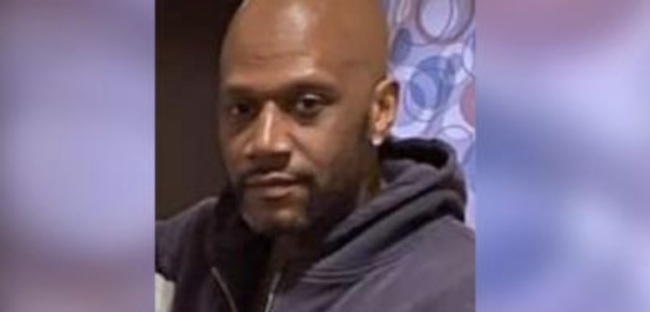
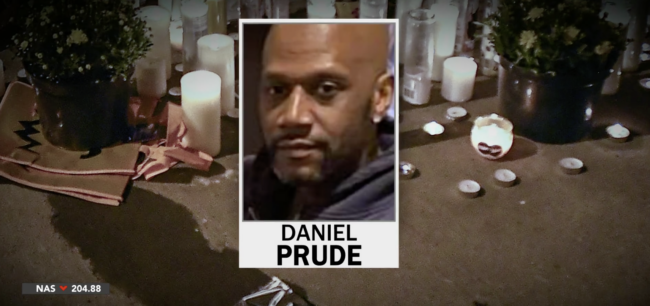
Screen shot of Daniel Prude, 41, who was killed by police in Rochester, NY.
TRIGGER WARNING: EXTREME VIOLENCE AGAINST UNARMED, NAKED AFRICAN-AMERICAN MAN
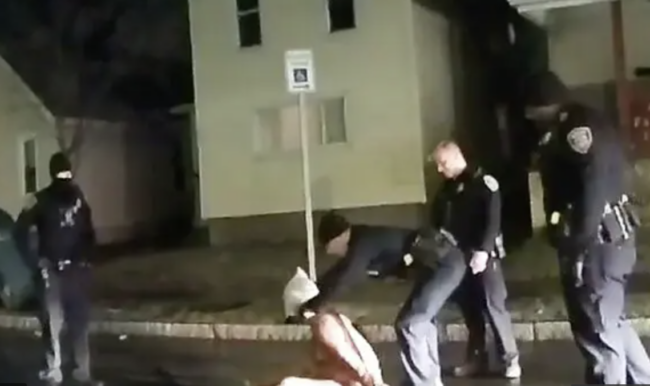
A chilling police custody case that happened in March 2020 is surfacing today. Victoria Albert of CBS News is reporting Daniel Prude, 41, died seven days after an altercation with police in which the victim was naked, handcuffed, had a hood placed over his head and his face pressed into the ground for more than three minutes by members of the Rochester Police Department. According to the medical examiners autopsy report, the death has been classified as a homicide and the cause is asphyxiation.
Screen shot of police video of Daniel Prudes arrest.
Prude’s family lawyer Don Thompson and his family held a press conference today. His brother Joe stated, they called the police for help and informed them when they came to the door, “My brother is only a threat to himself, not you so don’t kill my damned brother. Not even fifteen minutes later they come back telling me my brother’s dead.” Watch below:
The family of Daniel Prude wants the officers arrested.
Mayor Lovely Warren, who is African American has asked for patience because the Attorney General’s office has to investigate and prosecute these types of cases. The mayor said, “The case is not within our control because the executive order outlines the case has to be handled by the attorney general’s office.” Brown also added, “I know that the Prude family is frustrated right now, but rest assured, we are going to make sure we do everything possible to ensure that the truth comes out and that justice is held here.”
Watch below:
Rochester police chief La’Ron Singletary, who is also African-American said, “This is not a cover-up,” and added the officers have not been suspended.
Protesters are calling for the mayor and police chief to resign.
This story is developing.
This breaking news post was written by Nsenga K. Burton, founder & editor-in-chief of The Burton Wire. Follow her on Twitter @Ntellectual.
Follow The Burton Wire on Twitter @TheBurtonWire. </em
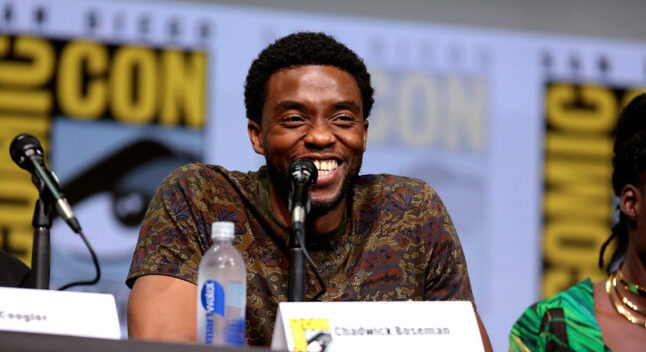
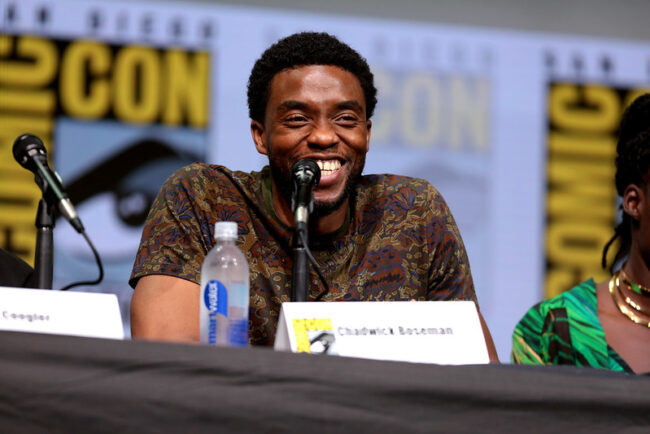
Iconic star Chadwick Boseman dies at 43.
Photo: Flickr/Gage Skidmore at 2017 San Diego Comic Con
Iconic star Chadwick Boseman dies at 43. Photo: Flickr/Gage Skidmore at 2017 San Diego Comic Con
The world is reeling from the loss of iconic actor Chadwick Boseman, who died Friday, August 28, after losing a private battle to colon cancer. Boseman died at home surrounded by his family.
A statement released by his family said Boseman was diagnosed with stage three colon cancer in 2016 and the disease progressed to stage 4. Boseman endured countless surgeries and treatments as he continued to make films from Marshall (directed by Reginald Hudlin), Da 5 Bloods (directed by Spike Lee) and August Wilson’s Ma Rainey’s Black Bottom (directed by George C. Wolfe and produced by Denzel Washington).
Washington and Boseman were first introduced when Washington paid for Boseman and several other Howard University students to continue their theater studies by taking a theater course in Oxford.
The Howard University-educated thespian was the star of Marvel’s Black Panther franchise, bringing to life one of the most important and revered superheroes in American film history.
Directed by Ryan Coogler, Black Panther was the first superhero movie to be nominated for a best picture Oscar and one of the highest-grossing films of all time, bringing in over $1billion.
Black Panther became more than a movie, morphing into a celebration of Black culture, art, history, achievement and intellect in addition to highlighting the Black cultural presence and influence in comic book culture.
Boseman was no stranger to playing iconic characters, bursting onto the big screen in 2013’s 42 as baseball legend Jackie Robinson, who broke the color barrier in major league baseball. Boseman went on to star as Soul legend James Brown in 2014’s Get On Up and Thurgood Marshall in Marshall in 2017. Boseman brought a quiet dignity and powerful presence to these characters, with performances reflective of the weight they hold in world culture.
Prior to breaking into film, Boseman lived in New York, teaching at the Schomburg Center for Research in Black Culture while cutting his teeth on small roles on shows like Law & Order, Third Watch, ER and Lie to Me, eventually landing recurring roles on Lincoln Heights and Persons Unknown.
It was Boseman’s turn as Jackie Robinson that cemented his film star status and his performance as T’Challa in Marvel’s Black Panther, that catapulted him to superstardom. Black Panther grew beyond the big screen and became a cultural phenomenon. Boseman, who hails from Anderson South Carolina, gave moviegoers a king who was stoic, powerful and captivating as he led warriors with love, intellect and strategy as they fought to maintain control of their powerful, technologically superior nation, ripe for poaching by outsiders.
Much like the Gullah culture of his home state, Boseman was able to effortlessly blend African and American culture to help create a fantastical world on screen that was inspirational and recognizable. Boseman led an all-star cast including Angela Bassett, Michael B. Jordan, Danai Gurira, Daniel Kaluuya, Letitia Wright, Sterling Brown, Winston Duke and Academy award-winning actors Lupita Nyong’o and Forrest Whitaker, holding his own and fortifying his status as a Hollywood superstar.
Boseman, who also appeared as T’Challa/Black Panther in Avengers Infinity War and Avengers: End Game, starred in and produced the films 21 Bridges, Marshall and Message from the King, which he served as Executive Producer. At the time of his death, Boseman was in pre-production as producer on Yasuke, a film about the world’s first Black Samurai in which Boseman was slated to star.
In addition to acting and producing, Boseman was also an activist and philanthropist supporting social justice initiatives like Michelle Obama’s #WhenWeAllVote and celebrating fellow Bison Kamala Harris’ history making selection as the Democratic Vice-Presidential nominee for the 2020 U.S. Presidential election, which was his last Twitter post before his death.
In 2018, the wonderkind performer delivered a powerful commencement speech at Howard University encouraging students to rise above traumatic experiences and applauding their campus activism. Boseman, who was mentored by fellow Howard University alum Phylicia Rashad and helped financially by Denzel Washington as a student donated $100,000 to #Change4Change, which supports HBCUs in November 2019.
The private public figure spent time visiting children suffering from cancer at St. Jude’s Research Center. In April 2020, the actor donated $4.2 million worth of PPE equipment to hospitals serving Black communities during the COVID-19 pandemic.
The youngest of four, Boseman is survived by his parents Leroy and Carolyn Boseman, siblings Kevin, Dionne and Derrick and wife Taylor Simone Ledward. Boseman was 43.
This article was written by The Burton Wire founder & editor-in-chief Nsenga K. Burton, Ph.D. for NNPA/Black Press USA, where it originally appeared.
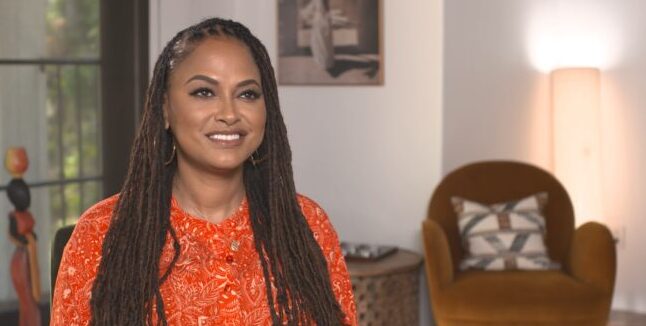
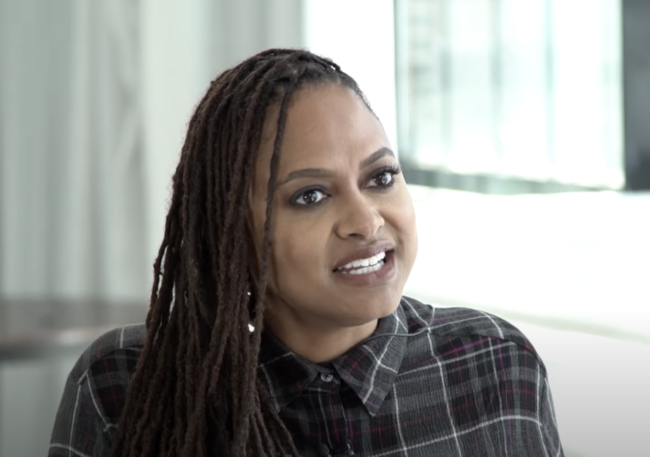
Screenshot: Ava DuVernay discussing the significance of August 28th in Black American Lives. (Photo: Screenshot YouTube)
Celebrated filmmaker Ava DuVernay released her short film, “August 28: A Day in the Life of a People,” starring Lupita Nyong’o, Angela Bassett, Don Cheadle, Regina King, David Oyelowo, Gugu Mbatha-Raw, André Holland, Michael Ealy and Glynn Turman.
Written, produced and directed by DuVernay, “August 28” traverses a century of black progress, protest, passion and perseverance of African American people. The project gives historical perspective within the creative framework of one date that has had a profound effect on America including: the passing of The Slavery Abolition Act on August 28, 1833, the lynching of Emmett Till on August 28, 1955, the first radio airplay from Motown Records on August 28, 1961 with The Marvelettes “Please Mr Postman,” Dr. Martin Luther King Jr.’s “I Have A Dream” speech during the massive March on Washington on August 28, 1963, Hurricane Katrina making its tragic landfall on August 28, 2005 and then-Senator Barack Obama’s acceptance of the Democratic nomination for the presidency on August 28, 2008. The film was lensed by cinematographer Malik Sayeed and edited by Oscar nominee Spencer Averick. Ten-time Grammy nominee Meshell Ndegeocello composed the score. Paul Garnes produced, with co-producers Tilane Jones and Tammy Garnes.
“August 28” will debut today as part of “OWN Spotlight: Culture Connection & August 28th, a special airing Friday, August 28 at 1 p.m., 4 p.m. and 6 p.m. ET/PT on OWN and streams for freeon the Watch OWN app and the OWN Facebook and Youtubepages beginning at 2 p.m. ET.
This special is part of OWN’s overall OWN YOUR VOTEinitiative, a bipartisan registration and get-out-the-vote campaign partnering with national and local grassroots and voting rights organizations to provide tools and resources that will empower Black women to vote this November. Black women powerfully influence election outcomes, and OWNYOURVOTE supports this group of voters to show up to the polls and help friends, family, and their community to do the same. Winfrey recently shared that OWN will grant November 3rd as a company holiday to ensure all employees have the time to vote and volunteer. “I challenge other companies to do the same because this might be the most important election of our lives,” Winfrey said in her social post.
“OWN Spotlight: Culture Connection & August 28th, Ava DuVernay & Rev. Sharpton” is produced by OWN. The executive producers are Oprah Winfrey and Tara Montgomery.
This post was curated by Nsenga K. Burton, Ph.D., founder & editor-in-chief of The Burton Wire. Follow Nsenga on Twitter @Ntellectual. Follow The Burton Wire on Twitter @TheBurtonWire.
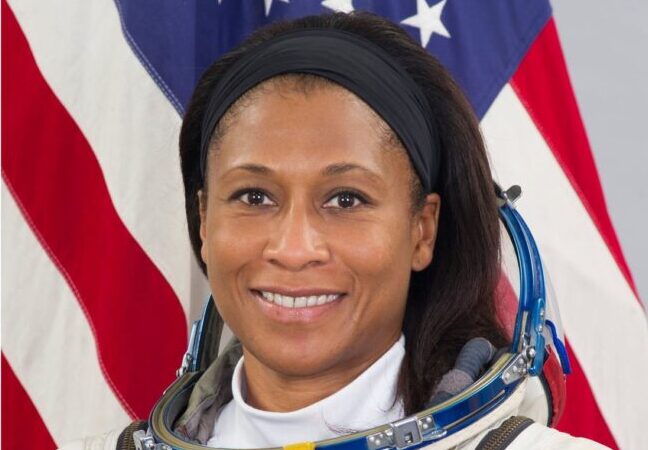
Astronaut Dr. Jeanette Epps could become first Black woman on an international space station. (Photo: NASA.gov)
The blogosphere is teeming with news Dr. Jeanette Epps could become the first Black woman to join an International Space Station.
NASA has assigned astronaut Jeanette Epps to NASA’s Boeing Starliner-1 mission, the first operational crewed flight of Boeing’s CST-100 Starliner spacecraft on a mission to the International Space Station.
Epps will join NASA astronauts Sunita Williams and Josh Cassada for a six-month expedition planned for a launch in 2021 to the orbiting space laboratory. The flight will follow NASA certification after a successful uncrewed Orbital Flight Test-2 and Crew Flight Test with astronauts.
Epps was set to make history two years ago when slated to work as a crew member on a Russian space station. She was pulled from the assignment without explanation.
“Though more than a dozen Black Americans have traveled to space since Guion Blufordbecame the first to do so in 1983, none has had the opportunity to live and work in space for an extended period, as the ISS has enabled more than 200 astronauts to do since 2000.
The spaceflight will be the first for Epps, who earned a bachelor’s degree in physics in 1992 from LeMoyne College in her hometown of Syracuse, New York. She completed a master’s degree in science in 1994 and a doctorate in aerospace engineering in 2000, both from the University of Maryland, College Park.
To read more about Dr. Epps, visit her NASA profile. To read the CNN story reference above, click here.
This post was written by Nsenga K. Burton, Ph.D., founder & editor-in-chief of The Burton Wire. Follow her on Twitter @Ntellectual.
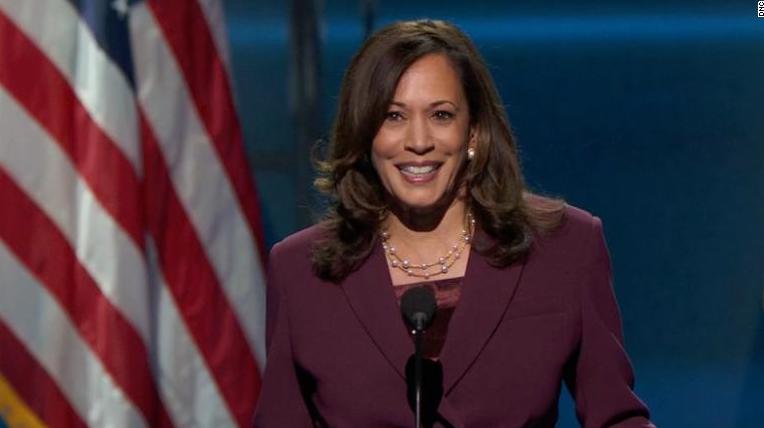
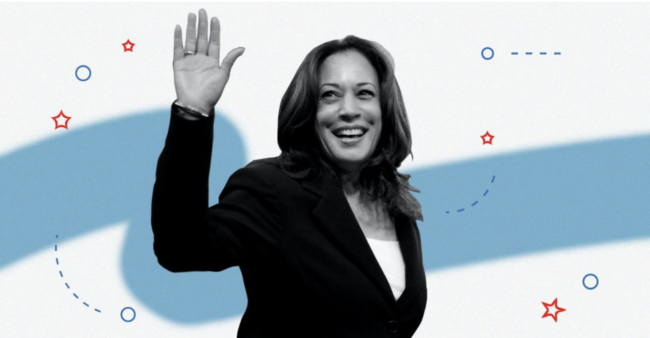
Kamala Harris accepts Democratic Vice-Presidential Nomination becoming the first Black woman and person of Asian Descent to do so.
(Photo: Screengrab)
Kamala Harris accepts Democratic Vice-Presidential Nomination becoming the first Black woman and person of Asian Descent to do so. (Photo: Screengrab)
Day three of the 2020 Democratic National Convention did not disappoint. Senator Kamala Harris made history by accepting her formal nomination for Vice-President on the Democratic ticket, becoming the first Black woman and person of Asian descent on a major party’s national ticket.
Introduced by her sister Maya, stepdaughter and niece, Harris let viewers into her life as the child of an Indian woman and black man in Oakland, reminding detractors that she was born at Kaiser Hospital in Oakland. Harris shouted out her sorority, Alpha Kappa Alpha Sorority, Incorporated, the nations first sorority for Black college women, the Divine Nine, Historically Black Colleges and Universities and her birthplace of Oakland, CA while delivering her thoughtful speech which detailed how she became the woman she is. Harris referenced her mother many times, whose “shoulders she stands on” in addition to the Black women activists and politicians who came before her like Fannie Lou Hamer, Dianne Nash and Shirley Chisholm to make her political run possible.
Harris turned her focus to ousting President Trump, stating, “I know a predator when I see one,” and reminding viewers “we’ve gotta do the work” to get rid of Trump if Democrats expect to win this next presidential election.
Prior to Harris’ speech, viewers heard from former U.S. Secretary of State and presidential candidate Hilary Clinton, Senator Elizabeth Warren, former Arizona representative Gabby Gifford, who suffered catastrophic injuries from being shot while in office, all of whom endorsed Harris and Biden and also drilled down on the need to have a plan to vote based on the voter suppression efforts at work including destruction of the U.S. Postal Service.
Former president Barack Obama also spoke about Harris’ tenacity and greatness while making the case for voting for Biden by pummeling President Trump. He stated, “For close to four years now, he’s [Trump] shown no interest in putting in the work; no interest in finding common ground; no interest in using the awesome power of his office to help anyone but himself and his friends; no interest in treating the presidency as anything but one more reality show that he can use to get the attention he craves.”
Harris also gave her support of Biden for president and talked about helping to bring his plan into fruition.
Tonight the history maker will introduce former Vice-President Joseph Biden, who will formally accept the Democratic Party nomination for President of the United States.
Watch the Democratic National Convention live here or on any major network.
This post was written by Nsenga K. Burton, Ph.D., founder & editor-in-chief of The Burton Wire on Instagramor Twitter @TheBurtonWire. Follow Nsenga on Twitter @Ntellectual.
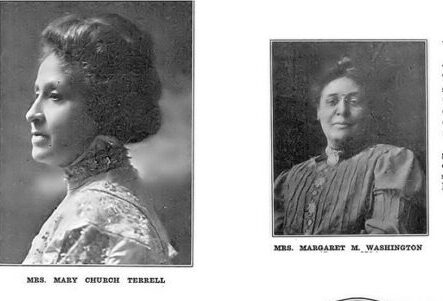
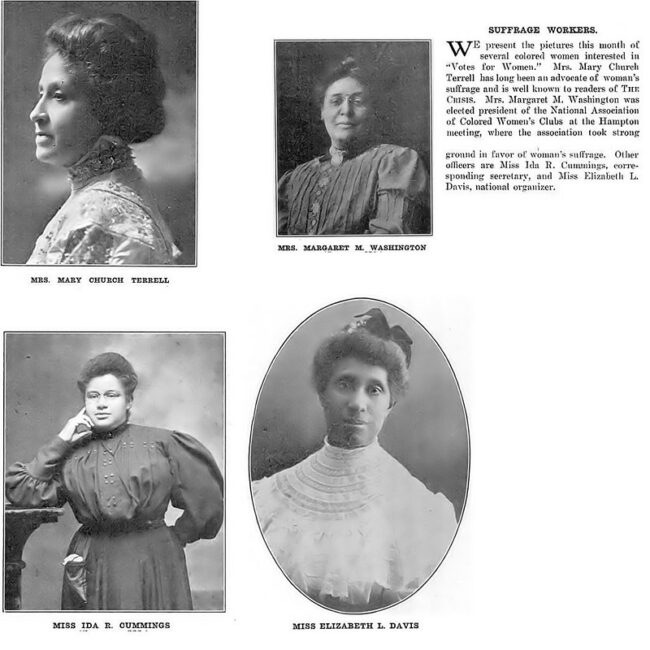
Photo: The Crisis Magazine, September, 1912; Mary Church Terrell (top l), Margaret M. Washington (top r), Ida Cummings (bottom l) and Elizabeth L. Davis (bottom r) (Flickr Creative Commmons/Vielles Annonces)
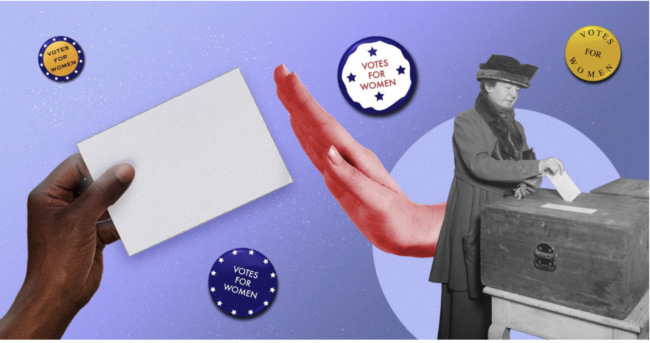
Photo: Desiree Tapia for Courier.
Writing for Courier Newsroom, The Burton Wire‘s founder & editor-in-chief Nsenga K. Burton, Ph.D. discusses the importance of writing the work of Black Women Suffragists into the dominant narrative of Women’s Suffrage as we celebrate the centennial of passage of the 19th Amendment, which gave women the right to vote. Check out an excerpt below:
EXCERPT
When Americans discuss the women’s suffrage movement in the United States, Susan B. Anthony, Alice Paul, Betsy Ross, and Elizabeth Cady Stanton are the names you often hear associated with the work to pass the 19th Amendment. On Aug. 18, 1920—exactly 100 years ago on Tuesday—the amendment was ratified by the final state needed, and women won the constitutional right to vote.
But it would be a full 45 years following passage of the 19th Amendment—when the 1965 Voting Rights Act was enacted—before Black women (and men) would be able to exercise their right to vote fully.
Due to the imposition of poll taxes and literacy tests in the Jim Crow South—not to mention the racial terror in the form of mob violence and mass murder experienced by Blacks attempting to vote in the South and throughout other pockets of the United States—Black women were often unable to participate in the electoral process. The passage of the 19th Amendment meant little for them.
Celebrated white women suffragists like Stanton and Ross and other high-profile leaders in the movement didn’t support the 14th and 15th amendments, which granted former slaves citizenship rights and gave Black men voting rights, respectively. So, unsurprisingly, helping Black women—many of whom were former slaves—gain the right to vote was not on these women’s agenda.
Thus, when people speak of the women’s suffrage movement, they speak of a middle to upper-class white women’s movement that disregarded Black women and left them disenfranchised following passage of the 19th Amendment.
No wonder the activism and struggle of Black women suffragists to obtain the right to vote are often left out of the dominant narrative.
The names of Black women suffragists like Mary Church Terrell, Harriet Forten Purvis, Anna Julia Cooper, Frances Ellen Watkins, and Mary Ann Shadd Cary are often excluded from the history books and dialogue of the women’s suffrage movements. Part of the reasoning for doing so was plain old white supremacy, but some of it was strategy. The presence of Black women made it difficult for Northern white women to collaborate with Southern white women, who refused to work in the same organizations as Black women.
Photo: The Crisis Magazine, September, 1912; Mary Church Terrell (top l), Margaret M. Washington (top r), Ida Cummings (bottom l) and Elizabeth L. Davis (bottom r) (Flickr Creative Commmons/Vielles Annonces)
When the 19th Amendment was ratified, more than a dozen states had already given women the right to vote, so millions of white women were already participating in elections. In those states, many Black women were still unable to vote because of the hurdles put in place by state legislatures targeting Black Americans in general. When Terrell, who helped found the National Association of Colored Women, appealed to white women suffragists for help, the response she and others received was that the disenfranchisement of Black women voters was a race problem, not a gender problem.
But Black women were organizing around the issue of voting rights long before their white counterparts: They worked closely with Black men to help them obtain that right through the 15th Amendment in 1870. They founded their own clubs and organizations to fight for the rights of Black women, including suffrage, and continued working well into the next century.
In 1913, for example, journalist, anti-lynching activist, and longtime women’s rights activist Ida B. Wells founded the Alpha Suffrage Club, the first suffrage organization for Black women in Chicago. Black women worked diligently for universal women’s suffrage just as they had worked for citizenship and for Black men to have the right to vote. They knew full well they would continue to be disenfranchised and subjugated by both groups, but had the vision to understand that universal equality would eventually mean Black women’s equality.
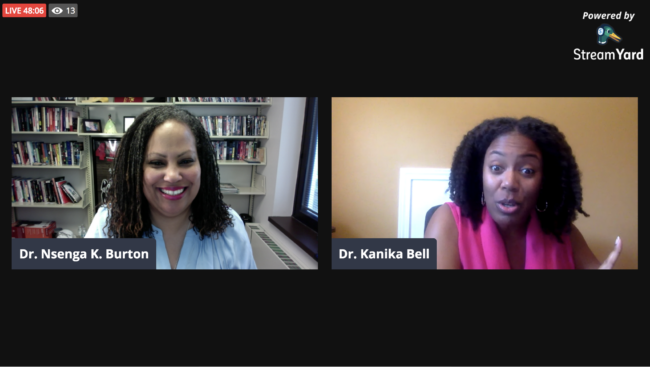
The Burton Wire Happy Hour kicked off with founder & editor-in-chief Dr. Nsenga K. Burton and friend/colleague Dr. Kanika Bell as they discussed topics related to gender, politics and pop culture. “A word” was said on the subject of Senator Kamala Harris, rappers Cardi B and Megan Thee Stallion and murdered EMT Breonna Taylor, whose killers have still not been arrested. Check us out here:
Writing for Courier Newsroom, The Burton Wire‘s founder & editor-in-chief Nsenga K. Burton, Ph.D. discusses finding out Senator Kamala Harris would be named Vice-President by presumptive 2020 Democratic Presidential nominee Joe Biden and the Democratic Party while picking up her daughter and what that means for Black women and girls everywhere. Read an excerpt below:
EXCERPT
I received the text alert just before picking up my daughter from school. On Tuesday, California Sen. Kamala Harris was chosen to be presumptive Democratic presidential nominee Joe Biden’s running mate.
Not only had Harris made history as the first Black and South Asian American vice-presidential candidate, but the choice also signaled that the Democratic Party finally recognized the work Black women have done in and for the party since gaining the right to vote.
But, for me, the choice of Harris for VP meant so much more.
My daughter and I held hands and skipped to the car—even with my bad knee. I buckled her in and gave her snacks.
“Kai,” I said, smiling, “we have a vice-presidential candidate who looks like us.”
Kai is four, so she didn’t know what I meant. “What, Mommy?”
I pulled up a news article on my cell phone and showed her a picture of Harris.
“She looks like you,” Kai replied excitedly. “Mommy, she looks like you! She looks like me.”
My elation turned to tears when I realized my daughter and other Black and brown girls in this country finally have the opportunity to see themselves as someone who could someday be vice president of the United States.
I cried because I was relieved. In this current social climate ripe with anti-Black racism and rampant sexism, I had worried about who Biden would choose to join him in the fight to take back the White House. Despite the long list of qualified candidates, I wasn’t convinced Biden would actually select a Black woman. Although Black women have given so much to this country in a myriad of ways, I wasn’t sure it would matter.
Greenleaf finale airs August 11, 2020 at 9 p.m. EST.
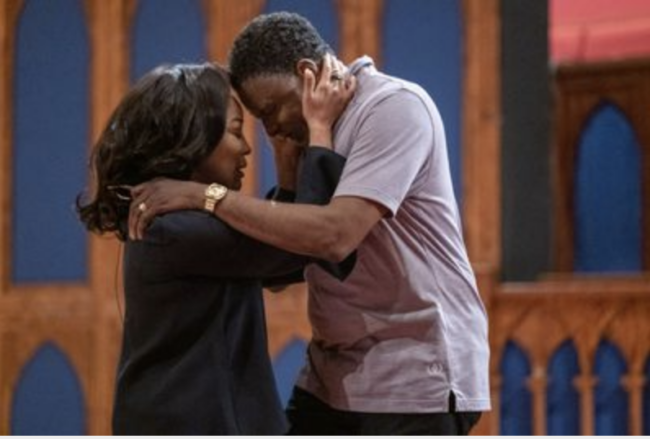
Lady Mae Greenleaf (Lynn Whitfield) and Bishop James Greenleaf (Keith David) embrace. OWN’s Greenleaf finale airs August 11, 2020 at 9 p.m. EST.
LOS ANGELES – The stars of OWN’s hit megachurch drama “Greenleaf,” the critically-acclaimed series from Lionsgate, award-winning writer/executive producer Craig Wright (“Lost,” “Six Feet Under”), and executive producers Clement Virgo (“Empire”), Kriss Turner Towner (“Black Monday”) and Oprah Winfrey, will take an look back at the beloved show in a one-hour special airing Tuesday, August 11 at 10:00 p.m. ET/PT, immediately following the series finale. The special will feature “Greenleaf” cast including Merle Dandridge, Keith David, Lynn Whitfield, Lamman Rucker, and Deborah Joy Winans sharing favorite moments from the past five seasons and answering questions from the devoted fans.
The penultimate (8/4/20) episode of “Greenleaf” garnered a season-high 2,117,000 viewers and continued to be Tuesday night’s #1 cable telecast among Women 25-54 and W18-49. During its current season, “Greenleaf” is the #1 original series across broadcast and cable for African American women, households and total viewers.
Watch a clip from the final episode of “Greenleaf” airing Tuesday, August 11 at 9p.m. ET/PT:
“Greenleaf” has garnered ten NAACP Image Award nominations, including wins for Outstanding Drama Series in 2020, and Outstanding Supporting Actress in a Drama Series in 2019 and 2020 (Lynn Whitfield). The series has also been recognized by the Alliance for Women in Media’s Gracie Allen Awards and by the Black Reel Awards for Television.
Greenleaf stars Merle Dandridge as Grace Greenleaf; Keith David as Bishop James Greenleaf; Lynn Whitfield as Lady Mae Greenleaf; Kim Hawthorne as Kerissa Greenleaf; Lamman Rucker as Jacob Greenleaf; and Deborah Joy Winans as Charity Greenleaf-Satterjee.
“Greenleaf” is produced for OWN by Lionsgate in association with Harpo Films and Pine City. Executive producers are Oprah Winfrey, Craig Wright, Kriss Turner Towner, and Clement Virgo.
A “Greenleaf” spinoff, currently in development with Lionsgate, was announced in May 2020.
Viewers can now catch up on the show’s complete four seasons on Netflix.
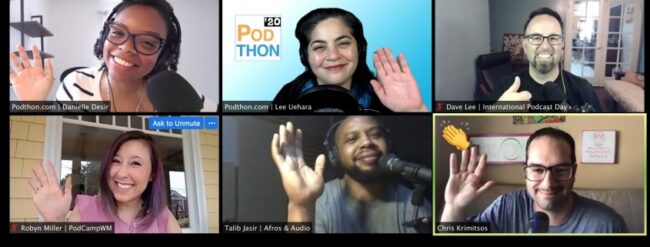
Podthon Panelists - July 18, 2018. (Photo: Podthon)
Podthon Panelists – July 2020. (Photo: Podthon)
Amid the global pandemic, the demand for media content to fill our “free” time has steadily increased. There are now a multitude of streaming networks, and live video has become a staple. Just when we thought we’ve reached our media limits, podcast listening made a comeback after an early slump with the halting of regular commutes.
Ad dollars for podcasting suffered an initial COVID-19 hit, but the industry is beginning to bounce back. A new IAB and PricewaterhouseCooper’s full-year podcast ad revenue study projects advertising revenues to reach 14.7% year over year to the tune of $1 billion in 2020. This space has also seen a plethora of podcast conferences, which translates to both learning and speaking opportunities. Essentially, podcasting is big business.
While this study means opportunities for many podcasters as a whole are in abundance, such options are often absent for podcasters of color. The dearth of diverse voices at conferences is no secret – and this is precisely what podcasters Lee Uehara and Danielle Desir sought to solve by creating Podthon, a virtual conference hosted by the Women of Color (WOC) Podcasters and the Asian American Podcasters Association (AAP).
“We started Podthon because we wanted to create our own opportunity for podcasters of color to speak on stage after seeing so many speaker submission rejections from the larger industry conferences,” said Uehara, who also co-founded AAPC. “That’s our general message to everyone — go out and create your own opportunities.”
Standing out in a space that seems saturated with conferences requires innovative thinking. As such, Desir, co-founder of WOC Podcasters, says they seek speakers who provide fresh and innovative information.
“We pride ourselves on sourcing speakers who can speak to topics that are outside of the norm. This year, Norman Chella shared how to break into the Asian podcast market and Tracey Nguyen Mang shared how to find grants to fund your podcast. Both topics we have never seen discussed in the podcasting space before.”
Desir also noted that among the offerings were two keynote panels, where podcast event organizers and podcast news editors shared how to craft press releases and secure speaking gigs at larger podcast conferences. Both Desir and Uehara assert that Podthon’s virtual venue is attractive to attendees in part because it cuts down on travel and lodging costs, allowing participants and speakers to attend from any location.
At its core, Podthon acts as an incubator for podcasters of color to network and hone speaking skills.
“One of the pillars of our mission is to coach speakers, who may need a little help, so that they go on to larger stages with confidence,” said Uehara. “So, part of our vision is to continue to offer fantastic presentations from podcasters of color who then go on to become even greater speakers.”
As for Podthon’s future direction, the pair intend to expand to offerings outside of the set conference time frame.
“We’re working on other exciting things such as our monthly Round Table Series (RTS) — the next is self-publishing for podcasters” Uehara said.
It’s clear that there are barriers preventing podcasters of color from being called on to share their expertise. In the Harvard Business Review, Ruchika Tulshyan writes about challenging such exclusion by recognizing and acknowledging “the systematic barriers holding back people of color (especially) from being recognized as experts.”
Based on the impressive speaker roster, it appears that Podthon’s founders are up for the challenge.
This post was written by Dr. Chetachi A. Egwu, Communication Faculty at University of Maryland University College. Dr. Egwu’s scholarship focuses on media, tech and pop culture and the African image in film, with an emphasis on documentary. The Howard University alumna is the host of the livestreamed show MediaScope, co-host of the podcast TV Channeling and co-creator of And We’re Live. Follow her on Twitter @Tachiada.