Crispian Balmer of Reuters Africa is reporting migrant boats that typically land in Sicily will be banned during the 43rd G7 being held May 26-27 in Taormina (ME). The main G7 countries include Canada, United States of America, United Kingdom, France, Germany, Italy, Japan and the European Union. Invited guests include Ethiopia, Kenya, Tunisia and Nigeria. The mission or theme of this year’s summit is “Building the Foundations of Renewed Trust,” which will try to address citizen’s mistrust of governments. One of the main goals of the summit is to stress that “governments should first and foremost adopt policies aimed at meeting their citizen’s overall expectations.” Does the migrant boat ban mean that the plight of African migrants will be ignored?
Balmer reports:
“A common sight off Sicily in recent years, the authorities have banned all migrant landings on the island during the Group of Seven Summit for security reasons, telling rescue vessels that pick them up at sea to take them to the mainland during the two-day meeting.
Out of sight does not mean out of mind. Italy chose to host the summit in Taormina, on the cliffs of eastern Sicily, to concentrate minds on Europe’s migrant crisis and to seek ways of developing Africa’s economy to hold back the human tide.
‘Africa is very important for us. Indeed, it is perhaps the focus of our G7 presidency,’ said Raffaele Trombetta, the senior Italian diplomat who has led behind-the-scenes negotiations on the G7 agenda with colleagues from the United States, Japan, Germany, Britain, France and Canada.
‘We don’t just want to talk about crises, like migration and famine, but also to promote innovation in Africa and see what we can do to help,’ he told Reuters.”
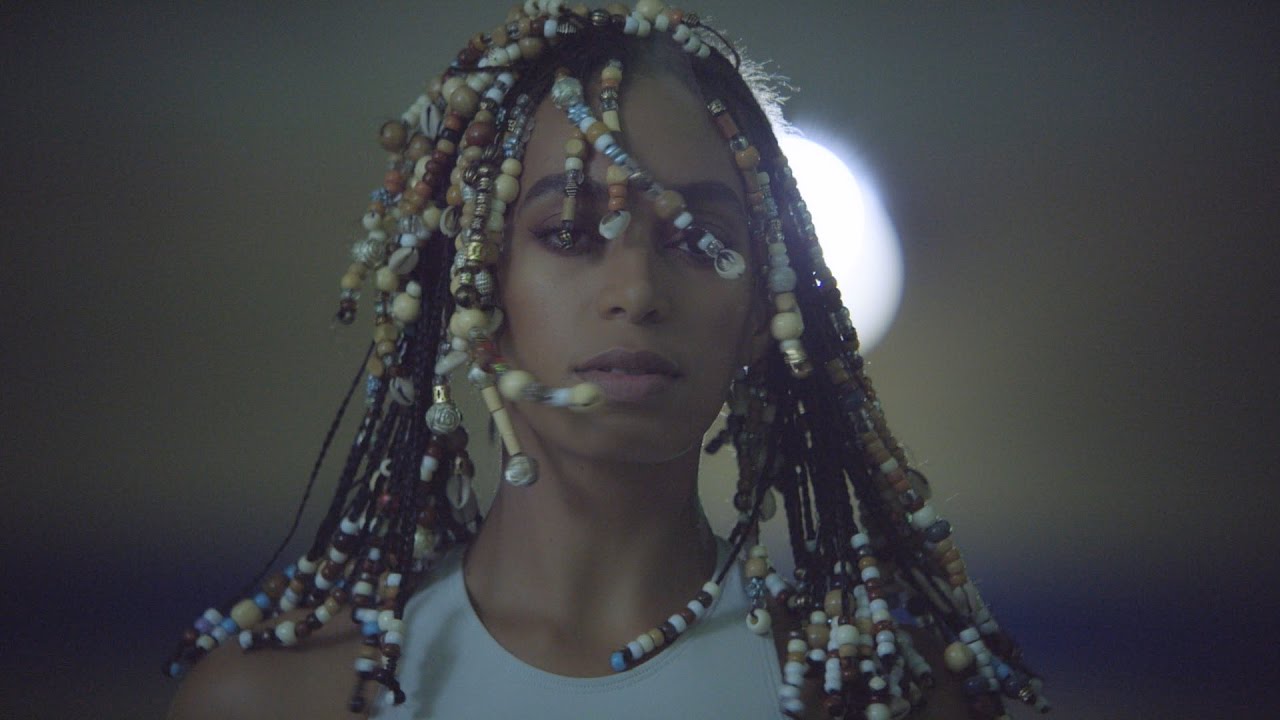
Solange Knowles, "Don't Touch My Hair." (Photo: Screen shot of YouTube video)
Writing for The Root, The Burton Wire‘s founder & editor-in-chief Nsenga K. Burton, Ph.D., discusses the growing number of cases of black girls being punished at school for wearing natural hair styles. Dr. Burton calls out “educators” for policing black girls bodies which is the only thing unnatural about wearing natural hairstyles. Check out an excerpt below:
EXCERPT
In recent weeks, there have been a number of news stories about black girls being discriminated against at school for wearing natural hairstyles. In July 2016, a news story went viral about a school in Pretoria, South Africa, banning black girls from wearing natural hairstyles like Afros because they were “untidy” and “unladylike.”
In March 2017, twins Grace and Thabisa, who are of South Sudanese descent, were pulled out of their classes at Bentleigh Seconday School in Melbourne, Australia, and told to remove their braids because it didn’t “represent the school.” After an uproar from parents who said the policy was an attack on African culture, the girls were allowed to return to school.
Last week, there was a story about twins Maya and Deanna Cook, students at Mystic Valley Regional Charter School in Malden, Mass., who were kicked off their sports teams and prohibited from attending a prom because they wore their hair in braids.
The school said that the girls were in violation of the dress code for wearing their hair in an “unnatural” way, which includes braids. The girls were also placed in detention for two weeks for refusing to change their hair, and other black students were singled out for hair inspections…
So why are black people in general and black girls specifically being targeted?
The Petty Pendergrass in me thinks that some folks are jealous because they don’t have the versatility that natural hair affords black women. We can loc, twist, cut, grow, curl, weave, braid, shave—pretty much do anything we want with it and look good doing it. If natural hairstyles worn by black girls are so bad, then why are white celebrities like Fergie, David Beckham, Juliette Lewis and the Kardashians celebrated for wearing them?
The academic in me knows that there’s something more occurring: the targeting of black girls for whatever infraction—perceived or real—of normative worldwide behavior. Historically, the bodies of young black girls have been policed, touched, harassed and violated—legally. See slavery. See segregation. See the civil rights era. See the post-civil-rights era. See the new millennium. See Halle Berry’s unwanted kiss from Adrien Brody at the 2003 Academy Awards. See the kidnapped girls of Chibok, Nigeria. If you think that a focus on people touching black women inappropriately, especially when it comes to our hair, is a stretch, then listen to Solange’s song “Don’t Touch My Hair” for a recent testimony.
What is happening to our girls now is not a stretch. In fact, it is part of the fabric of our country and its institutions…
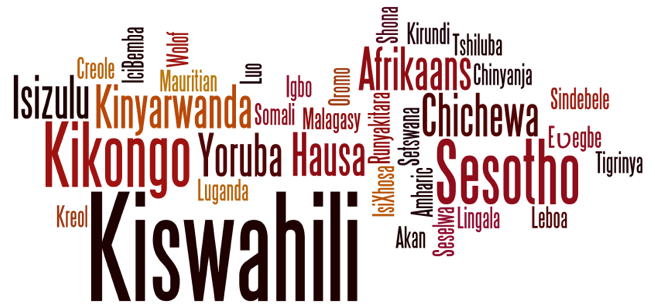
Africa.com has done a great service for travelers who may find themselves in one of the continents 54 countries by creating a Top 10 list of greetings in Africa’s most used languages. The top 10 languages spoken other than English and Arabic (more than 100 million speakers) are Swahili, Amharic, Yoruba, Oromo, Hausa, Igbo, IsiZulu, Shona, Portuguese and French.
The author writes:
“Africa is home to the highest linguistic diversity in the world with over 1500 different languages. Even though the continent has a wide range of languages, the principal languages found across all 54 countries include Arabic, French and English. Interesting facts to know about languages in Africa is that they form part of four language groups, namely Afro-Asiatic covering Northern Africa, Central Sahara and the Horn of Africa, Nilo-Saharan covering Central and Eastern Africa, Niger-Congo covering Central, Southern and Eastern Africa and Khoisan, covering the western part of Southern Africa.”
Check out a few of the ways to greet people in African languages below:
Swahili
Hello – “Hujambo,” but if you’re greeting elders or people older than you, say “Habari,” which also means “Good morning.”
How are you? – “Habari gani”
I am fine – “Nzuri”
Thank you – “Asante,” and “Thank you very much” is “Asante sana.”
Amharic
Hello – “Selam” or “Iwi selami newi.”
How are you? – “Inidēti nehi?” or “tenastalign?”
I am fine – “Dehina nenyi.”
Thank you – “Ameseginalehu.”
Yoruba
Hello – “Ẹ nlẹ o” for a general greeting; however, when greeting elders, the general greeting is “E nle ma” for women and “E nle sir” for men.
How are you? – “Ṣe daadaa ni o wa?” or “Bawo ni o se wa?”
Thank you – “E dupe” or “O se” or “E se.”
IsiZulu
Hello – “Sawubona” when greeting one person and “Sanibonani” when greeting two or more people.
How are you? – “Unjani?” but when asking elders, you say “Ninjani?”
I am fine – “Ngiyaphila”
Thank you – “Ngiyabonga.”
Learn more about African languages and greetings at Africa.com.
Golden Globe award-winning actress America Ferrera receives NAB Television Chairman’s Award.
(Photo: Chetachi Egwu)
Golden Globe award-winning actress America Ferrera receives NAB Television Chairman’s Award. (Photo: Chetachi Egwu)
The lights on the infamous Las Vegas strip were not all that shone brightly last week. In addition to serving as an advocacy group for American broadcasters, the National Association of Broadcasters (NAB) touts the largest forum of electronic media in the world, The NAB Show. An estimated 100,000 participants descend upon Las Vegas each April to engage in the business of media creation, delivery and consumption across platforms. This year’s event boasted 103,443 registered participants from 161 countries, about 1806 exhibitors in 1,091,792 net square feet of space, and numerous sessions and keynotes with media notables. The NAB Show event serves as the quintessential venue for anyone in the broadcast and entertainment industries.
Flying drone at 2017 National Association of Broadcasters Show. (Photo: Chetachi Egwu)
This year’s theme, the M.E.T. Effect (Media, Entertainment and Technology), examined convergence, communities and transformation and what M.E.T. means for the future of media, whether it be bringing in some of the ideas that VANTIQ sees in the business technology world or by changing the public perception at play. While it was impossible to see everything at NAB, allow me to point out some show highlights:
ATSC 3.0/Next Gen TV
The industry’s new broadcast standard went from last year’s conversation to this year’s demonstration, prominently featured on the Grand Concourse of the Las Vegas Convention Center. So what is Next Gen TV? Essentially, it allows for, two-way communication, live data delivery to multiple places (cars, homes, televisions, mobile devices) and can carry high dynamic range 4K TV, among other things. This takes it steps above the current over-the-air system, making for a richer viewing experience. The standard is currently being finalized in the U.S.
4K Livestream – From Space
On Day 3 of the show, a crowd of about 300 people was treated to the first-ever 4K livestream from space, thanks to a partnership between NASA and Amazon Web Services (AWS). The crowd cheered loudly as astronauts Peggy Whitson and Jack Fisher spoke from space, making live stream history.
NAB Television Luncheon
It was evident that recognition of diverse voices is still some part of the NAB conversation. The honorees at this year’s Television Luncheon were actor/activist and star of ABC’s ‘Superstore’ America Ferrera, and longtime Univision journalist Maria Elena Salinas. Ferrera earned the NAB Television Chairman’s Award and Salinas was inducted into the NAB Hall of Fame.
Virtual Reality gets social
One of the more talked about aspects was VR,AR and 360 video. From the M.E.T. 360 Pavillion on the concourse to vendors providing VR experiences, the VR, AR and 360 are starting to span beyond just being ‘cool’ to practical applications in advertising and medicine. One of my favorite experiences was Canon’s 60-foot Virtual Reality Dome. Virtual reality is usually a solitary experience, but leaning back in a comfy bean bag chair with 17 other people makes it more collective. Though the resolution could have been sharper, it won’t be long before this is the standard for the movie-going experience.
Live video is the new static
In addition to industry mainstays like Teradek and Live U who offered the latest in affordable livestreaming solutions, there were numerous sessions and dozens of media publications and personalities using Facebook Live (who had their own pavilion at the show), YouTube and Periscope to share the show floor with the outside world, present company included.
…and podcasting is still the new black
The success of the podcast ‘Serial’ and spin-off ‘S-town’, and the fact that the podcast ad market is projected to hit $250 million in 2017, has sparked even more interest in the platform. As such, there were sessions aimed at audience building, monetization, and radio using podcasts for growth.
The biggest takeaway? In this age of vilifying “the media”, and despite skeptics, that media matters, perhaps more than ever.
This post was written by Dr. Chetachi A. Egwu, Communication Faculty at University of Maryland University College. Her scholarship focuses on media, tech and pop culture and the African image in film, with an emphasis on documentary. The Howard University alumna is the host of the livestreamed show MediaScope, co-host of the podcast TV Channeling and owner of Conscious Thought Media. Follow her on Twitter @Tachiada.
Moshup Beach at Martha’s Vineyard. (Photo: Camille King via Flikr)
In an article entitled, “Dark Skin Tones and Skin Cancer: What You Need to Know,” on Skincancer.org, the author writes:
“People who have dark skin tones often believe they’re not at risk for skin cancer, but that is a dangerous misconception, says dermatologist Maritza I. Perez, MD, a senior vice president of The Skin Cancer Foundation.
‘Anyone can get skin cancer, regardless of race,’ she says. While incidence of melanoma is higher in the Caucasian population, a July 2016 study in the Journal of the American Academy of Dermatology showed it is more deadly in people of color. African American patients were most likely to be diagnosed with melanoma in its later stages than any other group in the study, and they also had the worst prognosis and the lowest overall survival rate.”
According to the article, 63 percent of African-Americans in the study stated they never use sunscreen, which is alarming. People of color can still get sunburned, and develop skin cancer from UV damage, so Blacks should definitely conduct yearly self-checks and use sunscreen regularly. Music legend Bob Marley died from melanoma at age 36.
Melanoma warning signs include the following:
A bump, patch, sore or growth that bleeds, oozes, crusts, doesn’t heal or lasts longer than a month. This may indicate basal cell carcinoma.
An ulcer, scaly red patch, wart-like growth or sore that sometimes crusts or bleeds could be a sign of squamous cell carcinoma. This type of skin cancer can also develop in old scars or areas of previous physical trauma or inflammation. Warts of any kind should never be ignored if you notice them on your body, especially if you find them in areas such as your anus. If you discover any of these issues on your body, you may want to find some information on what you can do about it on a website such as https://www.drkamrava.com/anal-warts/, where you can view some of your medical options.
New or existing moles that are asymmetrical, have an irregular border, more than one color, are larger than a pencil eraser or change in any way may indicate melanoma. Pay special attention to suspicious spots on the hands, soles of the feet or under the nails, which could signify ALM.
Melanoma. (Photo: Bay Harbour Med Spa)
Ways to prevent skin cancer include:
Seek the shade, especially between 10 AM and 4 PM.
Do not burn.
Avoid tanning and UV tanning beds.
Cover up with clothing, including a broad-brimmed hat and UV-blocking sunglasses.
Use a broad spectrum (UVA/UVB) sunscreen with an SPF of 15 or higher every day. For extended outdoor activity, use a water-resistant, broad spectrum (UVA/UVB) sunscreen with an SPF of 30 or higher.
Apply 1 ounce (2 tablespoons) of sunscreen to your entire body 30 minutes before going outside.Reapply every two hours or immediately after swimming or excessive sweating.
Keep newborns out of the sun. Sunscreens should be used on babies over the age of six months.
Examine your skin head-to-toe every month.
See your physician every year for a professional skin exam. You could even book an appointment at the doctor forest lodge and get a skin cancer check just to be on the safe side. If you ever have any concerns about your health, the first person you should speak to is your doctor.
As the summer rolls around, make sure you pay attention to any changes on your skin and see a doctor immediately if you find any of the above warning signs.
Reuters Africa is reporting South African president Jacob Zuma has signed an anti money-laundering bill FICA, which allows increased scrutiny of the bank accounts of ‘prominent individuals.’ Zuma, who has been under fire for corruption and ethics violations since taking office, is included as one of those ‘prominent individuals.’ Zuma signed the bill into law on Saturday, his office said. Reuters states:
“The country risked being kicked out of global fraud monitor, the Financial Action Task Force (FATF), if the Financial Intelligence Centre Amendment (FICA) bill was not signed by June.
The bill, intended to bolster the fight against global financial crime by making it easier to identify the ultimate owners of companies and accounts – including those of “domestic prominent influential persons” – was passed by parliament in May.
But Zuma sent in it back to the legislature saying he was concerned about the legality of provisions allowing searches without warrants.
‘The President is now satisfied that the Act addresses the constitutional concerns he had raised about warrantless searches,’ said the statement from the presidency.”
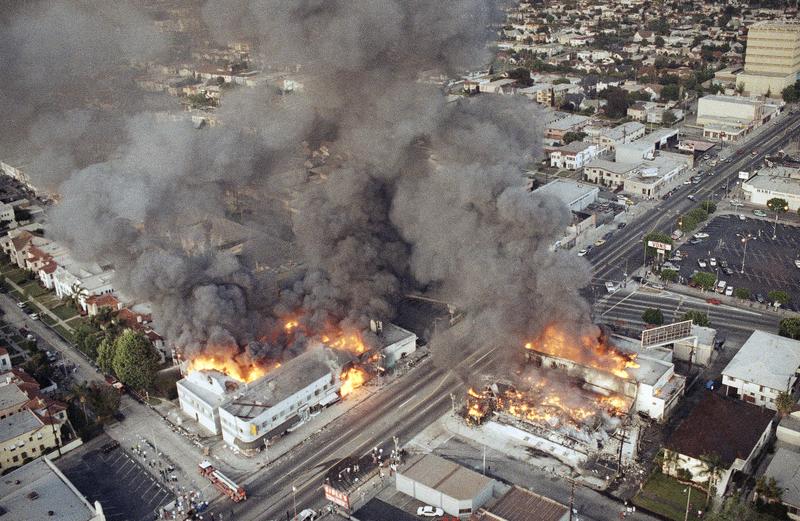
Commercial structures burn at Venice Boulevard and Western Avenue in Los Angeles on Thursday, April 30, 1992, on the second day of rioting in the city. (AP Photo/Paul Sakuma)
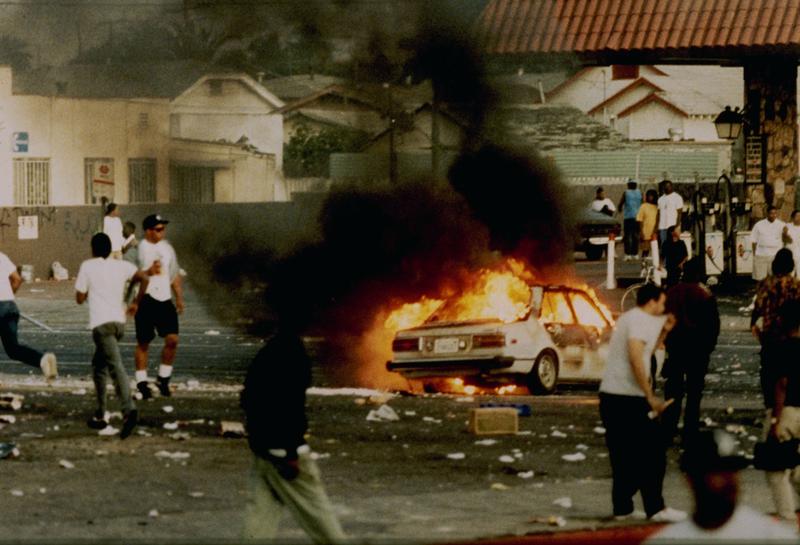
Looters and a burning vehicle at the intersection of Florence and Normandie Avenues on April 29, 1992 amidst the Los Angeles riots (Photo by Steve Grayson/WireImage).
Documentary filmmakers Dan Lindsay and TJ Martin anticipate one day doing less and less interviews about their work. The chatty cinematic pair would much rather concentrate on acknowledging how their films inspire people or mobilize them to make effective change.
The Academy Award-winning duo’s latest feature-length project, LA 92, revisits one of America’s most devastating period of civil unrest in history. LA 92 begins with the videotaped graphic beating of African-American motorist Rodney King by four white Los Angeles Police Department officers. The footage was novel then, unlike viral videos of the same types of video readily available now. Video of King’s beating at the hands of the officers was followed by the murder of overachieving black high school student, Latasha Harlins. Harlins, who was 15-years-old, was shot in the back of the head after an argument over orange juice with Korean shop owner Soon Ja Du, also in Los Angeles.
The acquittal of all four police officers by an all-white jury in Simi Valley and Du, who was found guilty but sentenced to probation serving no time in jail for the murder of the 15-year-old, drew a slew of protests from citizens, which evolved into full-on uprisings. The uprisings spiraled into violent attacks on motorists and the looting of various businesses throughout Los Angeles, many of them destroyed by arson. Lindsay and Martin, who were both teens 25 years ago when the uprisings took place, thought LA 92 deserved to be treated as an immersive visual experience.
“The intention was to draw you closer to what the events felt like, not necessarily analyzing the events or shying away from what the reality of the events were like,” Martin says via phone the afternoon following a community screening in Chicago.
LA 92 started when producers/cousins Simon Chinn and Jonathan Chinn acquired the rights to the story, immediately going after Martin and Lindsay to direct it.
The directors responsible for the 2011 football-themed documentary Undefeated sifted through more than 1,000 hours of never-before-seen footage and photographs to weave together 114 minutes of complex voices and perspectives from the courtrooms to the streets, articulating the despair and trauma permeating Los Angeles at that time.
The camera angles tremble periodically. The raw footage, coupled with accenting, lush string arrangements, appears extremely grainy and distorted. Beneath gushes of smoke and fog, there isn’t any narration or voiceovers to drive the story.
“It’s the consistent shifting of points of view that keep the moment going and the audience interested,” Martin insists, referring to LA 92 as a “symphony in movements.”
It was extremely important to Lindsay and Martin, who met in 2007, to tell a captivating story without overwhelming the viewer with a myriad of montages filled with devastating imagery. Neither filmmaker had any formal training or ever enrolled in film school. “We were cognizant to make sure we were only including things we felt we could provide the right emotional context for,” shares Lindsay, an alumnus of University of Missouri.
It was a hard decision regarding what sequences to include and remove. Lindsay mentioned one archived interview conducted by an ABC affiliate with a juror couldn’t be licensed by the network. Another frustrating setback for LA 92, Martin says, were the lack of major news organizations and broadcasters providing insight into the responses of Latino and Hispanic communities.
Despite what Lindsay and Martin couldn’t include in the film, LA 92 premiered at Tribeca Film Festival this year. The admittedly nervous creative partners eagerly anticipated seeing how the audience responded to the subject matter, especially in the Baltimore, Chicago, Atlanta and Los Angeles markets.
It’s surprising to Lindsay and Martin that their content resonated with millennials. Making it a point to stay after all screenings to chat and take selfies with the crowd, a biracial Martin, the first black American to earn an Oscar for “Best Feature Documentary,” commented on the post-screening Q&A in Atlanta.
“People were excited to talk, not afraid to feel or express themselves. That’s a win-win,” declares Martin, who studied American Cultural Studies at Fairhaven College and Western Washington University.
In retrospect, Lindsay and Martin appreciate how making documentaries and a slew of consumer brand commercials have strengthened their creative partnership. Both men agree they’re impressed with each other’s talents and abilities to make bold statements with visuals. Martin says what keeps them inseparable with work is trust.
“If you want to do good work, you have to be in a vulnerable position,” Martin proclaims, “and you have to share ideas, emotions and lots of facets of yourself. You have to open up to a certain degree.”
Lindsay and Martin never tire from having ongoing conversations with various people about filmmaking. Frequenting diverse communities is what actually fuels their storytelling. Those reactions, they believe, set the tone for the type of work they produce, especially LA 92.
“This is a tool to start asking questions more than to find solutions,” Martin confirms. “The moment we stop having these conversations is when it really gets dangerous.”
LA 92 premieres Sunday, Apr. 30 at 9 p.m. EST on the National Geographic Channel. Check local listings for channel availability.
This post was written by Christopher A. Daniel, pop cultural critic and music editor for The Burton Wire. He is also visiting faculty in the Department of Communication at Georgia State University. Follow Christopher @Journalistorian on Twitter.
The one and only Prince Rogers Nelson passed away on April 21, 2016, much to the shock and chagrin of the world. Prince had been battling health issues and played his last concert in Atlanta, GA just days prior to his untimely death. Prince was a trailblazer in many regards and faced-off against corporate record companies when many would not. A musical genius, Prince played at least 27 instruments that we know of. According to the For You album liner notes, Prince wrote, produced, arranged, composed, and played all 27 instruments on the recording, except for the song “Soft and Wet”, whose lyrics were co-written by Moon. Check out how fans are remembering him below:
Students perform “Let’s Work” in remembrance of Prince Rogers Nelson (Arranged and filmed by P.M. Eaton).
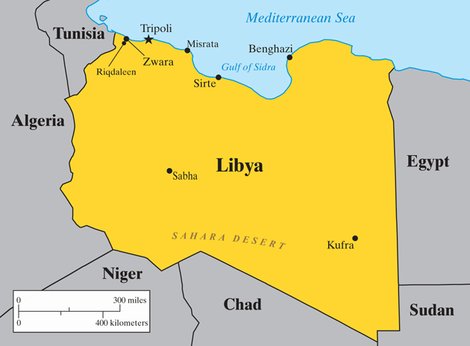
BBC Africa is reporting Africans trying to migrate to Europe are being sold into “slave markets” in Libya. The BBC reports:
“Victims told International Organization for Migrants (IOM) that after being detained by people smugglers or militia groups, they were taken to town squares or car parks to be sold. Migrants with skills like painting or tiling would fetch higher prices, the head of the IOM in Libya told the BBC…Hundreds of young sub-Saharan African men have been caught up in the so-called slave markets, according to the IOM report.”
Reportedly, the women are being sold to private Libyans as “sex slaves.”
PBS Newshour reported on the crisis in September 30, 2016:
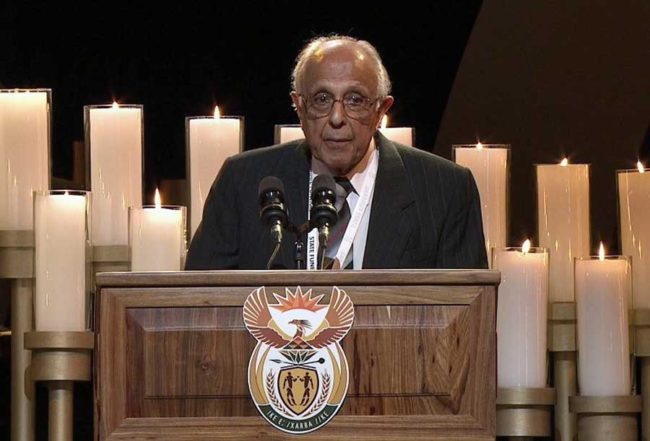
Anti-Apartheid activist and Mandela confidant Ahmed Kathrada dies.
(Photo: Google Images)
Anti-Apartheid activist and Mandela confidant Ahmed Kathrada dies. (Photo: Google Images)
BBC Africa is reporting the family of legendary anti-Apartheid activist Ahmed Kathrada has requested South African President Jacob Zuma not attend the funeral of Kathrada. Kathrada, was jailed alongside Nelson Mandela for fighting against white minority rule and spent more than 26 years in prison before his release in 1989. He later served as an adviser to then-President Mandela in South Africa’s first democratically elected government.
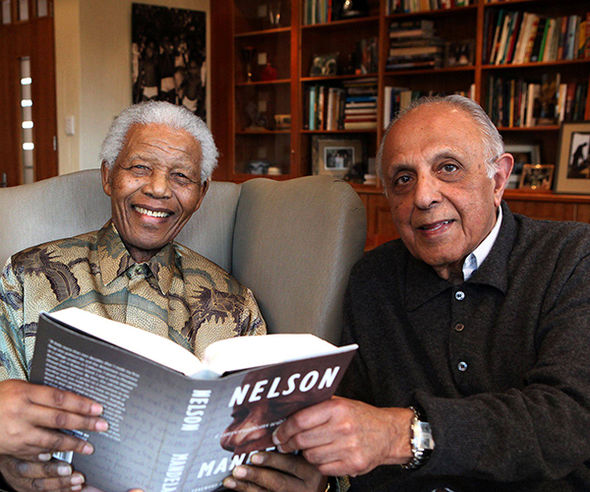
Anti-Apartheid legends Ahmed Kathrada and Nelson Mandela. (Photo: Google Images)
President Zuma ordered the national flag to fly at half-mast following the Kathrada’s death. The embattled president also postponed a cabinet meeting so officials could attend the funeral. Zuma complied with the families wishes and did not attend the funeral. He also said he would not attend a memorial service later this week “in compliance with the wishes of the family,” a government statement said. Kathrada was buried in Johannesburg, following his death on Tuesday.
Prior to his death. Kathrada called for President Zuma to resign after a series of corruption scandals. Attendees of the funeral made the same request during the ceremony.