Brazil's interim President Michel Temer.
(PHOTO: Screen shot)
Brazil’s interim President Michel Temer. (PHOTO: Screen shot)
Following protests by Brazilian artists, Brazil’s interim President Michel Temer will reinstate the Culture Ministry today, a government official said. Temer had created a policy to fold the Culture Ministry into the Education Ministry to save money, sparking protests from top performers like Caetano Veloso and Erasmo Carlos, pioneers of Brazil’s tropicalia and rock music movements.
Reuters reports:
“The decision to ax the culture ministry was part of Temer’s drive to tackle Brazil’s record government deficit by reducing the number of ministries by 10 to 23, one of the first measures he announced when he took office on May 12.
Singer-songwriters Caetano Veloso and Erasmo Carlos, pioneers of Brazil’s tropicalia and rock music movements, held a concert in the Education building in Rio de Janeiro last Friday in one of the protests by artists against the move.
Temer had also invited actress Bruna Lombardi and singer Daniela Mercury to head up the scaled-back culture portfolio. Both refused.
Temer will reinstate the ministry using a presidential decree and the new minister Marcelo Calero, a diplomat, will take office on Monday, Education Minister Jose Mendonca Filho said on his Twitter account late on Saturday.
It was the latest in a series of reversals by the interim government in its hastily organized transition.”
Grammy-winning music icon Stevie Wonder receives a Doctor of Humane Letters from Spelman College this year (Photo Credit: Spelman College).
Grammy-winning music icon Stevie Wonder receives a Doctor of Humane Letters from Spelman College this year (Photo Credit: Spelman College).
“Every single honor that I receive is only saying to me ‘Do more. Do more. Do more.’” That declaration is a tender and harmonic refrain that music legend and humanitarian Stevie Wonder vocalizes prior to receiving a Doctor of Humane Letters from Spelman College this year. At the lavish President’s brunch held prior to the institution’s commencement exercises, the celebrated musician and prolific songwriter, along with other honorary degree recipient Attorney General Loretta Lynch, delivered a compelling address that refused to leave a dry eye throughout the entire ballroom.
Awarded a record 25 Grammys, the most ever by a male solo artist, Wonder opened his remarks by giving praise for all of his success and achievements resulting from his five-plus decade career. The groundbreaking Rock and Roll Hall of Famer and Songwriters Hall of Famer spent six minutes at the podium fully expressing his gratitude for all of the people instrumental in solidifying his longevity before seguing into how heavy his heart is.
Wonder’s poetic, thought-provoking lyricism throughout his career has explored and celebrated poverty, race, war, politics, spirituality, love, family, mysticism and African (American) history. The second overall recipient of the coveted Gershwin Prize takes periodic deep pauses, sharing how ambitious he still is about his own creative impulse, spirituality and love for humanity.
“I still want for God to give me that song that will say to everyone let’s truly stop hating and love,” says the Presidential Medal of Freedom recipient. “I still ask God to give me that melody that I can sing that will say to everyone’s ears ‘People, let’s come together.’”
The Academy Award-winning composer and multi-instrumentalist continues, “I still ask God for that note that I can play that rings into everyone’s ears that says ‘Ok. We must do it right now.’ And I still ask God for that song that I can write lyrically that will say ‘God, we’ve done it. We are one.’”
Stevie Wonder is escorted into Spelman College’s commencement exercises by his son, Kwame (Photo Credit: Spelman College).
Wonder emphasizes the importance of people working together to create harmony. The entertainer responsible for finely crafting a canon of classic, genre-fusing concept albums like Where I’m Coming From, Music of My Mind, Talking Book, Innervisions, Fulfillingness First Finale, Songs in the Key of Life and Hotter Than July believes seeking higher consciousness is a divine mission.
“No matter what color we are, what ethnicity, what religion we are or where we’re from that we will all understand that #BlackLivesMatter, all lives matter but most importantly, God matters,” proclaims Wonder, who was named the U.N.’s Messenger of Peace in 2009. The music icon spent some additional minutes indirectly paying homage to some of his deceased musical peers like Michael Jackson, Whitney Houston, Maurice White, David Bowie and most recently, Prince.
It devastates Wonder, who turned 66 on May 13, how he’s outlived so many of his recording industry colleagues. The youngest ever recognized by the Kennedy Center Honors, a diplomatic Wonder challenges members of the press, opinion leaders and religious fundamentalists to reevaluate how they comment on various sectors of society, especially performers who use their talents and influence to improve the human condition.
“We’re left with too many people of the media, press and gossipers on the internet that are comfortable tearing their careers apart when all they gave you was love,” stresses Wonder. “It’s such a heartbreak.”
“We as human beings are far, far better than anyone who writes or gossips,” adds an optimistic Wonder, “or whatever kind of doctor they might be to try to spread energy or negativity. Love really is king. God really is king. It’s not about the religion. It’s about the relationship.”
Still hailed as one of the most innovative and commercially successful artists in music history, Wonder continues to use his voice as an instrument for driving social change. Forty five years ago, he championed performers of color actively utilizing their performance rights. Wonder signed an unprecedented deal with his label, Motown Records, allowing him to have full creative autonomy, higher royalties and non-negotiable ownership of his music.
The musical architect spoke out extensively about having Dr. Martin Luther King, Jr.’s birthday declared a national holiday. Appearing on charitable chart-toppers like “We Are the World” and “That’s What Friends Are For,” Wonder plays numerous benefit concerts and supports causes such as ending apartheid in South Africa, rights for disabled and visually impaired, literacy, famine, poverty, education, Hurricane Katrina relief, Flint water crisis and juvenile diabetes.
Wonder knows it’s his social responsibility to raise awareness on various issues and social problems. “I must be out there to stand for those things that maybe no one wants to talk about or sing about,” utters Wonder. “I must be out there ready to protect you from that bullet of injustice and bring us together as a united people of this country and throughout the world.”
As Wonder brings his comments to a close, the musical genius wisecracks about not being bubble wrapped. The concerned visionary recapitulates his appreciation for being awarded an honorary degree from Spelman College, referring to the all-female institution as “the joy inside my tears.”
Wonder says Spelman women are his muse. Those women of color are a reflection of the women he typically writes about in his compositions. Continuing to express his optimism, Wonder concludes, “This world that we live in right now unfortunately is dying, but it’s making its way for the new world where we truly will enjoy life as it is in Heaven on Earth.”
This post was written by Christopher A. Daniel, pop cultural critic and music editor for The Burton Wire. He is also a contributing writer for Urban Lux Magazine and Blues & Soul Magazine. Follow Christopher @Journalistorian on Twitter.
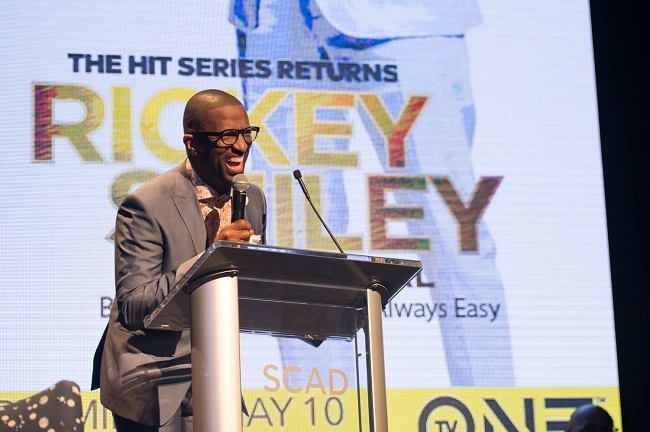
Comedian and media personality Rickey Smiley premieres the second season of his TV One docuseries, 'Rickey Smiley For Real,' in Atlanta (Photo Credit: Marcus Ingram/Getty Images).
Comedian, media personality and humanitarian Rickey Smiley premieres the second season of his TV One docuseries, ‘Rickey Smiley For Real,’ in Atlanta (Photo Credit: Marcus Ingram/Getty Images).
Funnyman Rickey Smiley thinks of comedy as his calling. The stand-up comic and star of TV One’s original docuseries Rickey Smiley For Real grants viewers a backstage pass into his life at home as a single father raising his two biological sons and his adopted children. The series simultaneously provides a glimpse into the synergy the 47-year-old comedian has with his staff at his nationally syndicated radio program, TheRickey Smiley Morning Show, and its sibling entertainment news series, Dish Nation.
The second season of Rickey Smiley For Real focuses on Smiley’s children managing their romantic relationships. The veteran entertainer’s staff explores various opportunities and their personal entrepreneurial aspirations. Smiley, on the other hand, vacations, tours with other comedians, interacts with his children, plans to record a gospel LP and continues to seek spiritual mentorship and guidance.
When Smiley sits for an hilarious, informal conversation, the multi-hyphenated man clarifies that the most important component to his non-scripted series is to show balance in both his work and professional lives. “Single parenting is hard,” says a throaty and extremely hospitable Smiley.
“I do a lot, but I still have time for the kids. It’s a crazy life, but I do get that time in.” Smiley raises his family as part of various co-parenting situations. The down home Birmingham, AL native, who also lives in Atlanta, maintains stable relationships with each of his children’s biological parents to ensure he provides them with proper guidance and awareness of their identities.
“I’m a grown man, and I have baby daddies and baby mamas (laughs) for establishing rules and regulations,” jokes Smiley. If Smiley is on-air, it’s not uncommon for him to multi-task, whether it’s washing loads of laundry, playing music between segments or sometimes styling his daughter’s hair before school. Wearing many hats, Smiley says, is how he leads by example as the head of his household.
“Women get their confidence from their fathers,” continues Smiley. “It takes a man to teach a boy how to be a man. A father is very important, so don’t ever disregard us.”
Raised by both his grandfather and uncles, who were all members of the military, Smiley takes implementing structure seriously. He considers himself to be a non-negotiable disciplinarian despite making his kids laugh and taking good care of them. “Don’t no kids run my house,” warns a stern-faced Smiley slapping his palm across the table. “I run my household. I have the last word and the last say. When I say something, that’s the end of it. I demand respect in my house. I don’t play.”
Smiley often uses analogies and euphemisms to impart wisdom on his children. He elaborates on why he chooses to use colorful language as a method. “It paints the picture,” continues Smiley. “When people can see stuff, they respond better to graphics. Seeing is believing.”
Always giving out the kindness of his heart, Smiley’s greater sense of purpose comes anytime he can pay his success forward. His nonprofit organization, The Rickey Smiley Foundation, hosts various activities that enhance the quality of life for diverse people. Every Christmas morning, Smiley, his kids and the Birmingham Police Department deliver gifts to over 20 underprivileged families. The philanthropist puts on free comedy shows for senior citizens along with a fish fry. Smiley often feeds the homeless at The Salvation Army and donates toiletries.
Far before his career reached its current magnitude, it was nothing for Smiley, a former recipient of Section 8 public assistance, to self-fund most of his outreach efforts. Before the school year starts, Smiley rents out Legion Field to arrange for boys to get free haircuts and a backpack. The selfless Alabama State University alumnus returned to his high school in April to develop a College Readiness program that encourages students to pursue college degrees. He also donated 8,000 books to a school in Jackson, MS.
As Smiley segues into addressing humanitarianism, he randomly morphs into impersonating his elderly character, Ms. Bernice Jenkins. The humorist synonymous with his slapstick on-air prank calls pulls his eyeglasses below his nose and scrolls on his iPhone screen slowly with his index finger immediately before explaining his selflessness. “I have a responsibility in radio,” proclaims Smiley. “Sometimes God gives you a microphone and puts you in a position to see what you gonna do with it.”
“You got to get out here and help somebody,” adds Smiley. “You got to love and care about somebody. It ain’t about you. I don’t care nothing about none of this celebrity stuff. I’m not in this for that. I’m trying to be reunited with my grandmother and God someday. I don’t have nothing to prove. I ain’t trying to impress nobody.”
Smiley upholds building cohesive families and communities with high regard. It’s common for him on any production set to prepare big meals for his kids, employees and crew members. The self-proclaimed “best cook” and true Alabamian lists all of the scrumptious dishes and desserts he prepares. As quiet as it is kept, Smiley has anonymously paid utility bills for struggling individuals and funded burial arrangements for deceased people.
Rickey Smiley For Real’s executive producer, Roger Bobb, is always impressed with Smiley’s courtesy, respect and professionalism. “I only work with people who I respect and whose message I want to get across,” comments Bobb seated to Smiley’s left.
“I have a very specific purpose for the content I put out. We want to make you laugh but at the same time educate you.” Smiley, who cracks himself up the entire chat and offers an array of inspirational messages, reiterates why his family and professional lives are in sync.
To Smiley, raising a family and being a comic for the last 26 years are interchangeable. “I just learned to love,” he confirms. “Comedy is a ministry. We make people laugh. You have to feel people, make them comfortable and feel welcomed. Life is about loving and giving. This is what I have to do.”
Rickey Smiley For Real airs on TV One on Tuesdays at 8 p.m. ET. Check local listings for availability.
This post was written by Christopher A. Daniel, pop cultural critic and music editor for The Burton Wire. He is also a contributing writer for Urban Lux Magazine and Blues & Soul Magazine. Follow Christopher @Journalistorian on Twitter.
Barbados Prime Minister Freundel Stuart.
(Photo: Google Images)
Barbados Prime Minister Freundel Stuart. (Photo: Google Images)
Caribbean 360 is reporting a no-confidence motion against the Freundel Stuart administration will be debated in Parliament today. The author writes:
“Barbados Labour Party (BLP) leader Mia Mottley said the motion, which was laid in Parliament on May 3, was prompted by the persistent crises facing the country, which she said was caused by poor governance. It is the third no-confidence motion filed by the BLP against the Democratic Labour Party (DLP) administration DLP since it took office in 2008.”
The motion addresses the following issues in addition to others:
a. high public sector debt; economic downturn
b. downgrades by international credit rating firms
c. declining investment; increase in unemployment
d. increase in taxes
e government’s failure to pay income, corporation and Value Added Tax refunds
f. the administration’s lack of consultation and discussion with the public
Prime Minister Stuart has dismissed the validity of the motion.
Paulette McKenzie Leaphart will walk 1,000 miles from Mississippi to Washington, DC to raise awareness about the high cost of breast cancer treatment. (Photo: Google Images)
Paulette McKenzie Leaphart will walk 1,000 miles from Mississippi to Washington, DC to raise awareness about the high cost of breast cancer treatment. (Photo: Google Images)
Patrick Clarke of ABC News is reporting Paulette Leaphart, 49, is going to Washington, D.C. and she will make the entire 1,000-mile journey on foot. Clarke writes:
“She will walk from Biloxi, Mississippi, tomorrow completely topless, showing the evidence of her double mastectomy. Leaphart wants to talk to lawmakers about the uphill battle everyday Americans with cancer, like herself, face in trying to afford the sky-high cost of life-saving treatments. She is serious about putting health care reform front and center on the table of Capitol Hill, and this breast cancer survivor thinks she can do it.
‘I’m marching to D.C. to put my scars in the face of Congress,’ Leaphart told ABC News.”
Leaphart was diagnosed in 2014 with Stage 2, grade 3 breast cancer, an aggressive form of cancer and decided to have a double mastectomy. Medication for her treatment cost the single mother of four $1500 per month, forcing her to sell her car and all of her assets. Leaphart says she wants to make Congress aware of the cost of battling breast cancer and to pass measures to help make treatment more affordable.
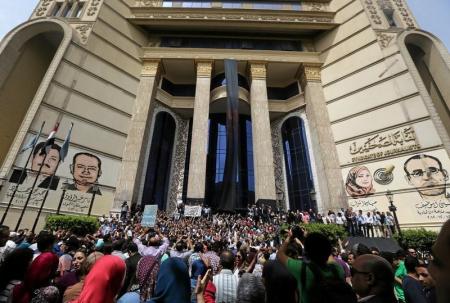
Journalists protest against restriction on the press and to demand the release of detained journalists, in front of the Press Syndicate in Cairo, Egypt May 4, 2016. REUTERS/Staff
Journalists protest against restriction on the press and to demand the release of detained journalists, in front of the Press Syndicate in Cairo, Egypt May 4, 2016. REUTERS/Staff
Reuters Africa is reporting an Egyptian court on Saturday sought the death penalty for three journalists and three others charged with endangering national security by leaking state secrets and documents to Qatar.
The final ruling is expected on June 18, after the sentence has been referred to the top religious authority, the Grand Mufti, for a non-binding opinion. The verdict against former president Mohamed Mursi, who is charged in the same case, was postponed to the same day.
Reuters writes:
“The three journalists, one Jordanian, were sentenced in absentia. Two of them work for Qatar-based broadcaster Al Jazeera. They can appeal. The sentence is the latest since a crackdown on the Muslim Brotherhood after an army takeover stripped Mursi of power in 2013 following mass protests against his rule. Mursi and other Brotherhood leaders, as well as leading figures from the 2011 popular uprising that toppled autocrat Hosni Mubarak, many of them secular activists and journalists, are now in jail.”
Sadiq Khan is London's first Muslim mayor.
(Photo: Google Images)
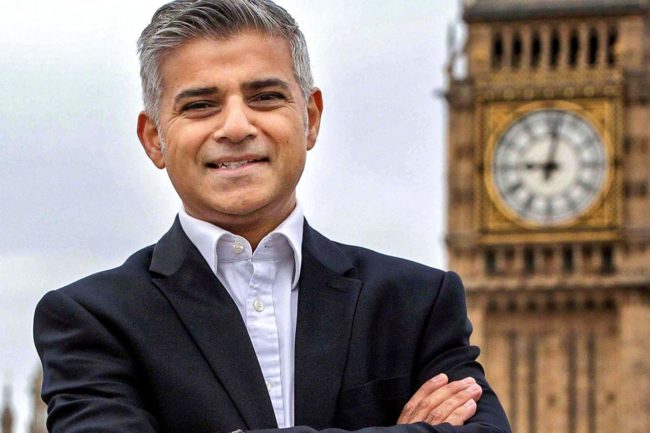
Sadiq Khan is London’s first Muslim mayor. (Photo: Google Images)
The Guardian is reporting Sadiq Khan has been elected mayor of London, reclaiming the post for Labour after eight years of Conservative rule and becoming the first Muslim mayor of a major western capital. Robert Booth writes:
“Khan took 1,310,143 votes (57%) after second preferences were taken into account, beating Conservative Zac Goldsmith into second place on 994,614 (43%). His tally gave him the largest personal mandate of any politician in UK history.
The 45-year-old son of a Pakistani bus driver beat Zac Goldsmith at the end of a sometimes bitter campaign during which the Conservatives accused Khan of being ‘dangerous’ and ‘pandering to extremists’. Labour complained that Goldsmith’s campaign was Islamophobic.
In his victory speech Khan said he was ‘deeply humbled by the hope and trust’ voters placed in him, adding: ‘I want to thank every single Londoner for making the impossible possible.’
He added: ‘I’m so proud that Londoners have today chosen hope over fear and unity over division.'”
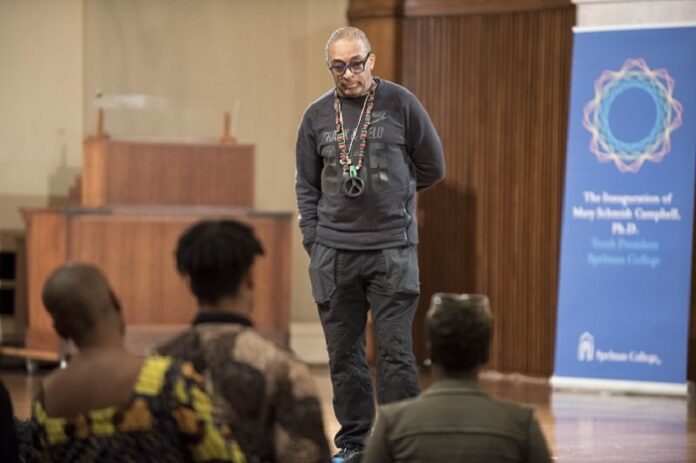
Filmmaker Spike Lee (Morehouse College, C'79) visits Spelman College to screen his socially conscious documentary, '2 Fists Up,' as part of inauguration activities for president Dr. Mary Schmidt Campbell (Photo Credit: Spelman College).
Filmmaker Spike Lee (Morehouse College, C’79) visits Spelman College to screen his socially conscious documentary, ‘2 Fists Up,’ as part of inauguration activities for president Dr. Mary Schmidt Campbell (Photo Credit: Spelman College).
When Spelman College’s 10th president Dr. Mary Schmidt Campbell asked filmmaker, writer, actor and producer Spike Lee to come back to Atlanta, he wasted no time revisiting where his illustrious career all began. The astute, brow-raising native of Brooklyn became a tenured film professor at NYU’s world-renown Tisch School of the Arts under Dr. Campbell’s two-plus decade leadership as dean, joking during his brief remarks at her inauguration ceremony that she stole him from Harvard.
“I loved working for her and under her at NYU,” acknowledges the iconic Morehouse College alumnus (C’79) wearing a navy blue New York Yankees fitted cap, blue frames and pastel-colored Air Jordan hi-top sneakers. “She really brought [NYU] to its greatest heights, one of the most dynamic people to run a school.”
During Lee’s visit to Spelman’s campus, the 59-year-old maestro hosted an exclusive screening of his latest documentary, 2 Fists Up. The hour-long piece, in partnership with ESPN Films, spotlights the wave of black youth activism in response to ongoing police brutality and racist acts pervasive on predominately white college campuses. The film director responsible for the 40 Acres and a Mule Filmworks imprint spotlights #BlackLivesMatter and the onslaught of protests from various pockets of students at Mizzou such as the football team and Concerned Student 1950 via news footage and candid interviews.
“In the United States of America, race permeates everything, so why shouldn’t film be affected?” insists the monotone, deadpan-faced icon resting his chin on his left hand minutes before the screening.
Rightfully so, Lee, a third generation Morehouse man whose mother and grandmother are both Spelman alumnae, points out that 2 Fists Up concentrates specifically on how black and brown women are at the forefront of the movement. “Students have the consciousness to go out and change the world [once they leave Spelman’s beautiful campus],” he adds. “Use that negative energy into positive energy. Use those slights and stuff and turn them into creativity.”
Lee leads a call-and-response chant following ‘2 Fists Up’ screening at Spelman College (Photo Credit: Spelman College)
Being on Atlanta University Center (AUC) grounds reminds Lee of how his own art and ideologies have manifested. He credits Clark Atlanta University film professor Dr. Herbert Eichelberger, affectionately referring to him as “my guy,” for encouraging him to make films. The cinematic giant forewent receiving his Lifetime Achievement Academy Award earlier this year as a response to no people of color earning nominations in lead categories.
Lee’s protest is one of the architects behind #OscarsSoWhite, trending throughout social media and the press. “Social media is affecting the whole world, so why shouldn’t film be a part of that,” reiterates a cross-legged Lee simultaneously rubbing the back of his neck, typing on his Blackberry and gripping his fists. “#BlackTwitter is huge.”
Lee mentions a recent UCLA study revealing blockbuster films with diverse casts generate more revenue at the box office than any other films. He speaks about ABC Entertainment president Channing Dungey becoming the first woman of color to head a major network, suggesting that understanding inequality for blacks in Hollywood begins by understanding the film industry’s hierarchy and infrastructure.
“People are alert,” suggests the Peabody award winner. “Film is about money. It takes a lot of money to do films. We’re not in the room. We’re not a part of those gatekeepers. We’re not in those rooms when those projects are decided. It’s more feasible for these white studios to understand this. If it was the right thing to do, they would’ve been doing it from jump.”
A visionary who perseveres, Lee’s debut feature, She’s Gotta Have It, premiered exactly 30 years ago. Pioneering crowdfunding, the black-and-white film shot in two weeks was made for $175,000, grossing over $7 million. Last year’s hip-hop flavored satire, Chi-Raq, became the first full-length film ever distributed via Amazon Pictures.
Lee’s canon of films (School Daze, Do the Right Thing, Jungle Fever, Malcolm X, Bamboozled, 4 Little Girls, The Huey P. Newton Story, When the Levees Broke, Inside Man, 25th Hour and Get on the Bus among others) typically has racially-themed subject matter. However, the Dorothy and Lillian Gish Prize recipient has explored other genres, too. Lee created the NBA2K16 video game. He has directed music videos for Michael Jackson, Prince, Fishbone, Chaka Khan, Bruce Hornsby, Miles Davis, Arrested Development, Tracy Chapman, Phyllis Hyman, Public Enemy, Naughty By Nature and Anita Baker.
Lee’s character from She’s Gotta Have It, Mars Blackmon, became synonymous with his immensely popular Nike commercials. His last documentary, Michael Jackson’s Journey from Motown to Off the Wall, premiered at Sundance Film Festival this year before airing on Showtime. Lee reveals that he’s doing another documentary on Jackson’s record-breaking Thriller LP, further suggesting that people take time to surf his IMDB profile to see the diversity of his work.
“There’s no one way to do anything,” confirms Lee. “We can do the independent route. Why should one abandon Hollywood? We can do it all. Everything is open, so we should pursue it.”
Lee says he learns a lot from teaching and lecturing on college campuses. He’s delivering a commencement address and earning an honorary degree from Johns Hopkins University next month. Coming from a family of educators, Lee advises his film students that good films start with a great script and the right people attached to it.
“Tell your story,” empowers Lee. “You can’t get discouraged. All it takes is one yes. If they say no and doors get slammed in your face, don’t take that to heart. Keep stepping. That’s what Michael Jordan does.”
In addition to promoting perseverance, making periodic trips back to the AUC makes Lee feel proud. Instructing at NYU since 1993 and becoming artistic director in 2002, Lee is appreciative to have supporters like Dr. Campbell who fully understand what he originally set out to accomplish through cinema.
“The filmmaker that did Do the Right Thing is not the same filmmaker that did She’s Gotta Have It,” insists Lee with his right leg resting on the arm of a chair. “It’s just the way it is. It’s always good to be here. This is a great moment in a very special place. [Spelman] is in good hands.”
This post was written by Christopher A. Daniel, pop cultural critic and music editor for The Burton Wire. He is also a contributing writer for Urban Lux Magazine and Blues & Soul Magazine. Follow Christopher @Journalistorian on Twitter.
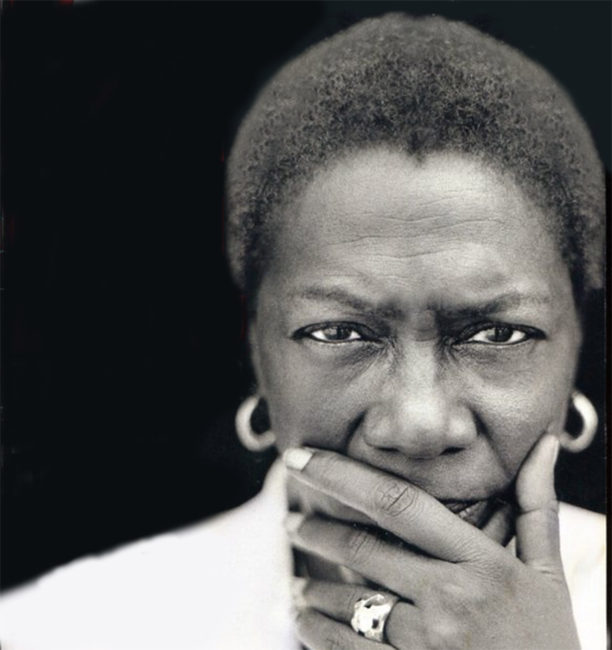
CNN is reporting Afeni Shakur-Davis, mother of iconic rapper Tupac Shakur has died. Elliott C. McLaughlin reports:
“Though she is best known as Tupac Shakur’s mom, she was also a Black Panther as a young adult and an activist and philanthropist in her later years. Deputies responded to a call reporting ‘a possible cardiac arrest’ at her Sausalito home around 9:34 p.m. Monday, the Marin County Sheriff’s Office said. Shakur Davis was taken to the hospital where she died at 10:28 p.m., the office said.”
Shakur-Davis, a former Black Panther and activist, later became a philanthropist after her son was killed in a 1996 shooting that is still unsolved. She founded Amaru Entertainment to keep Tupac’s music and memory alive, funding arts programs for children in Stone Mountain, GA. In addition to arts camps, in 2009 Shakur-Davis founded the Tupac Amaru Shakur Collection at the AUC Woodruff Library on the campus of Clark Atlanta University. Through a partnership with the Tupac Amaru Shakur Foundation and Shakur-Davis, the collection which includes Shakur’s handwritten manuscripts, song lyrics, track listings, video and album treatments, short stories and poetry was created as a resource for understanding the life work of the late rapper. Other materials include manuscripts written by the members of the Outlawz, media and publicity materials, correspondence and legal documents.
In March 2016, Shakur filed for divorce from her husband Gust Davis, a preacher who was requesting alimony and half of her earnings from the late rapper’s estate. It has been reported the two did not have a prenuptial agreement.
Shakur-Davis was living on a houseboat in Sausalito, CA when she was found. She is survived by her daughter Sekyiwa Shakur and estranged husband. Shakur-Davis was 69.
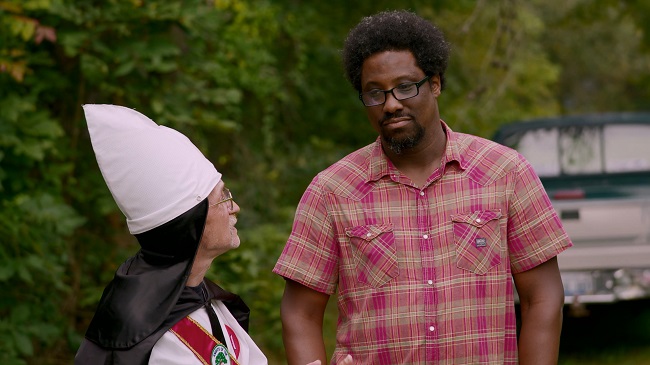
Comedian W. Kamau Bell interacts with a Ku Klux Klan member on the pilot episode of the CNN docuseries 'United Shades of America' (Photo Credit: CNN).
Comedian W. Kamau Bell interacts with a Ku Klux Klan member on the pilot episode of the CNN docuseries ‘United Shades of America’ (Photo Credit: CNN).
Comedian W. Kamau Bell wants to spark conversations about society with his new CNN docuseries United Shades of America. In eight episodes, the perceptive, six-foot-four Bay Area native travels and interacts with ethnically distinctive communities to make sense of the cultural dynamics penetrating those people.
The extremely thorough, mini Afro-wearing former star of the now-defunct FX comedy series, Totally Biased, embarks on journeys to places where the average person may completely feel uncomfortable. He puts his observations in context by interjecting witty narration, snippets of his stand-up routines, historic overviews and interviews with numerous local subjects.
The end result is a groundbreaking style of cultural anthropology married to sociological humor. “Comedy is all about asking questions and looking at the world from a critical perspective,” insists a very relaxed Bell following a screening of United Shades of America in Atlanta. “It helps me get to places other people can’t get to sometimes. I’m just using the skills I got.”
United Shades of America’s pilot episode follows Bell to a series of rural towns where Ku Klux Klan chapters are present. Bell experiences first-hand a cross burning, a self-proclaimed hooded Christian meeting him at night on a dirt road for a brief chat, meeting a neo-Nazi educator at a school where kids of different races can’t play together and visits the set of a web series hosted by a conservative minster and his daughter spreading hate speech.
On the other hand, the admittedly curious host of the San Francisco-based talk radio show Kamau Right Now! and co-host of the podcast Denzel Washington is the Greatest Actor of All Time Period connects with a special interest group that seeks to create a welcoming community.
Bell shares what satisfaction he gains from doing United Shades of America. “It gives me more empathy for people,” declares the Berkeley, CA resident. “If people come to the table with good faith, I can have a conversation with anybody.”
All episodes of United Shades of America were taped a year before the show premiered. Originally titled Black Man, White America, the series was first pitched to CNN by a production company. Bell says he thought the show would reach its shelf life after the fourth episode, urging the show’s producers to concentrate on more multicultural perspectives. “I live in the Bay Area, so it doesn’t make sense to me to treat it like a black-and-white world,” stresses Bell.
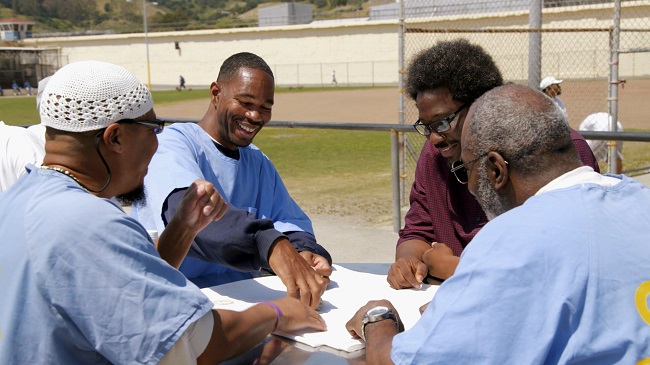
The second episode of United Shades of America takes an ethnographic look inside of San Quentin State Prison. Unlike what is often portrayed in mainstream media, Bell gets to know the death row inmates as industrious individuals who learn trades and fully accept accountability for their actions. An Ambassador of Racial Justice for the American Civil Liberties Union (ACLU), Bell tours the racially segregated, geographically alienated prison grounds with staff members as well as the inmates.
Bell mingles with inmates at San Quentin State Prison on episode two of ‘United Shades of America’ (Photo Credit: CNN).
“They were just great dudes,” says Bell, “and you just think about all of the wasted human potential that’s behind the bars of prison.”
Bell eats with the inmates, speaks their language making small talk and hears accounts about what mistakes led to their imprisonment. Along the way, the astute NAACP Image and GLAAD award-nominated humorist drops devastating statistics and observations that reveal the inequities that exist within the prison-industrial complex. Bell shares that seeing the inmates laugh made him appreciate his visit to San Quentin.
“They were being more comfortable around me than if a journalist had been there,” declares Bell. “I wanted them to shine, not me.” Bell admits to not having much empathy for prisoners before he taped that second episode. As the show was being edited, the producers and editors wanted to show the conventional narratives about prison culture. A protective Bell thought it was important to provide an alternative to those expectations.
Bell comments on the pros and cons of collaboration but emphasizes how varying opinions and skill sets are important to bringing United Shades of America on-air. He also says he doesn’t want to misrepresent his relationships with ACLU and social justice organization Race Forward
“There’s a lot of negotiation back and forth about all of that stuff,” he says. “They put a lot of trust in me by giving me those titles. I try to make sure the work I do is in that lane. This is the work I like to do. I work really hard at it.”
United Shades of America is a project that fully aligns with Bell’s voice. Even Chris Rock, the executive producer of Totally Biased, lends his support if Bell ever needs it. Referring to Rock as his “guru in a glass case,” Bell is determined to set the tone of the show himself, not allow it to become too consumed by Rock’s influence.
“I don’t want people to think that I always have to use him to get everything done,” swears Bell scratching the back of his neck. “I’m happy I got this show off the strength of the work I’d done [with Chris] already. He’s been very supportive.”
Bell reiterates that United Shades of America should spark dialogue about making a difference. The show took the top slot for cable news in its premiere week, motivating Bell to believe recurring seasons are possible. He likes to think of himself as simply a comedian with a positive attitude who takes his sense of humor with him.
Nonetheless, he aspires for others to look at United Shades of America as a series that could aid in changing the system and empower others to find their niche in changing society. “Get in where you fit in,” says Bell with his hands in his pocket. “Figure out how to engage and what you can do to amplify the problem. Everybody in a way can make change.”
United Shades of America with W. Kamau Ball airs on Sundays at 10 p.m. ET on CNN. Check local listings.
This post was written by Christopher A. Daniel, pop cultural critic and music editor for the Burton Wire. He is also contributing writer for Urban Lux Magazine and Blues & Soul Magazine. Follow Christopher @Journalistorian on Twitter.