The young woman at the center of the story that went viral Keisha, now Kylie Austin and her mother. (Photo Credit: Google Images)
Writing for The Root, The Burton Wire’s founder & editor-in-chief Nsenga K. Burton, Ph.D. interviewed filmmaker Phill Branch about his upcoming documentary ‘Searching for Shaniqua.’ You may have heard about the topic that went viral last week regarding a 19-year-old bi-racial woman’s decision to change her name from Keisha to Kylie to avoid taunting from “friends”. We’ve read the studies where having a “black sounding” name can send your resume straight to the paper shredder at many places of employment in the United States.
Branch tackles these issues in this documentary by interviewing people about their thoughts on the subject, asking what’s in a name? Check out an excerpt from the interview with Branch and the trailer to the documentary on The Burton Wire. Let us know your thoughts in the comments section below:
TR (The Root): What prompted you to make a documentary about this subject?
PB: Honestly, I had a friend who was a substitute teacher, and she would tell me these stories about her class rosters. She would be nervous every time she went into a new classroom, because the names were so hard to figure out. Then, one day I was out and met this woman with a name that had too many syllables and too much punctuation. I was so annoyed by her name, I mean really annoyed. I went home that night and started a blog called “Searching for Shaniqua.” I found out that there are so many women named Shaniqua from diverse backgrounds.
I felt like I could use them as a framework to tell a story. My aim initially was to document my quest to find the oldest living Shaniqua. Then, as I read and learned more, I became more serious about the subject. I began to really be invested in this idea of names as they relate to bullying or discrimination. I also began to think about how annoyed I was by that woman’s name and what that may say about me. I started having discussions with my friends about names, and they’d always turn into heated debates. I knew this was something that needed to be addressed. I decided to do a documentary.
TR: How did you find subjects to interview for the documentary?
PB: At first I sent private messages to friends, but I think some folks took offense to the question. Then, I decided that a better approach would be to start some discussions on Facebook about naming. I wanted people to see that I wasn’t going to make fun of them. Folks got into the discussions and have become more open to talking to me. I’m doing what I can to be able to travel and get to all of the people who have reached out. I’m also researching people in different fields who are at high levels of success with “nontraditional” names. I want them to talk about their experiences.
I also approach folks on the street. One of my best interviews was with a woman who was waiting on me at a restaurant. Her name, Chinneaqua—C-H-I-N-N-E-A-Q-U-A—was on her apron, and there was no way I was not going to get her on-camera. I interviewed her after her shift ended.
The young woman at the center of the story that went viral Keisha, now Kylie Austin and her mother. (Photo Credit: Google Images)
Writing for The Root, The Burton Wire’s founder & editor-in-chief Nsenga K. Burton, Ph.D. interviewed filmmaker Phill Branch about his upcoming documentary ‘Searching for Shaniqua.’ You may have heard about the topic that went viral last week regarding a 19-year-old bi-racial woman’s decision to change her name from Keisha to Kylie to avoid taunting from “friends”. We’ve read the studies where having a “black sounding” name can send your resume straight to the paper shredder at many places of employment in the United States.
Branch tackles these issues in this documentary by interviewing people about their thoughts on the subject, asking what’s in a name? Check out an excerpt from the interview with Branch and the trailer to the documentary on The Burton Wire. Let us know your thoughts in the comments section below:
TR (The Root): What prompted you to make a documentary about this subject?
PB: Honestly, I had a friend who was a substitute teacher, and she would tell me these stories about her class rosters. She would be nervous every time she went into a new classroom, because the names were so hard to figure out. Then, one day I was out and met this woman with a name that had too many syllables and too much punctuation. I was so annoyed by her name, I mean really annoyed. I went home that night and started a blog called “Searching for Shaniqua.” I found out that there are so many women named Shaniqua from diverse backgrounds.
I felt like I could use them as a framework to tell a story. My aim initially was to document my quest to find the oldest living Shaniqua. Then, as I read and learned more, I became more serious about the subject. I began to really be invested in this idea of names as they relate to bullying or discrimination. I also began to think about how annoyed I was by that woman’s name and what that may say about me. I started having discussions with my friends about names, and they’d always turn into heated debates. I knew this was something that needed to be addressed. I decided to do a documentary.
TR: How did you find subjects to interview for the documentary?
PB: At first I sent private messages to friends, but I think some folks took offense to the question. Then, I decided that a better approach would be to start some discussions on Facebook about naming. I wanted people to see that I wasn’t going to make fun of them. Folks got into the discussions and have become more open to talking to me. I’m doing what I can to be able to travel and get to all of the people who have reached out. I’m also researching people in different fields who are at high levels of success with “nontraditional” names. I want them to talk about their experiences.
I also approach folks on the street. One of my best interviews was with a woman who was waiting on me at a restaurant. Her name, Chinneaqua—C-H-I-N-N-E-A-Q-U-A—was on her apron, and there was no way I was not going to get her on-camera. I interviewed her after her shift ended.
HBO’s long awaited documentary, Whoopi Goldberg Presents Moms Mableypremieres tonight. Produced, narrated and directed by Academy award-winning actress/comedienne Goldberg, the documentary special shines light on the life and career of one of comedy’s most groundbreaking yet underrated black female performers.
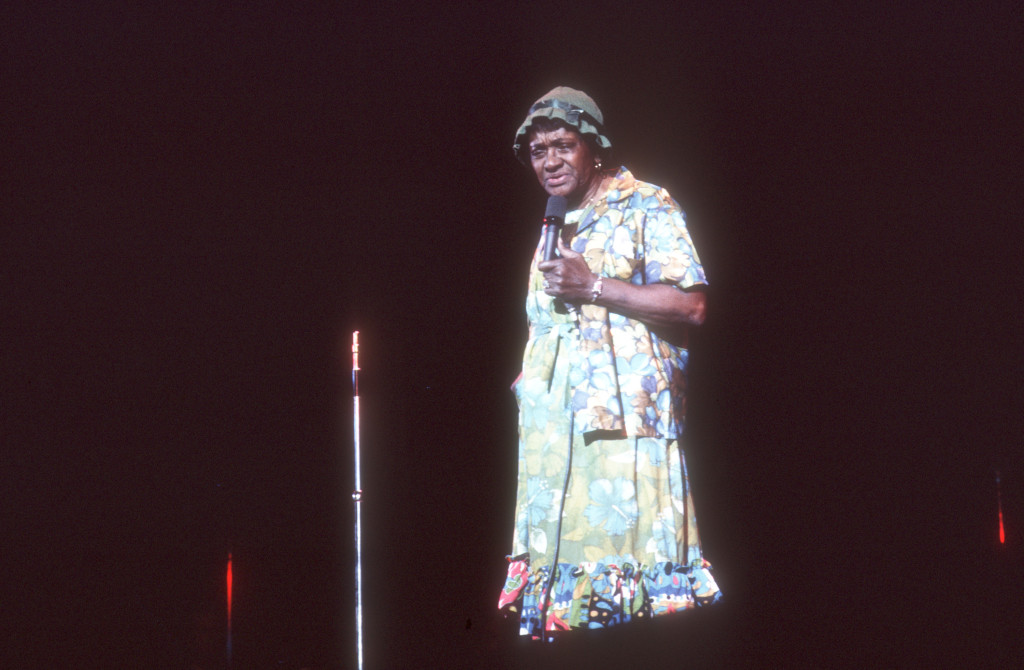
Jackie “Moms” Mabley emerged out of chitlin’ circuit stages (early 20th century) to simultaneously headline at both Apollo Theater and Carnegie Hall. She often appeared as this toothless, girthy woman with a raspy voice. Her costumes were eccentric patterned grandma dresses, colorful socks and a flimsy hat.
Considered by many to be “the funniest woman in the world,” Mabley possessed a knack for telling incredible stories and often joking about dating younger men. Her stories were a combination of clever wordplay and vivid details. Mabley’s offbeat humor at its core was social commentary: taking issues of class, sexism, racial prejudice and social injustice head on.
Goldberg’s film brilliantly weaves together grainy black and white footage, news clippings and television appearances to illustrate Mabley’s unparalleled, pioneering comic genius. Mabley is portrayed as a consummate entertainer: tap dancing, releasing twenty albums and becoming the oldest woman to crack the Billboard Top 40.
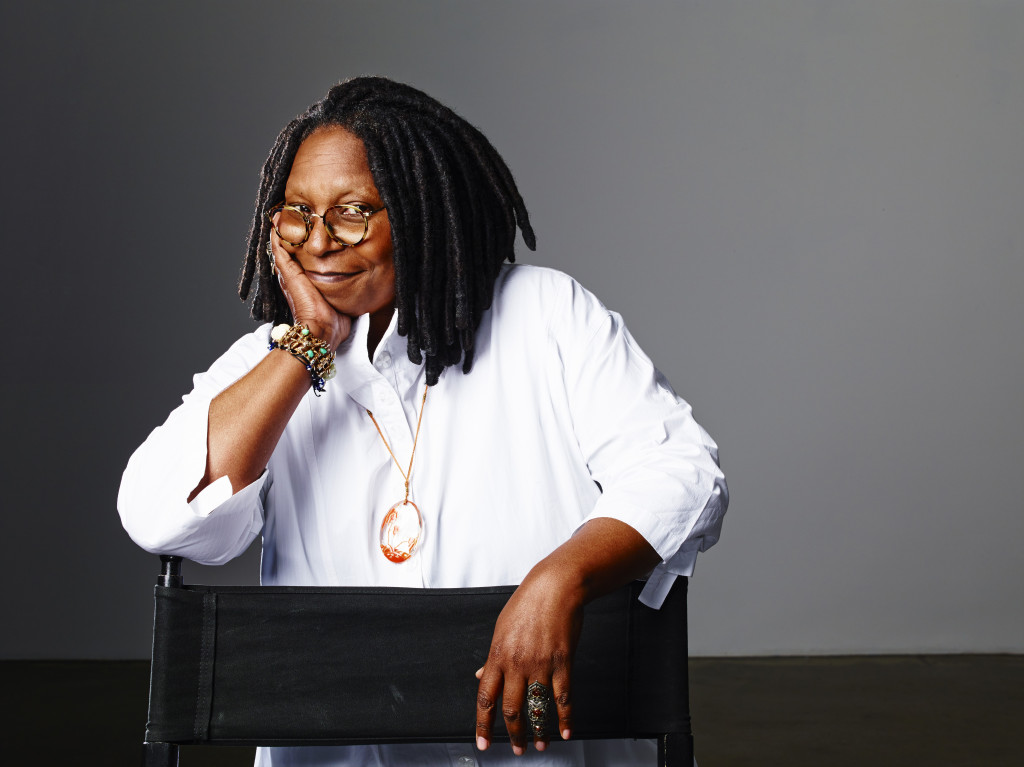
Comedienne Whoopi Goldberg brings Moms Mabley’s story to the screen. (Timothy White/HBO)
The challenges in Mabley’s life are briefly detailed. Born Loretta Mary Aiken in Brevard, NC, Mabley was never sure of her actual birthdate. She was raped twice and delivered two children from those incidents.
In addition to exploring Mabley’s childhood, Goldberg celebrates Mabley’s persona in and out of the limelight. At the height of her career, Mabley was a cigarette smoking, gender bender who had open relationships with other women. She liked to gamble and often wore well-tailored suits. Mabley was so in-demand, she was also among the highest paid entertainers of her era.
Whoopi Goldberg Presents Moms Mabley establishes how Mabley’s influence crosses all comedic, political, sexual and entertainment boundaries. Goldberg, early in her career, performed a tribute to Mabley, who died in 1975, as part of her act. Eddie Murphy says Mabley was the inspiration behind the grandmother in The Nutty Professor.
Whoopi Goldberg Presents Moms Mabley is proof that the comedienne has made a documentary that celebrates, memorializes and pays homage to the influence of black women on American comedy.
This post was written by Christopher A. Daniel, pop cultural critic and music editor for The Burton Wire. He is also a contributing writer for Urban Lux Magazine and Blues & Soul Magazine. Follow Christopher @Journalistorian on Twitter.
HBO’s long awaited documentary, Whoopi Goldberg Presents Moms Mableypremieres tonight. Produced, narrated and directed by Academy award-winning actress/comedienne Goldberg, the documentary special shines light on the life and career of one of comedy’s most groundbreaking yet underrated black female performers.
Jackie “Moms” Mabley emerged out of chitlin’ circuit stages (early 20th century) to simultaneously headline at both Apollo Theater and Carnegie Hall. She often appeared as this toothless, girthy woman with a raspy voice. Her costumes were eccentric patterned grandma dresses, colorful socks and a flimsy hat.
Considered by many to be “the funniest woman in the world,” Mabley possessed a knack for telling incredible stories and often joking about dating younger men. Her stories were a combination of clever wordplay and vivid details. Mabley’s offbeat humor at its core was social commentary: taking issues of class, sexism, racial prejudice and social injustice head on.
Goldberg’s film brilliantly weaves together grainy black and white footage, news clippings and television appearances to illustrate Mabley’s unparalleled, pioneering comic genius. Mabley is portrayed as a consummate entertainer: tap dancing, releasing twenty albums and becoming the oldest woman to crack the Billboard Top 40.
Comedienne Whoopi Goldberg brings Moms Mabley’s story to the screen. (Timothy White/HBO)
The challenges in Mabley’s life are briefly detailed. Born Loretta Mary Aiken in Brevard, NC, Mabley was never sure of her actual birthdate. She was raped twice and delivered two children from those incidents.
In addition to exploring Mabley’s childhood, Goldberg celebrates Mabley’s persona in and out of the limelight. At the height of her career, Mabley was a cigarette smoking, gender bender who had open relationships with other women. She liked to gamble and often wore well-tailored suits. Mabley was so in-demand, she was also among the highest paid entertainers of her era.
Whoopi Goldberg Presents Moms Mabley establishes how Mabley’s influence crosses all comedic, political, sexual and entertainment boundaries. Goldberg, early in her career, performed a tribute to Mabley, who died in 1975, as part of her act. Eddie Murphy says Mabley was the inspiration behind the grandmother in The Nutty Professor.
Whoopi Goldberg Presents Moms Mabley is proof that the comedienne has made a documentary that celebrates, memorializes and pays homage to the influence of black women on American comedy.
This post was written by Christopher A. Daniel, pop cultural critic and music editor for The Burton Wire. He is also a contributing writer for Urban Lux Magazine and Blues & Soul Magazine. Follow Christopher @Journalistorian on Twitter.
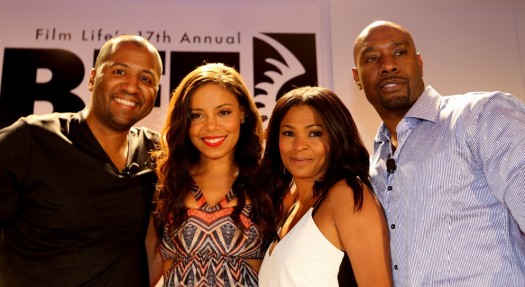
The Best Man Holiday director Malcolm D. Lee with cast members Sanaa Lathan, Nia Long and Morris Chestnut. (Photo Credit: Wilson Morales)
“You know, people really know me from The Best Man. I’ve done five other movies since then, but it always comes back to ‘The Best Man’. It was time to do the sequel.” – Malcolm D. Lee, Director ‘The Best Man Holiday’
Malcolm D. Lee is back with a hit film, The Best Man Holiday. It is quite possibly the most-anticipated film of the year with cast members and the director appearing on magazine covers, television, radio and at film festivals to hawk the sequel to The Best Man, a black film that made its mark in Hollywood nearly 15 years ago.
The year was 1999 and a consistent stream of films directed by black directors had been making a dent in Hollywood for over a decade. At the top of the decade, there was Spike Lee, Robert Townsend, John Singleton, Mario Van Peebles, George Jackson, Bill Duke, Kevin Hooks, Doug McHenry, F. Gary Gray, the Hudlin and Hughes Brothers making films that were literally changing the face of Hollywood. Black films were turning major profits and showcasing tremendous black talent in front of and behind the screen. Hollywood was buzzing with action-packed universal stories, featuring black casts, writers, producers and directors. Add to the mix, the official takeover of popular culture by Hip-Hop music, art and fashion, and the ingredients for success were solidified.
Against this backdrop, black films in the late 1990s began to more fully explore themes of love, friendship, family and memory. Films like Love Jones (1997), Soul Food (1997), Eve’s Bayou (1997), Hoodlum (1997) and indie darling Hav Plenty (1997), made their way onto the big screen. Jeff Friday, Byron E. Lewis and Warrington Hudlin launched the Acapulco Black Film Festival (ABFF) (now the American Black Film Festival), creating a place where members of Black Hollywood could network, collaborate and celebrate black film. While 1997 was chock full of black films, 1998 was a bit sparse, with even media mogul Oprah Winfrey’s critically-acclaimed Beloved (1998)tanking at the box office. During this precarious time, director Malcolm D. Lee, a young man being watched as much for his training at New York University’s prestigious graduate film program as for his family ties to the most prolific and celebrated contemporary black filmmaker of the 20th century, Spike Lee, releases The Best Man, which is a fan hit.
Malcolm D. Lee made a film that would prove that movies featuring black casts with universal storylines were not only desired by audiences, but could still make money at the box office. In October 1999, a story about a group of friends coming together to celebrate a wedding, while discovering just how much they don’t know about each other resonated with audiences to the tune of $30 million, despite an “R” rating for language and sexuality. A film that was made for roughly $9 million, was a solid hit, foreshadowing the success of popular black films like The Wood (1999) and Love and Basketball (1999), and critically-acclaimed films like A Lesson Before Dying (1999).
Nearly 15 years later, Malcolm D. Lee is back with The Best Man Holiday (2013), the much-anticipated sequel to a film that is as important to the canon of black film as it is to audiences that love the film and what it represents. When asked what prompted Lee to make a sequel to such a beloved film, the director says it was the right time. Lee states, “I always wanted to do a follow-up at some point. I didn’t think that I wanted to do a sequel right away, because there were people encouraging me to do a sequel, a television show right away. I wanted other stories to tell as an artist. I didn’t want to be pigeon holed as an artist, telling only one kind of story. I had said to myself even back then that I would re-visit these characters 10 years later just to see what kind of life they have lived. I’d let the characters live some life and me live some life so that I would have some kind of story to tell. So when it came to wanting to do it, the time was just right.”
Lee, who has directed five films since The Best Man including Undercover Brother (2002),Roll Bounce (2005) and Welcome Home Roscoe Jenkins (2008) is mostly remembered for The Best Man. Writing and directing a sequel to a film that is his signature film, that audiences still love and could potentially break box office records would be a stressful task for most directors, but not Lee. Lee wasn’t worried about tinkering with the magic of the original film because he thought long and hard about making the sequel. “When I decided to make a sequel, I said to myself we can’t just repeat ourselves, we have to do something that is just as special, if not more special, we have to top ourselves,” says Lee. Lee has had success with his other films, working with larger budgets and established stars as he has honed his craft as a director, which is an asset to the film. Lee states, “I don’t see any reason why we shouldn’t succeed given that I feel like I’m a better writer than I was then. I’m a better director than I was then. The actors – as great as they were then – are better now. So, why wouldn’t we make something that’s just as satisfying, more sophisticated, just as funny, more emotional and do something special again?”
Lee’s words convey the passion with which he approached the project and reflects his ability to get the entire original cast on board. Sanaa Lathan who reprises her role as Robyn in The Best Man Holiday discusses how Lee got everyone back on board over dinner at a restaurant in Beverly Hills. “We were just so excited to see each other because we’re all friends, it was like a reunion. He pitched it, moment-by-moment, scene-by- scene. Within five minutes, we were on the edge of our seats literally like we were watching the movie and by the end of the pitch, we were like okay Malcolm, please write this and we will all be on board,” says Lathan.
The excitement expressed by Lathan mirrors the excitement of audiences that were anticipating the film. Lee sees the film as a continuation of the previous film, so audiences can expect a different experience, not necessarily a different movie. Lee offers, “The characters have grown. They’ve got children now; they’ve got mortgage payments. The things that you worry about in your mid-20s aren’t the same things you worry about in your mid to late 30s or in your 40s. There are issues and things that occur, that come up and change your life, that need to be addressed in this movie.”
While Lee has a track record of success in Hollywood, and this film is expected to mine box office gold, this doesn’t mean that there aren’t challenges. “I’m driven more by my heart more than anything else and my head and sometimes those things are counter intuitive. I’m still trying to figure out a way to make them both work.” One thing that Lee knows for sure is that right now, all that is on his brain is The Best Man Holiday. When asked what’s next for the director, he simply responded, “Best Man Holiday. I can’t look beyond that now.”
The Best Man Holiday is now playing in theaters.
This post was written by Nsenga K. Burton, Ph.D., founder & editor-in-chief of the award-winning news site The Burton Wire. Follow her on Twitter @Ntellectual or @TheBurtonWire.
The Best Man Holiday director Malcolm D. Lee with cast members Sanaa Lathan, Nia Long and Morris Chestnut. (Photo Credit: Wilson Morales)
“You know, people really know me from The Best Man. I’ve done five other movies since then, but it always comes back to ‘The Best Man’. It was time to do the sequel.” – Malcolm D. Lee, Director ‘The Best Man Holiday’
Malcolm D. Lee is back with a hit film, The Best Man Holiday. It is quite possibly the most-anticipated film of the year with cast members and the director appearing on magazine covers, television, radio and at film festivals to hawk the sequel to The Best Man, a black film that made its mark in Hollywood nearly 15 years ago.
The year was 1999 and a consistent stream of films directed by black directors had been making a dent in Hollywood for over a decade. At the top of the decade, there was Spike Lee, Robert Townsend, John Singleton, Mario Van Peebles, George Jackson, Bill Duke, Kevin Hooks, Doug McHenry, F. Gary Gray, the Hudlin and Hughes Brothers making films that were literally changing the face of Hollywood. Black films were turning major profits and showcasing tremendous black talent in front of and behind the screen. Hollywood was buzzing with action-packed universal stories, featuring black casts, writers, producers and directors. Add to the mix, the official takeover of popular culture by Hip-Hop music, art and fashion, and the ingredients for success were solidified.
Against this backdrop, black films in the late 1990s began to more fully explore themes of love, friendship, family and memory. Films like Love Jones (1997), Soul Food (1997), Eve’s Bayou (1997), Hoodlum (1997) and indie darling Hav Plenty (1997), made their way onto the big screen. Jeff Friday, Byron E. Lewis and Warrington Hudlin launched the Acapulco Black Film Festival (ABFF) (now the American Black Film Festival), creating a place where members of Black Hollywood could network, collaborate and celebrate black film. While 1997 was chock full of black films, 1998 was a bit sparse, with even media mogul Oprah Winfrey’s critically-acclaimed Beloved (1998)tanking at the box office. During this precarious time, director Malcolm D. Lee, a young man being watched as much for his training at New York University’s prestigious graduate film program as for his family ties to the most prolific and celebrated contemporary black filmmaker of the 20th century, Spike Lee, releases The Best Man, which is a fan hit.
Malcolm D. Lee made a film that would prove that movies featuring black casts with universal storylines were not only desired by audiences, but could still make money at the box office. In October 1999, a story about a group of friends coming together to celebrate a wedding, while discovering just how much they don’t know about each other resonated with audiences to the tune of $30 million, despite an “R” rating for language and sexuality. A film that was made for roughly $9 million, was a solid hit, foreshadowing the success of popular black films like The Wood (1999) and Love and Basketball (1999), and critically-acclaimed films like A Lesson Before Dying (1999).
Nearly 15 years later, Malcolm D. Lee is back with The Best Man Holiday (2013), the much-anticipated sequel to a film that is as important to the canon of black film as it is to audiences that love the film and what it represents. When asked what prompted Lee to make a sequel to such a beloved film, the director says it was the right time. Lee states, “I always wanted to do a follow-up at some point. I didn’t think that I wanted to do a sequel right away, because there were people encouraging me to do a sequel, a television show right away. I wanted other stories to tell as an artist. I didn’t want to be pigeon holed as an artist, telling only one kind of story. I had said to myself even back then that I would re-visit these characters 10 years later just to see what kind of life they have lived. I’d let the characters live some life and me live some life so that I would have some kind of story to tell. So when it came to wanting to do it, the time was just right.”
Lee, who has directed five films since The Best Man including Undercover Brother (2002),Roll Bounce (2005) and Welcome Home Roscoe Jenkins (2008) is mostly remembered for The Best Man. Writing and directing a sequel to a film that is his signature film, that audiences still love and could potentially break box office records would be a stressful task for most directors, but not Lee. Lee wasn’t worried about tinkering with the magic of the original film because he thought long and hard about making the sequel. “When I decided to make a sequel, I said to myself we can’t just repeat ourselves, we have to do something that is just as special, if not more special, we have to top ourselves,” says Lee. Lee has had success with his other films, working with larger budgets and established stars as he has honed his craft as a director, which is an asset to the film. Lee states, “I don’t see any reason why we shouldn’t succeed given that I feel like I’m a better writer than I was then. I’m a better director than I was then. The actors – as great as they were then – are better now. So, why wouldn’t we make something that’s just as satisfying, more sophisticated, just as funny, more emotional and do something special again?”
Lee’s words convey the passion with which he approached the project and reflects his ability to get the entire original cast on board. Sanaa Lathan who reprises her role as Robyn in The Best Man Holiday discusses how Lee got everyone back on board over dinner at a restaurant in Beverly Hills. “We were just so excited to see each other because we’re all friends, it was like a reunion. He pitched it, moment-by-moment, scene-by- scene. Within five minutes, we were on the edge of our seats literally like we were watching the movie and by the end of the pitch, we were like okay Malcolm, please write this and we will all be on board,” says Lathan.
The excitement expressed by Lathan mirrors the excitement of audiences that were anticipating the film. Lee sees the film as a continuation of the previous film, so audiences can expect a different experience, not necessarily a different movie. Lee offers, “The characters have grown. They’ve got children now; they’ve got mortgage payments. The things that you worry about in your mid-20s aren’t the same things you worry about in your mid to late 30s or in your 40s. There are issues and things that occur, that come up and change your life, that need to be addressed in this movie.”
While Lee has a track record of success in Hollywood, and this film is expected to mine box office gold, this doesn’t mean that there aren’t challenges. “I’m driven more by my heart more than anything else and my head and sometimes those things are counter intuitive. I’m still trying to figure out a way to make them both work.” One thing that Lee knows for sure is that right now, all that is on his brain is The Best Man Holiday. When asked what’s next for the director, he simply responded, “Best Man Holiday. I can’t look beyond that now.”
The Best Man Holiday is now playing in theaters.
This post was written by Nsenga K. Burton, Ph.D., founder & editor-in-chief of the award-winning news site The Burton Wire. Follow her on Twitter @Ntellectual or @TheBurtonWire.
Airing in February 2014 on Vh1, the travelogue explores how bands and their pulsating bass riffs, rhythmic drumming and danceable grooves not only transformed black music but American pop culture.
“Funk is the missing link. It’s the link between soul and hip hop. At its essence is blues. The musicians were influenced by psychedelica and African rhythms. It’s serious music, but it’s fun music. No one really celebrated it. We were doing an archaeological duty, and we wanted to get the story back,” says George during a talkback at Woodruff Arts Center.
George thinks back to being in high school and reading a Rolling Stonereview on a Brothers Johnson album written by a white journalist. The writer’s inability to connect with the duo’s sound resonated with George. The experience encouraged the Brooklyn native to embark on a successful career articulating black cultural production to the masses.
“I’m part of the culture. These people didn’t have a connection to the culture. Our culture needs to be defined through our eyes. We need to be a part of that dialogue. You have to go and dance to it to judge it. It’s about rhythm,” says George.
George offers, ““We weren’t making a film about funk. This film is not the history of funk. It’s too big. We were making a film about a generation of creative people. They’re eccentric, interesting men. So many of their songs were about space. They were fashion forward, very adventurous and pushed the envelope,” he says.
George’s transition into filmmaking stems from constantly being asked to provide commentaries for other films. His perspective and writing was often exaggerated or altered. “You never know where stories are gonna come from. I got tired of people messing up stuff I was writing. I had to take control of my own narrative,” he says.
The Grammy award-winning writer is developing an e-book to include all full-length interviews and commentaries from the performers. “We couldn’t get it in there. [Funk] is a participatory culture, and we are aware of our absence from the official record. I want to do stories embedded in our music culture. We should have fun with that,” says George.
Not certain if he will produce another music documentary, George is currently working on a film highlighting dancer Misty Copeland. One of the authorities on black culture, George believes it is important for black content providers and creators to own, create and think outside of the box.
“Do things that you’re not comfortable doing. You will get better by challenging your skill set,” says George.
This post was written by Christopher A. Daniel, pop cultural critic and music editor for The Burton Wire. He is also a contributing writer for Urban Lux Magazine and Blues & Soul Magazine. Follow Christopher @Journalistorian on Twitter.
Airing in February 2014 on Vh1, the travelogue explores how bands and their pulsating bass riffs, rhythmic drumming and danceable grooves not only transformed black music but American pop culture.
“Funk is the missing link. It’s the link between soul and hip hop. At its essence is blues. The musicians were influenced by psychedelica and African rhythms. It’s serious music, but it’s fun music. No one really celebrated it. We were doing an archaeological duty, and we wanted to get the story back,” says George during a talkback at Woodruff Arts Center.
George thinks back to being in high school and reading a Rolling Stonereview on a Brothers Johnson album written by a white journalist. The writer’s inability to connect with the duo’s sound resonated with George. The experience encouraged the Brooklyn native to embark on a successful career articulating black cultural production to the masses.
“I’m part of the culture. These people didn’t have a connection to the culture. Our culture needs to be defined through our eyes. We need to be a part of that dialogue. You have to go and dance to it to judge it. It’s about rhythm,” says George.
George offers, ““We weren’t making a film about funk. This film is not the history of funk. It’s too big. We were making a film about a generation of creative people. They’re eccentric, interesting men. So many of their songs were about space. They were fashion forward, very adventurous and pushed the envelope,” he says.
George’s transition into filmmaking stems from constantly being asked to provide commentaries for other films. His perspective and writing was often exaggerated or altered. “You never know where stories are gonna come from. I got tired of people messing up stuff I was writing. I had to take control of my own narrative,” he says.
The Grammy award-winning writer is developing an e-book to include all full-length interviews and commentaries from the performers. “We couldn’t get it in there. [Funk] is a participatory culture, and we are aware of our absence from the official record. I want to do stories embedded in our music culture. We should have fun with that,” says George.
Not certain if he will produce another music documentary, George is currently working on a film highlighting dancer Misty Copeland. One of the authorities on black culture, George believes it is important for black content providers and creators to own, create and think outside of the box.
“Do things that you’re not comfortable doing. You will get better by challenging your skill set,” says George.
This post was written by Christopher A. Daniel, pop cultural critic and music editor for The Burton Wire. He is also a contributing writer for Urban Lux Magazine and Blues & Soul Magazine. Follow Christopher @Journalistorian on Twitter.
France’s Justice Minister has been subjected to racist taunts and slurs likening her to a monkey. (Photo Credit: Google Images)
Writing for The Root, Breanna Edwards writes that France’s Justice Minister Christiane Taubira has been subjected to a slew of racist slurs and insults in recent weeks. Edwards writes:
“It’s the third time in about a month that France’s justice minister, Christiane Taubira, has been publicly ridiculed with racist gibes, causing backlash for the lack of respect afforded the foremost black politician.
The far-right weekly magazine Minute published a cover declaring, ‘Crafty as a monkey, Taubira gets her banana back,’ the Agence France-Presse reports.
Given the public reaction, Interior Minister Manuel Vells said that he would look into seeing whether it was legally possible to block the magazine’s distribution, saying the insidious headline cannot be overlooked.
According to the AFP, politicians went to Twitter, demanding the magazine’s editor be prosecuted for incitement to racial hatred. The human rights group SOS Racisme is investigating lodging a formal legal complaint, forcing authorities to look into any possible breach of laws.”
This isn’t the first time that Taubira has been subjected to racist taunts. In October, National Front (FN) candidate Anne-Sophie Leclere, the FN candidate for Rethel in the northeastern Ardennes region, caused a fire storm of criticism by comparing Justice Minister Christiane Taubira to a monkey on French television. Leclere also admitted that she created a photo-montage showing Taubira, who is from French Guiana, alongside a baby monkey which was posted on her Facebook page. The caption underneath the baby monkey said “At 18 months,” while the other caption under Taubira’s current photo said, “Now.”
In April 2013, Minister Taubira made a historic speech introducing France’s gay marriage and adoption bill to Parliament. Her speech has been likened to other historic speeches like Simone Veil’s plea for abortion rights in 1974 and Robert Badinter’s speech supporting the abolition of the death penalty in 1981.
France’s Justice Minister has been subjected to racist taunts and slurs likening her to a monkey. (Photo Credit: Google Images)
Writing for The Root, Breanna Edwards writes that France’s Justice Minister Christiane Taubira has been subjected to a slew of racist slurs and insults in recent weeks. Edwards writes:
“It’s the third time in about a month that France’s justice minister, Christiane Taubira, has been publicly ridiculed with racist gibes, causing backlash for the lack of respect afforded the foremost black politician.
The far-right weekly magazine Minute published a cover declaring, ‘Crafty as a monkey, Taubira gets her banana back,’ the Agence France-Presse reports.
Given the public reaction, Interior Minister Manuel Vells said that he would look into seeing whether it was legally possible to block the magazine’s distribution, saying the insidious headline cannot be overlooked.
According to the AFP, politicians went to Twitter, demanding the magazine’s editor be prosecuted for incitement to racial hatred. The human rights group SOS Racisme is investigating lodging a formal legal complaint, forcing authorities to look into any possible breach of laws.”
This isn’t the first time that Taubira has been subjected to racist taunts. In October, National Front (FN) candidate Anne-Sophie Leclere, the FN candidate for Rethel in the northeastern Ardennes region, caused a fire storm of criticism by comparing Justice Minister Christiane Taubira to a monkey on French television. Leclere also admitted that she created a photo-montage showing Taubira, who is from French Guiana, alongside a baby monkey which was posted on her Facebook page. The caption underneath the baby monkey said “At 18 months,” while the other caption under Taubira’s current photo said, “Now.”
In April 2013, Minister Taubira made a historic speech introducing France’s gay marriage and adoption bill to Parliament. Her speech has been likened to other historic speeches like Simone Veil’s plea for abortion rights in 1974 and Robert Badinter’s speech supporting the abolition of the death penalty in 1981.