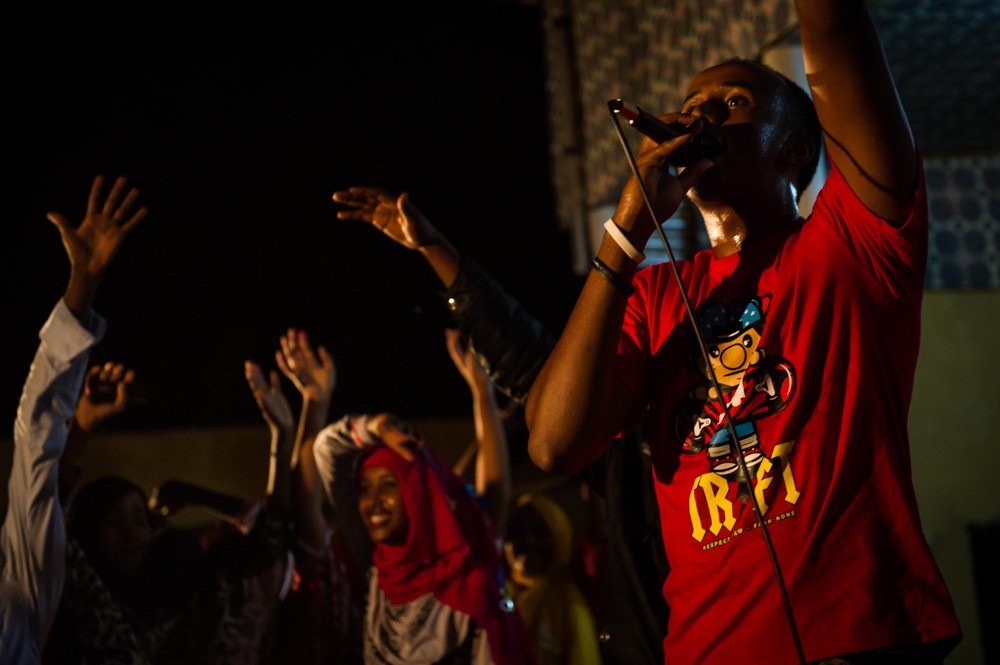
Somali hip-hop collective Waayaha Cusub performed in Mogadishu, Somalia for the first time in the country’s first formal musical event in 25 years. (Google Images)
Phil Moore ofAl Jazeera is reporting that Somalia held its first formal musical performances in more than 25 years last week. The festival, held in the capital city of Mogadishu, was organized in last-minute secrecy and featured 18 international artists from seven different countries. The al-Shabaab reign outlawed music in 2009, and the effects still linger even after their removal by the African Union in 2011. Last week’s festival featured a performance by a Somali hip-hop group formed by Shiine Ali, who was long a target for his messages against al-Shabaab.
Moore writes:
International acts from the US to Sudan supported Waayaha Cusub, a Somali hip-hop collective who formed while in exile in the Kenyan capital, Nairobi. They had never before played a concert in Mogadishu. Shiine Ali, who founded the group, has spoken out strongly against al-Shabaab, which made him a target in 2007 when gunmen shot him five times and left him for dead.
Since then, his lyrics have continued to encourage Somalis to turn their back on al-Shabaab. He believes these concerts represent a major milestone in Mogadishu’s return to normality.
“What with the range of ideology, religious belief, political commitment and background, age, and experience, something interesting was always going on. Because no matter our differences, this group had one thing in common, moral stubbornness. Whatever we believed, we really believed and were not at all shy about advancing. We were where we were only because of our willingness to affirm our beliefs even at the risk of physical injury. So it was never dull on death row.” — Stokely Carmichael
The Student Nonviolent Coordinating Committee (SNCC)
April 8, 1960: The Student Nonviolent Coordinating Committee (SNCC), one of the principal organizations of the Civil Rights Movement, was founded after a series of student meetings led by Ella Baker at Shaw University in Raleigh, North Carolina. Future leaders attending those meetings included Stokely Carmichael, Julian Bond, Diane Nash, John Lewis, James Bevel, and Marion Barry, who served as the first chairman of SNCC. SNCC was primarily focused on voter registration in the South and in 1963 conducted the Freedom Ballot in Mississippi. In 1964, they conducted the Mississippi Summer Project to organize the Mississippi Freedom Democratic Party to win seats at the 1964 Democratic National Convention. SNCC also established Freedom Schools to teach children to read and to educate them to stand up for their rights. Although still active in some cities, SNCC largely disappeared in the early 1970’s.
The Akosua Report: Facts on The African Diaspora, is written by Akosua Lowery. Follow her on Twitter @AkosuaLowery.
Towson University students march in response to the call for patrols on campus by members of a non-affiliated white power organization. (Google Images)
I teach African American literature at Towson University. Every semester, I try to make relevant the varied stories—fiction and nonfiction—of our recent and distant American past. I try to make real the everyday realities of racism, and sexism as we read the books from the “olden days” or the unspecified past that begins, most often, before right now.
For the last year I haven’t had to try too hard to make the past real. It has found its way onto campus through the lens of two student-run (albeit not affiliated with the university) groups, Youth for Western Civilization (YWC) and the White Student Union (WSU). Both groups were created to celebrate the historical and moral value of whiteness. YWC lost traction last year after smearing the campus with racial slurs and losing its faculty advisor, but its leaders rebranded and gave it a new name, “The White Student Union.” The WSU has made national headlines with its brand of ideology that recalls the rhetorical turns of yesteryear’s white supremacist organizations, such as the Klan or the White Citizens’ Council. What was once “back then” has made it into classroom discussions as part of right now.
My students have responded with horror and annoyance and have taken action. They want to speak about the complicated ways that racism has made its way on to their campus and into their classrooms. They want to speak against the silences that have rendered racism a figment of an American past. Last year after YWC chalked the campus with racial slurs, students in my first-year seminar asked to make a public service announcement against racism and for learning history. Their message—“Stop violence. Learn History”—was simple because we can’t stop what we refuse to see, name, or remember. They wanted to be sure that their peers could see, name, and remember this very present reality.
Two days ago, I went to a rally on campus led by yet another group of students armed with a collective of voices. They spoke of “peace,” “unity,” and “diversity” and asked participants to #bethechangeTU that we wished to see on campus. They trekked through campus reclaiming space and laughing together. They walked for a sense of a greater collective and shared experience. Some rocked t-shirts that said #TUstands4 and etched in puffy paint, words, like hope, community, freedom, unity.
My hope is that they also walked to remember the stories that we sometimes would rather not speak; I hope they walked to remember the students, faculty and staff stopped by campus police because they look suspicious. I hope they walked to remember that racism doesn’t always look like the extremism of the WSU. Sometimes, it looks like a refusal to speak up. Racism has never worked well as the act of one rogue person. History teaches us that it lives off a structural power source. But we must keep telling our stories. We must keep learning history to remember this lesson.
Tara Bynum, Ph.D. is an Assistant Professor in the Department of English at Towson University.
Towson University students march in response to the call for patrols on campus by members of a non-affiliated white power organization. (Google Images)
I teach African American literature at Towson University. Every semester, I try to make relevant the varied stories—fiction and nonfiction—of our recent and distant American past. I try to make real the everyday realities of racism, and sexism as we read the books from the “olden days” or the unspecified past that begins, most often, before right now.
For the last year I haven’t had to try too hard to make the past real. It has found its way onto campus through the lens of two student-run (albeit not affiliated with the university) groups, Youth for Western Civilization (YWC) and the White Student Union (WSU). Both groups were created to celebrate the historical and moral value of whiteness. YWC lost traction last year after smearing the campus with racial slurs and losing its faculty advisor, but its leaders rebranded and gave it a new name, “The White Student Union.” The WSU has made national headlines with its brand of ideology that recalls the rhetorical turns of yesteryear’s white supremacist organizations, such as the Klan or the White Citizens’ Council. What was once “back then” has made it into classroom discussions as part of right now.
My students have responded with horror and annoyance and have taken action. They want to speak about the complicated ways that racism has made its way on to their campus and into their classrooms. They want to speak against the silences that have rendered racism a figment of an American past. Last year after YWC chalked the campus with racial slurs, students in my first-year seminar asked to make a public service announcement against racism and for learning history. Their message—“Stop violence. Learn History”—was simple because we can’t stop what we refuse to see, name, or remember. They wanted to be sure that their peers could see, name, and remember this very present reality.
Two days ago, I went to a rally on campus led by yet another group of students armed with a collective of voices. They spoke of “peace,” “unity,” and “diversity” and asked participants to #bethechangeTU that we wished to see on campus. They trekked through campus reclaiming space and laughing together. They walked for a sense of a greater collective and shared experience. Some rocked t-shirts that said #TUstands4 and etched in puffy paint, words, like hope, community, freedom, unity.
My hope is that they also walked to remember the stories that we sometimes would rather not speak; I hope they walked to remember the students, faculty and staff stopped by campus police because they look suspicious. I hope they walked to remember that racism doesn’t always look like the extremism of the WSU. Sometimes, it looks like a refusal to speak up. Racism has never worked well as the act of one rogue person. History teaches us that it lives off a structural power source. But we must keep telling our stories. We must keep learning history to remember this lesson.
Tara Bynum, Ph.D. is an Assistant Professor in the Department of English at Towson University.
Pope Francis has addressed the sex abuse problem in the Catholic Church for the first time publicly. (Google Images)
According to the BBC, Pope Francis addressed for the first time in public the topic of sex abuse within the Church, urging the Congregation for the Doctrine of Faith, a Vatican watchdog, to take action on the issue. While the group deals largely with this problem, action had not previously been taken under Pope Benedict XVI, whom many claim covered up sexual abuse cases before resigning earlier this year.
The BBC writes:
A leading sex abuse survivors’ group has responded with scepticism, saying “actions speak louder than words”.
…
In his remarks on Friday, Pope Francis said combating the crisis – which has mired the Church in scandal from the US, Ireland and Europe to Australia – was important for the credibility of the Church.
A Vatican statement said the Pope had urged Bishop Mueller to “act decisively as far as cases of sexual abuse are concerned, promoting, above all, measures to protect minors, help for those who have suffered such violence in the past (and) the necessary procedures against those who are guilty”.
“No white American ever thinks that any other race is wholly civilized until he wears the white man’s clothes, eats the white man’s food, speaks the white man’s language, and professes the white man’s religion.” ― Booker T. Washington, Up from Slavery
Booker T. Washington
April 5, 1856: Booker Taliaferro Washington, educator, author and leader, was born enslaved on the Burroughs Plantation in Virginia. His family gained their freedom at the end of the Civil War and Washington was educated at Hampton Institute and Wayland Seminary. In 1881, Washington was appointed the first leader of Tuskegee Institute, which he headed for the rest of his life. Washington was the dominant leader of the African American community from 1890 to his death on November 14, 1915.
The Akosua Report: Facts on The African Diaspora, is written by Akosua Lowery. Follow her on Twitter @AkosuaLowery.
Flash floods devastated Argentina between Tuesday, April 2 and Wednesday, April 3. (Google Images)
The BBC is reporting that, after a heavy storm’s flash floods killed 54 people in both La Plata and the capital city of Buenos Aires, the Argentinean government declared three days of mourning throughout the country. About 16 inches of rain were recorded in La Plata between Tuesday and Wednesday, with nearly six inches hitting Buenos Aires earlier. The devastation has displaced thousands, including President Cristina Fernandez de Kirchner’s mother. Many in the affected areas have begun looting, and there is fear that it will continue.
The BBC writes:
Residents have described spending nights on rooftops to escape the deluge while the coastguard used boats to help people who were stranded.
…
[Provincial governor Daniel] Scioli said that many of those who died in La Plata were drowned or electrocuted after taking shelter in their cars in the suburb of Tolosa.
“We are giving priority to rescuing people who have been stuck in trees or on the roofs of their homes,” he added.
The city’s oil refinery was flooded and then had to close due to a fire. YPF, the company which runs the facility, said “an extraordinary accumulation of rainwater and power outages in the entire refinery complex” caused the fire.
The UN General Assembly on Tuesday approved a new global arms treaty. (Google Images)
Colum Lynch of The Washington Post is reporting that the United Nations General Assembly on Tuesday voted in favor of a new and landmark international arms regulation treaty. In particular, this new legislation would regulate the sale of “a wide range of conventional weapons” to armed groups, including governments, that commit mass atrocities such as war crimes and genocide. While the vote was largely supported by advocates and countries including the U.S., it was denounced by smaller countries such as Syria, who claim these regulations will compromise their defense mechanisms.
Lynch writes:
Although legally binding on states that ratify it, the treaty does not establish an enforcement agency. Instead, signatories will be required to pass new laws and regulations governing their arms trade and national authorities will be responsible for enforcing them.
The United States, which co-sponsored the treaty, said U.S. agencies will review the accord before it is presented to President Obama for signature. The treaty would then require ratification by a two-thirds vote of the Senate.
…
The United Nations’ 193-member assembly voted 154 to 3 to adopt the treaty. There were 23 abstentions, including from major arms traders such as China, India and Russia, as well as Qatar and Saudi Arabia, which are supplying weapons to opposition groups in Syria. The treaty will not go into force until 90 days after it is ratified by at least 50 member states.
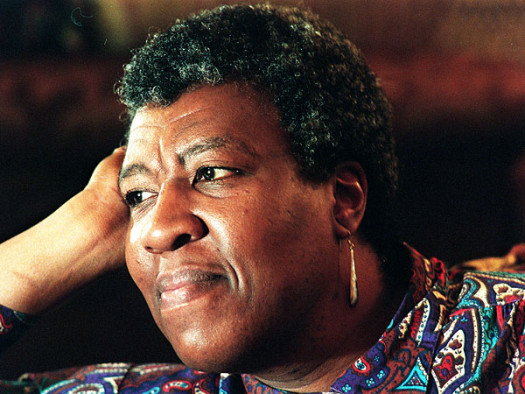
The work of Octavia Butler was honored at Spelman College’s half-day conference, “Black to the Future.” (Google Images)
Many are still reeling from the recent death of Things Fall Apart (1958)author Chinua Achebe (1930-2013). While the world remembered the man known as the ‘Grandfather of African Literature,’ black authors Robert Beck (1919-1992), known by pseudonym “Iceberg Slim,” and Octavia E. Butler (1947-2006) were immortalized in Atlanta.
Portrait of a Pimp, directed by Ice T.’s longtime manager, Jorge Hinojosa, was screened during the 2013 Atlanta Film Festival. Hinojosa’s self-funded 90-minute documentary chronicles Slim’s evolution from astute yet flamboyant Chicago pimp to best-selling author of seven books.
Spelman College, on the other hand, honored Butler with a half-day conference, “Black to the Future.” Organized by award-winning Cosby ChairTananarive Due, the event also spotlighted Afrofuturism, which highlights relevant black issues in the context of fantasy, supernatural, science fiction and horror.
Slim and Butler both pioneered genres for the African American literary canon. Slim’s books reveal a gritty underworld filled with crime, sex, drug addiction, poverty, imprisonment and death. His books Pimp: Story of My Life (1969), Trick Baby (1971), Mama Black Widow (1969)and Airtight Willie & Me (1979)collectively adapt street colloquialisms, the ghetto as the backdrop and dynamic character portraits. Slim’s explicitness and realism was the antithesis to blaxploitation films and grotesque media reports.
Samuel “Chip” Delany, another pioneering black speculative fiction writer, adds that Butler, an avid reader with a salt-and-pepper mini-Afro who loved research, was consistently straightforward. “When she opened her mouth, it was very clear that she had something to say,” says Delany.
Slim’s intellectual property consistently sold well as paperbacks but was often subjected to greedy book publishers and mixed reviews from critics. Slim’s storytelling and character development would lay the groundwork for streetwise fiction authors Donald Goines, Odie Hawkins and Wahida Clark. Ice-T, Too $hort and Snoop Dogg also cite Slim as an influence on their records. Cash Money Content, founded by Cash Money Records’ “Slim” and “Baby” Williams, owns and publishes all of Slim’s books.
Hinojosa says classic literature often comes out of censorship and resistance. “People are uncomfortable with silence, but that’s when the jewels come out,” says Hinojosa.
Like Slim, Butler was often criticized by other writers (predominately white men). There was the perception that her android-styled writings didn’t have any traces of a black following. Steven Barnes, novelist and television writer, says both book publishers and television executives often make generalizations regarding black audiences and science fiction.
“People like seeing stuff that looks like them. That’s a universal human trait. I had to argue with a white female editor who said ‘Black people aren’t interested in science fiction,’ but there is curiosity. Be willing to take the pain of rejection,” says Barnes.
With both Slim and Butler, the criticism never stopped their prolific output. Their books further imprint a legacy of black cultural production synonymous with passion and a willingness to challenge the conventions of literature. “[Octavia] was the purest writer that was still sane. She invested so much of herself in her work. She just wanted to do the work and did,” says Barnes.
Christopher A. Daniel is the music and culture editor for The Burton Wire. He is also a contributing writer for Urban Lux Magazine and Blues & Soul Magazine. Follow Christopher @Journalistorian on Twitter.
IRIN has released a list of core health issues for a new British health care program to address in the Democratic Republic of Congo. (Google Images)
AllAfrica.com is reporting that Britain will provide an expansive new health care program in the Democratic Republic of the Congo (DRC). The US$270.7 million (£179 million) initiative will last five years and aid in rebuilding facilities, training care givers, and supplying medications and equipment. Humanitarian news group IRIN has released five key health issues in the country that the project should address. These areas include maternal and child health, sexual violence, diarrhoeal diseases, immunization, and HIV.
AllAfrica.com writes:
Civil war has destroyed much of the country’s health infrastructure, as well as the road networks and vital services such as electricity, meaning patients often have to travel long distances to health centres that may not be equipped to handle their complications.


 “What with the range of ideology, religious belief, political commitment and background, age, and experience, something interesting was always going on. Because no matter our differences, this group had one thing in common, moral stubbornness. Whatever we believed, we really believed and were not at all shy about advancing. We were where we were only because of our willingness to affirm our beliefs even at the risk of physical injury. So it was never dull on death row.” — Stokely Carmichael

 “No white American ever thinks that any other race is wholly civilized until he wears the white man’s clothes, eats the white man’s food, speaks the white man’s language, and professes the white man’s religion.” ―