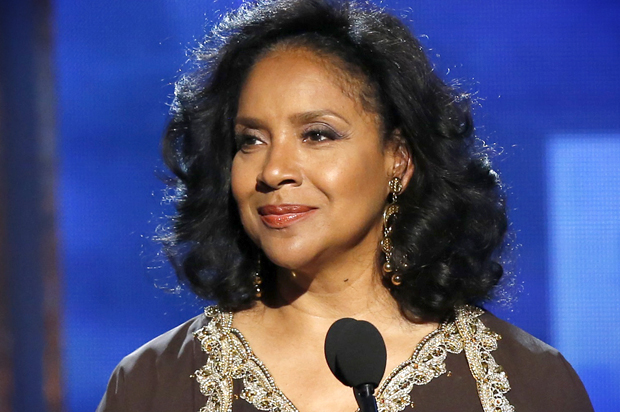
Boxing legend Hector ‘Macho’ Camacho dies at age 50. (Google Images)
The Associated Press is reporting that Hector “Macho” Camacho has died. The article reports that Camacho “was a brash fighter with a mean jab and an aggressive style, launching himself furiously against some of the biggest names in boxing. And his bad-boy persona was not entirely an act, with a history of legal scrapes that began in his teens and continued throughout his life.”
The man who once starred at the pinnacle of boxing, winning several world titles, died Saturday after being ambushed in a parking lot back in the Puerto Rican town of Bayamon where he was born. Packets of cocaine were found in the car in which he was shot.
Camacho, 50, left behind a reputation for flamboyance — leading fans in cheers of “It’s Macho time!” before fights — and for fearsome skills as one of the top fighters of his generation.
The fighter’s last title bout came in 1997 against welterweight champion Oscar De La Hoya, who won by unanimous decision. Camacho’s last fight was his defeat by Saul Duran in May 2010. He had a career record of 79-6-3.
Doctors pronounced Camacho dead on Saturday after he was removed from life support at his family’s direction. He never regained consciousness after at least one gunman crept up to the car in a darkened parking lot and opened fire.
No arrests have been made, and authorities have not revealed many details beyond the facts that police found cocaine in the car and that the boxer and his friend, who was killed at the scene, had no idea the attack was coming. “Apparently, this was a surprise,” said Alex Diaz, a police spokesman.
Survivors include his mother; three sisters, Raquel, Estrella and Ester; a brother, Felix; and four sons, Hector Jr., Taylor, Christian and Justin. He was 50-years-old.
“Our party needs a lot of work to do if we expect to be competitive in the near future.”
During all this Republican self-examination (Republicans on Hispanic voters, on young voters, on Asians voters, on Women voters, on Gay voters), there is very little mention of black voters. Despite the fact that Blacks make up about 36 million of the U.S. population and have the highest voter turnout of all ethnic minorities and even with a Black man in the White House, we continue to be the “blind spot” in American politics. It’s ironic considering it was the Republican Party’s Southern Strategy, the widespread stoking of racial resentment between southern whites and blacks, which set them on this path. It’s unfortunate for those of us who feel we have been forced to choose between the lesser of two evils: The Democratic Party who has taken our vote for granted and the Republicans who have consciously and consistently waged these ethnic wars using us as scapegoat and boogieman.
Alternative for the N-Word
In this recently released video below, the infamous Republican strategist Lee Atwater described how the Republican Party could code racism in a way that it would not hurt them politically. Instead of screaming the N-word, he told them to use phrases like forced bussing, states’ rights, or cutting taxes. That lexicon has evolved to include affirmative action, crime, entitlements, takers and a host of other code words.
http://youtu.be/X_8E3ENrKrQ
As Republicans try to reinvent themselves, they are questioning the efficacy of the “Southern Strategy” with a 21st century electorate. Unfortunately, it’s not because anyone has said “No” to the continued demonization of black voters. It’s simply because they have suddenly discovered the concept of “Math,” meaning the “us against them” rhetoric is only being questioned because there are simply too many of “them” and not enough of “us” in the equation.
Marginalizing the black vote: the Democrats
It’s silly to argue race is not a part of politics, and it’s naïve to assume only one party uses it to control votes. While Republicans use it to motivate Southern white voters, Democrats have also used it. They use it by creating this narrative that we need them to protect us from racist Republicans, and more broadly racist white folks – who without the protection of good white Democrats would trample upon our rights.
Sure, that’s offensive. What annoys me is the constant “handling of blacks” that appears more pervasive among Democrats. What worries me is leverage. More to the point, it’s the fact that a monolithic black electorate has no political leverage. Politics is not, nor has it ever been, an exercise in altruism. And politicians sure as hell aren’t altruistic. Until black voters demand more out of the political process and politicians, issues affecting us like an institutionally racist criminal justice system, unfair drug sentencing, affirmative action, the lack of urban economic policy solutions and near utter failure of urban K-12 schools will continue to be ignored. Only in America does having a black man in the White House not immediately advance but somehow complicate the cause of Black people.
Devona Walker is Politics Editor for The Burton Wire.
Like The Burton Wire on Facebook. Follow us on Twitter @TheBurtonWire.
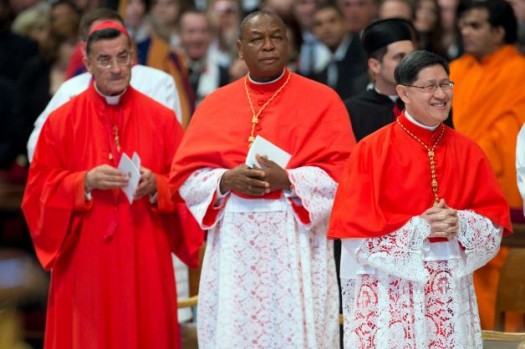
Pope Benedict XVI appoints Archbishop John Olorunfemi Onaiyekan of Abuja, Nigeria and Archbishop Ruben Salazar Gomez of Bogota, Colombia as Cardinals. (Google Images)
Rome (CNN) — CNN is reporting that Pope Benedict XVI appointed six new cardinals in a special ceremony at St. Peter’s Basilica on Saturday, all of them from countries outside Europe.
One of those elevated to the College of Cardinals was American Archbishop James M. Harvey, who currently serves as prefect of the papal household, according to Vatican Radio.
The others were Bechara Boutros Rai, a Maronite patriarch from Lebanon; Baselios Cleemis Thottunkal, an Indian archbishop and head of the Syro-Malankara Church; Archbishop John Olorunfemi Onaiyekan of Abuja, Nigeria; Archbishop Ruben Salazar Gomez of Bogota, Colombia; and Archbishop Luis Antonio Tagle of Manila, Philippines.
During the ceremony each received the traditional red hat, or “biretta,” gold ring and a document with the name of the cardinal’s titular church in Rome.
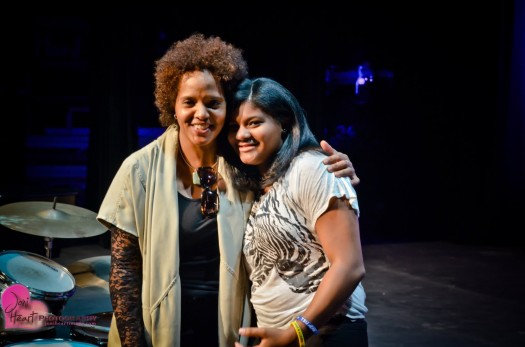
Jazz drummer Teri Lyne Carrington works with students in the community and as a professor at Berklee College of Music in Boston. (Jina Wilson/Joni Heart Photography)
Terri Lyne Carrington takes getting involved and seizing full advantage of all opportunities quite seriously.
The Grammy Award-winning drummer, composer and producer – famous for her all-female concept album, The Mosaic Project— reveals she didn’t realize how powerful her talents were at one point in her career. “I was playing at seven and a professional by age 10, and I didn’t really appreciate the experience,” she says. “Playing with Dizzy [Gillespie] and Ella [Fitzgerald] gives me more gratitude now. Appreciate all of your experiences – especially your teachers and mentors.”
Carrington currently serves as a professor at Berklee College of Music, her alma mater in her native, Boston, where she received a full scholarship at age 11. Carrington shares Duke Ellington’s philosophy that jazz is “freedom of expression.” She adds that jazz musicians have to be disciplined and focused. “You definitely gotta have a certain set of vocabulary and a certain skill level to play it. Once you have that, it’s freedom. Jazz means freedom,” she says.
At the close of the town hall-styled clinic, Carrington performed with another young drummer. As Carrington performs her improvised set, she talks directly to the student and gives her full eye contact. The performer believes her experience serves as effective advice for the young students. “We have to give back or the music won’t continue,” Carrington says. “I’ve been there and done that. No one explained it to me. It’s trial and error especially when you’re dealing with the old school jazz cats. You just watch and listen. I tend to try and explain as much as I can just to see if I can help them a little quicker to their destination. I won’t say skip a beat but skip a step and maybe cut some of their journey a little bit shorter if they listen.”
The Arsenio Hall Show’s former house drummer later performed as part of Jazz Roots’ “Ladies of Jazz” series, where she opens for Grammy-winning bassist Esperanza Spalding. Along with pianist Geri Allen, the jazz instrumentalists play in a trio, Allen Carrington Spalding (ACS). Carrington believes she and Spalding are kindred spirits. “We both think the same things are hip,” she says. “I always say we’re like minded. We tend to break up the time in similar ways. When we play together, I feel very much at home immediately. That’s a hard thing especially with a bass player. It’s kinda magical.”
Carrington sets a fine example to young performers. It marks yet another instance in which jazz musicians believe it is their duty to use their wisdom and gifts to guide the next generation into a brighter future. “Do whatever you can to really have a voice,” she says. “Try to be a part of your community. Try to be a part of your political scene. Do your share. We all enjoy and reap the benefits of work that so many other people have done, so it’s up to us to do something.”
Christopher A. Daniel is a pop cultural critic and music editor for The Burton Wire. He is also a contributing writer for Urban Lux Magazine and Blues & Soul Magazine. Follow Christopher @Journalistorian on Twitter.
Like The Burton Wire on Facebook. Follow us on Twitter @TheBurtonWire.com.
Police officers detain student protesters in Port-au-Prince. (Google Images)
Evans Sanon of ABC News is reporting an unidentified man was shot dead Friday during a student protest in downtown Port-au-Prince. The killing occurred near a university campus where students have been protesting over a prison guard’s alleged fatal shooting of a 24-year-old graduate student last Saturday.
Sanon writes:
Frantz Lerebours, spokesman for Haiti’s police force, said the young man was killed when a “civilian” hopped off the back of a passing motorcycle in the heart of Port-au-Prince and shot the victim. He said police were searching for the killer.
Police made one arrest on charges of public disturbance during the protest, Lerebours said. The arrest brought the week’s total of arrests to three, for the same charges.
The victim appeared to be in his twenties. He was shot three times. The investigation into his death is ongoing.
Swedish furniture giant IKEA denies allegations of using Cuban political prisoners for labor. (Google Images)
Caribbean 360 is reporting that Swedish furniture giant IKEA has denied reports about the use of Cuban prison labor to manufacture goods for its stores. The company also said that it did not have a “long-term business relation with suppliers on the Spanish-speaking Caribbean island.
The writer of the article reports:
“IKEA issued an apology after an audit by the accounting firm Ernst & Young confirmed reports that some suppliers used forced prison labor, including many political dissidents, in communist-ruled East Germany in the 1980s.”‘We deeply regret that this could happen,’ in East Germany, manager Jeanette Skjelmose said in a statement issued here. “The use of political prisoners for manufacturing was at no point accepted.”
The report also stated that there was never any long-term relationships with suppliers and the company was likely unaware of the use of political prisoners in the manufacturing of the furniture.
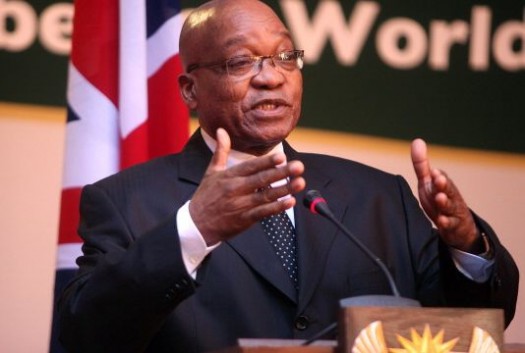
South African President Jacob Zuma received a vote of no confidence from several opposition parties. (Google Images)
Nickolaus Bauer of Mail & Guardian is reporting that the African National Congress (ANC) has reversed its original decision to block the no confidence vote against President Jacob Zuma in Parliament. Secretary-general Gwede Mantashe said the matter would be debated, but not immediately.
Bauer writes:
‘”The ANC cannot refuse to discuss a motion of no confidence, but we will not be frogmarched into doing so. It is not an urgent matter,” he told journalists in Johannesburg. The decision comes a day before an urgent interdict to debate the matter was to be heard in the Western Cape High Court. The ruling party has labeled the motion of no confidence tabled against the president on Thursday as a ‘playful, silly publicity stunt’ that “belongs to the rubbish bin.'”
Bauer adds:
Several opposition parties said the motion was “motivated by the Marikana killings; the Nkandlagate scandal; the failure by the government to deliver textbooks and workbooks to school children in Limpopo and the Eastern Cape; the downgrading of South Africa’s credit rating by two major ratings agencies; the mounting disrespect for our Constitution and judiciary; unemployment; and the ‘uncontrollable and rising tide’ of corruption in the public service.”
Originally the ANC opposed the debate, but soon backpedaled after complaints arose that the move was unconstitutional.
David Frankham’s four-part HBO Documentary series, “Witness” has a segment on South Sudan’s Arrow Boys, a voluntary militia. (Veronique de Viguere/HBO)
His HBO Documentary Series, Witness, takes a candid look at the conflict photojournalists’ quest to provide first person accounts of various parts of the world plagued by social ills. The four-part series, co-executive produced by director Michael Mann, is the offspring of Frankham’s discontent with news sources and their disconnect from the stories they report. “I’ve been kinda tough on the news lately, but it’s obviously a different format,” he says. “I was feeling very numb about the news summing up very complicated situations into very simplistic black and white, good vs. evil scenarios. You’re watching these newscasters, and most of them have never been to Somalia.”
The Los Angeles native and 12-year veteran of directing commercials made his way to Atlanta for the BronzeLens Film Festival’s “Cinema and Social Justice” screenings. The self-proclaimed news junkie recalls seeing reports on Somali pirates following the birth of his now three-year-old daughter. He questioned the editorial decisions of the investigative reporters. “Why are we not getting the story from these photographers on the ground?” he asks.
The documentarian took matters into his own hands. He self-funded a 15-day trek to Juarez, Mexico with a five-person crew and produced a 30-minute short on the nation’s high-profile drug wars, which was shortlisted by the Academy Awards in 2011. Michael Mann immediately became a champion of Frankham’s vision after seeing the film short. The series (hour-long segments) developed into excursions into Libya and Rio de Janeiro. “[Michael’s] a master and one of my heroes in filmmaking,” Frankham says. “[Michael] challenged us when discussing the photographers, specific conflicts and events. He was constantly reminding us to keep it a character-driven, experiential film and to not try to do too much.”
The South Sudan installment, airing November 19, follows pregnant French photojournalist Veronique de Viguerie. She accompanies the Arrow Boys, a voluntary militia, in the villages post-Joseph Kony’s Lord’s Resistance Army (LRA) imperialism. She gets to know the natives personally, experience death on-site and hears of their hardships. “It’s very important to understand both sides, to understand what’s going on and to create an immersive experience where all of these films leave you with more questions than answers,” Frankham says. “I can’t give it to you all in 100 hours, but I want to engage on a human level.”
With the internet and downsizing of various news organizations, opportunities for the media to embark on global reports are steadily dwindling. Frankham reflects on the deaths of Tim Hetherington, Oscar-nominated photojournalist and director behind Restrepo, and Chris Hondros, another Pulitzer Prize-nominated photojournalist, during production in Libya. He says their passion and dedication to deliver the stories make Witness a landmark program. “There are a lot of conflicts that need this kind of attention along with people putting themselves in harm’s way,” Frankham says. “There are less and less photographers getting these assignments, and it’s harder to be a conflict photographer. ‘Witness‘ expands the medium.”
Witness is a watershed moment for Frankham’s career, investigative journalism and documentaries. HBO fully endorses his creative and political liberties. He aspires to create a movement. “I hope that we continue to do more of them,” he says. “There are a lot of people interested in conflicts all over the world, and they want a more in-depth conversation.”
Christopher A. Daniel is a pop cultural critic and music editor for The Burton Wire. He is also a contributing writer for Urban Lux Magazine and Blues & Soul Magazine. Follow Christopher @Journalistorian on Twitter.
Like The Burton Wire on Facebook. Follow us on Twitter @TheBurtonWire.com.
David Frankham’s four-part HBO Documentary series, “Witness” has a segment on South Sudan’s Arrow Boys, a voluntary militia. (Veronique de Viguere/HBO)
His HBO Documentary Series, Witness, takes a candid look at the conflict photojournalists’ quest to provide first person accounts of various parts of the world plagued by social ills. The four-part series, co-executive produced by director Michael Mann, is the offspring of Frankham’s discontent with news sources and their disconnect from the stories they report. “I’ve been kinda tough on the news lately, but it’s obviously a different format,” he says. “I was feeling very numb about the news summing up very complicated situations into very simplistic black and white, good vs. evil scenarios. You’re watching these newscasters, and most of them have never been to Somalia.”
The Los Angeles native and 12-year veteran of directing commercials made his way to Atlanta for the BronzeLens Film Festival’s “Cinema and Social Justice” screenings. The self-proclaimed news junkie recalls seeing reports on Somali pirates following the birth of his now three-year-old daughter. He questioned the editorial decisions of the investigative reporters. “Why are we not getting the story from these photographers on the ground?” he asks.
The documentarian took matters into his own hands. He self-funded a 15-day trek to Juarez, Mexico with a five-person crew and produced a 30-minute short on the nation’s high-profile drug wars, which was shortlisted by the Academy Awards in 2011. Michael Mann immediately became a champion of Frankham’s vision after seeing the film short. The series (hour-long segments) developed into excursions into Libya and Rio de Janeiro. “[Michael’s] a master and one of my heroes in filmmaking,” Frankham says. “[Michael] challenged us when discussing the photographers, specific conflicts and events. He was constantly reminding us to keep it a character-driven, experiential film and to not try to do too much.”
The South Sudan installment, airing November 19, follows pregnant French photojournalist Veronique de Viguerie. She accompanies the Arrow Boys, a voluntary militia, in the villages post-Joseph Kony’s Lord’s Resistance Army (LRA) imperialism. She gets to know the natives personally, experience death on-site and hears of their hardships. “It’s very important to understand both sides, to understand what’s going on and to create an immersive experience where all of these films leave you with more questions than answers,” Frankham says. “I can’t give it to you all in 100 hours, but I want to engage on a human level.”
With the internet and downsizing of various news organizations, opportunities for the media to embark on global reports are steadily dwindling. Frankham reflects on the deaths of Tim Hetherington, Oscar-nominated photojournalist and director behind Restrepo, and Chris Hondros, another Pulitzer Prize-nominated photojournalist, during production in Libya. He says their passion and dedication to deliver the stories make Witness a landmark program. “There are a lot of conflicts that need this kind of attention along with people putting themselves in harm’s way,” Frankham says. “There are less and less photographers getting these assignments, and it’s harder to be a conflict photographer. ‘Witness‘ expands the medium.”
Witness is a watershed moment for Frankham’s career, investigative journalism and documentaries. HBO fully endorses his creative and political liberties. He aspires to create a movement. “I hope that we continue to do more of them,” he says. “There are a lot of people interested in conflicts all over the world, and they want a more in-depth conversation.”
Christopher A. Daniel is a pop cultural critic and music editor for The Burton Wire. He is also a contributing writer for Urban Lux Magazine and Blues & Soul Magazine. Follow Christopher @Journalistorian on Twitter.
Like The Burton Wire on Facebook. Follow us on Twitter @TheBurtonWire.com.
Ivory Coast President Alassane Ouattara dissolves government over rebuff of new marriage law allowing women to be joint heads of household. (Google Images)
The BBC is reporting that President Alassane Ouattara has dissolved the government due to a fight over a change in the marriage law. The new law, which Ouattara supports, would make wives joint heads of households, whereas the current law only recognizes men as heads of households who make all major decisions for the household. Ouattara’s move has critics questioning the political stability of the world’s largest cocoa producer.
The BBC reports:
“It [Ivory Coast] is slowly recovering from months of unrest following the poll, in which former President Laurent Gbagbo refused to accept Mr Ouattara’s victory. PDCI candidate Henri Konan Bedie came third in the election and in exchange for his support in the run-off, Mr Ouattara appointed a prime minister from the PDCI. But sources say Mr. Ouattara feels he no longer has the full support of the PDCI, which governed Ivory Coast for 39 years from independence until a 1999 coup.”
Outtara has been attempting to bring economic stability to the country, while fending off armed attacks allegedly by by allies of Mr Gbagbo from neighboring Ghana. The border between the two countries was closed for two weeks after an attack on an army checkpoint in September.