Quvenzhane Wallis, 9, earned a 2013 Academy Award nomination for best actress for her performance in ‘Beasts of the Southern Wild’, becoming the youngest person ever nominated in that category. (Google Images)
Quvenzhane Wallis is the youngest nominee in the category of Best Actress in the history of the Academy Awards.
Todd Leopold of CNN is reporting that Denzel Washington and Quvenzhane Wallis have been nominated for Oscars. Leopold writes:
“As always, there were a handful of surprises. The most notable, perhaps, was the showing by the small independent film “Beasts of the Southern Wild.” Its 9-year-old star, Quvenzhane Wallis, earned a nomination for best actress, becoming the youngest person ever in that category. In addition, the film was nominated for best picture, best director (Benh Zeitlin) and best adapted screenplay — four nominations in all.”
Wallis will compete against Jessica Chastain (“Zero Dark Thirty”), Jennifer Lawrence (“Silver Linings Playbook”), Naomi Watts (“The Impossible”) and Emmanuelle Riva (“Amour”) for the honor.
Denzel Washington received a Best Actor nomination for his role in “Flight.” He will compete against Day-Lewis (“Lincoln”), Hugh Jackman (“Les Miserables”), Joaquin Phoenix (“The Master”) and Bradley Cooper (“Silver Linings Playbook”) for the honor.
Best Picture nominees include the controversial “Django Unchained” and “Zero Dark Thirty,” although directors Quentin Tarantino and Kathryn Bigelow did not receive Best Director nods. Lincoln directed by Steven Spielberg topped the list receiving 12 nominations including Best Director and Best Picture.
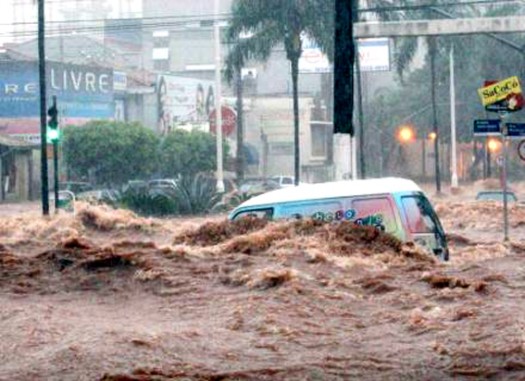
Torrential rain caused major flooding in Rio de Janeiro claiming lives and displacing thousands of people. (Google Images)
Anna Kaiser, contributing reporter to The Rio Times, is reporting that torrential rains tore across Rio de Janeiro state late last week, taking 2 lives and displacing 3,000 families, and leaving a path of destruction. The government has announced plans to relocate families from high-risk areas across the state, which also brings controversial hardships to many irregular housing and favela communities. Xerém is the region hardest hit by the storm.
Mayor of Duque Caxias, Alexandre Cardoso stated, “through a study by the Secretary of the Environment, there will be a program for rehabilitation of the river banks and a relocation of the people who live there. Rio state’s Governor Sergio Cabral also approved a payment extension for the damaged areas.”
Recognizing that heavy rains like those of last week are inevitable, the State Geological Survey identified that 67 of Rio’s 92 municipalities have areas at risk for landslides. Of those, 49 exhibit points of imminent risk and have over 36,000 inhabitants.
President of the State Geological Survey, Flávio Erthal told o Globo that for the study, they “flew [over] all these areas to map the points of imminent risk. The situation is alarming. But it is not a problem that started today, but sixty years ago, with the migration of much of the population from the countryside to the cities, occupying areas without adequate prior planning.”
You may recall that areas near Rio de Janeiro flooded in January 2011, with the death toll reaching nearly 300 people. Something has to be done to stop the continued devastation to the area and the people.
The serengeti is featured in the PBS eight-part series AFRICA. (Google Images)
A joint venture between Thirteen/WNET New York’s NATURE and National Geographic Television, AFRICA is an eight-part series, shot in widescreen, super 16mm format, that takes viewers on a kaleidoscopic adventure across Africa’s major regions and into the homes of the people who live there. Episode one takes on the Serengeti, focusing on two women searching for their spiritual identity. Alice Wangui, a Nairobi hair salon owner, takes a trip to her native Kikuyu village so that her child will be born with a sense of community. On the savanna proper, Flora Salonik lives in an isolated farming hamlet, and struggles with the decision of whether or not to return to her own roots: the bustling metropolis of Arusha, Tanzania.
Episode two follows Adam, 9, who crosses hundreds of miles of desolate and dangerous desert on his first trans-Saharan salt caravan in order to sell the salt for food and clothing.
Episode six involves the Sahel, the semi-arid border between the Sahara and the savanna. This episode follows Errou Sisse, a young man thatmust leave his girlfriend and travel hundreds of miles across parched earth with his family’s cattle in search of adequate grazing land. As he travels through the desolate landscape, he and his fellow herders must survive on milk, and what little they can trade in the widely scattered villages of the Sahel. Meanwhile, another young man is hoping to mark an important passage of his own. In a cliffside Dogon village in Mali, Atime Dogolo Saye awaits the sacred dama ceremony to honor the spirits of the dead. Without participating in the dama, Atime will forever remain a boy, denied the right to raise a family of his own. Will these two young men be successful in their journeys?
Each episode shares different stories of the continent. There is a ‘teaching tools’ section on the website for educators interested in sharing the series with students.
The serengeti is featured in the PBS eight-part series AFRICA. (Google Images)
A joint venture between Thirteen/WNET New York’s NATURE and National Geographic Television, AFRICA is an eight-part series, shot in widescreen, super 16mm format, that takes viewers on a kaleidoscopic adventure across Africa’s major regions and into the homes of the people who live there. Episode one takes on the Serengeti, focusing on two women searching for their spiritual identity. Alice Wangui, a Nairobi hair salon owner, takes a trip to her native Kikuyu village so that her child will be born with a sense of community. On the savanna proper, Flora Salonik lives in an isolated farming hamlet, and struggles with the decision of whether or not to return to her own roots: the bustling metropolis of Arusha, Tanzania.
Episode two follows Adam, 9, who crosses hundreds of miles of desolate and dangerous desert on his first trans-Saharan salt caravan in order to sell the salt for food and clothing.
Episode six involves the Sahel, the semi-arid border between the Sahara and the savanna. This episode follows Errou Sisse, a young man thatmust leave his girlfriend and travel hundreds of miles across parched earth with his family’s cattle in search of adequate grazing land. As he travels through the desolate landscape, he and his fellow herders must survive on milk, and what little they can trade in the widely scattered villages of the Sahel. Meanwhile, another young man is hoping to mark an important passage of his own. In a cliffside Dogon village in Mali, Atime Dogolo Saye awaits the sacred dama ceremony to honor the spirits of the dead. Without participating in the dama, Atime will forever remain a boy, denied the right to raise a family of his own. Will these two young men be successful in their journeys?
Each episode shares different stories of the continent. There is a ‘teaching tools’ section on the website for educators interested in sharing the series with students.
Capetown, South Africa native Dr. Sean Jacobs recently launched a blog, “Africa is a Country,’ to challenge images of Africa that only include famine, Bono or Barack. (Google Images)
Ebony.com is highlighting a number of Africans that are launching publications to combat the negative stereotypes of Africans in culture and society. Nana Ekua Brew-Hammond writes:
The stereotypes about Africa/Africans are too many to list here. They’re mostly negative, myopic depictions that focus on war, famine, abject poverty, disease, and corruption. In other oversimplifications, Africans are written up as model immigrants, overachieving geniuses, or displaced chiefs moonlighting as gas station attendants.
Outside of these caricatures, many Africans are going to work and school, voting in their local elections, and spending way too much time on Facebook. And they’re over the ignorance that has collectively miscast them. In response, a swelling movement of young Africans are launching concerted efforts to wrest the image of Africa from entities and interests that don’t promote a balanced understanding of the continent.
Among this group is South African professor Sean Jacobs who founded the incisive Africa is a Country, billing it as “the media blog that’s not about famine, Bono, or Barack Obama.” Ghanaians Sandra Appiah and Isaac O. Babu-Boateng launched Face 2 Face Africa Magazine to combat portrayals of Africa as pathological and troubled.
Likewise, Nigerian-American Enyinne Owunwanne started ecommerce boutique Heritage 1960 to promote what she says is “the best of the best, when it comes to African fashion, lifestyle and culture”. Fellow Nigerian-American Ngozi Odita initiated AFRIKA21 to broaden the conversation around what 21st century Africa really looks like, apart from the stereotypes, you could even pick up some tips on how to start an eCommerce website of your own.
Two men convicted sentenced to 3 years for ‘looking gay’ in Cameroon, are freed. (Google Images)
The Associated Press is reporting that a Cameroonian court has overturned the conviction of two men who were sentenced for five years in prison for “looking gay” and ordering Bailey’s Irish Cream.
The Court of Appeals Monday acquitted the men and ordered their release. The two men had already spent more than a year in jail where they were subjected to abuse from guards and other prisoners, according to human rights advocates.
The new ruling has been hailed by human rights lawyers and gay rights advocates who urged President Paul Biya to release all other prisoners found guilty under the country’s harsh anti-gay laws.
On Dec. 17, a Cameroonian court upheld the five-year-sentence of another man, Roger Jean-Claude Mbede, who was convicted of sending a text message that said “I love you” to another man.
TBW Commentary: What is the world coming to when you can’t have a shot of Bailey’s Irish Creme? What is the world coming too when foolishness like this passes as justice?
Two men convicted sentenced to 3 years for ‘looking gay’ in Cameroon, are freed. (Google Images)
The Associated Press is reporting that a Cameroonian court has overturned the conviction of two men who were sentenced for five years in prison for “looking gay” and ordering Bailey’s Irish Cream.
The Court of Appeals Monday acquitted the men and ordered their release. The two men had already spent more than a year in jail where they were subjected to abuse from guards and other prisoners, according to human rights advocates.
The new ruling has been hailed by human rights lawyers and gay rights advocates who urged President Paul Biya to release all other prisoners found guilty under the country’s harsh anti-gay laws.
On Dec. 17, a Cameroonian court upheld the five-year-sentence of another man, Roger Jean-Claude Mbede, who was convicted of sending a text message that said “I love you” to another man.
TBW Commentary: What is the world coming to when you can’t have a shot of Bailey’s Irish Creme? What is the world coming too when foolishness like this passes as justice?
Standard & Poor downgraded several Caribbean countries including Barbados and the Bahamas in 2012. (Google Images)
Peter Richards of Caribbean 360 gives the lowdown on all of the changes that occurred in the Caribbean that resulted in a bevy of social, economic and political turmoil in 2012. Richards methodically highlighted the challenges facing many countries in the Caribbean:
*McKeeva Bush became the the first head of government (Cayman Islands) in modern Caribbean history to be detained by police on suspicion of theft in connection with financial irregularities relating to the alleged misuse of a government credit card, breach of trust, abuse of office and allegedly importing explosive substances without valid permits on or before February 2012. Subsequently, he received a vote of no-confidence and was voted out of office by his administration.
*After leading his Free National Movement (FNM) into defeat in the general elections in March, Hubert Ingraham bowed out of politics in the Bahamas. “I shall return to private life from whence I came,” he said, soon after the Progressive Liberal Party (PLP), headed by Perry Christie, won what it termed the “most important general elections since 1967”.
*In Grenada, Prime Minister Tillman Thomas got Governor General Sir Carlyle Glean to prorogue parliament in the face of a second vote of no confidence in 2012. The first, filed in April, had been brought by the main opposition New National Party (NNP) of Dr. Keith Mitchell and although the National Democratic Congress (NDC) closed ranks in defeating the motion, the second in September was brought by Thomas’s former foreign affairs minister Karl Hood.
*Former Turks and Caicos Islands premier Michael Misick was arrested at the Santos Dumont Airport in Rio de Janeiro by Brazilian Federal Police. INTERPOL had issued an international warrant for Misick, who also found himself the subject of a warrant issued by the Brazilian Supreme Court. His arrest was sought in relation to an ongoing investigation by the Turks and Caicos Islands authorities into issues uncovered during the Sir Robin Auld’s 2008-09 Commission of Inquiry regarding alleged corruption and maladministration. Misick was implicated in large-scale corruption in Turks and Caicos that led to the suspension of the democratic government in the TCI by the United Kingdom. He faces several “serious charges” relating to corruption and maladministration.
*Jamaica has still yet to sign a new Stand By Agreement with the International Monetary Fund (IMF).
*In St. Lucia, the government of Prime Minister Dr. Kenny Anthony launched a multi-million dollar stimulus package in a bid to turn around a sluggish economy.
*The US-based rating agencies, Standards & Poor’s (S&P) and Moody’s, downgraded several Caribbean countries including Barbados and the Bahamas during 2012, with S&P also downgrading the Barbados-based Caribbean Development Bank (CDB) long term rating to AA with a warning that the ratings could plunge even lower if a regional government borrower fails to “clear its arrears” with the financial institution.S&P said that the decision to lower the ratings from AA+ to AA reflects “embedded credit risks in CDB’s loan portfolio.”
Standard & Poor downgraded several Caribbean countries including Barbados and the Bahamas in 2012. (Google Images)
Peter Richards of Caribbean 360 gives the lowdown on all of the changes that occurred in the Caribbean that resulted in a bevy of social, economic and political turmoil in 2012. Richards methodically highlighted the challenges facing many countries in the Caribbean:
*McKeeva Bush became the the first head of government (Cayman Islands) in modern Caribbean history to be detained by police on suspicion of theft in connection with financial irregularities relating to the alleged misuse of a government credit card, breach of trust, abuse of office and allegedly importing explosive substances without valid permits on or before February 2012. Subsequently, he received a vote of no-confidence and was voted out of office by his administration.
*After leading his Free National Movement (FNM) into defeat in the general elections in March, Hubert Ingraham bowed out of politics in the Bahamas. “I shall return to private life from whence I came,” he said, soon after the Progressive Liberal Party (PLP), headed by Perry Christie, won what it termed the “most important general elections since 1967”.
*In Grenada, Prime Minister Tillman Thomas got Governor General Sir Carlyle Glean to prorogue parliament in the face of a second vote of no confidence in 2012. The first, filed in April, had been brought by the main opposition New National Party (NNP) of Dr. Keith Mitchell and although the National Democratic Congress (NDC) closed ranks in defeating the motion, the second in September was brought by Thomas’s former foreign affairs minister Karl Hood.
*Former Turks and Caicos Islands premier Michael Misick was arrested at the Santos Dumont Airport in Rio de Janeiro by Brazilian Federal Police. INTERPOL had issued an international warrant for Misick, who also found himself the subject of a warrant issued by the Brazilian Supreme Court. His arrest was sought in relation to an ongoing investigation by the Turks and Caicos Islands authorities into issues uncovered during the Sir Robin Auld’s 2008-09 Commission of Inquiry regarding alleged corruption and maladministration. Misick was implicated in large-scale corruption in Turks and Caicos that led to the suspension of the democratic government in the TCI by the United Kingdom. He faces several “serious charges” relating to corruption and maladministration.
*Jamaica has still yet to sign a new Stand By Agreement with the International Monetary Fund (IMF).
*In St. Lucia, the government of Prime Minister Dr. Kenny Anthony launched a multi-million dollar stimulus package in a bid to turn around a sluggish economy.
*The US-based rating agencies, Standards & Poor’s (S&P) and Moody’s, downgraded several Caribbean countries including Barbados and the Bahamas during 2012, with S&P also downgrading the Barbados-based Caribbean Development Bank (CDB) long term rating to AA with a warning that the ratings could plunge even lower if a regional government borrower fails to “clear its arrears” with the financial institution.S&P said that the decision to lower the ratings from AA+ to AA reflects “embedded credit risks in CDB’s loan portfolio.”
Gov. Bev Perdue pardons the Wilmington 10, who were falsely accused, convicted and imprisoned for crimes they did not commit while fighting for civil rights. (Google Images)
Ann Blyth of the Charlotte Observer is reporting that North Carolina Bev Perdue has pardoned members of the Wilmington 10, a group of civil rights activists, falsely accused and convicted of crimes they did not commit. Blyth writes:
“Ben Chavis fell to his knees in prayer on Monday after learning that Gov. Bev Perdue had pardoned him some four decades after a tainted and racially biased Civil Rights-era prosecution wrongfully sent him to prison.
With five days left in office, Perdue issued a full pardon of innocence for Chavis and the nine others who became known as the Wilmington 10…
Chavis, who went to Wilmington in 1971 as head of the United Church of Christ’s Commission for Racial Justice, has lived much of his life clouded by a smoldering injustice.
In 1971, Chavis was arrested with eight other black men and one white woman and accused of firebombing a white-owned grocery store in a black neighborhood in Wilmington. They also were accused of shooting at emergency workers who responded to the blaze.
The accused denied any role in the fire or the shooting, but they were convicted of arson and conspiracy and sentenced to prison.”
The Wilmington 10 served several years in prison before their sentences were commuted but not pardoned by then Governor Jim Hunt. In addition to Chavis, the surviving members of the Wilmington 10 are Reginald Epps, James McKoy, Wayne Moor, Marvin Patrick and Willie Earl Vereen. Those who have died are Jerry Jacobs, Ann Shepard, Connie Tindall and Joe Wright. Wright was the youngest, arrested when he was 16 years old.